Tuesday, August 19, 2014

Mission Creep

"TV: Spoiler alert" (Ava and C.I., The Third Estate Sunday Review):
There were so many pleasant surprises throughout.

And this was a case where a tight budget forced additional creativity.

"US war planes and armed drones are hitting . . .," Lynn Berry declared on Weekend Express (HLN) about the bombings falling near the Mosul dam and reminding us that the runway budget of one of the most expensive wars in American history continues.

At this point, the Iraq War is the Heaven's Gate of wars and could likely bring down the United States the way that Michael Cimino box office disaster brought down United Artists.

Berry explained the bombing was taking place to 'save' Iraqis because IS [Islamic State] had control of it and they could seriously harm Iraq by destroying the dam and releasing the water.  The US government, Berry explained, was "afraid it [the dam] could rupture, the result would be disastrous" leading to "flooding all the way to Baghdad."

So the US was bombing the area . . . to take back the dam . . . because bombing would not cause any risk of the dam rupturing?

Like a summer action film, the plot falls apart if you examine it.


I would argue that Ava and C.I. just summed up the US intervention in Iraq better than anyone.

They really did an amazing piece this week, bringing in The Killing's final season on Netflix and using it to jump over to Iraq covered by CNN, CBS and ABC.

Ava and C.I. stand alone in critiquing media coverage of Iraq these days.  The Justin Raimondos offer a sentence or two of the press in general.  To do real critiques is too much work for the 'manly' men against war.

As usual, it's left to two women (Ava and C.I.) to do all the heavy lifting.

Time's Michael Crowley has a piece on mission creep in Barack's Iraq:


In 2003, George W. Bush was too quick to declare that “major combat operations in Iraq have ended.” In 2014, Barack Obama may be too slow to admit that they are just beginning.

The only mission Barack appears to have planned is how to get the US even more into Iraq.

I do not believe this was unintentional.


"Iraq snapshot" (The Common Ills):
Monday, August 18, 2014.  Chaos and violence continue, Barack talks Iraq, Marie Harf insists the US can stand with IS in Syria and oppose it in Iraq and not be contradicting itself, a new poll has some depressing and distressing findings, and much more.


A busy day for Iraq with violence and political overtures, various US cabinets making statements and US President Barack Obama speaking on the topic.

Let's start with  CENTCOM which issued the following:

TAMPA, Fla., Aug. 18, 2014 – U.S. Conducts More Airstrikes Near the Mosul Dam
From a U.S. Central Command News Release
TAMPA, Fla., Aug. 18, 2014 — U.S. military forces today continued to attack ISIL terrorists in Iraq, using a mix of fighter, bomber, and remotely piloted aircraft to successfully conduct 15 airstrikes near the Mosul Dam.
The strikes damaged or destroyed nine ISIL fighting positions; an ISIL checkpoint; six ISIL armed vehicles; an ISIL light armored vehicle; an ISIL vehicle-mounted anti-aircraft artillery gun, and an IED emplacement belt.
All aircraft exited the strike areas safely.

 Since Aug. 8, U.S. Central Command has conducted a total of 68 airstrikes in Iraq. Of those 68 strikes, 35 have been in support of Iraqi forces near the Mosul Dam. These strikes were conducted under authority to support Iraqi security forces and Kurdish defense forces as they work together to combat ISIL, as well as to protect critical infrastructure, U.S. personnel and facilities, and support humanitarian efforts.


Barack noted the dam in his speech today as well, "Today, with our support, Iraqi and Kurdish forces took a major step forward by recapturing the largest dam in Iraq, near the city of Mosul. The Mosul dam fell under terrorist control earlier this month, and is directly tied to our objective of protecting Americans in Iraq."

So this was a success?

Forget your feelings on bombings.  Along with all that the Kurdish and Iraqi military do, the US military conducted 35 air strikes in approximately five days and with that, the US government insists, the Islamic State is no longer in control of the Mosul dam.

I'm confused.

How many air strikes did IS conduct?

I'm pretty sure that number is zero.

US military might used to bomb repeatedly -- 35 air strikes -- is what it took to apparently rescue one dam.

That's really not looking good for the US military, the Iraqi military and/or the Kurdish military.

The only one who comes out looking strong in that recap is IS.

We're all aware that Iraq has more than one dam, right?


In that general vicinity alone, Iraq also has Duhok Dam, Badush Dam, Bekhme Dam, Dukan Dam and Dibis Dam.

That's not a full listing of Iraq's dams.  It's not even a full listing of the dams in the Tigris river basin (the Ephrates river basin also has dams).

But this is what it took to wrestle one dam away.  Barack's spoken of the alleged danger of that dam -- probably more to justify his own actions.

Baghdad would be flooded!

That was the claim.  It popped up on the chat and chews all weekend which is how you knew it was a White House talking point.

No, Baghdad would not have been flooded.

There is not a grand Slip and Slide between Mosul and Bahgdad that will carry the water through.

There is dried land, land that bakes in the summer heat.  Iraq's supposed to reach 116 degrees F on Tuesday and 117 on Wednesday.  We all get what happens in those temperatures, right?

 Most of the water from the dam -- had the dam been ruptured -- would have endangered very little -- even Mosul itself may not have seen water standing for hours.

But it was a talking point.

Why?


To justify the actions taken.

Barack declared this afternoon, "If that dam was breached, it could have proven catastrophic, with floods that would’ve threatened the lives of thousands of civilians and endanger our embassy compound in Baghdad."

No, the Baghdad Embassy was not in danger of 'flooding.'

Barack's going to have to work hard at scaring Americans.

In "TV: Spoiler alert" on Sunday, Ava and I touched on some of the TV coverage of Iraq:


Martha Raddatz was again filling in as host of the program and she wanted [ABC News' Terry] Moran to "tell us the difference between these airstrikes" and the earlier ones the US launched last week.

"This is different," Moran responded.  "This is moving on beyond helping people."

What was he speaking of, this difference?


Bombing IS near a Mosul dam was not part of the defined mission.

Thursday, for example, US President Barack Obama declared:


Last week, I authorized two limited missions:  protecting our people and facilities inside of Iraq, and a humanitarian operation to help save thousands of Iraqi civilians stranded on a mountain.
A week ago, we assessed that many thousands of Yezidi men, women and children had abandoned their possessions to take refuge on Mount Sinjar in a desperate attempt to avoid slaughter.  We also knew that ISIL terrorists were killing and enslaving Yezidi civilians in their custody, and laying siege to the mountain. Without food or water, they faced a terrible choice -- starve on the mountain, or be slaughtered on the ground.  That’s when America came to help.
Over the last week, the U.S. military conducted humanitarian air drops every night –- delivering more than 114,000 meals and 35,000 gallons of fresh water.  We were joined in that effort by the United Kingdom, and other allies pledged support. Our military was able to successfully strike ISIL targets around the mountain, which improved conditions for civilians to evacuate the mountain safely.
Yesterday, a small team of Americans -– military and civilian -– completed their review of the conditions on the mountain.  They found that food and water have been reaching those in need, and that thousands of people have been evacuating safely each and every night.  The civilians who remain continue to leave, aided by Kurdish forces and Yezidis who are helping to facilitate the safe passage of their families.  So the bottom line is, is that the situation on the mountain has greatly improved and Americans should be very proud of our efforts.Because of the skill and professionalism of our military –- and the generosity of our people –- we broke the ISIL siege of Mount Sinjar; we helped vulnerable people reach safety; and we helped save many innocent lives.  Because of these efforts, we do not expect there to be an additional operation to evacuate people off the mountain, and it’s unlikely that we’re going to need to continue humanitarian air drops on the mountain. 


Martha Raddatz also spoke to retired Colonel Steve Ganyard who noted the change, pointing out Barack was moving away from his declaration that "these strikes will only be based on humanitarian purposes and to protect American people" in Iraq. 


After a weekend full of nonsense about how the water in the dam could flood Baghdad, Barack declared today it could have harmed the US Embassy in Baghdad.

Do the lies ever end?

It's all so confusing.

For instance, the US government says IS is bad and evil in Iraq but the same US government backs IS in Syria.

Efforts failed in today's State Dept press briefing to make sense of this nonsensical 'mission' which cancels itself out.  Spokesperson Marie Harf moderated.  Excerpt.


QUESTION: Can we move to Syria?

MS. HARF: We can.

QUESTION: As you know, the Syrian regime has been bombing Islamic State’s positions in Raqqa for two days. Since you are doing the same thing across the border in Iraq, what would you say --

MS. HARF: I would disagree that we’re doing the same thing, but go ahead.

QUESTION: But, I mean, you are bombing Islamic State position in Iraq, so would you say that the U.S. and Syria are on the same page against a common enemy?

MS. HARF: No. No, I would not. And in large part, that’s because it’s the Assad regime’s own actions that helped lead to the rise of ISIS or ISIL or IS or whatever we’re going to call it this week. It is the security environment they created. It is them – the Assad regime encouraging the flow of fighters into Iraq that they did, certainly, when we were there and also have done recently. So I would strongly disagree with the notion that we are on the same page here in terms of what we’re doing.

QUESTION: Regardless of the cause, you do agree that you share an enemy in common, correct? I mean with ISIS, in particular.

MS. HARF: I don’t want – I’m not going to say that we share anything in common with the Syrian regime.

QUESTION: Okay. Let me ask you this. Do you think that ISIS --

QUESTION: Anything? (Inaudible) breathe, don’t you? About air, do you have that in common?


MS. HARF: I missed your insightful questions, Matt.


QUESTION: Is ISIS in Iraq a different organization than ISIS in Syria, or is it one and the same, to the best of your knowledge?

MS. HARF: They’re an organization, it’s my understanding, with the same leadership in general. Obviously, there’s different parts of it on the ground operating in different places, but under the general same umbrella of this group, yes, it’s my understanding.

QUESTION: So if you bomb them in Iraq and the Syrian regime bombs them in Syria, you’re bombing the same organization, right?

MS. HARF: Well, the – that’s a little too simplistic, Said. The reason that they were able to flourish and grow so strong is because of the Assad regime who enabled them to grow in the security environment and indeed fostered their growth throughout many years. So I think that I – again, I just – I don’t concede the point that we’re on the same page here in any way.


"That's a little too simplistic" huffed the woman who sees bombings as different based upon who is being killed.  She was pressed again on the topic shortly afterwards.


QUESTION: I just want to stay on Syria. The Syrian coalition has asked actually the United States to bomb ISIS positions in Syria. So people – what do you respond – but what do you respond --


MS. HARF: Well, the operational picture is a lot different in Syria.


QUESTION: Sure. They say you’re bombing in Iraq, but they don’t recognize a geographical border. Why can’t you go --


MS. HARF: Okay. Well --


QUESTION: -- if they ask you officially to bomb it?


MS. HARF: -- let’s talk about the difference here. First, in Iraq we have a government that has asked for our help and asked for our support and welcomed us in. That obviously is not the case in Syria. Even if the moderate opposition is asking, I would remind people that the Syrian Government does still maintain some level of anti-aircraft capabilities. It’s a very different operating picture. It would require very different things.


Did the Iraqi government ask for help?

I ask because  All Iraq News reported:


The office of the Commanding General of the Iraqi Armed Forces announced that "The Iraqi Government did not give permission for any military plane to violate the Iraqi space," in a sign to the US airstrikes targeting the shelters of the Islamic State in Iraq and the Levant near Erbil and Mosul.
A statement by the office received by AIN cited "During the last few days, we noticed violation of some military air-jets for Iraqi space and handing over of military equipment without permission of the Iraqi Government," which is a sign for providing the Kurdish peshmerga with western weapons.


The statement added "We welcome the supportive stances of the international community for Iraq in its war against terrorism but we assert the necessity of respecting the sovereignty of Iraq."


It would appear things are not as simplistic as the US government has portrayed them.

But why should they worry?  Why should Barack?

The US is bombing Iraq.

And Barack honestly believes the world will believe his lie (This is NOT a combat mission!) as long as significant numbers of US troops are not on the ground in Iraq.  Until then, Barack's convinced he can conduct a war but no one will  call it out.

Raed Jarrar continues to struggle with holding Barack accountable.  However, he does manage to point out (in a column for the Chicago Tribune), "Iraq cannot be bombed into stability or moderation. So-called surgical strikes will not transform the war-torn nation into a peaceful and prosperous one. While the United States should search for productive multilateral methods to help Iraq, our top priority should be doing no additional harm.

It's interesting that Barack presented his own actions and decisions as a humanitarian impulse when All Iraq News reports that it's the Australian Government which has announced it is prepared to take in 2,200 refugees from Iraq.

Of course, humanitarian actions do not include War Crimes.

Nouri al-Maliki remains prime minister of Iraq.  So it's no surprise his War Crimes continue.  Nouri continues to bomb the residential neighborhoods of Falluja.  Alsumaria reports 6 people were killed in the latest bombing with another seven left injured.


Barack's speech today prompted questions.


  • Others found humor in the hypocrisy of the remarks:


  • People told me if I voted for McCain and Romney, we'd have another war in Iraq. Turns out they were right!
  • Barack Obama says there will be no American "boots on the ground" in Iraq. You know what this means? HOVER SOLDIERS.


  • Moving to another topic . . .


    The wolf is at Iraq's door declared Barack in the brief question and answer period which followed his speech:


    Dr. Abadi has said the right things. I was impressed in my conversation with him about his vision for an inclusive government.  But they’ve got to get this done because the wolf’s at the door and in order for them to be credible with the Iraqi people, they’re going to have to put behind some of the old practices and actually create a credible united government.

    Haider al-Abadi is the prime minister-designate of Iraq.  He was named that last Monday and has 30 days to form a Cabinet or, per the Constitution, someone else gets named prime minister.

    For now, many are tossing signs that they are eager to see al-Abadi move from prime minister-designate to prime minister.  For example, Alsumaria reports that cleric and movement leader Moqtada al-Sadr expressed his desire to see his bloc work with al-Abadi and that a delegation had met with Haider to explore how that could happen and how Iraq can work at inclusion.  Wael Grace (Al Mada) reports the Kurds are gearing up to meet with al-Abadi in Baghdad.   Nidal al Laythi (Al-Monitor) offers:


    Prime Minister-designate Haider al-Abadi is working, along with some of his assistants, including friends and colleagues, on drafting the governmental program he will discuss with the other blocs to form the new government, Dawa Party spokesman Zuhair al-Naher says.
     Naher, who's close to Abadi, told Azzaman [in London] over the phone: “Abadi’s priority is to reinforce the armed forces through training and armament. The decision to designate Abadi is purely Iraqi. Washington and Tehran only agreed on the decision after it was already made, like all other countries.”
    Naher added that the prime minister-designate is going to ask the UN Security Council to issue a resolution which allows an international joint operation to be conducted with Iraqi forces against the Islamic State (IS) to liberate Mosul, Tikrit and the rest of the villages controlled by IS in Diyala and Kirkuk.


    In other news, National Iraqi News Agency notes 1 person was shot dead in Yusifiyah,  2 Alexandria car bombings left 1 person dead and eight more injured, a battle west of Kirkuk left 3 rebels dead and two more injured, and an air strike in Sedira Village left 1 suspect dead.  Alsumaria adds 2 corpses were discovered near Baquba.


    Reporting on the latest poll, Susan Page (USA Today) notes,  "Americans are increasingly inclined to say the United States has a responsibility to respond to rising violence in Iraq, a USA TODAY/Pew Research Center Poll finds, although most also express fears about getting pulled back into a extended conflict there."


    Has the White House -- including Barack -- really been that successful in selling more war?

    Not seeing it.

    But I do see idiotic behavior from the likes of Justin Raimondo (Antiwar.com) to ridicule victims.  As we noted awhile back, that sort of behavior only sends people running.

    The fight really is for the uninformed on any issue.  You have similar percentages supporting and opposing and the 'winner' is whomever gets the uninformed motivated.

    When you mock victims, you repulse a number of people.  These people no longer need to know any intricate issue, they just need to know that they don't want to be on the same side as the boorish prick making fun of victims.

    I favored air drops and opposed a US bombing campaign.

    You could have opposed both and done so in a manner that didn't repulse people.


    Where does the Pope stand?

    Supposedly, Pope Francis is in full support of war on Iraq.

    Supposedly.

    Greg Hillis argues people are reading everything but what Pope Francis actucally said.


  • iraq

    Saturday, August 16, 2014

    Music


    "This edition's playlist" (The Third Estate Sunday Review):

    annwilson


    1) Ann Wilson's Hope & Glory.

    2)  Neil Young's Living With War.

    3) Ben Harper's Both Sides of the Gun.

    4) Janis Ian's Folk Is The New Black.

    5) Joni Mitchell's Shine.

    6) The Cowboy Junkies' at the end of paths taken.

    7) Pink's I'm Not Dead.

    8) The Rolling Stones'  A Bigger Bang.

    9) Josh Ritter's The Animal Years.

    10) David Rovic's Halliburton Boardroom Massacre.


    With the US back in Iraq big time, our focus was on albums that spoke to the illegal war.

    I love every album on that list but probably most especially --

    Nope.

    Can't do it.

    I love every one of them.

    If there's anything above you haven't listened to yet, make a point to now.  These are ten great albums.


    "Iraq snapshot" (The Common Ills):
    Friday, August 15, 2014.  Chaos and violence continue, possibilities as to why Nouri is steeping down, some look to the prime minister-designate for hope, and much more.


    Yesterday's big news that Iraq's two-term prime minister and forever thug Nouri al-Maliki had agreed to step down continues to be news.   Al Mada notes statements of relief made by US Secretary of State John Kerry, National Security Advisor Susan Rice and the UN Secretary-General's Special Envoy to Iraq Nickolay Mladenov.  Andrew Reiter (US News and World Reports) offers:
     
    This is an unquestionably positive development for Iraq. First, the peaceful transfer of power represents a key step in Iraq’s young democracy. Second, the new government should be better equipped to deal with the worsening security threat posed by Islamic State militants. And third, it could usher in a period of improved relations with the U.S.
    A peaceful transfer of power is a welcome development for Iraq’s nascent democracy that has seen al-Malaki consolidate his rule over his eight years in office. Following the controversial 2010 parliamentary elections, al-Malaki created the Office of the Commander-in-Chief, giving himself direct control over the Iraqi army and police. In response to recent events, he deployed a number of elite security forces throughout Baghdad’s Green Zone in an overt threat to his opponents. Fears of a military coup were rampant.


    Loveday Morris and Karen DeYoung (Washington Post) point out, "Maliki has become a deeply divisive figure but had clung to his position in the face of a growing consensus among Iraq’s politicians and the international community that only a new leader would have a chance of unifying a country experiencing growing sectarian divisions."  How bad did it get for Nouri?  Martin Chulov, Julian Borger and Spencer Ackerman (Guardian) explain, "He had lost the support of his party, of the president, the parliament, the Americans, Saudis and finally the Iranian government, his biggest foreign ally and sponsor. Even the Iranian Supreme Leader, Ali Khamenei, issued a statement pointedly welcoming the appointment of Abadi."

    How did he lose the support of Ali Khamenei?  Ali Hashem (Al-Monitor) reports:

    An Iraqi source close to Ayatollah Ali Sistani told Al-Monitor: “Around 10 days before the designation, an envoy representing the Iranian leadership visited Ayatollah Ali Sistani in Najaf. The envoy heard a clear stance from Sistani: Nouri al-Maliki shouldn’t continue as a prime minister. …​ Sistani won’t say this in public, but he had to tell it to the Iranians, because he thought the crisis in the country needed a solution and that the deadlock would complicate efforts to reach an agreement.”
    According to Al-Monitor’s sources in Tehran and Baghdad, Iranian Supreme Leader Ayatollah Ali Khamenei, after learning of Sistani’s position, asked his aides to facilitate the change, calling on them to play a role in convincing Maliki to withdraw. “There were several alternatives for Maliki, one was him being appointed vice president. He refused. He was obstinate on the prime minister position and gave all those who tried [to talk] with him reasons for him not to accept. His main challenge was that he’s the leader of the bloc that won the election, and the constitution gives him the right to form the new government.”

    Also weighing in was The Diane Rehm Show.  In the second hour of Friday morning's broadcast, Diane addressed Iraq with her guests Nancy A. Youssef (McClatchy Newspapers), Greg Myre (NPR) and Jim Sciutto (CNN).  Excerpt:


    REHM: Good to see you all. Jim Sciutto, what finally made Iraqi Prime Minister al-Maliki agree to step aside? 

    SCIUTTO:  I think the loss of the support of the support of both the U.S. and Iran. And once you had public statements. For the U.S. statement, somewhat more predictable, but once the Iranians said they wanted a transition, they wanted a more inclusive government, he saw the writing on the wall. But it was touch and go, because on Sunday night, and we were on the air Sunday night, as you had tanks in the streets, bridges closed in Baghdad. Forces loyal to Maliki being ordered -- you know, accounts from Baghdad police telling us ordered around key buildings. It looked like, for a moment, he was gonna make a power grab. So, you know, it appeared he had some second thoughts towards the end, but once that support disappeared, even he could see the writing on the wall. 

    REHM:  Nancy. 

    YOUSSEF:  So, the reason he gave, in his speech, in which he was surrounded by members of his party and his successor, was, in part, that he didn't want to see Iraq return to dictatorship, which arguably was code for that he didn't think that the militias and the armed forces he put on the street could actually keep him in power. The only other list -- person I would add to that list is Sistani, Ayatollah Sistani, who's the leader of the Shias in Iraq had called and supported his transition.  And so, internally, that was perhaps the most important loss for his support. And so, once all those factors came in to play, it was impossible to see who would support him. In addition, I would add also are the court systems, because the last time he had sort of been challenged, the courts had supported him, and constitutionally, he didn't have the ground to stand on to continue his fight. 

    REHM: Greg. 

    MYRE: Just looking back, Maliki came to power in 2006. At that moment, Iran was facing this Sunni insurgency that was tearing the country apart. The U.S. felt a real sense of urgency to intervene. Here we are eight years later going through the same thing. And you can go back, and the U.S. military involvement has now been over 20 years in Iraq. And are we moving forward anywhere, or are we just going in circles? 

    While various possibilities were tossed around at various outlets, few bothered to examine Iraqi sentiment.  Kholoud Ramzi (Niqash) covers Iraqi reaction:


    The desperate attempts of Iraqi Prime Minister Nouri al-Maliki to stay in power may have been taken seriously by many and led to questions about attempted coups and concern as to which sectors of the military supported him - but there are many Iraqis who are not taking al-Maliki seriously at all. Sarcastic pictures, jokes and comments have been circulating on Iraqi social media for the past few days, with those photo shopping pictures and posting jokes appearing to compete amongst themselves to make a mockery of their soon-to-be-former Prime Minister.
    One of the most popular pictures shows al-Maliki wearing a Hitler-style moustache. Another shows US President Barack Obama patting al-Maliki on the back, as if to bid him farewell. This has garnered a number of humorous comments. 
    One Iraqi Kurdish journalist shared a picture that shows young men trampling on a picture of al-Maliki that is lying on the floor. “They started to throw your pictures on the ground as soon as they heard about al-Abadi,” the journalist wrote in the caption. “They started to throw shoes at the picture as soon as they knew you were out. I fear that soon they will beat you with their shoes. We Iraqis are the kind of people who receive our leaders with cheering and applause and then farewell them with shoes.”
    Another picture showed two tribal leaders, or sheikhs, sitting behind al-Maliki at a funeral. “Let us grieve for the soul of [al-Maliki’s] third term,” those who shared the picture wrote. “The funeral of the State of Law bloc.”
    Another Iraqi prankster posted a picture of al-Maliki’s wife. “Breaking news,” they wrote. “Al-Abadi’s wife has called al-Maliki’s wife to ask her where she put the presidential mugs.”
    Those who supported al-Maliki also came in for ribbing, with politicians who protested al-Abadi’s nomination or al-Maliki’s ouster also targeted by jokers. 
    Another commenter wrote this: “Al-Maliki ruled us for eight years and he brought us right back to the era of the Caliphate. If he had had another four years, we might have seen dinosaurs roaming the streets of Baghdad”. 
    Some other activists wrote on one of al-Maliki’s Facebook pictures that Iraqis need to thank the Prime Minister for his achievements before he leaves. They listed 14 of the most important ones. This included sectarianism, displacement, insecurity, corruption and lack of government services. “Last but not least we should congratulate him on the birth of Daash, which came from all of these achievements,” they wrote, using the Arabic acronym for the Sunni Muslim extremist group known as the Islamic State, that now controls parts of the country.

    Deeply unpopular Nouri.  So many have wanted him gone for so long now.  And where do things stand now?  Shashank Bengali and Patrick J. McDonnell (Los Angeles Times) state, "Maliki’s surprise announcement Thursday that he would give up his bid for a third four-year term raised hope that a new government could unite a country that is more bitterly divided than at perhaps any time since the sectarian civil strife of 2006-07."

    So few want to admit that.  In part because they whored for Nouri and in part because they lack the ability to they were wrong to cheer Nouri on.  The man was a tyrant and a despot. He had Iraqis rounded up -- usually Sunnis -- mass 'arrests' that lacked arrest warrants.  The people were then lost in the 'legal' system -- often never tried, not on trial once, but kept in prisons.  Some people were arrested with arrest warrants -- for other people!

    They have an arrest warrent for Ali al-Mutlaq.  They go to his family's home.  Ali is not present so they arrest Ali's wife, sister, child or parent.  That's not justice.  It is why so many innocents rot in prison -- accused of no crime but held regardless.

    Many of the females in Nouri's prison arrived there as a result of being a relative of someone.  Once in prison, many girls and women were assaulted or raped.  Nouri attempted to ignore this when it became the topic of fall 2012.  An investigation by Parliament found that the assaults and rapes were taking place -- this would also be backed up by the work of Human Rights Watch:


    Iraqi authorities are detaining thousands of Iraqi women illegally and subjecting many to torture and ill-treatment, including the threat of sexual abuse. Iraq’s weak judiciary, plagued by corruption, frequently bases convictions on coerced confessions, and trial proceedings fall far short of international standards. Many women were detained for months or even years without charge before seeing a judge.
    The 105-page report, “‘No One Is Safe’: Abuses of Women in Iraq’s Criminal Justice System,”documents abuses of women in detention based on interviews with women and girls, Sunni and Shia, in prison; their families and lawyers; and medical service providers in the prisons at a time of escalating violence involving security forces and armed groups. Human Rights Watch also reviewed court documents and extensive information received in meetings with Iraqi authorities including Justice, Interior, Defense, and Human Rights ministry officials, and two deputy prime ministers.
    “Iraqi security forces and officials act as if brutally abusing women will make the country safer,” said Joe Stork, deputy Middle East and North Africa director at Human Rights Watch. “In fact, these women and their relatives have told us that as long as security forces abuse people with impunity, we can only expect security conditions to worsen.”


    There was his targeting of Iraq's LGBTQ community.  There was his attack on protesters -- most infamously the April 23rd massacre of a sit-in in Hawija resulted fvia  Nouri's federal forces storming in.  Alsumaria noted Kirkuk's Department of Health (Hawija is in Kirkuk)  announced 50 activists have died and 110 were injured in the assault.   AFP reported 53 dead  -- indicating that some of the wounded did not recover.  UNICEF noted that the dead included 8 children (twelve more were injured).

    This is who some people are praising?  This is the real Nouri al-Maliki and they ought to explain how 'great' he is to have earned their praise.

    That's why Iraq needed a new prime minister.

    On that need,  Martin Chulov (Guardian via Irish Times) explains:


      Iraq risks being torn apart by warring sects unless Haider al-Abadi, the new prime minister, can gather the country’s estranged factions behind him and form a government, senior Iraqi politicians said yesterday.
    “This is all or nothing,” said one senior Iraqi official who is hoping for a senior ministry within the new cabinet. “None of us are sure that he can do it. And if he can’t, we are doomed.”


    Former State Dept employee Ali Khedery offers, in an essay for the New York Times:


    But if anyone has the potential to unite Iraq and hold it together in the face of ISIS terrorism and Iranian meddling, it is Mr. Abadi. In a society where name and upbringing count for a lot, he comes from a respected Baghdad family and was raised in an upscale neighborhood. He studied at one of the capital’s best high schools, earned a degree from one of its top universities and later received a doctorate in engineering in Britain.
    While Mr. Maliki spent his years in exile in Iran and Syria and earned degrees in Islamic studies and Arabic literature, Mr. Abadi, a fluent English speaker, worked his own way through his long and costly studies abroad. In meetings over the past decade, Mr. Abadi always impressed me and other American diplomats with his self-effacing humor, humility, willingness to listen and ability to compromise -- extremely rare traits among Iraq’s political elite, and precisely the characteristics that are needed to help heal the wounds Iraqis sustained under Hussein and Mr. Maliki.
    “We’ll give Abadi a real chance if for no other reason than because he’s a Baghdadi — not a thug from a village like almost everyone else that’s ruled us since ’58,” a shadowy financier of the Sunni insurgency told me this week.

    There are many expectations out there.  Whether al-Abadi can live up to them -- or even half of them -- all eyes are on him for now.    Chelsea J. Carter and Tim Lister (CNN) report:


    Abadi is viewed as a moderate and has shown more of a willingness to compromise than al-Maliki, Ranj Alaadin, an Iraqi specialist at Columbia University, told the BBC.
    "He is very engaging, articulate and direct," Alaadin told the British network.
    Abadi was born in Baghdad in 1952, according to his website.
    A long-time member of the Dawa Party -- he is said to have joined as a teenager -- he was one of thousands of prominent Iraqis who left the country during Saddam Hussein's rule.
    Abadi left to study abroad after receiving a bachelor's degree in 1975, and stayed away as Hussein tightened his grip on the country. Two of his brothers were not so lucky; they were executed in 1982 for belonging to the Dawa Party. The following year, the regime canceled Abadi's passport.

    There are many issues to be addressed.  Mustafa Habib (Niqash) runs down some and concludes:


    Of all the challenges, any new Iraqi government will have to face, possibly the most frightening and complex is economic.
    The country has seen budget deficits rise by as much as a third, last year’s budget has not been approved and this year’s budget has not yet been tabled.
    “In 2012 and 2013 Iraq had about US$18billion in its coffers in the Development Fund for Iraq [a fund created to save Iraq’s oil revenues] but this year there’s only about US$5billion, according to figures from the International Monetary Fund,” says local economist and researcher Mathhar Mohammed Saleh. “This is very dangerous. But nobody has really paid it much attention because everyone is busy with political conflicts and security problems.”


    The Development Fund is supposed to bridge any budget deficits – but as the deficit gets bigger and the bridging funds get smaller, Iraq may well be facing a serious economic problem.
    “Additionally the delay in approving the national budget gave the last government license to spend in an uncontrolled way,” says Iraqi Kurdish politician, Najiba Najib, who was on the previous government’s Finance Committee. “We don’t know how or where the government spent the money but we do know this conflict with the IS group is draining resources.”
    Additionally, since 2010, al-Maliki has continually rejected any requests to submit annual accounts to Parliament. The excuse was that government ministries had not sufficiently developed their accounting departments or that there were technical issues. However for a long time it has been thought that these excuses were really just a cover for major corruption.
    Iraq has consistently been ranked as one of the most corrupt states in the world by the international watchdog organization, Transparency International.


    “The new Prime Minister is going to spend his four-year term searching for solutions to the problems created by al-Maliki,” says local political analyst, Khalid al-Ani. “Al-Maliki has made a lot of enemies and created many problems. His successor cannot possibly solve them all. He needs the cooperation of all political players as well as international support to find solutions.”


    Ayad Allawi was the leader of 2010's winning political slate Iraqiya -- they bested Nouri's State of Law.  National Iraqi News Agency reports that he offered a cautionary note today:

    Head of the National Coalition Iyad Allawi said on Friday that the Iraq crisis does not depend on changing faces but by putting Iraq on the right road associated with a clear program to solve the Iraq crisis," pointing out that "Abadi is a part of the political structure that ruled Iraq, which is from the womb of Dawa party and we are waiting for what would he do.
    Allawi expressed his doubts on the ability of the Abadi to correct the political process, especially as he has come out of the womb of the Dawa Party, and he is the heir to the unique approach of political governance and based on indifference with politicians in Iraq.
    He stressed "the need to correct the ways of dialogue with the Kurds, especially because they consider themselves to be part of Iraq, and recognize its sovereignty, and there should be clear rules and explicit to deal with the Kurds and the order of the relationship with them is the most important law (oil and gas). 


    Meanwhile, we'll note this Tweet.


    Embedded image permalink
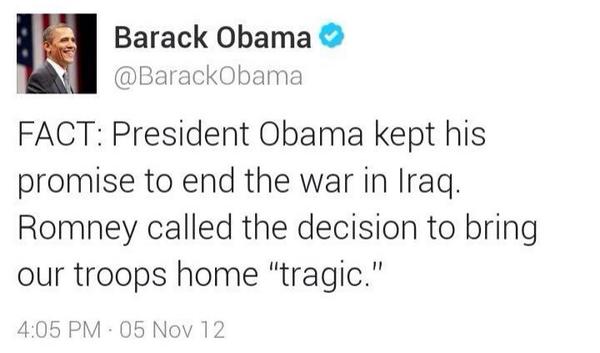
    Remember that time Obama bragged about ending the war in Iraq? Yeah, me too. '


    Lastly, the following community sites were updated since the last snapshot:


  • iraq
    shashank bengali


    all iraq news
    al mada

    Thursday, August 14, 2014

    Iraq

    "U.S. reopens war on Iraq" ( WSWS):
    Aug. 11 — President Barack Obama has now become the fourth successive U.S. president to order the bombing of Iraq, this time with a “humanitarian” pretext. But it soon became clear that Obama’s “humanitarian” excuse was as much a lie as the pretexts raised by the other three U.S. presidents and that the bombing was aimed at defending U.S. imperialism’s corporate and strategic interests.
    On Aug. 7, Obama announced the U.S. bombing raids on Iraqi soil. He claimed his reason was that the fighters of the force known as the Islamic State were “barbaric” and were about to carry out “genocide” against a minority religious group in Iraq called Yazidis. Some 200,000 Yazidis had fled their home villages near the Kurdish region in Iraq.
    The corporate media reported that tens of thousands of Yazidis were trapped by a siege of I.S. forces on Mount Sinjar, near the Syrian border with Iraq, where they had neither food nor water.
    Obama said, “Well, today [the U.S.] is coming to help [Iraq].” He insisted that this would be limited “aid” and that he would not reintroduce U.S. ground troops into Iraq. (New York Times, Aug. 7) By Aug. 9, Obama admitted the U.S. bombing raids could go on for months.
    According to German parliament member Ulla Jelpke, a spokesperson for the party Die Linke, who was on a mission to northern Iraq, it was neither U.S. bombs nor the Kurdish regime’s Peshmerga that saved tens of thousands of the Yazidis. It was revolutionary guerrilla fighters from the Kurdistan Workers Party (PKK). This liberation organization is on the “terrorist list” of the U.S. and the European Union. Many Yazidis told her, “God and the PKK saved us.” (German daily Junge Welt, Aug. 10)
    They all had pretexts
    In January 1991, George H.W. Bush ordered a massive bombing of Baghdad and a military assault against the Iraqi army. His pretext was the entry of Iraqi troops into Kuwait. Before Iraq’s intervention, however, U.S. Ambassador to Iraq April Glaspie had indicated to the Iraqi leaders that the U.S. would stay neutral in Iraq’s conflict with the Kuwaiti monarchy, which was siphoning off Iraqi oil through slant drilling.
    Bill Clinton not only continued his predecessor’s murderous sanctions that killed hundreds of thousands of Iraqis, but in December 1998 ordered four days of bombing. His pretext was the “dangerous weapons” Iraq allegedly had in its arsenal.
    George W. Bush ordered the 2003 invasion and what turned into an eight-year occupation of Iraq. His pretext was the “weapons of mass destruction,” which turned out to be nonexistent. This war killed 1.5 million Iraqis and created 5 million Iraqi refugees. It also resulted in the death and maiming of thousands of U.S. troops, who were fighting to expand U.S. imperialist control of energy sources.
    The goal of these interventions was destroying the sovereign Iraqi state and conquest of Iraq.
    Faced with a heroic Iraqi resistance movement in 2004-05, the occupation power quickly moved to plan B: divide and conquer. U.S. officials in Iraq set up a puppet regime where the laws exacerbated differences among Iraqis of different religious and ethnic groupings. Meanwhile, the U.S. supported a subservient Kurdish regime in Iraq’s north.
    The U.S.-backed Baghdad regime headed by Nuri al-Maliki has persecuted, jailed and eliminated any Iraqi leaders who had any ties with the former Ba’athist government and has discriminated against Sunni leaders. The regime is hated in the Sunni areas of Iraq and is unpopular even in the majority Shiite south for its corrupt and dictatorial record. Now it has become the target of an uprising made up of disparate forces, which include as the most aggressive fighters the group known as the Islamic State.
    These same forces — the I.S. — acted in Syria against the Syrian government and received arms and funding there from U.S./NATO imperialists and their allied regimes in Turkey and the monarchists in Saudi Arabia, Qatar and the Gulf emirates.
    Washington has had ambivalent relations with reactionary groups like the I.S. and al-Qaida. It has armed and used them in Afghanistan in the 1980s and more recently in Libya and Syria. At the same time the U.S. demonizes them as “Islamic terrorists” to justify military intervention, as it is doing now in Iraq.

    U.S. imperialist goals

    Like Bush Sr., Clinton and Bush Jr., Obama is the chief executive of U.S. imperialism. U.S. military intervention has brought only death and chaos to Iraq, as well as to Libya, Afghanistan and — through its weapons and proxy forces — to Syria and Ukraine, where U.S./NATO backs the most reactionary neo-Nazi forces that murder and plunder in the Donbass region.
    The goal of these interventions is to extend U.S. and NATO military reach and recolonize the various peoples under imperialist control. That these interventions failed to establish stable puppet regimes does not soften the horror that U.S. intervention brought to these countries.
    Can anyone possibly believe that this time the U.S. intends to make a “humanitarian” intervention in Iraq or that U.S. bombing will help the people there? If Washington has “humanitarian” goals, why does the Pentagon resupply Israel’s army with all the weapons it uses to carry out genocidal warfare in Gaza?
    By Aug. 9, the real intention of what can only be seen as the initial, rushed U.S. bombing became clear, as admitted by administration spokespeople.
    I.S. forces, whatever their intentions toward the Yazidis, are close enough to the Kurdish center of Erbil to threaten to take that city. The Kurdish region of Iraq is the only part of the country with a pro-U.S. regime that is somewhat stable. Erbil is the center where the U.S. has recently built a massive consulate and where Canadian, European and Japanese consulates have been constructed to aid business investment in Iraq and especially in the Kurdish region.
    The New York Times on Aug. 10 reported, “The American airstrikes, carried out by drones and fighter jets, were intended to support the Kurdish forces fighting to defend Erbil, the capital of the Iraqi Kurdistan region, according to a statement by the United States Central Command.” The U.S. military still claimed its goals were “limited.”
    While Yazidis suffering hunger and dehydration in the mountains are at risk, the Obama administration has as much as admitted that aid to the Yazidis is a pretext, not a reason, for the bombing. Washington is protecting its strategic and business interests in the Kurdish region of Iraq.
    Whether this current intervention will lead to a U.S. re-occupation of Iraq cannot be ruled out. Any U.S. intervention can only lead to more suffering for Iraqis, and will also result in more sacrifices from U.S. working people, just as the 2003 invasion and occupation did.
    Articles copyright 1995-2014 Workers World. Verbatim copying and distribution is permitted in any medium without royalty provided this notice is preserved


    It's kind of hard to get a clear picture on what the president has planned for Iraq when he's currently on vacation.

    Any one going to point that out?

    "Iraq snapshot" (The Common Ills):
    Wednesday, August 13, 2014.  Chaos and violence continue, Nouri doesn't want to go, the Pope Tweets, and much more.


    Glen Ford (Black Agenda Report) weighs in on Iraq:

    The U.S. corporate media were more interested in the rest of al-Baghdadi’s message, in which he warned Washington that “soon enough, you will be in direct confrontation – forced to do so, God willing. And the sons of Islam have prepared themselves for this day. So wait, and we will be waiting, too.” For most self-obsessed Americans, this was received as a threat to attack “the Homeland.” However, downtown Manhattan is not on the Caliphate leader’s map. Al-Baghdadi meant that the American strategy of financing Muslim muppets to fight imperialism’s wars is kaput, and that the Pentagon will soon have to do its own dirty work, dressed in “Crusader” uniform.
    Accordingly, the U.S. is sending additional hundreds of “non-combat” troops to northern Iraq – as if Marines and Special Forces are anything but combat soldiers – to join the 1,000 or so American military and “security” personnel already there, by official count. Contrary to what many Americans on the Left believe, U.S. planners are not itching to send large American units to Arab lands (the Kurds are not Arabs), since their presence is counter-productive in the extreme. The problem is, the Pentagon’s proxies are evaporating, in flight, or – in the case of Arab Iraq – growing even more dependent on Iran and (who would have predicted it?) Russia, which is assisting in reconstituting the Iraqi air force.
    Some leftists in the U.S. even imagine that Washington has achieved some kind of victory with the imminent departure of Prime Minister Nouri al-Maliki, the veteran American stooge. But, Maliki’s ouster was also backed by Iran, Iraq’s Grand Ayatollah Ali al-Husayni al-Sistani (who mobilized millions demanding an end to the U.S. occupation), Muqtada al-Sadr (whose militia fought two wars against the occupation), and even much of Maliki’s own Dawa Party. Only the Kurds remain in Washington’s (and Israel’s) pocket – and this matter of convenience, too, may pass as the neighborhood changes all around Kurdistan.


    There's more to the piece than just that.

    But on that?

    Sorry, Glen, if Barack hadn't pulled US support, the world would not be attempting to rush Nouri off the stage. 


    That is the power of the United States -- it's frequently misused by presidents, but it can also accomplish good.

    And Nouri going is good. 

    Is Grand Ayatollah Ali al-Sistani responsible?  Absolutely.  As is Moqtada and many leaders and officials not mentioned -- a list which would include KRG President Massoud Barzani, ISCI leader Ammar al-Hakim (who surprised many US participants by not attempting to seek the post himself despite working very hard to ease Nouri out), and Ayad Allawi among others. 

    But most of all this came about because of the Iraqi people -- Sunni, Shia, Kurd and other.

    In the midst of the Arab Spring or 'Arab Spring,' Iraqis took to the streets and protested in large numbers.  They were largely ignored by the world.  The same was true from December 2012 through January of 2013.  That time, they protested non-stop and turned out every week.

    They showed up to protest despite threats, despite torture --

    In fact, let's stop there.

    You didn't have to peacefully participated in protesting for Nouri to sick his goons on you.  Hadi al-Mahdi was rounded up for reporting on the protests.  Falling back to the September 8, 2011 snapshot:


    In Iraq, a journalist has been murdered.  In addition to being a journalist, he was also a leader of change and part of the movement to create an Iraq that was responsive to Iraqis. 
    Al Mada reports Iraqi journalist Hadi al-Mahdi is dead according to an Interior Ministry source who says police discovered him murdered in his Baghdad home.  Along with being a journalist, Al Mada notes he was one of the chief organizers of the demonstrations demanding change and service reform that began on February 25th -- the day he was arrested by Iraqi security forces and beaten in broad daylight as he and others, after the February 25th protest, were eating in a restaurant. The New York Times didn't want to tell you about, the Washington Post did.  And now the man is dead. Gee, which paper has the archives that matter to any real degree.  Maybe it's time to act like a newspaper and not a "news magazine" with pithy little human interest stories?  (That is not a dig at Tim Arango but at the paper's diva male 'reporter' who went on NPR to talk of an Iraqi collegue this week.)  So while the Times missed the story (actaully, they misled on the story -- cowtowing to Nouri as usual),  Stephanie McCrummen (Washington Post) reported:

    Four journalists who had been released described being rounded up well after they had left a protest at Baghdad's Tahrir Square. They said they were handcuffed, blindfolded, beaten and threatened with execution by soldiers from an army intelligence unit.
    "It was like they were dealing with a bunch of al-Qaeda operatives, not a group of journalists," said Hussam al-Ssairi, a journalist and poet, who was among a group and described seeing hundreds of protesters in black hoods at the detention facility. "Yesterday was like a test, like a picture of the new democracy in Iraq."


    That day's snapshot?  That's the day Haidi was murdered.  Like so many other journalists killed in Nouri's Iraq, the killer was never found -- mainly because no one ever made a point to look for a killer to begin with.

    Did Black Agenda Report cover his murder?

    No.

    No, they did not.

    They didn't cover the hunting of Iraq's LGBTQ community.  Nouri's 'acting' Minister of the Interior helped with that on Nouri's orders.  Young men and boys who were gay or wrongly thought to be gay were targeted.  Death didn't come easy to those killed.  To cite two popular examples for ways to murder, some were beaten to pulp with bricks, some had their anuses super glued.  This was barbaric not just in that innocents were being killed -- being gay is as normal as being straight -- but in the way they were being killed -- slowly and painfully in an effort to inflict the most pain possible.

    Does Glen want to explain why that was?

    Better yet, can he?

    Nouri's flunkies went into high schools and middle schools handing out pamphlets about how awful these people were -- they had same-sex sex, they were vampires, they were this, they were that.  (Of course Nouri and his flunkies denied it -- but both Al Mada and Alsumaria got ahold of the handouts the Ministry of Interior was distributing to children.)

    What Nouri's gotten away with?  War Crimes.

    Has Black Agenda Report objected even once to the bombing of Falluja's residential neighborhoods?  We all know that collective punishment is a legally defined War Crime.  But since the start of this year, Nouri has daily attacked and left wounded and dead numerous civilians whose only 'crime' was to live in Falluja.

    I like Glen and think he's an important voice.

    I also he's a very sad person if he can't, for even one moment, think of the Iraqi people.

    The Pope Tweeted a popular message today:


    I thank all those who are courageously helping our brothers and sisters in Iraq.


    Reuters notes Pope Francis wrote a letter to United Nations Secretary-General Ban Ki-moon today which stated, among other things, "I write to you, Mr. Secretary General, and place before you the tears, the suffering and the heartfelt cries of despair of Christians and other religious minorities of the beloved land of Iraq."


    Nouri is a thug and they had to endure 8 years of him. 

    US President Barack Obama pulled the US government's support. 

    I wish Barack had done that in 2010 -- when Nouri lost the election -- but I don't for one moment think doing it now didn't make a difference.

    I also have no problem praising Barack for taking that step. 

    If he used the rest of his final term to do similar things, I'd praise him for that as well.

    Will he?

    I wouldn't bet on it.

    I support the air drops of food, water, etc for the Yazidis trapped on Mount Sinjar.  They are victims and relief missions are something every nation could do and take part in.

    Barack's taken that beyond air drops.  And today the Defense Dept issued the following:


    Release No: NR-427-14
    August 13, 2014


    Statement by Pentagon Press Secretary Rear Admiral John Kirby


    As part of the ongoing humanitarian efforts ordered by President Obama, today a team of U.S. military personnel, accompanied by USAID, conducted an assessment of the situation on Mt. Sinjar and the impact of U.S. military actions to date. The team, which consisted of less than twenty personnel, did not engage in combat operations and all personnel have returned safely to Irbil by military air. The team has assessed that there are far fewer Yazidis on Mt. Sinjar than previously feared, in part because of the success of humanitarian air drops, air strikes on ISIL targets, the efforts of the Peshmerga and the ability of thousands of Yazidis to evacuate from the mountain each night over the last several days. The Yazidis who remain are in better condition than previously believed and continue to have access to the food and water that we have dropped. Based on this assessment the interagency has determined that an evacuation mission is far less likely. Additionally, we will continue to provide humanitarian assistance as needed and will protect U.S. personnel and facilities.


    The mission Barack's now having US troops carry out in terms of the Yazidis is riskier than air drops but air drops are risky as well.  I'm sure Alissa J. Rubin knew that long ago but it was certainly made clear Tuesday when the Kurdish helicopter the New York Times reporter was on crashed after dropping aid and attempting to rescue some Yazidis.

    Rubin walked away with painful injuries (broken wrists are painful), Yazidi MP Vian Dakhil was injured, the pilot died and a few more passengers who haven't been named yet were left injured.  The pilot hasn't been named either.


    We noted this Tweet last week from the Financial Times' Borzou Daragahi:


  • The MP he was Tweeting about was Vian Dakhil.


    I don't support fly over bombings -- nor do I believe for one minute that the bombs being dropped from the air means the US is not in 'combat' in Iraq. 

    I do not support more US troops going into Iraq (or any being there other than to guard US embassy staff -- which Marines do around the world).   All Iraq News notes, "About 130 American military advisers have arrived in Iraq to help with its humanitarian aid in north area of the country, U.S. Defense Secretary Chuck Hagel said in a press statement."  The number of US troops in Iraq keeps increasing.  That's not a good thing to those of us opposed to war.


    The addition was noted in today's US State Dept press briefing moderated by spokesperson Marie Harf:

    QUESTION: Okay. And conversely, you deployed – or the United States deployed some 130 --

    MS. HARF: Uh-huh.

    QUESTION: -- advisors and so on to Erbil. Does that mean that the situation in Baghdad or around Baghdad is quiet enough where you don’t need this kind of advisory effort?

    MS. HARF: Well, let’s be clear about what these 130 advisors will and will not be doing. They are focused squarely on looking at the humanitarian situation on Mount Sinjar and developing options to potentially move people and relocate people safely from the mountain. As we know, dropping food and water is not a long-term solution for the tens of thousands of people on that mountain. So these U.S. military personnel that have just gone in are assessing the best way to bring these people to safety, whether that’s some sort of airlift, whether that’s a humanitarian corridor. They’re looking at the options, they’ll present them to the President, and then he’ll make decisions about how – the best way that we can help do that will be.

    QUESTION: And I know yesterday that you denied that there was any kind of pressure on Maliki to leave August from early June or mid-June right after the fall of Mosul. So no one has talked to him at that time, “It’s time for you to leave?”


    MS. HARF: What we’ve always said, Said, is that there is a constitutional process and that process needs to move forward. There are very clear rules under that process for how a new prime minister for a new government is designated. We have encouraged everyone to play by those rules, period. And that’s the message that we’ve been sending for a very long time.


    Former Governor of New Mexico and 2012 Libertarian Party Presidential nominee Gary Johnson Tweeted the following today:


  • WSJ: "U.S. Begins to Assess Iraq Rescue Strategy". Obama insists we are not going back to war, but how many bombs & troops = war??


  • Let's turn to the political in Iraq.  Jason Ditz (Antiwar.com) maintains Iraq's prime minister-designate Haider al-Abadi is Nouri al-Maliki circa 2006.


    Comically, he does that as Antiwar.com is in the midst of a fund raiser boasting they're always right.

    I'm not always right.  I'm often wrong.

    But I wasn't wrong about Nouri.

    And, unlike Jason Ditz, I didn't giggle on air and agree with Scott Horton about how wonderful Nouri was.

    Jason Ditz has a lot of nerve.  I've been kind but we all know I forget nothing.

    I can quote from those chats with Horton -- where Scott and Jason made like the Gabby Gabors enthralled with Nouri.

    Is Haider the same?

    No.

    Is he good or bad, saint or sinner?  I already said this week that we don't know.

    But what we know is that Nouri's selling point for the American government was chiefly his paranoia which, it was thought, would make him easily manipulated.

    I knew about the paranoia and we wrote about it here, what, three or four years before WikiLeaks confirmed what we were saying?

    I'm not hitting anyone up for their piggy banks.

    I am saying that if you have the nerve, before the prime minister-designate has done anything, to insist he's another Nouri, you damn well better have called out Nouri.

    Or you can sit your tired ass down.

    This is my last nice, Jason Ditz. 

    I'm not in the mood.

    Back to today's State Dept press briefing:


    QUESTION: In Iraq, please. Today Prime Minister al-Maliki said he would not step down from his post until the Iraqi judiciary rules on whether or not his constitutional challenge to the process should go forward or not. I’m wondering if you all have any idea of how long this process might take as it speaks to some concerns people have raised about whether he will try to run out the clock on the 30 days he now – that designate al-Abadi has.

    Also I’m wondering if you were able to get an answer to my question yesterday as to what level of confidence does the U.S. have in the Iraqi judiciary system.

    MS. HARF: A couple issues, and then we’ll – I’m sure you’ll have follow-ups. The comments made by the prime minister today were similar to ones he’s made in recent days, quite frankly. And as I said yesterday, with all political systems there will be differences with how certain processes unfold. We never expected this to be completely seamless, but the United States firmly rejects any effort to achieve outcomes through coercion or manipulation of the constitutional or judicial processes.

    And then look, I don’t want to get ahead of the constitutional process that’s underway. We just began the 30-day time clock for the Prime Minister-designate al-Abadi to form a new government. They are moving along with that process. So we will watch day by day as that plays out, but Prime Minister-designate al-Abadi is moving forward as part of this process, and that’s what we’ll be focused on in the coming days.

    QUESTION: So you don’t believe this court challenge that Maliki is posing is going to be slowing that 30-day clock in any way?

    MS. HARF: Well, look, the prime minister-designate is the one who is in charge of what happens during the 30-day clock, and he’s working actively towards that. And again, we would reject any efforts by anyone to use the judicial processes to manipulate or coerce the outcomes here. But there is a separate process and it’s the constitutional one, and that’s moving forward.

    QUESTION: How is it that the designate has control of the clock when Maliki is still the prime minister?

    MS. HARF: Well, he has control of the clock. What I meant was the progress that can be made in the 30 days to form a new government is in the hands of the prime minister-designate, who has the support, as I said over the last few days. He was nominated by the Shiite bloc, including many members of Prime Minister Maliki’s own party.

    So we’ve seen these kind of comments from the current prime minister before, but separate from those comments there is a process under the constitution that is moving forward. And we expect that to move forward and we will continue watching what happens in the coming days.

    QUESTION: Do you have any expectations of how long this court appeal will last?

    MS. HARF: I don’t have any guess on that.

    QUESTION: May I just follow up on that? I mean, his words were very critical of the United States, today – Maliki’s speech. He basically said that you espouse democratic values but you go ahead and sabotage the democratic process. What do you have to say to that?

    MS. HARF: Well, the Iraqis have their democratic process that’s underway right now, and that process has led to a new prime minister-designate being named by the current prime minister’s own bloc. So the process is playing out how it should. Again, we knew this would not be without complication. Nothing ever is – certainly not here in Iraqi politics. But their own democratically, constitutionally outlined process has been ongoing and that’s what’s happening right now.

    QUESTION: I know that you warned against manipulating whatever legal process in the courts or whatever to sow divisions and so on in Iraq. Has anyone talked to the prime minister personally to say refrain from doing that because you’re driving the country further into the abyss?

    MS. HARF: We’ve certainly had conversations with a range of leaders, including Prime Minister Maliki, emphasizing, Said, that this is a key, critical time in Iraq on the security front, on the political front – they are very closely intertwined – and that nobody should do anything to prevent the progress that’s laid out under the constitution from taking place and from moving forward. Nobody should.

    QUESTION: Mm-hmm.

    MS. HARF: We’ve certainly had those conversations.

    QUESTION: Okay. Now, as we – Iran, Saudi Arabia, Turkey, they all welcome the prime minister-designate Haider Al-Abadi, but Maliki still has some support within the Shiites. He has some support within some, like, militant type of militias and so on. Are you concerned that he actually might resort to violence?

    MS. HARF: I don’t want to venture to guess on that hypothetical, Said. There’s a process in place and that process is moving forward. What’s key here is that the President asked the prime minister-designate to name a government. This was the designate that his own bloc, Prime Minister Maliki’s own bloc selected. So I think that should speak very clearly about the support that Prime Minister-designate al-Abadi has. And, again, the process is moving forward.


    We'll note this Tweet.


    Twenty eight women (prostitutes) killed in Iraq! A reminder of Iranian regime when prostitutes were burned to die!


    I have no idea why a woman would do that to other women.

    28 women were killed.  By thugs.

    The thugs call them whores.

    And we repeat that?

    That's how we show sympathy for these women who were killed?

    The Tweeter's never been there and knows nothing.

    'A press report said it!'

    Oh, okay then.  Press report are never wrong, right?

    It would be something wonderful if we could see people rejecting an urge to insult the dead.  (I am not attacking women who engage in sex work.  I am noting that prostitute is a huge pejorative in Iraq and dead women who can't defend themselves shouldn't have prostitute tied around their dead necks solely because a group of men -- who killed them -- have labeled them whores.)

    I'm not interested in running down violence.  Monday night, I noted a death and offered Tuesday might be the last snapshot.  The friend I dictated it too wisely pulled that.  But a friend died this week and it really makes me question the point of online life.


    This week saw the passing of actors Robin Williams and Lauren Bacall.  (I was referring to Robin in the previous paragraph.)  TCM has a video clip entitled "Lauren Bacall -- (TCM Remembers) 1924-2014."  PBS' The NewsHour remembers her here.

    Maria noted her passing in "The Walker," Ann in "Remembering Lauren Bacall," Stan with "Bacall," Elaine with "The great star Lauren Bacall," Ruth with "Lauren Bacall," Trina with "Lauren Bacall -- one of a kind," Betty with "Lauren" and Kat with "The wrong people keep dying."  Robin's passing was noted in Mike's "Robin starred in so much of our childhood," Rebecca's "robin" and Marcia's "Iraq and Robin Williams." In addition, Robin was noted in a statement the Pentagon released earlier this week:


    August 11, 2014

    Statement by Secretary of Defense Chuck Hagel on the Passing of Robin Williams


    The entire Department of Defense community mourns the loss of Robin Williams. Robin was a gifted actor and comedian, but he was also a true friend and supporter of our troops. From entertaining thousands of service men and women in war zones, to his philanthropy that helped veterans struggling with hidden wounds of war, he was a loyal and compassionate advocate for all who serve this nation in uniform. He will be dearly missed by the men and women of DoD - so many of whom were personally touched by his humor and generosity.


    the washington post
    stephanie mccrummen