
Christies is holding an auction (that ends about 8 hours after this posts) of Norman Seeff's prints.
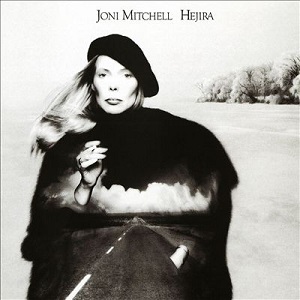
That's the cover of Joni's Hejira album (1976). Seeff took the portrait of Joni (leave out road, background and "Hejira") and it's among those up for auction.

He also took this cover shot of Carly's 1975 album Playing Possum. That cover was considered 'shocking' in 1975 and Sears (which was the iTunes of its day) refused to stock the album due to the cover.
Of the photo ("playing possum" and "carly simon" don't appear on the print), Christie's notes:
The larger, scrawling signature in red wax pencil on the verso of this print signifies that it was considered by the artist at the time to be one of his 'master' prints.
"That was an ongoing sequence of hundreds of shots, all in that particular outfit. The album cover was published in Time and Newsweek as one of the sexiest ones of all time, but in fact Carly was doing a bunch of yoga stretches. You can see the sequences of images leading up to that shot. We never intended to have a sexual innuendo. Carly just happens to be one of the sexier women in the world.” – Norman Seeff, from an interview with Jill Krasny, Esquire, 5.18.13
The Diana Ross photo is from 1982 and it's of her and Michael Jackson.
The Cher photo is of her and Gregg Allman from their brief time together.
There's Diane Keaton, Jodie Foster, Rod Stewart, Ann and Nancy Wilson of Heart, Whitney Houston, Frank Zappa, Dionne Warwick, Tina Turner, Steve Martin, Ray Charles, John Huston, Cher (without Altman from 1976), John Travolta, Mel Brooks, KISS, Dennis Hopper, Ringo Starr, Gladys Knight & the Pips and many more.
Make a point to check it out. It's history in addition to being art.
"Iraq snapshot" (The Common Ills):
Tuesday, October 8, 2013. Chaos and violence continue, the non-Iraqi
press (again) drops the ball, the spokesperson for the Governor of
Nineveh is assassinated, corpses continue to surface on Iraqi streets,
Nouri's lie-filled and idiotic interview gets (the wrong kind of)
attention, the scramble remains in the KRG for who will lead the fallen
PUK, Arabic social media questions a terrorism organization's claim, and
more.
Corpses discarded in the streets were common place in the 2006 - 2007 ethnic cleansing which took place in Iraq. With no notice yet from the foreign media (foreign media means non-Iraqi media), the corpses have returned. It's previously been a day here, two days later, etc. It's now on the fourth day in a row. It's a pattern. It's a shame investigators are taught to look for patterns but journalists aren't.
CNN's Mohammed Tawfeeq Tweeted Sunday:
And the 'surge' continues today. National Iraqi News Agency reports 1 corpse (male, approximately 30-years-old) was discovered near Kirkuk ("on a roadside near Bibis district) and he'd been strangled to death, 1 headless male corpse was discovered on the streets of Falluja today, 1 barber was shot dead in Baiji at his barbershop, a Falluja armed attack left 1 bystander dead, a Heet bombing left two people injured, a Falluja grenade attack left one person injured, Saad Zaghloul was assassinated in his Mosul home (he had been the spokesperson for Nineveh Governor Atheel al-Nujaifi), an armed clash in Jurf al-Sakhar left 4 members of the Iraqi police and 6 rebels dead, a southern Baghdad car bombing left four people injured, a Mosul bombing claimed the lives of 3 Iraqi soldiers, Nouri al-Maliki's federal police killed 7 suspects in Mosul (while carrying out mass arrests) and 1 suspect was killed in downtown Falluja. All Iraq News adds that three people were kidnapped in Tikrit. Al-Shorfa reports an al-Ameriya armed clash left 2 police members and 4 "gunmen" dead according to Anbar police chief Major General Hadi Kassar Erzaij. Alsumaria adds the three kidnap victims were traveling together in a private car when they were ambushed. Amjad Salah and Safaa Abel Hamid (Al Jazeera) report an eastern Baghdad car bombing claimed 3 lives and left nine people injured and that 1 oil security guard was shot dead in front of his Mosul home, an attack on a Samarra headquarters for the federal police left three federal police injured, and Alsumaria notes (no byline on piece) an evening Baiji bombing left 1 police officer dead and three more injured.
At least 37 reported dead today. (Check my math.) That's awful. But with 59 killed yesterday (Iraq Body Count), some may sigh with relief. Of course, if you're reading western media, you may not just be sighing, you may be giddy. According to Qassim Abdul-Zahra (AP) only 9 people died today.
Sunday's violence included an attack on a school. The United Nations Childrens Fund (UNICEF) issued the following:
Statement by Marzio Babille, UNICEF representative in Iraq, on deadly school attack
ERBIL, Iraq, 7 October 2013 – “A suicide bomb attack yesterday on a primary school in Tal Afar in northern Iraq left at least 10 children and their teachers dead and many others injured.
“This attack is an abominable act of hatred and an affront to all the children of Iraq.
“Schools are zones of peace where children must be allowed to play and learn in safety and security.
"UNICEF condemns this attack and calls for an end to the spiraling violence in Iraq."
For more information please contact:
Najwa Mekki, UNICEF Regional Office for the Middle East and North Africa, nmekki@unicef.org, Tel: + 962-79-573-2745
Children are targets in Iraq. Everyone is. The recent attack in the KRG demonstrates every area is also at risk. In the face of this, people make decisions about the safest ways to live their lives. Nihad Qais (Alsumaria) has a very important report which includes:
Yazidis celebrated on Sunday, October 6 their annual seven-day pilgrimage holiday (Jama) in the Lalish Temple amidst tight security measures and without performing any rituals, in fear of security breaches. On this occasion, the Yazidis wished for peace, safety and coexistence in Iraq.
The Yazidi Spiritual Council announced that Jama Holiday rituals will not be undertaken in Lalish Temple, revealing that this decision was taken to avoid security breaches during the 7-day celebration.
“Jama is one of the most important holidays for Yazidis and it lasts for 7 days”, said a prominent Yazidi clergyman from the Lalish Temple named Babeh Jawesh, in a statement to Alsumaria. “This holiday’s rituals can only be held in the Lalish Temple every year and thousands take part in it from different locations in the world”, he revealed.
“This year we will not perform the holiday’s ritual in the Lalish Temple in fear of security breaches and to spare the lives of the Temple’s visitors”, added Babeh Jawesh, mentioning “we do not want to turn the holiday’s joyful spirit into a tragedy”.
Of the reality of violence in Iraq, Krista Ritterhoff (Cisternyard) observes, "This increased level of violence in Iraq is a horrible reminder of the country’s darkest days that many hoped the long and costly ten-year-war would have solved. It seems that in an attempt to bring stability to the country and eliminate terror, the United States has only created a new state of instability, which breeds terror and violence. " The reality of violence have even crept into the Kurdistan Regional Government as last month wound down. Dropping back to September 29th:
[National Iraqi News Agency reports] there was an attack on the Asayis Headquarters in Erbil (think military intelligence) with 2 car bombs and 4 suicide bombers attempt to storm the building -- along with the 4 suicide bombers, the dead includes 6 Asayish and the injured includes forty-two Asayhish and one police officer.
Again, this attack on Erbil may actually led to outlets (US outlets) paying some attention to Iraq this week. It is a complete surprise. Erbil is the capital of the Kurdistan Regional Government. Tim Arango has a report online (and in Monday's New York Times) which notes:
The attackers hit a building that houses the regional Kurdish government’s security service, and the scenes that unfolded -- terrified people fleeing black plumes of smoke, the charred and smoking husks of vehicles in the streets -- were extraordinary for a region that has largely been spared the violence that for years has plagued the rest of Iraq.
All Iraq News says it was 6 suicide bombers (not four) and that all 6 were killed by security forces. They get six because the 2 car bombs were actually being driven by bombers. The outlet adds strict measures were quickly put in place. They mean a clamp down. They don't note it but this included shutting down the Erbil Airport. Arango notes, "In the aftermath, Iraqi forces swept across Erbil, and Sulaimaniya, another major Kurdish city, setting up checkpoints and other security measures familiar to residents of other Iraqi cities."
Asharq Al-Awsat (via The Majalla) reports today:
Last month’s suicide attack on the headquarters of the Security Directorate in Erbil, capital of Iraqi Kurdistan, which the Islamic State of Iraq and Syria (ISIS) claimed responsibility for, was intended to free ISIS-linked prisoners, Asharq Al-Awsat has learned.
The attack took place on September 29 and led to the death of the six attackers along with six local security personnel, while 62 security officers and local residents were also injured.
Speaking to Asharq Al-Awsat on the condition of anonymity, Kurdish sources said that the aim of the attackers was to “storm the prison that belongs to the Directorate of Security, which is believed to hold detainees affiliated with the organization [ISIS] who have been arrested in previous pursuits by the local forces.”
“But they failed to break through the prison’s main gate after the prison guards confronted and killed them,” the source added.
In a statement posted online, ISIS said that the attack came in response to threats from the president of the Kurdistan Regional Government (KRG), Masoud Barzani, to send fighters to Kurdish areas in Syria to fight Islamists threatening the region’s inhabitants.
Zana Khasraw Gul (of the George Soros-backed Open Democracy) offers:
Furious fighting has broken out in Syria between the Jihadists and the Kurds, particularly the most powerful Kurdish militia, People Protect Unit (YPG), the military wing of the Democratic Union Party (PYD) which is an offshoot of the PKK. The JN, ISIL, Ahrar Al-Sham Brigade and ten other rebel factions have formed an alliance, the ‘Islamic Army’, that has rejected the Free Syrian Army’s (FSA) allegiance to the Syrian National Council (SNC). These developments have brought the civil war to a menacing juncture, with regional ramifications.
As Assad’s enemies have fragmented and are fighting each other, a war is going on between the Arab rebels and the Kurds. Massoud Barzani, the President of Iraq’s semi-autonomous Kurdistan region, has reportedly warned of intervention in Syria to defend the slaughter of the Kurdish people by radical Islamist groups who are fighting against Assad’s regime, although officials have since backtracked on the statement. In the meantime, the influx of refugees into the Iraqi Kurdistan region is continuing. In the last few months, tens of thousands of refugees, mostly Syrian Kurds, have crossed the border, posing a challenge to the KRG which is hard pressed to cope with their large numbers.
Supposedly, the attack was planned for a month. There is skepticism of this in Arabic social media with many claiming that it was a Saturday, September 28th meet-up which led to the Sunday, September 29th attack. (For more on the meet-up, you can refer to Baghdad's Kassahkhoon's English language write-up of the meeting.) Not noted in the commentary is a pretty clear fact: That attack, if planned, was poorly planned. The 'plan' seemed to be: Send in 6 bombers and hope something works.
If there was planning of that attack, the attackers should be going after the planner right now. A plan is:
You hit the entrance with a tiny bombing." As people rush out, we have a suicide bomber in the crowd rushing over. S/he looks distressed like everyone else. As a calm settles, the bomber detonates a large bomb. 30 seconds later, 4 cars (with suicide bombers) barrel towards the entrance, and . . .
That's a plan. The attack the press described was an erratic, ill-timed affair.
Let's stay with Syria and violence and then come back to the KRG. NINA reports State of Law MP Abbas al-Bayati insisted today that the violence in Iraq is linked to events in Syria. In making that statement, he was echoing the remarks of the head of State of Law Nouri al-Maliki. World Bulletin notes:
Iraqi Prime Minister Nouri al-Maliki, in an interview with Al-Monitor, said that Iraq supports a “transitional government that will manage affairs until elections are held and a constitution is adopted” in Syria.
Maliki, who opposed a US strike on Syria and any outside military intervention there, said that he told US Vice President Joe Biden two years ago that Syria “would not be resolved in two years, or even more, and that the social situation, the political and population structure and the sensitive region make it difficult to predict the end of an armed conflict of such cruelty and ferocity.”
We noted that laughable 'interview' yesterday. I was kind and just focused the scorn on Nouri. Now that the bulls**t is being picked up by others, we're going to have to return to the Mustafa al-Kadhimi (Al-Monitor) interview. We've already noted how stupid it is for Nouri to blame others when he's bred hatred and sectarianism since November 2010 when he created the ongoing political crisis. Let's note something else. Al-Monitor, you don't do anyone favors by repeating lies and allowing them to go unchallenged.
There is difference of opinion. There are foggy circumstances. And there are also real events which cannot be denied.
In the awful interview, which was conducted by e-mail, Nouri is allowed to get away with this lie. It's not challenged in the exchange, it's not challenged in any intro or conclusion to the interview:
As for the youth demonstrations, this is a natural thing and we consider it a sign of activity, effectiveness and participation, as long as it takes place within the framework of the law. Let me tell you frankly that these demonstrations were dealt with seriously, whether the youth demonstrations that were focused on [revoking] the privileges of members of parliament or the sit-ins that sometimes bordered on sectarian incitement and defying the law, in addition to including legitimate demands. Iraq's method of dealing with these demonstrations serves as a civilized, humanitarian model for dealing [with such events]. Everyone can see how demonstrations, with normal demands, are dealt with in regional countries, and the number of victims. I see no need to provide examples — there are many, and this has been covered in the press. Perhaps there were some problems on the part of security forces or demonstrators here or there, but these things are being followed up on so that they will not happen again. These things occur naturally, but a decision has been made to hold those who were negligent or acted maliciously accountable, whether they be from the security services or demonstrators.
Now there are bold faced lies throughout and many of the lies cover for deaths. Surely, for example, functioning public services would save lives. But we're focusing on that comment by Nouri where he claims that Iraq has a "method" that "serves as a civilized, humanitarian model for dealing" with protesteors and "perhaps there were some problems . . . here or there." What a load of trash.
The April 23rd massacre of a sit-in in Hawija resulted from Nouri's federal forces storming in. Alsumaria noted Kirkuk's Department of Health (Hawija is in Kirkuk) announced 50 activists have died and 110 were injured in the assault. AFP reported the death toll eventually (as some wounded died) rose to 53 dead. UNICEF noted that the dead included 8 children (twelve more were injured).
An example for the world?
Nouri is a cheap, trashy thug. He's the "Dirty Ol' Man" The Three Degrees warned you about in the seventies. And he exposed his real self in that massacre.
By the way, where's his investigation?
Nouri was overseeing that, remember? It's October. Where are the results, Nouri?
Nouri al-Maliki is a cheap thug and damned liar. He repeatedly claims he will investigate some incident but there's never any follow up. And the press -- international press -- refuses to press him on it.
Ayad Allawi's Iraqiya beat State of Law in the 2010 elections and Allawi should be prime minister. But, her body order not withstanding, US President Barack Obama thinks Samantha Power is bright and listened to her 'logic' on how the US government should subvert the democratic rights of the Iraqi people and ignore their votes to give Nouri a second term. (He was installed by the US government in 2006 when the Iraqis wanted Ibrahim al-Jaafari.) Allawi, the true leader of Iraq, Tweets today:
Allawi is the head of Iraqiya. A prominent Iraqiya member is Nineveh Governor Atheel al-Nujaifi (brother of Speaker of Parliament Osama al-Nujaifi) and, as noted earlier in this snapshot, his spokesperson Saad Zagloul was assassinated today outside of his Mosul home. All Iraq News reports Iraqiya MP Mohammed Eqbal is calling for the culprit or culprits to be arrested "and present[ed] . . . to judiciary. The indulging [of] this issue by the security forces allows the criminal to commit more crimes against the Iraqis." MP Eqbal also expressed, "His sorrow for the continuity of the assassination attempts to the journalists and activists in Nineveh."
If the pattern stands, not only will Nouri never announce any investigation results but the international press will never call him on it.
Back to the KRG, the Kurdistan Regional Government held provincial elections Saturday, September 21st. Iraq has 18 provinces. Three of them are in the semi-autonomous Kurdistan Regional Government. The September 21st elections meant 17 of the provinces had voted. Only disputed Kirkuk was prevented from voting. (Why? Because Nouri's never implemented Article 140 -- he was commanded to do so, in the Constitution, by the end of 2007. He has refused.) The three KRG provinces are: Erbil, Sulaimaniya and Dahuk. October 2nd, the official results were finally announced.
AP explained the KDP came in first and they will have 38 seats in the KRG Parliament (there are 111 seats in the Parliament). (In fairness to AP, I should note that they didn't cite the crackpot in their work. They were among the few outlets over the last years who hadn't.) IANS added: that Gorran (Change) got 24 seats, the PUK got 18 seats, the Kurdistan Islamic Union got "10 seats and the Islamic Group got six seats." Those were the major winners and that adds up to 96 seats (check my math). Anadolu Agency explained, "Minority candidates won 11 seats."
IANS reports, "Talabani's PUK and Barzani's KDP have long dominated politics in the three-province autonomous region of northern Iraq; however, the latest results showed that the Gorran movement won decisively in Sulaimaniyah province, which is the home base of the PUK." Anadoulu Agency adds, "Gorran is led by the PUK's former number two, Noshirwan Mustafa, who broke away from Talabani in 2006." Goran now joins the KDP as one of the two dominant political parties in the KRG. Whether this is a momentary upset for the PUK or the beginning of its slide downward isn't clear.
Dropping back to the September 20th snapshot:
If the PUK does less well than in 2009, there will be complaining. If the PUK does really bad, there will be outrage. The one who will face the most criticism may be First Lady of Iraq Hero Ibrahim Ahmed who has been reluctant to heed the advice of PUK leaders and assume the presidency in her husband's absence. Could she? Yes. In the plan they outlined, Hero would not be "President Hero," she would be carrying out the will of her husband while he remains in Germany. She would be voting by proxy. She has refused that (just as she refused to take over the position outright) arguing that to do so would leave the impression that Jalal was unable to do his job.
She's correct people would assume that. But Jalal has now been out of the country for nine months. Iraq's been without a president for nine months. Speaker of Parliament Osama al-Nujaifi's recent revelation that he was refused when he attempted to visit Jalal in the hospital last April does not bode well for Jalal's health or his stature. And it really makes the point for the posters in Arabic social media who compared the May 18th photos of 'healthy' Jalal to Weekend At Bernies. (In Weekend At Bernies, two men use Bernie's corpse to pretend Bernie's still alive.)
If Hero has the most to lose in tomorrow's vote, the one with the most to gain from the PUK suffering a big loss is Iraq's Foreign Minister Hoshyar Zebari who has wanted to grab the Iraqi presidency for some time and attempted a move right after Jalal's stroke but was rebuffed by those in party leadership loyal to Jalal and Hero.
Credit to Prashant Rao for covering the fact that Jalal's absence may negatively impact the PUK vote tomorrow but is no one going to run through what that means? Probably not. It appears AFP is the only western media outlet that's going to report on the KRG elections from inside the Kurdistan Region.
And Hero was made the fall guy. Not her absent husband. Last December, Iraqi President Jalal Talabani suffered a stroke. The incident took place late on December 17th (see the December 18th snapshot) and resulted in Jalal being admitted to Baghdad's Medical Center Hospital. Thursday, December 20th, he was moved to Germany. He remains in Germany currently. With October starting tomorrow? He's one month shy of a full year of being unable to perform his duties. With Hero pushed out of her position in the PUK, those eyeing Jalal's job just got a big boost.
Hoshyar Zebari is a member of the PUK and has long eyed Jalal's job. His position as Iraq's Minister of Foreign Affairs appeared to give him some traction. Whether he will achieve that rise or not, Kitabat reports the opposite party, the KDP, appears to know who they want after Massoud Barzani: Barham Salih. Unrepresented Nations and Peoples Organization reposts an analysis of the election results by Rudaw:
The success of the Kurdistan Democratic Party (KDP) in last month’s elections in Iraqi Kurdistan mean closer ties between Erbil and Turkey, the Ankara-based International Middle East Peace Research Center (IMPR) said in a recent report.
The 18-page report also said that the September 21 polls for the autonomous Kurdistan Region’s own parliament were orderly, honest and transparent. It said they were an assurance of stability and security for Turkey’s southern borders.
The KDP received the largest number of votes at the polls but the Patriotic Union of Kurdistan (PUK), its partner in the Kurdistan Regional Government (KRG), did not fare as well. It lost its standing as the second-strongest party to the opposition Change Movement, Gorran. The composition of the next government is yet to be decided.
“The KDP’s dominance in the forthcoming government would provide a powerful ally to Turkey both in Kurdistan and in the region because of the KDP’s desire to have even stronger relations with Turkey,” said the IMPR report, titled “KRG's parliamentary elections, coalition discussions and their effects on Turkey.”
Meanwhile, NINA reports:
The adviser of the President of the Kurdistan Regional Parliament Tariq Jawhar said that the formation of the new provincial government will not be as easy as that took place in previous sessions .
He explained, in a statement to the National Iraqi News Agency/ NINA / on Thursday 8, Oct that the recent elections produced a new facts and results , as some of the major parties lost a lot of seats , while other parties made significant gains in this election . "
He added, "The Patriotic Union of Kurdistan PUK, led by President Jalal Talabani, despite losing a lot of votes and seats , but it still has a mass base and a major political weight," adding that " all options are open in front of the PUK on participation in the next government or not ."
He continued , " The PUK wants the next government to be with broad popular base and be broad representation and includes everyone."
The results are finally in and official for the KRG. It shouldn't have taken this long and it's actually an embarrassment for Iraq's Independent High Electoral Commission that it has taken this long.
Still on the KRG, last week, Renee Montagne (NPR's Morning Edition, link is audio and transcript) spoke with an American educator in the KRG:
RENEE MONTAGNE, HOST: There is an old Arab saying that proclaims books are written in Cairo, published in Beirut and read in Baghdad. Those cradles of civilization were cradles of learning, and that education continues even as those places in modern times fell into unrest and violence, in part thanks to a string of English-language American universities dating back to Beirut in the 1800s. We're going to hear now from Dawn Dekle. Just weeks ago, she took up her duties as president of the American University in Iraq, founded six years ago in the Kurdish region. She came to Iraq from Kabul, where she was the top administrator at the new American University there. We reached her via Skype in Iraq.
DAWN DEKLE: If you're somebody right now in Afghanistan or Iraq, you've got a son or daughter who is capable, you want to try to send that son or daughter to the United States. You might completely disagree with American foreign policy, but no one really disagrees that the Harvards, the MITs, the Stanfords of the world are world-class. Having said that, you can get sticker shock from some of these schools. You could have visa issues trying to get your son or daughter into these schools. So why not bring the school to the students?
MONTAGNE: So did you - I mean, I know these are two very different countries and two very different situations. But tell us about the transition from the American University in Kabul in Afghanistan to the American University in Iraq. What did you find that was similar and what is the difference?
DEKLE: One variable that's a little bit different here than possibly Afghanistan, is that within the Kurdish region of Iraq, Americans are welcomed. Whereas, in Afghanistan, many of the Afghans that I met were a bit fatigued with having Americans in their country. I'm not saying Afghans are not welcoming, because their culture is legendary for being wonderful hosts. It's just more of a slight undertone. And who can blame them? What I find that the Kurdish, they're so enthusiastic. They want to ask us all about the United States and speak English with you, and they're just wonderful. I feel very welcomed here.
On the topic of some Iraqi's wishing to leave Iraq, US Senators John McCain and Jeanne Shaheen issued the following statement last week:
Iraq
mohammed tawfeeq
all iraq news
al mada
al-shorfa
national iraqi news agency
the new york times
tim arango
world bulletin
upi
hurriyet daily news
npr
morning edition
renee montagne
Corpses discarded in the streets were common place in the 2006 - 2007 ethnic cleansing which took place in Iraq. With no notice yet from the foreign media (foreign media means non-Iraqi media), the corpses have returned. It's previously been a day here, two days later, etc. It's now on the fourth day in a row. It's a pattern. It's a shame investigators are taught to look for patterns but journalists aren't.
CNN's Mohammed Tawfeeq Tweeted Sunday:
-
#Iraq suffers 'accelerated surge' in sectarian violence http://www.cnn.com/2013/10/06/world/meast/iraq-violence/index.html?sr=sharebar_twitter …
 Mohammed Tawfeeq
And the 'surge' continues today. National Iraqi News Agency reports 1 corpse (male, approximately 30-years-old) was discovered near Kirkuk ("on a roadside near Bibis district) and he'd been strangled to death, 1 headless male corpse was discovered on the streets of Falluja today, 1 barber was shot dead in Baiji at his barbershop, a Falluja armed attack left 1 bystander dead, a Heet bombing left two people injured, a Falluja grenade attack left one person injured, Saad Zaghloul was assassinated in his Mosul home (he had been the spokesperson for Nineveh Governor Atheel al-Nujaifi), an armed clash in Jurf al-Sakhar left 4 members of the Iraqi police and 6 rebels dead, a southern Baghdad car bombing left four people injured, a Mosul bombing claimed the lives of 3 Iraqi soldiers, Nouri al-Maliki's federal police killed 7 suspects in Mosul (while carrying out mass arrests) and 1 suspect was killed in downtown Falluja. All Iraq News adds that three people were kidnapped in Tikrit. Al-Shorfa reports an al-Ameriya armed clash left 2 police members and 4 "gunmen" dead according to Anbar police chief Major General Hadi Kassar Erzaij. Alsumaria adds the three kidnap victims were traveling together in a private car when they were ambushed. Amjad Salah and Safaa Abel Hamid (Al Jazeera) report an eastern Baghdad car bombing claimed 3 lives and left nine people injured and that 1 oil security guard was shot dead in front of his Mosul home, an attack on a Samarra headquarters for the federal police left three federal police injured, and Alsumaria notes (no byline on piece) an evening Baiji bombing left 1 police officer dead and three more injured.
At least 37 reported dead today. (Check my math.) That's awful. But with 59 killed yesterday (Iraq Body Count), some may sigh with relief. Of course, if you're reading western media, you may not just be sighing, you may be giddy. According to Qassim Abdul-Zahra (AP) only 9 people died today.
Sunday's violence included an attack on a school. The United Nations Childrens Fund (UNICEF) issued the following:
Statement by Marzio Babille, UNICEF representative in Iraq, on deadly school attack
ERBIL, Iraq, 7 October 2013 – “A suicide bomb attack yesterday on a primary school in Tal Afar in northern Iraq left at least 10 children and their teachers dead and many others injured.
“This attack is an abominable act of hatred and an affront to all the children of Iraq.
“Schools are zones of peace where children must be allowed to play and learn in safety and security.
"UNICEF condemns this attack and calls for an end to the spiraling violence in Iraq."
For more information please contact:
Najwa Mekki, UNICEF Regional Office for the Middle East and North Africa, nmekki@unicef.org, Tel: + 962-79-573-2745
Children are targets in Iraq. Everyone is. The recent attack in the KRG demonstrates every area is also at risk. In the face of this, people make decisions about the safest ways to live their lives. Nihad Qais (Alsumaria) has a very important report which includes:
Yazidis celebrated on Sunday, October 6 their annual seven-day pilgrimage holiday (Jama) in the Lalish Temple amidst tight security measures and without performing any rituals, in fear of security breaches. On this occasion, the Yazidis wished for peace, safety and coexistence in Iraq.
The Yazidi Spiritual Council announced that Jama Holiday rituals will not be undertaken in Lalish Temple, revealing that this decision was taken to avoid security breaches during the 7-day celebration.
“Jama is one of the most important holidays for Yazidis and it lasts for 7 days”, said a prominent Yazidi clergyman from the Lalish Temple named Babeh Jawesh, in a statement to Alsumaria. “This holiday’s rituals can only be held in the Lalish Temple every year and thousands take part in it from different locations in the world”, he revealed.
“This year we will not perform the holiday’s ritual in the Lalish Temple in fear of security breaches and to spare the lives of the Temple’s visitors”, added Babeh Jawesh, mentioning “we do not want to turn the holiday’s joyful spirit into a tragedy”.
Of the reality of violence in Iraq, Krista Ritterhoff (Cisternyard) observes, "This increased level of violence in Iraq is a horrible reminder of the country’s darkest days that many hoped the long and costly ten-year-war would have solved. It seems that in an attempt to bring stability to the country and eliminate terror, the United States has only created a new state of instability, which breeds terror and violence. " The reality of violence have even crept into the Kurdistan Regional Government as last month wound down. Dropping back to September 29th:
[National Iraqi News Agency reports] there was an attack on the Asayis Headquarters in Erbil (think military intelligence) with 2 car bombs and 4 suicide bombers attempt to storm the building -- along with the 4 suicide bombers, the dead includes 6 Asayish and the injured includes forty-two Asayhish and one police officer.
Again, this attack on Erbil may actually led to outlets (US outlets) paying some attention to Iraq this week. It is a complete surprise. Erbil is the capital of the Kurdistan Regional Government. Tim Arango has a report online (and in Monday's New York Times) which notes:
The attackers hit a building that houses the regional Kurdish government’s security service, and the scenes that unfolded -- terrified people fleeing black plumes of smoke, the charred and smoking husks of vehicles in the streets -- were extraordinary for a region that has largely been spared the violence that for years has plagued the rest of Iraq.
All Iraq News says it was 6 suicide bombers (not four) and that all 6 were killed by security forces. They get six because the 2 car bombs were actually being driven by bombers. The outlet adds strict measures were quickly put in place. They mean a clamp down. They don't note it but this included shutting down the Erbil Airport. Arango notes, "In the aftermath, Iraqi forces swept across Erbil, and Sulaimaniya, another major Kurdish city, setting up checkpoints and other security measures familiar to residents of other Iraqi cities."
Asharq Al-Awsat (via The Majalla) reports today:
Last month’s suicide attack on the headquarters of the Security Directorate in Erbil, capital of Iraqi Kurdistan, which the Islamic State of Iraq and Syria (ISIS) claimed responsibility for, was intended to free ISIS-linked prisoners, Asharq Al-Awsat has learned.
The attack took place on September 29 and led to the death of the six attackers along with six local security personnel, while 62 security officers and local residents were also injured.
Speaking to Asharq Al-Awsat on the condition of anonymity, Kurdish sources said that the aim of the attackers was to “storm the prison that belongs to the Directorate of Security, which is believed to hold detainees affiliated with the organization [ISIS] who have been arrested in previous pursuits by the local forces.”
“But they failed to break through the prison’s main gate after the prison guards confronted and killed them,” the source added.
In a statement posted online, ISIS said that the attack came in response to threats from the president of the Kurdistan Regional Government (KRG), Masoud Barzani, to send fighters to Kurdish areas in Syria to fight Islamists threatening the region’s inhabitants.
Zana Khasraw Gul (of the George Soros-backed Open Democracy) offers:
Furious fighting has broken out in Syria between the Jihadists and the Kurds, particularly the most powerful Kurdish militia, People Protect Unit (YPG), the military wing of the Democratic Union Party (PYD) which is an offshoot of the PKK. The JN, ISIL, Ahrar Al-Sham Brigade and ten other rebel factions have formed an alliance, the ‘Islamic Army’, that has rejected the Free Syrian Army’s (FSA) allegiance to the Syrian National Council (SNC). These developments have brought the civil war to a menacing juncture, with regional ramifications.
As Assad’s enemies have fragmented and are fighting each other, a war is going on between the Arab rebels and the Kurds. Massoud Barzani, the President of Iraq’s semi-autonomous Kurdistan region, has reportedly warned of intervention in Syria to defend the slaughter of the Kurdish people by radical Islamist groups who are fighting against Assad’s regime, although officials have since backtracked on the statement. In the meantime, the influx of refugees into the Iraqi Kurdistan region is continuing. In the last few months, tens of thousands of refugees, mostly Syrian Kurds, have crossed the border, posing a challenge to the KRG which is hard pressed to cope with their large numbers.
Supposedly, the attack was planned for a month. There is skepticism of this in Arabic social media with many claiming that it was a Saturday, September 28th meet-up which led to the Sunday, September 29th attack. (For more on the meet-up, you can refer to Baghdad's Kassahkhoon's English language write-up of the meeting.) Not noted in the commentary is a pretty clear fact: That attack, if planned, was poorly planned. The 'plan' seemed to be: Send in 6 bombers and hope something works.
If there was planning of that attack, the attackers should be going after the planner right now. A plan is:
You hit the entrance with a tiny bombing." As people rush out, we have a suicide bomber in the crowd rushing over. S/he looks distressed like everyone else. As a calm settles, the bomber detonates a large bomb. 30 seconds later, 4 cars (with suicide bombers) barrel towards the entrance, and . . .
That's a plan. The attack the press described was an erratic, ill-timed affair.
Let's stay with Syria and violence and then come back to the KRG. NINA reports State of Law MP Abbas al-Bayati insisted today that the violence in Iraq is linked to events in Syria. In making that statement, he was echoing the remarks of the head of State of Law Nouri al-Maliki. World Bulletin notes:
Iraqi Prime Minister Nouri al-Maliki, in an interview with Al-Monitor, said that Iraq supports a “transitional government that will manage affairs until elections are held and a constitution is adopted” in Syria.
Maliki, who opposed a US strike on Syria and any outside military intervention there, said that he told US Vice President Joe Biden two years ago that Syria “would not be resolved in two years, or even more, and that the social situation, the political and population structure and the sensitive region make it difficult to predict the end of an armed conflict of such cruelty and ferocity.”
We noted that laughable 'interview' yesterday. I was kind and just focused the scorn on Nouri. Now that the bulls**t is being picked up by others, we're going to have to return to the Mustafa al-Kadhimi (Al-Monitor) interview. We've already noted how stupid it is for Nouri to blame others when he's bred hatred and sectarianism since November 2010 when he created the ongoing political crisis. Let's note something else. Al-Monitor, you don't do anyone favors by repeating lies and allowing them to go unchallenged.
There is difference of opinion. There are foggy circumstances. And there are also real events which cannot be denied.
In the awful interview, which was conducted by e-mail, Nouri is allowed to get away with this lie. It's not challenged in the exchange, it's not challenged in any intro or conclusion to the interview:
As for the youth demonstrations, this is a natural thing and we consider it a sign of activity, effectiveness and participation, as long as it takes place within the framework of the law. Let me tell you frankly that these demonstrations were dealt with seriously, whether the youth demonstrations that were focused on [revoking] the privileges of members of parliament or the sit-ins that sometimes bordered on sectarian incitement and defying the law, in addition to including legitimate demands. Iraq's method of dealing with these demonstrations serves as a civilized, humanitarian model for dealing [with such events]. Everyone can see how demonstrations, with normal demands, are dealt with in regional countries, and the number of victims. I see no need to provide examples — there are many, and this has been covered in the press. Perhaps there were some problems on the part of security forces or demonstrators here or there, but these things are being followed up on so that they will not happen again. These things occur naturally, but a decision has been made to hold those who were negligent or acted maliciously accountable, whether they be from the security services or demonstrators.
Now there are bold faced lies throughout and many of the lies cover for deaths. Surely, for example, functioning public services would save lives. But we're focusing on that comment by Nouri where he claims that Iraq has a "method" that "serves as a civilized, humanitarian model for dealing" with protesteors and "perhaps there were some problems . . . here or there." What a load of trash.
The April 23rd massacre of a sit-in in Hawija resulted from Nouri's federal forces storming in. Alsumaria noted Kirkuk's Department of Health (Hawija is in Kirkuk) announced 50 activists have died and 110 were injured in the assault. AFP reported the death toll eventually (as some wounded died) rose to 53 dead. UNICEF noted that the dead included 8 children (twelve more were injured).
An example for the world?
Nouri is a cheap, trashy thug. He's the "Dirty Ol' Man" The Three Degrees warned you about in the seventies. And he exposed his real self in that massacre.
By the way, where's his investigation?
Nouri was overseeing that, remember? It's October. Where are the results, Nouri?
Nouri al-Maliki is a cheap thug and damned liar. He repeatedly claims he will investigate some incident but there's never any follow up. And the press -- international press -- refuses to press him on it.
Ayad Allawi's Iraqiya beat State of Law in the 2010 elections and Allawi should be prime minister. But, her body order not withstanding, US President Barack Obama thinks Samantha Power is bright and listened to her 'logic' on how the US government should subvert the democratic rights of the Iraqi people and ignore their votes to give Nouri a second term. (He was installed by the US government in 2006 when the Iraqis wanted Ibrahim al-Jaafari.) Allawi, the true leader of Iraq, Tweets today:
-
الاصلاح الرئيسي هو تعزيز العملية السياسية بأن تكون شاملة، لا تقصي احداً الا القتلة والمجرمين ولا تؤذي احداً حيث يكون العراقيين كلهم متساوين
-
The political process needs to be reformed so that it is all-inclusive whereby all Iraqis are equal and the criminals are brought to justice
 Ayad Allawi
Allawi is the head of Iraqiya. A prominent Iraqiya member is Nineveh Governor Atheel al-Nujaifi (brother of Speaker of Parliament Osama al-Nujaifi) and, as noted earlier in this snapshot, his spokesperson Saad Zagloul was assassinated today outside of his Mosul home. All Iraq News reports Iraqiya MP Mohammed Eqbal is calling for the culprit or culprits to be arrested "and present[ed] . . . to judiciary. The indulging [of] this issue by the security forces allows the criminal to commit more crimes against the Iraqis." MP Eqbal also expressed, "His sorrow for the continuity of the assassination attempts to the journalists and activists in Nineveh."
If the pattern stands, not only will Nouri never announce any investigation results but the international press will never call him on it.
Back to the KRG, the Kurdistan Regional Government held provincial elections Saturday, September 21st. Iraq has 18 provinces. Three of them are in the semi-autonomous Kurdistan Regional Government. The September 21st elections meant 17 of the provinces had voted. Only disputed Kirkuk was prevented from voting. (Why? Because Nouri's never implemented Article 140 -- he was commanded to do so, in the Constitution, by the end of 2007. He has refused.) The three KRG provinces are: Erbil, Sulaimaniya and Dahuk. October 2nd, the official results were finally announced.
AP explained the KDP came in first and they will have 38 seats in the KRG Parliament (there are 111 seats in the Parliament). (In fairness to AP, I should note that they didn't cite the crackpot in their work. They were among the few outlets over the last years who hadn't.) IANS added: that Gorran (Change) got 24 seats, the PUK got 18 seats, the Kurdistan Islamic Union got "10 seats and the Islamic Group got six seats." Those were the major winners and that adds up to 96 seats (check my math). Anadolu Agency explained, "Minority candidates won 11 seats."
IANS reports, "Talabani's PUK and Barzani's KDP have long dominated politics in the three-province autonomous region of northern Iraq; however, the latest results showed that the Gorran movement won decisively in Sulaimaniyah province, which is the home base of the PUK." Anadoulu Agency adds, "Gorran is led by the PUK's former number two, Noshirwan Mustafa, who broke away from Talabani in 2006." Goran now joins the KDP as one of the two dominant political parties in the KRG. Whether this is a momentary upset for the PUK or the beginning of its slide downward isn't clear.
Dropping back to the September 20th snapshot:
If the PUK does less well than in 2009, there will be complaining. If the PUK does really bad, there will be outrage. The one who will face the most criticism may be First Lady of Iraq Hero Ibrahim Ahmed who has been reluctant to heed the advice of PUK leaders and assume the presidency in her husband's absence. Could she? Yes. In the plan they outlined, Hero would not be "President Hero," she would be carrying out the will of her husband while he remains in Germany. She would be voting by proxy. She has refused that (just as she refused to take over the position outright) arguing that to do so would leave the impression that Jalal was unable to do his job.
She's correct people would assume that. But Jalal has now been out of the country for nine months. Iraq's been without a president for nine months. Speaker of Parliament Osama al-Nujaifi's recent revelation that he was refused when he attempted to visit Jalal in the hospital last April does not bode well for Jalal's health or his stature. And it really makes the point for the posters in Arabic social media who compared the May 18th photos of 'healthy' Jalal to Weekend At Bernies. (In Weekend At Bernies, two men use Bernie's corpse to pretend Bernie's still alive.)
If Hero has the most to lose in tomorrow's vote, the one with the most to gain from the PUK suffering a big loss is Iraq's Foreign Minister Hoshyar Zebari who has wanted to grab the Iraqi presidency for some time and attempted a move right after Jalal's stroke but was rebuffed by those in party leadership loyal to Jalal and Hero.
Credit to Prashant Rao for covering the fact that Jalal's absence may negatively impact the PUK vote tomorrow but is no one going to run through what that means? Probably not. It appears AFP is the only western media outlet that's going to report on the KRG elections from inside the Kurdistan Region.
And Hero was made the fall guy. Not her absent husband. Last December, Iraqi President Jalal Talabani suffered a stroke. The incident took place late on December 17th (see the December 18th snapshot) and resulted in Jalal being admitted to Baghdad's Medical Center Hospital. Thursday, December 20th, he was moved to Germany. He remains in Germany currently. With October starting tomorrow? He's one month shy of a full year of being unable to perform his duties. With Hero pushed out of her position in the PUK, those eyeing Jalal's job just got a big boost.
Hoshyar Zebari is a member of the PUK and has long eyed Jalal's job. His position as Iraq's Minister of Foreign Affairs appeared to give him some traction. Whether he will achieve that rise or not, Kitabat reports the opposite party, the KDP, appears to know who they want after Massoud Barzani: Barham Salih. Unrepresented Nations and Peoples Organization reposts an analysis of the election results by Rudaw:
The success of the Kurdistan Democratic Party (KDP) in last month’s elections in Iraqi Kurdistan mean closer ties between Erbil and Turkey, the Ankara-based International Middle East Peace Research Center (IMPR) said in a recent report.
The 18-page report also said that the September 21 polls for the autonomous Kurdistan Region’s own parliament were orderly, honest and transparent. It said they were an assurance of stability and security for Turkey’s southern borders.
The KDP received the largest number of votes at the polls but the Patriotic Union of Kurdistan (PUK), its partner in the Kurdistan Regional Government (KRG), did not fare as well. It lost its standing as the second-strongest party to the opposition Change Movement, Gorran. The composition of the next government is yet to be decided.
“The KDP’s dominance in the forthcoming government would provide a powerful ally to Turkey both in Kurdistan and in the region because of the KDP’s desire to have even stronger relations with Turkey,” said the IMPR report, titled “KRG's parliamentary elections, coalition discussions and their effects on Turkey.”
Meanwhile, NINA reports:
The adviser of the President of the Kurdistan Regional Parliament Tariq Jawhar said that the formation of the new provincial government will not be as easy as that took place in previous sessions .
He explained, in a statement to the National Iraqi News Agency/ NINA / on Thursday 8, Oct that the recent elections produced a new facts and results , as some of the major parties lost a lot of seats , while other parties made significant gains in this election . "
He added, "The Patriotic Union of Kurdistan PUK, led by President Jalal Talabani, despite losing a lot of votes and seats , but it still has a mass base and a major political weight," adding that " all options are open in front of the PUK on participation in the next government or not ."
He continued , " The PUK wants the next government to be with broad popular base and be broad representation and includes everyone."
The results are finally in and official for the KRG. It shouldn't have taken this long and it's actually an embarrassment for Iraq's Independent High Electoral Commission that it has taken this long.
Still on the KRG, last week, Renee Montagne (NPR's Morning Edition, link is audio and transcript) spoke with an American educator in the KRG:
RENEE MONTAGNE, HOST: There is an old Arab saying that proclaims books are written in Cairo, published in Beirut and read in Baghdad. Those cradles of civilization were cradles of learning, and that education continues even as those places in modern times fell into unrest and violence, in part thanks to a string of English-language American universities dating back to Beirut in the 1800s. We're going to hear now from Dawn Dekle. Just weeks ago, she took up her duties as president of the American University in Iraq, founded six years ago in the Kurdish region. She came to Iraq from Kabul, where she was the top administrator at the new American University there. We reached her via Skype in Iraq.
DAWN DEKLE: If you're somebody right now in Afghanistan or Iraq, you've got a son or daughter who is capable, you want to try to send that son or daughter to the United States. You might completely disagree with American foreign policy, but no one really disagrees that the Harvards, the MITs, the Stanfords of the world are world-class. Having said that, you can get sticker shock from some of these schools. You could have visa issues trying to get your son or daughter into these schools. So why not bring the school to the students?
MONTAGNE: So did you - I mean, I know these are two very different countries and two very different situations. But tell us about the transition from the American University in Kabul in Afghanistan to the American University in Iraq. What did you find that was similar and what is the difference?
DEKLE: One variable that's a little bit different here than possibly Afghanistan, is that within the Kurdish region of Iraq, Americans are welcomed. Whereas, in Afghanistan, many of the Afghans that I met were a bit fatigued with having Americans in their country. I'm not saying Afghans are not welcoming, because their culture is legendary for being wonderful hosts. It's just more of a slight undertone. And who can blame them? What I find that the Kurdish, they're so enthusiastic. They want to ask us all about the United States and speak English with you, and they're just wonderful. I feel very welcomed here.
On the topic of some Iraqi's wishing to leave Iraq, US Senators John McCain and Jeanne Shaheen issued the following statement last week:
STATEMENT BY SENATORS McCAIN AND SHAHEEN ON CONGRESS PASSING IRAQ VISA LEGISLATION
October 3, 2013
Washington, DC
– U.S. Senators John McCain (R-AZ) and Jeanne Shaheen (D-NH) today
released the following statement after Congress sent President Obama
their legislation extending the Special Immigrant Visa Program for Iraqi
citizens who assisted U.S. troops during the Iraq War. The legislation
was passed unanimously by the Senate on Tuesday and by the House last
night.
“Extending
the Iraq Special Immigrant Visa Program will help those who helped us
during a time of war,” said Senators McCain and Shaheen.
“Brave Iraqis who risked their lives to protect and assist American
troops are now living under the threat of retribution from terrorists
and militants as a result. The United States has a moral obligation to
help those Iraqis who stood with our troops.
“Despite
the dysfunction that has taken hold of Washington today, this
legislation demonstrates that Congress can still work together to uphold
our country’s promises and commitments. We are deeply grateful for the
efforts of Senators Patrick Leahy, Lindsey Graham and Chuck Grassley,
and for the critical support that our colleagues on both sides of the
Capitol, especially House Majority Leader Eric Cantor, have shown to
sustain this vital program.”
###
Iraq
mohammed tawfeeq
all iraq news
al mada
al-shorfa
national iraqi news agency
the new york times
tim arango
world bulletin
upi
hurriyet daily news
npr
morning edition
renee montagne


 W.G. Dunlop
 John Drake