Monday, April 16, 2012

Carole

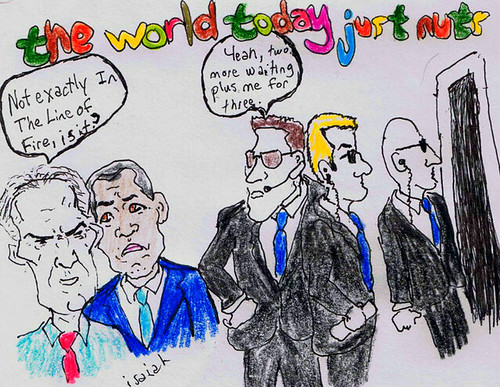
Isaiah's The World Today Just Nuts "Spring Break Columbia: War On Women Edition"


spring break columbia war on women edition

Saturday, "In every episode, there is Ellis" went up.  Bronwyn e-mailed this of Anjelica Huston speaking to Entertainment Tonight of Anjelica Huston discussing Ellis last March,  "He's a little snake in the grass, isn't he? But a very charming snake. Which is fine as long as he's working for you. But not to be trusted, that's for sure."

Bonnie Raiit's new album?  Kat's "Kat's Korner: Bonnie's got another classic" praises it as Bonnie's best ever.  If you're a fan of music, you should check that out.

You should also check out Ava and C.I.'s latest book review.  They're tackling . . . Carole King.


"Carole King's Conditioned Role and Desire (Ava and.C.I.)" (The Third Estate Sunday Review):
She often makes moments seem real and alive. This is especially true when recounting how she had to battle the state of Idaho in court repeatedly when they attempted to call a private road on her property a public one. Those pages are probably the strongest of the book because they give Carole something to really rage against.

She doesn't rage elsewhere in the book.

Everything's great and everyone's wonderful. She manages that feat of Pollyanna-ism by simply rendering major people in her life invisible. Phil Spector? Carole hated him. They fought bitterly. She fought with Gerry over Phil claiming credit on the songs she and Gerry wrote together. Carole stood up to Phil at a time when few people did. (Cynthia Weil always stood up to Phil.) Now days, Phil Spector doesn't control the music industry. Today, he's infamous for his abuse and torture of Ronnie Spector (the Ronettes lead singer who made the mistake of marrying Phil) and for being in prison currently after being convicted of murdering Lana Clarkson. And despite Carole knowing him and working with him for years in the sixties, he shows up only in a single sentence, "More recently he [Lester Sill] had been the 'Les' of Philles Records (Spector being the 'Phil') and the music supervior of the Monkees' movie, Head."


As this sort of thing happens repeatedly throughout the book, you sort of get the feeling that if she'd spent years in the Philippines with the Marcoses, she'd work in a sentence about Imelda's lovely shoe collection. Or maybe she would have developed a crush on Ferdinand Marcos and written an unbelievable portrait of him the way she has James Taylor?

It's a real shame Carole never slept with 'baby' James. If she had, her romantic and child-like view of him would have died real quick. James can't stand women, he's treated all of his wives poorly, the only ex-girlfriend he doesn't trash is the one who left him (Joni Mitchell) and was smart enough not to cater to him. (The minute you cater to James is the minute you cease to be a person in his eyes.)

Reading Carole's James stories, after you shake off the school girl crush that she can't, you realize she doesn't know a thing about this man she claims to be friends with. She has no insight into him or awareness of him or even fond shared memories unless you're talking memories located in studios and concert halls.


I don't know if I picked the right part for the excerpt.  They really do a thorough review of this book.  It really is something.  Carole writes about domestic abuse in the book (her third husband) and Ava and C.I. point out that no one deserves to be beaten but that maybe someone like Carole needs to explain their role in glamorizing abuse?

(Carole wrote the musics, her first husband wrote the words, to the song "He Hit Me, It Felt Like A Kiss."

I agree with them, that's something Carole should have addressed the issue.  She didn't.

If you read the amazing piece Ava and C.I. wrote, you will be blown away.  They really capture everything about the book in that review.

"Iraq snapshot" (The Common Ills):
Monday, April 16, 2012.  Chaos and violence continue, Nouri's latest power-grab gets a little attention, Moqtada al-Sadr joins the list of people publicly rebuking Nouri, Bloomberg News warns that what everyone's watching Nouri do isn't even the half of it, and more.
 
 
In a new interview, Jane Arraf (Al Jazeera -- link has video and text) has asked Iraqi President Jalal Talabani about charges that Prime Minister and thug Nouri al-"Maliki is on the road to becoming a dictator" and Talabani denied the charge and stated, "There are some shortages -- it is not only him responsible.  I am also responsible.  I am responsible for looking after everything to guard the constitution.  I must also speak, so we are all responsible for the shortages in the government."  Well then Talabani needs to start exercising some responsibility and do so very quickly.
 
Yesterday Farah al-Haidari and Karim al-Tamimi were released from jail as was expected -- AFP reported Friday that they would "be jailed until Sunday, a fellow commission member told AFP."  As noted in Friday's snapshot, last Tuesday the UN Secretary-General's Special Envoy Martin Kobler was praising the Independent High Electoral Commission to the United Nations Security Council and discussing how important it was to the upcoming provincial elections next year and then the parliamentary elections scheduled for the year after. So news that Nouri's had two members of that commission arrested on Thursday, as reported in real time by Raheem Salman (ioL news), was startling and alarming. Karim al-Tamimi serves on the commission while Faraj al-Haidari is the head of the commission. 
 
How outrageous were the arrests?  Saturday, Al Mada reported that Moqtada al-Sadr declared that the arrests were indications that Nouri al-Maliki might be attempting to delay the elections or call them off all together. He makes it clear that the the arrest needs to be based on eveidence and not on some whim of Nouri's and that it shouldn't be done because Nouri desires to "postpone or call of the election."   Xinhua reported, "The government in Iraq's northern semi-autonomous Kurdistan region said Saturday that it has called on the central government in Baghdad to release the electoral commission's head and another member arrested on corruption charges." The Oman Tribune notes that the KRG issued the following statement on Friday: "The decision of the authorities in Baghdad to issue a detention order against Faraj Al Haidari and Karim Al Tamimi amounts to a gross violation and dangerous infringement of the political process. Such a decision is targeting the independence of the electoral commission ... We call (on the authorities) to reconsider the detention order immediately and refrain from persisting in insulting the democratic operation."  As Mohamad Ali Harissi (AFP) observed, "Key political factions accused the premier of moving towards a dictatorship with the arrest of Iraq's electoral commission chief, a charge the prime minister denied on Saturday."  W.G. Dunlop (AFP) quoted Iraqiya MP Haidar al-Mullah stating, "When the head of the independent electoral commission is being targeted, it means it is a message from the one who is targeting him that he is above the law and above the political process. The one who is standing behind this is the head of the State of Law coalition (Maliki), because he wants to send a message that either the elections should be fraudulent, or he will use the authorities to get revenge on the commission. This arrest is an indication that the judiciary has become an obedient tool in the hands of Mr Nuri al-Maliki."
 
Al Rafidayn explained Nouri al-Maliki released a statement Saturday decrying those who doubted the arrests were sound. The Baghdad court that Nouri controls made no attempt to even pretend to be impartial or about justice.  The Supreme Judicial Council announced yesterday that Faraj al-Haidari had used UNHCR money to purchase plots of land and that he will face a seven year prison term for those actions.  AFP spoke with al-Haidari after his release and he explained the charges are related to approved one-time bonuses for five employees of amounts between $80 and $125 (US equivalent). One-time bonuses to five employees. And he tells them this case was previously dismissed by the court but the State of Law MP bringing the charges filed an appeal. From the article:

He said that Hanan al-Fatlawi, an MP from Prime Minister Nuri al-Maliki's State of Law coalition, had pursued a large number of complaints against IHEC that eventually wound up with the Iraqi judiciary.
"For the last 6 months... the judiciary was sending warrants of investigation every day to the employees," Haidari said.

State of Law is the political slate that Nouri al-Maliki heads.  Tim Arango (New York Times) points out, "Mr. Maliki has sought for two years to consolidate control over the electoral commission, whose independence is viewed as essential in ensuring that Iraqi elections are free from fraud, vote rigging and interference from political parties. Mr. Maliki's critics say the effort is a part of a pattern of power grabs -- his near total takeover of the security forces, a recent attempt to exert influence over the central bank and politically motivated arrests under the pretext of thwarting coup plots. And it reinforces a narrative that Mr. Maliki is emerging as an authoritarian leader in the wake of the American military withdrawl."
 
Meanwhile the editors of Bloomberg News note that the very visible power grabs aren't the end of the story:
 
More quietly, Maliki's government is pursuing worrisome measures that are potentially of greater long-term importance, as it crafts rules that will govern the new Iraq into the distant future.
These laws, regulating such things as mass communications and political parties, are necessary. Unfortunately, as detailed in a report by the Canada-based Centre for Law and Democracy, the versions drafted by Maliki's government for parliamentary approval would unreasonably hinder freedom of expression, assembly and association.
The Internet Bill provides for life imprisonment and heavy fines for offenses such as publishing information about the manufacture of "any tools or materials used in the planning or execution of terrorist acts." It sounds reasonable, but the measure could cover articles about the making of ink, paper, computers, guns, knives, or just about anything. An individual can be heavily fined or jailed for life for using a computer or information network to harm the reputation of Iraq. Similar laws elsewhere -- Turkey's infamous Article 301, for example, which made it a crime to "insult Turkishness" and a successor law that bars insulting the Turkish nation -- have inevitably led to dubious prosecutions and infringements on human rights.
 
 
And on to more violence.   AFP notes that an Iraqi man apparently exploded his own Saadiyah home in the midst of an Iraqi military raid on the house -- in addition to his own life, the explosion killed 4 members of his family.  In other violence, AP reports that 4 Shi'ite famers were shot dead today in Rashidiyah. ioL News notes yesterday saw a Taji home bombing which claimed the life of both parents and their five-year-old son ("a two-year-old girl survived but was wounded"), a Kirkuk car bombing claimed 1 life and left eleven people injured and a roadside bombing outside Nawafei village claimed the life of 1 man who was the son of a Sahwa leader. Margaret Griffis (Antiwar.com) notes other Sunday violence included a Wadi Hajar bombing which claimed the life of 1 police officer (three people injured), a Baghdad sticking bombing targeting a dentist claimed his life, 1 Shabak was shot dead in Mosul, 1 suspected assailant was shot dead by Mosul police, a Tuz Khormato home invasion claimed the life of 1 Iraqi soldier, 1 former government official was shot dead in Buhriz, a Gatoun bombing injured a woman and her daughter, a Tikrit bombing injured a police officer and "The body of the deputy major of Suleimaniya was discovered hanged in his jail cell. The family of Zana Hama Saleh insisted that he would not have committed suicide because he said he was awaiting release. No evidence of forced suicide was found. Saleh was detained on corruption charges." Alsumaria adds that a street cleaner was shot dead outside Tikrit.
 
 
On this week's Law and Disorder Radio -- a weekly hour long program that airs Monday mornings at 9:00 a.m. EST on WBAI and around the country throughout the week, hosted by attorneys Heidi Boghosian, Michael S. Smith and Michael Ratner (Center for Constitutional Rights), the hosts explored the topics of security, the law, the benefits, for whom, etc. with  attorney and professor Natsu Taylor Saito who has written Meeting the Enemy: American Exceptionalism and International Law.  In the section we're about to excerpt, they have been discussing the move to punish people for their perceived power, to silence a dream by silencing them.
 
 
Heidi Boghosian: There's -- There's so many names of individuals in this condition.  Russell Maroon Shoatz also a former Black Panther who's been incarcerated I think almost 40 years but half of that has been in solitary confinement at SCI Greene in Pennsylvania.  The reason they give there is that they're afraid that, at the age of seventy almost, that he will be seen as a leader, a political leader who will inspire other inmates to resist.
 
Natsu Taylor Saito:  Yes.  And what we're seeing is back in the 60s and 70s when they were targeting political activists -- when the federal government was targeting political activists -- it was clear that they were identifying people because of their ability to influence others.  Like Fred Hampton, for example.  Killing Fred Hampton was very significant because he was being effective in mobilizing a true rainbow coaltion -- not because he was a Black separatist or, you know, whatever.
 
Heidi Boghosian:  Right.
 
Natsu Taylor Saito: But they were always pretending like that's not what it was about.  And now they're coming out and being quite blatant, right?  Your ideas, your ability to have what some of us would consider a positive influence on other inmates or young people who are incarcerated makes you dangerous and therefore we will impose these conditions.   And that's really sort of the trend I see generally with so much of what has been happening recently is the taking of these political suppression techniques that were at least covert in the 60s and 70s and bringing them out, normalizing them, legitimizing them in their framework.  You know, making them technically legal and pushing one step further each time  with the PATRIOT Act, the Defense Authorization Act  this time.  You know, taking these types of COINTELPRO measures of spying on people and putting in informants and falsely accusing and arresting people and even assassinating people.  We see that all being out in the open.  And I find that particularly frightening that there seems to be acquiescence with that process.
 
 
Heidi Boghosian:  We've seen it with the establishment of communications management units in which individuals such as Daniel McGowan, who was an animal rights activist, has been basically locked away, kept out of communication from others and it does seem that even in those movements that have emerged in the last, you know, 15 or 20  years, those techniques that you described are now routinely now applied to target leaders or charasmatic individuals who have a demonstrated track record that they can work to effect change.
 
 
Natsu Taylor Saito:  Yes, it's like you are not allowed to be an effective communicator of the so-called wrong ideas.  And even if we look at Lynne Stewart's case, right?  They tagged her with terrorism offensives for facilitating a communication that everybody can see had no actual effect.  But it was a communications restriction on her client that ended up getting her convicted.
 
Michael S. Smith: Yeah.  She issued a press release and, for doing that, they put her away for ten years.
 
Natsu Taylor Saito:  Mmm-hmm.
 
Michael S. Smith:  And ironically, the person whom she was representing, his movement looks like it's coming into substantial power in Egypt.

Natsu Taylor Saito:  That is interesting.
 
Michael S. Smith:  I read a very good article that you wrote some years ago after the US PATRIOT Act was passed and one of the questions you posed, talking about homeland security, and you said, "Whose homeland and whose security?"  That was seven years ago.  Can you bring that up to date and ask that question again?
 
Natsu Taylor Saito:  Yes.  I think that really is becoming more and more clear.  And it sort of ties back to some of the themes of this notion of American exceptionalism.  You know, who is the American that's supposed to be so exceptional?  And what is the America that is supposed to be so exceptional?  I really see that reflected -- sort of frighteningly -- across the political spectrum.  Like, I think in campaign rhetoric of the Republican primaries right now you see this constant reference to America being exceptional and we want to bring the country back to what it was and it's like whose country are they talking about?  And who are they excluding?  And it's fairly clear that they're not talking about people of color, they're not talking about poor people -- any of these other groups though sometimes they claim to be populist.  But we also see it with the Obama administration authorizing of assassinations and indefinite detentions of American citizens.  Well which American citizens are we talking about?  And are they more secure?  Are any of us more secure when this all rest on some secretive executive branch decision?  And even with movements that seem to have, in many ways, wonderful political potential -- like the Occupy movement -- there is a sort of homogenizing of who it is we're talking about.  And one example that will probably make your listeners hate me is in Denver there was an effort made by folks in the American Indian Movement and the community here in Denver to get the Occupy folks to acknowledge that -- there has to be acknowledgment of the fact that this land was taken from American Indians and that American Indians still have a right to self-determination -- not to just be lumped into 'we all want a share of this ill gotten pie,' right? But when that was taken apparently to the national movement, it was resoundingly rejected as being divisive.  And, to me, that illustrates this notion that we get to define who's American and then then we get to propose a course of political action on their behalf.  But each of these sectors has exclusionary definnitions of who's an American.  And I find that really troubling.
 
Heidi Boghosian: Natsu, going back to your book Meeting the Enemy: American Exceptionalism and International Law, I think it's been a year since we've had you on to talk about that and we've been disappointed with President Obama's record: the invasion of Libya, other military actions, you've referenced some of our policies.  But what's your take on what we're facing in the next year or so?  What are the repercussions from our ill gained military power?
 
Michael S. Smith: Selectively applying international law.
 
Heidi Boghosian: Right.
 
Natsu: Yes.  I think that that's a really major problem.  And that's a lot of what I was talking about in there, this sort of selective reliance on international law.  It's -- One of the misperceptions, I think, is that the United States doesn't care about international law.  In fact, it utilizes international law heavily in certain arenas.  For example, for preventing people in poor countries from getting access to drugs that US pharmaceutical companies have patents on and they're protected by certain intellectual property agreements.  But on the other hand being willing to flaunt international law rather dramatically.  And I think the invasion of Libya is a good example of that.  Of going into another country that is in a certain state of political turmoil and essentially moving in to assassinate its leaders.  I think the assassination of Osama bin Laden falls in that category.  These are things that are being justified based on the personal characteristics of these individuals which is very dangerous.  It violates long-standing international law on both state sovereignty but also the way in which political participation and true democracy is supposed to be working -- which the United States claims to be promoting.  If you can go in and assassinate those indiviuals that you don't like, that completely throws out of whack international law in terms of the state relations.  But also it sets up the precedent that anybody we don't like, we can just assassinate rather than giving due process of law to.  I find that setting a very frightening precedent.  And I think the renewal of the drone strikes in Pakistan is another good example of that. I don't think international law -- as it exists -- allows those kinds of measures.  I don't think the United States would begin to argue it was legal if it was at least half of the rest of the countries of the world doing it.  And it undermines the entire system in a way that really says "might makes right."  And that's a dangerous position for everybody right now -- in the world -- but it's also dangerous for the United States because there's no assurance that the United States will always be the most powerful country in the world.
 
 
Staying with radio, the latest broadcast of Correspondents Report with Elizabeth Jackson (Australia's ABC -- link is audio), finds Stephanie Kennedy in DC  visiting the section of Arlington Cemetery where the fallen from the Iraq War and the Afghanistan War are buried. Excerpt.

Stephanie Kennedy: They died on the battlefields in dusty deserts and on unforgiving mountains on foreign soil. But their final resting place is here, in the rolling meadows of Arlington Cemetery. Tucked away in a pocket of this hallowed ground is what's become known as "The Saddest Acre in America." Section 60 is in the south-east part of this vast cemetery. It's the burial ground for more than 800 American soldiers killed in Iraq and Afghanistan. Cemetery officials have very strict rules about adding decorations on gravestones here but, in this little corner, they've turned a blind eye. And the manicured grounds are the same as is the perfect symetry of the headstones. But what's different here is the personal touches left by the families of the fallen. Mementos of lives lived adorn many of the graves: laminated photographs of soldiers in uniform in happier times, with families and wives and fiancees, there's childrens' drawings, and even a can of tobacco on one grave, unopened beer bottles and with Easter came chocolate eggs and balloons. And here's a stuffed bear -- he's actually fallen over so I'll just prop him back up. It's actually -- It's actually a little Easter bunny -- or a big Easter bunny. There are cards and letters too. This one reads: "Beloved son, your smile lit up our world. Life is not nearly so bright without you. We love and miss you so much."
 
Finally, earlier this month, the US Justice Dept announced charges against a Home Depot in Arizona asserting that they had violated the Uniformed Services Employment and Reemployment Rights Act (see "Home Depot fires people for being deployed?"). The law firm of Boyle, Autry & Murphy have filed suit against the Pennsylvania Department of Corrections over their treatment of the firm's client Iraq War veteran Bryan Kubic:

 
Master Sgt. Bryan N. Kubic fought for his country for 23 years, but now is forced to battle his state government. With the help of Attorney Devon M. Jacob, Kubic is seeking civil relief after being harassed, criminally charged and wrongfully terminated from his employment by individuals at the Pennsylvania Department of Corrections (DOC).
The disturbing story began in 2010, when Tammy Ferguson became the DOC's chief of security. Ferguson continually harassed military personnel - including Kubic - about current and past requests for military leave. As a result, Kubic requested a transfer to a prior position he held at the DOC Training Academy.
Upon seeing the request to transfer, Ferguson called Kubic a "coward" and denied his request. She scolded him, saying that the "U.S. military does not trump the DOC." Kubic - who was awarded the Combat Infantry Badge while serving in Iraq - continued following DOC protocol for military leave requests, and Ferguson escalated her harassment by launching a criminal investigation into Kubic's military leave use history. Knowing he was in the right, Kubic waived his Miranda rights and voluntarily submitted to an interrogation by DOC investigator Stephen Allen.
Kubic provided evidence demonstrating that he was either on military duty or at Veterans Affairs (VA) medical appointments during his times of leave. Regardless, Allen brought criminal charges against Kubic for theft by deception and receiving stolen property, and Ferguson suspended Kubic's employment.
At a preliminary hearing on the charges, investigator Allen admitted that he had no evidence to establish that Kubic was not performing military duty during the times in question. Both charges were eventually dismissed and this story should have ended. Sadly, it did not.
Ferguson continued an extrajudicial campaign aiming to terminate Kubic's employment with the DOC. Kubic battled the disciplinary charges, providing the DOC with evidence convincingly demonstrating his military service on the dates in question and his compliance with DOC military leave directives.
In spite of the evidence clearly showing Kubic's proper and legal use of military leave, Ferguson terminated Kubic's employment. Perhaps Ferguson believed she had won the final battle of her personal power struggle over the DOC employees' ability to serve in the military. Regardless of Ferguson's motives, Kubic wants to see justice prevail, so that military personnel can freely work at the DOC without suffering unlawful discrimination.
"When you serve your country, you don't expect to be treated differently than anyone else," Kubic told CBS 21 news.
Kubic has teamed with Attorney Jacob of Boyle, Autry & Murphy to bring a federal civil rights lawsuit against Ferguson, Allen and one other DOC employee responsible for the charges unfairly leveled against him. The case, Kubic v. Allen, et al., is pending in the United States District Court for the Middle District of Pennsylvania.
The decorated war veteran - who is not suing the DOC itself - hopes to see Ferguson terminated for her abhorrent behavior. Kubic, who suffers from post-traumatic stress disorder (PTSD) as a result of his military service, is also seeking financial compensation for the psychological and financial harm caused by the criminal charges and the unlawful termination of his employment.
Kubic's disturbing story demonstrates the importance of the American civil justice system: Without the power of a civil lawsuit, Ferguson would have dealt the final, damaging blow to Kubic's reputation and livelihood.
With his day in court, Bryan Kubic will have an opportunity to clear his name and ensure that justice is achieved. Kubic has suffered irreparable harm to his reputation - something that money can't fix - but he believes that when he prevails in federal court it will help to guarantee that military personnel receive the equal treatment and respect that they deserve.


Saturday, April 14, 2012

In every episode, there is Ellis

I'm tired and not in the mood for the news.  So I'm just going to blog about Smash and hope that's okay.  It's a weekly show that airs Mondays on NBC.  It's about a group of people trying to put on a show.

However, this is no Mickey & Judy look at us have fun project.  (Rooney and Garland.)
Instead this is a group of cut-throat people who will backstab to get the project made.

Anjelica Huston plays Eileen who is trying to produce the play despite limited funds due to a divorce and an angry would-be ex who has frozen their funds.  Debra Messing plays Julia, the lyricist who apparently also writes scenes.  Her partner is Tom who writes the music.  Katherine McPhee plays Karen who auditions to play Marilyn Monroe in the musical (now called "Bombshell") and despite being tremendously qualified, she gets shoved into the chorus and the too broad (in acting and physique) Ivy gets the role instead.  Jack Davenport plays the director Derek.  He propositions Karen and she turns him down.  He's no longer interested in her for the role.  Ivy doesn't turn him down and she gets the role.

The workshop is a joke.  They fire the guy playing Joe DiMaggio.  Why?  Because Julia slept with him.  That's it.  He was not the worst thing.  But married Julia renewed her affair with Michael and so she and Tom both insist he be fired.  Derek rightly notes that Ivy is the weak link.  Eileen obviously agrees because she and Derek ask Karen to work on a new number.

Ivy is the weak link.  She's an obvious choice for Marilyn which is why she's all wrong.  She doesn't bring anything to the role other than what is already visible.  She also lacks sex appeal, as Derek has pointed out.

Ivy screws herself over by going onstage in the chorus of Tom's other play Heaven On Earth and doing so while she's drugged.  She loses that role and damages her reputation so badly that she can't get hired by anyone else.

If you haven't already checked out the show, hopefully, the above recap interests you.  Uma Thurman joined the cast (for a few episodes) last Monday as a movie star they want to play Marilyn. 

In every episode, there is Ellis.


 Anjelica Huston and Ellis

That's Ellis, played by Jaime Cepero, watching Eileen.  It's precisely Ellis as he should be captured, always watching, always calculating.

In the first episode, Ellis showed up as Tom's new assistant who was making Tom's life so easy and simple.  Tom's returning home and Ellis already has everything set up to make for an easy return.  Julia takes an immediate dislike to him and his fixing comfort foods for Tom.  Julia and Tom are talking about writing a new musical -- really about not writing one.  Ellis says that they should do one on Marilyn Monroe.  Julia dismisses the idea and Tom's not really interested.  Then Tom thinks about it and decides it's a good idea and convinces Julia.

Ellis thinks he has a right to the musical as a result of his limited input.

He hates Julia -- who fired him as Tom's assistant until Tom hired him back -- and can't stand her.  When he discovered her affair with Michael, I thought for sure he would out her.  But by then he was already angling to be important to Eileen.  He's now become Eileen's assistant.  He 'forgot' to inform Tom.  But how stupid is Tom?

Ellis is his personal assistant and Ellis is at Eileen's office every day for at least two days.  Shouldn't his boss Tom be aware of that?   At the very least that Ellis isn't showing up for work?

Tom's such an idiot.

So Ellis got Rebecca (Uma Thurman) for the play and he now wants to be a co-producer.  Eileen laughed at the idea two episodes ago but last week seemed more open to it.

Ellis is the Eve (as in All About Eve). 

You'll love him, you'll hate him.  You'll marvel over how he'll stab anyone in the back to advance, how he'll sleep with anyone to advance.

When he first showed up, I thought he was gay.  I ended up surprised when he was apparently sleeping with a female roommate.  Then, to get Rebecca for the musical, he sleeps with her male agent.

Who is the real Ellis?

He's played it dumb.  When a video of a Marilyn number showed up online, it was Ellis.  Julia fired him for that.  He explained he didn't leak it to anyone, he just mailed it to his grandma (or mother, I forget).  Tom felt sympathetic for him.

But I think Ellis leaked it.  I thought that then and think it now.  I also believe we don't know the half of what Ellis is capable of or what his actual background is.


I wouldn't be surprised if the season finale has a great deal to do with Ellis. 

I don't do comments at this site.  This goes back to the issue that came up with The Common Ills.  Keesha is one of the community members present from the start.  Back then, TCI allowed comments.  Keesha objected because, as an African-American woman, what she experienced at other sites were dog piles from various White commentators.  C.I. said if that happened, comments would be shut down.  Blue dog Democrats piled on to Keesha who was apparently too left for them.  C.I. closed the comments and that's how they've stayed.

I've followed that.  But the season finale will be here next month and I'm offering my guess.  A lot of e-mails come in on Smash.  If you'd like to leave a season finale guess, a comment on the acting or the writing or anything Smash-related, feel free.  I'm allowing comments on this post.

By the way, if you're an Ivy fan, please feel free to leave praise for the character.  I have avoided naming the actress in my criticism because I'm critiquing the character.

Ivy has many supporters and fans.  If you're one of them, feel free to sing her praises below.  Oh, also, if you have an opinion on the love triangle of John-Tom-Sam, feel free to leave that as well.  I am strongly in favor of John and think Tom's treated him horribly.  If you disagree, your comment and opinion is as valid as mine so feel free to say so.  (I also think Tom would be better paired with Derek, based on two episodes ago.  He has no chemistry with Sam or John.) 


"Iraq snapshot" (The Common Ills):

Friday, April 13, 2012. Chaos and violence continue, Nouri's power-grab leads to more arrests, Nouri's 'promise' not to seek a third term is ignored as a third term is pushed, pilgrims are attacked in Iraq, and more.
As a friend who covers Iraq (but isn't there currently) said of the big news today, "You could say the s**t hit the fan but it seems to do that every week now since US forces left." Since most US forces left. And that's not an argument on my part for the US to send in more troops. It is noting that both Bush and Barack bear responsibility for the problems in Iraq because both administrations supported Nouri al-Maliki. Even after his secret prisons were known, even after the torture was known, even after he consolidated control of the security forces, even after he was rejected by the voters, the White House backed him in 2010. The election results meant that Iraq could have been freed of the US-installed tyrant. But Barack Obama decided to back Nouri. Despite the will of the Iraqi voters as expressed in the March 2010 elections.
Well's it's hit the fan again. Repeatedly today. For context, let's drop back to Tuesday when UN Secretary-General's Specail Envoy Martin Kobler was telling fairy tales to the United Nations Security Council. US Ambassador to the UN Susan Rice presided over the meeting.
Martin Kobler: Madam President, it goes without saying that there can be no democracy without free, fair and competative elections. This makes UNAMI's work to provide election support all the more important for consolidating democracy in Iraq. At the request of the Council of Representatives [Parliament], UNAMI has been serving as advisor and observer in the selection process of the board of commission of the Independent High Electoral Commission before the expiration of the current board's term this month. The participation of UNAMI and the NGOs in the selection process is a clear sign to ensure transparency in the process. The final vote and selection of the nine new commissioners -- which was expected by the end of this month -- is unlikely to take place. However, in order to avoid delays in the upcoming elections in the Kurdistan region in September and the provincial elections in early 2013, the Council of Representatives is encouraged to extend the mandate of the current board of commissioners to enable it to initiate preparations for the conduct of those polls.
Oh, what pretty little words. Oh, what pretty little fantasies. Dropping back to yesterday's snapshot:

In more dist[ur]bing power-grab news, Raheem Salman (ioL news) reports, "The head of Iraq's Independent High Electoral Commission (IHEC) and one of its members were arrested by police on Thursday on corruption charges, IHED officials said, in the latest apparent move for more government control of independent bodies. Iraq's Prime Minister Nuri al-Maliki won a court ruling in January 2011 that put the IHED and other entities, including the central bank, under cabinet supervision, raising concern over attempts to consolidate power by the Shi'a premier."
Yes, two arrested. Two arrested who were supposed to oversee the upcoming elections in the KRG and in the rest of Iraq. These are provincial elections. The last ones were in 2009 (early 2009 for the bulk of Iraq, the summer for the KRG). And there are no new commissioners in part because UNAMI couldn't get its act together. And now Nouri's arrested two of the commissioners whose terms were supposed to carry over for these upcoming elections.


AP notes that the two are Karim al-Tamimi and the commission's chief Faraj al-Haidari. Yeah, the chief of the commission. Kind of important role, kind of an important person. He and Nouri have a history, of course. Nouri's angered pretty much everyone -- even erstwhile ally Motada al-Sadr -- in his too-long reign. Reuters observes, "Critics fear that the premier may be showing autocratic tendencies in some of his actions and view Maliki's control over key security ministries with suspicion." AFP does a service by explaining the history behind what went down, "There is bad blood between Haidari, a 64-year-old Shia Kurd, and Iraqi Prime Minister Nuri a-Maliki's State of Law list over his refusal to carry out a national recount after 2010 parliamentary polls, in which the premier's list came in second to rival Iyad Allawi's Iraqiya list."
For those who've forgotten the March 2010 parliamentary elections, they played out like a little psy-ops operations -- in fact, you have to wonder if the US government just provided support on that or if they actively devised the plan?
Nouri is the head of Dawa. It is the political party he belongs to. They are Shi'ites. They had all these plans for the 2010 elections but they hadn't done well enough for Nouri in 2009 (provincial elections). Nouri misread the 2009 results. Dawa wasn't the big problem. The big problem was sectarianism. Iraq's rejected it. That's why a number of sure-thing pre-election announcements were revealed as empty gas baggery once the ballots were counted and the tallies released.
But Nouri lives in a bubble where he convinces himself that he's the fairests of them all and that his enemies are evil Snow Whites. He convinced himself that Dawa was being rejected because, unlike himself, they weren't 'strong.' He was the Iraqi strong-man who had restored order and surely the people loved him for it right? No, he's never been popular with the Iraqi people. In 2006, the US imposed him on Iraq to prevent the popular choice from becoming prime minister.
Convinced that he and he alone knew the right thing to do, he refused to run with Dawa and instead invented State of Law, a political slate headed by him, a slate whose very name would trumpet his 'accomplishment' of ruling Iraq with an iron fist.
A new slate emerged to rival him: Iraqiya. Ayad Allawi is the head. He might not have been the original head. That's not meant as an insult to him, that's just noting that a number of members of Iraqiya were forbidden by Nouri al-Maliki's Justice and Accountability Commission from running. They were (prepare to shudder) terrorists!
Or that's what Nouri and his cronies insisted. Strange, some of them were members of Parliament but now were accused of being unrepetant Ba'athists plotting the return of the Ba'ath Party. Were that true (it wasn't), why not make your allegation and let the people decide?
Probably because Nouri grasped that even the Ba'ath Party was more popular in Iraq than Nouri was. Al Jazeera did their last good reporting on the political issues and divisions with regards to the February and March 2010. They probably had to. The bulk of their viewers are Arabs. Arabs around the world have been outraged by Nouri's actions -- a fact that the US press doesn't like to inform you of. Which is how you get garbage like, most recently, "The Arab League Summit in Baghdad was a huge success!" followed by the whisper of, "Except none of the leaders of major Arab states attended."
The Arab world has seen a very different war than the US has and that includes not just who gought and who died but also the political policies and witch hunts that the US press has largely ignored. The US press pretends that Arab fighters cross over into Iraq to be part of al Qaeda in Mesopotamia and they site the anti-Arab SITE (run by the discredited Ritz Katz) as 'proof' for whatever false claims they make. Soemtimes they get honest enough that a few US outlets will say "al Qaeda linked" as opposed to declaring them "al Qaeda." It's all b.s. and nonsense. Arab fighters enter Iraq, throughout the long war and ongoing occupation, for one reason only: They preceive their Arab brothers and sisters to be victimized in the 'new' Iraq.
And they have that perception because that is what has taken place and what is taking place. The US press deludes Americans into thinking something puzzling took place when what happened is the most natural and obivous reaction and, if you remove the heightened term 'al Qaeda,' you have the story of every invasion and every response to it throughout history. But they want to play dumb and pretend that something puzzling and new and never-before-seen is taking place.
No such thing is or has happened.
In fairness to Shi'ites in Iraq, they lived as an oppressed people for years. It's very rare that an oppressed people learns from the experience. (A modern exception is South Africa where, after apartheid was finally overturned, the people sought justice and not vengence, equality and not oppression.) Equally true, most Shi'ites aren't taking part in oppressing anyone. Most Shi'ites are trying to go about their daily lives without getting killed the same as the Sunnis and other groupings.
Iraq is a country of widows and orphans. The current war, the sanctions before that and the Gulf War ensured that Iraq would remain a young country because so few people would live to an old age. The median age in Iraq is approximately 20.9 years. Again, it's a very young country age wise.
So all of the past oppressions could be distant enough that the Iraqi people could work together. The thing that prevents that, the thing always prevented that, has been the exiles the US placed in charge of the country.
Too damn scared to fight Saddam Hussein, they fled the country decades ago. Lived in Iran, Syria, England, etc. while they plotted to get other countries to over throw Iraq's president Saddam Hussein.
"Saddam tried to kill me!" Nouri has whimpered when telling his life story to a few members of the press. Yeah, maybe so. But your response was to run like a coward (he'd spend 8 years in Iran alone). Your response wasn't to stand up and fight. You're response wasn't to leave with dignity by making a life another country. You fled like a coward and spent years nursing your hatred. That's what you brought back with you to Iraq. that's all Nouri brought back, a grudge he's picked and nursed for decades. What kind of idiots would ever think someone like that should run a country?

Oh, that's right. The US government.
And not by accident. We commented on Nouri's paraonia months after he became prime minister in 2006. It was obivous to the naked eye. Thanks to WikiLeaks, we now know that as early as 2007, State Dept cables were noting Nouri's paranoia. Nouri was put in charge because he was paranoid. When you install a puppet, you don't want someone with a strong, positive self-image. They're harder to control. Hugo Chavez has a healthy ego. He was not installed by the US and cannot be co-opted by the US government because he doesn't have those inner demons. Nouri does.
With Nouri, the US always knew how to appeal to his vanity, how to prey on his fears. Want something done, tell Nouri that he looks weak, tell him that the Kurds are disrespecting him, feed his inner doubts and he will act.
He haas no core strength and he no ethics or beliefs he stands by. He is nothing but id and he responds not only instinctually but also instantly. That's why he became prime minister and that's why, in 2010, the White House backed him to continue as prime minister. A psychological dossier exits on Nouri and made him the best (meaning most pliable) choice for US interests. (I dispute that conclusion/finding. He accomplishes nothing. If the US government has certain goals that they want achieved via a puppet, they need a puppet who can accomplish something. Instead Nouri's technique of stalling leads to paralysis which is why the US puppet has still not been able to deliver and oil & gas law all these years later.)
The Iraqi people were supposed to be scared of Iraqiya. Members were being purged from the election. (If you were labeled a 'terrorist,' your name was pulled from the ballots.) The political slate was scrambling to find people to run. Nouri controlled state-TV and controlled the message. It should have been a landslide victory for Nouri -- as he was insisting it would be. As Quil Lawrence (NPR) reported the Monday after the Saturday elections (when no ballot totals existed) it was.
It wasn't. The Iraqi people continued the trend of 2009. The parliamentary elections reflected the provincial elections. In most cases, Iraqis didn't want sectarian rule. They were exhausted by it, they were tired of it and they were tired of living in fear (fear being the only thing Nouri had to campaign on).. They rejected it. And they rejected Nouri's State of Law.
Which is why it came in second to Iraqiya. For some reason -- attempts to whore for the US government? -- a number of reporters feel the need to insist that Iraqiya only won a few seats more than State of Law!
So what? It had many, many more votes. Since when do we refer to the voters desires by noting seats and not vote totals?
By votes, which is how the Iraqi people expressed themselves, Iraqiya was the clear winner and the direction the country to go in. Iraqiya, headed by Shi'ite Ayad Allawi, was a mixture of various sects. It was a party that spoke to national identity. They did this by the candidates they put forward, they did it by the spokespeople they put forward. Even now, the most prominent woman in Iraqi politics is the spokesperson for Iraqiya: Maysoon al-Damluji.
State of Law is the past, always refighting old battles, always seeking revenge. Iraqiya was a way forward for the country, representing a national identity ("We are Iraqis") and representing that all were taking part, regardless of sect, regardless of belief or religion, regardless of gender. Iraqiya's message was: "We are Iraq. We are the party of all Iraqis."
And then there was Nouri with his announcements that a terrorist attack would be taking place any second -- trying to use fear the way Bully Boy Bush did in the 2004 US elections.
That's why Iraqiya won despite all the problems they faced -- losing candidates (and that includes their candidates that were murdered in February -- no one killed State of Law candidates), losing the media wars, being outspent (Nouri bribes with potable water at election time, suddenly your village has water when Nouri shows up and he tells you that you will have water after the elections -- of course that doesn't come to be but he's all about the election cycle and not the future).
Iraqiya's victory was a huge victory and the press belittled it with "they only won a few seats more." THe press belittled because the US government was backing Nouri al-Maliki. Imagine if Iraqiya had run against Saddam Hussein and had the same outcome as they did in 2010? You don't think the world press would have been all over the surprise upset? Of course, it would have. But in 2010, the press curbed itself and took a surprise out-of-no-where win and demoted it to "no big deal."
Doing that allowed Nouri to steal the election. He first dug in his heels. He then announced the results of the Supreme Court he controls. Suddenly it was learned that Nouri had brought lawsuits regarding the process oof selecting a prime minister. No one knew about those lawsuits before hand. Damned the court he controlled didn't find in his favor.
There was the issue fo the Constitution but Nouri just ignored it. And dug his heels in creating Political Stalemate I which lasted eight months. During that time, the US and Iranian governments worked together to press everyone to give Nouri a second term as prime minister. The US held no sway over Moqtada al-Sadr but Iran did. So Moqtada's announcement that he would not back Nouri was set aside. The vote Moqtada held in April 2010, where he asked his followers to pick who he should back for prime minister also got set aside. While Iran worked on a number of Shi'ites (and Iran and the US worked on Amar al-Hakim, the head of ISCI), the US worked on the Kurds and Iraqiya. It was time to move forward was the message repeated over and over.
'Look, it's just a four year term. And if you give on this, if you show you're the better person, we will make sure that you receive concessions. In fact, we'll even make sure it's put in writing.'
Hence the Erbil Agreement which ended Political Stalemate I. A document with many concessions that allowed Nouri a second term. He honored the agreement . . . long enough to be established as prime minister for a second term. Then he trashed it and refused to deliver on what had been promised to the other political blocs.
To the Kurds, the promises in the Erbil Agreement covered a number of things but most importantly, it mean the question of Kirkuk would finally be addressed. The Kurds don't consider it disputed territory, they consider it to be their land. That was made very clear by KRG President Massoud Barzani when he spoke in the US last week. And even more so when he took questions on the issue of Kirkuk and the Erbil Agreement:
President Massoud Barzani: Article 140 is a Constitutional Article and it needed a lot of discussions and talks until we have reached this. This is the best way to solve this problem. It's regarding solving the problems of the territories that have been detached from Kurdistan Region. In fact, I do not want to call it "disputed areas" because we do not have any disputes on that. For us it is very clear for that. But we have shown upmost flexibility in order to find the legal and the Constitutional solution for this problem. And in order to pave the way for the return of these areas, according to the Constitution and the basis of law and legally to the Kurdistan Region. And we have found out that there is an effort to evade and run away from this responsibility for the last six years in implementing this Constitutional Article. And I want to assure you that implementing this Constitutional Article is in the interest of Iraq and in the interest of stability. There are people who think that time would make us forget about this. They are wrong. Time would not help forget or solve the problem. These are Kurdish countries, part of Kurdistan and it has to return to Kurdistan based on the mechanism that has been stipulated in the Constitution. And at the end of the day, as the Constitution stipulates, it's going back to what the people want to determine. So there is a referendum for the people of these areas and they will decide. If the people decide to join Kurdistan Region, they're welcome and if the people decide not to, at that time, we will look at any responsibility on our shoulders so people would be held responsible for their own decisions. As far as the second part of your question, the Erbil Agreement. In fact, the agreement was not only for the sake of forming the government and forming the three presidencies -- the presidency, the Speakership of Parliament and premier. In fact, it was a package -- a package that included a number of essential items. First, to put in place a general partnership in the country. Second, commitment to the Constitution and its implementation, the issue of fedarlism, the return of balance of power and especially in all the state institutions,the establishment in [. . .] mainly in the armed forces and the security forces, the hydrocarbons law, the Article 140 of the Constitution, the status of the pesh merga. These were all part of the package that had been there. Had this Erbil Agreement been implemented, we would not have faced the situation that we are in today. Therefore, if we do not implement the Erbil Agreement then there would certainly be problems in Iraq.
The Kurds have been the US government's biggest supporter in Iraq -- that's before the invasion, during the invasion and all the time that's followed. They wrongly thought that meant the US would look out for them and ensure that the Constitution and the Erbil Agreement were honored. They were wrong and they've slowly realized that. They've grasped that the US forever bends to Nouri and that, at present, it has no desire to stop.
That realization -- one that Iraqiya appears to have reached as well -- makes the ongoing political crisis all the more dangerous. And with Nouri now going after the independent commission overseeing elections, things are going to get a lot more dangerous.
An interesting development this week, Al Mada reports that the Islamic Supreme Council of Iraq is accusing State of Law of making the National Alliance less popular with the Iraqi people as a result of the war with the Kurds and Iraqiya. If someone were trying to figure out the reason for this public declaration, two spring quickly to mind. One, ISCI is speaking for others within the National Alliance and attempting to send Nouri a message that he needs to dial it back. Two, ISCI has already made a decision to replace Nouri and these statements are to prepare the public for that soon-to-emerge event. There are other possibilites, we're focusing on those two.

Why might they be concerned enough to be acting out either of the two scenarios? As Al Mada points out, Nouri sent to an independent MP with the National alliance (Ablzona al-Jawad) to the press yesterday to declare that Nouri is the only one who can lead. This is about a thrid term, as the MP makes clear. The third term's not that far away. Elections are now supposed to take place in 2014 -- though it may be 2015 or maybe Nouri will just call them off completely?
Nouri wants a third term. Nouri wants to be the New Saddam, actually. He hopes to go on and on and on in office. How else to keep his corrupts sons and cousins on the payroll? How else to fleece so much from the people of Iraq who live in poverty in an oil rich country while Nouri's own life is "palatial."

Nouri can't just run for a third term. There has to be a roll out. Because as Iraqis began protesting in January against him, against his fabeled "law and order" (they demanded to see their loved ones who'd been disappeared into the 'legal' system), against his corruption, and this took place while other leaders in the region were being challenged and overthrown. The protests in Iraq only grew in size and number. And what did Nouri do?
In March 2011, the New York Times editorial board offered "Mr. Maliki's Power Grab:"
Instead of taking responsibility, Mr. Maliki charged that the protests were organized by "terrorists." He ordered the closing of the offices of two political parties that helped lead the demonstrations.
His only concessions were vows not to seek a third term in 2014 and to cut his pay in half. That was not persuasive, especially given his many recent power grabs.
The press never followed up on the pay cut but how could they? No one knew then and no one knows now how much Nouri legally takes from the Iraqi treasury. But, as the editorial board noted, he did make a laughable claim that he wouldn't seek a third term. He made that claim to Sammy Ketz of AFP which quickly reported it. And other outlets quickly followed suit. But the day after he made that announcement, Ben Lando and Munaf Ammar (Wall St. Journal) reported that Nouri's spokesperson, Ali al-Mousawi, was declaring, "We would like to correct this article. Maliki said, 'I think that the period of eight years is adequate for the application of a successful program to the prime minister, and if he is not successful, he must vacate his place'."
From the February 7, 2011 snapshot:


Of course no one does easy, meaningless words like Nouri. Saturday, his words included the announcement that he wouldn't seek a third term. His spokesperson discussed the 'decision' and Nouri himself announced the decision to Sammy Ketz of AFP in an interview. Ketz reported him stating he won't seek a third term, that 8 years is enough and that he supports a measure to the Constitution limiting prime ministers to two terms.

Well Jalal Talabani declared he wouldn't seek a second term as President of Iraq in an interview and then . . . took a second term. Point, if you're speaking to a single journalist, it really doesn't seem to matter what you say. Did Nouri announce his decision to the people? No,
Iraqhurr.org is quite clear that an advisor made an announcement and that Malliki made no "public statement" today.


In other words, a statement in an interview is the US political equivalent of "I have no plans to run for the presidency" uttered more than two years before a presidential election. That's Iraqi politicians in general. Nouri? This is the man who's never kept a promise and who is still denying the existence of secret prisons in Iraq.
Deyaar Bamami (Iraqhurr.org) notes the Human Rights Watch report on the secret prisons and that they are run by forces Nouri commands.
And Nouri couldn't even make it 24 hours with his latest 'big promise.' Sunday, Ben Lando and Munaf Ammar (Wall St. Journal) reported that Nouri's spokesperson, Ali al-Mousawi, declared today, "We would like to correct this article. Maliki said, 'I think that the period of eight years is adequate for the application of a successful program to the prime minister, and if he is not successful, he must vacate his place'." Of course he's not announcing that. He's a thug. His previous four year term was an utter failure.

That's not speculation, that's not opinion. He agreed to the benchmarks that the White House set. He was supposed to achieve those in 2007. Those benchmarks, supposedly, were what would determine whether or not the US tax payer continued to foot the bill for the illegal war. But he didn't meet those benchmarks and apologists rushed forward to pretend like they weren't a year long thing and that, in fact, he had 2008 as well. Well 2008 came and went and the benchmarks were still not met. Nor were they in 2009. Nor were they in his last year in 2010.

That's failure. When you agree you will meet certain things -- such as resolving the Kirkuk issue -- and you do not, you are a failure. Not only did he fail at the benchmarks, he failed in providing Iraqis with basic services. He failed in providing them with security.

There is no grading system by which Nouri can be seen as a success.

But just as he will not admit to or own his failures from his first term as prime minister, do not expect to own or admit to his failures in his second term. In other words, Little Saddam wants to be around, and heading the Iraqi government, for a long, long time.

And, as 2011 entered its final month, Al Mada reported Nouri al-Maliki's legal advisor Fadhil Mohammad Jawad had stressed to the press that there is no law barring Nouri from a third term as prime minister. And at that moment, the trial balloon was officially floated.
Now we have it advanced even further by a Member of Parliament. And Nouri's arresting members of the electoral commission. And not a word, not a peep from the State Dept or from UANMI or from the United Nations.
It really is something how the world has destroyed Iraq.
We noted a friend at the top explaining how bad things had gotten since the bulk of US forces left Iraq. (Special Ops, 'trainers,' Marines to protect the embassy, the CIA and the FBI remain in Iraq as do thousands of contractors working for the State Dept.)
That was always going to happen, violence and power-grabs were always going to take place after most US forces left. We've argued and advocated for US forces to leave and to leave immediately. Most US forces leaving Iraq is not why you have the problems you have today. The problems you have right now go to Nouri al-Maliki and no one else in Iraq. Nouri is the cause of the problems. And the cause of Nouri is the US government.
The Bush administration demanded he be named prime minister in 2006. The Barack administration demanded he remain prime minister in 2010.
With US forces gone, Nouri no longer has to deal with the US military command. Nouri faced more calls for equality and fairness from US General Ray Odierno than he ever did from US Ambassador to Iraq Chris Hill. Odierno put pressure on him. And, yes, he could do that in part because he had forces Nouri needed the influence of. So those who want to say Iraq might be better off with a larger number of US forces on the ground may be right in the short term -- but that would also require having DoD in charge of them. Because Odierno did not represent the State Dept. And Barack has put the State Dept in charge of all operations in Iraq.
But possibly, for the short term, Iraq would be more peaceful right now -- at least in terms of the political process -- if a larger number of US forces were on the ground in Iraq and under DoD command. However, the struggle taking place currently would still take place at some point because US forces would have to leave at some point.
The mistake the US made after the initial mistake of starting an illegal war was to then go on and back Nouri al-Maliki whom the US government knew was deranged but thought they could control. "Control" not to protect the Iraqis, mind you, but control in terms of use him to influence Iraqi policies -- especially with regards to energy. That selfish choice (and idiotic one because Nouri can't influence anything, that was evident by 2007 if you paid attention) has doomed the Iraq people in the current situation that they're in. Barring a no-confidence vote the only hope Iraq has is the 2014 elections (if they take place) and, even then, you're asking Iraqis to risk violence to vote four years after they did just that and the US refused to respect their vote, the US refused to recognize their vote and the US government instead insisted that the losing political slate get to hold onto the post of prime minister.
Iraq today is a story of violence inflicted upon the average Iraqi by the US government and by puppets of the US govenrment. Reuters notes an armed attack on a bush of pilgrims headed to Samarra which left 5 dead and six injured and an armed attack on pilgrims headed to Kerbala which left 2 of them dead and six more injured. Alsumaria reports that 1 soldier was shot dead today in Mosul.
In the US, Senator Patty Murray is the Chair of the Senate Veterans Affairs Committee. The Committee notes:
Committee on Veterans' Affairs
United States Senate
112th Congress, Second Session
Hearing Schedule
Update: April 12, 2012
Saturday, April 21, 2012
10:30 am MST
2465 Grant Road
Billings, Montana
Field Hearing: Improving Access to Quality Health Care for Rural Veterans
Wednesday, April 25, 2012
10 am EST
Senate Dirksen Office Building Room 138
VA Mental Health Care: Evaluating Access and Accessing Care
Matthew T. Lawrence
Chief Clerk/System Administrator
Senate Committee on Veterans Affairs
202-224-9126

Thursday, April 12, 2012

Ann Romney

I do not post on Thursdays. I do group. I'm exhausted after.  (I'm a psychologist.) 

Tonight was no different.

But you're getting a tiny post from me.

Ann Romney? 

She didn't deserve to be insulted or attacked.

For Hilary Rosen to state that Ann Romney has never worked a day in her life went far, far beyond, "I should have said 'worked outside of the home'."

The silence from Women's Media Center wasn't at all surprising.  They really didn't do much to help women in 2008 as sexism paraded openly through the streets of America.

I am left. I am a feminist.

Hilary Rosen's remarks have no place in the world of feminism.

C.I. covered this so brilliantly in the snapshot.  Mike was telling me about it and I thought, "Oh s**t!"

Because I knew I'd have to get on the computer and read it now (as opposed to tomorrow when I've had some rest) and I knew I'd have to post.

C.I. is a strong voice because she stands up when it matters.

There's no way I'm leaving my friend standing up all alone.  She's right and feminists better start making it clear that it is wrong to do what Rosen did to Ann Romney -- wrong and unacceptable.


"Iraq snapshot" (The Common Ills):

Thursday, April 12, 2012.  Chaos and violence continue, the political crisis continues, gential mutilation gets some attention, a mayor's killed in Iraq, Barack Obama gets praise (yes, praise from me), and more.
 
US President Barack Obama did a good thing today.  We're going to start on something other than Iraq.  The reason being US President Barack Obama did a good thing today and a White House friend I was speaking to on the phone a little earlier said, "You won't mention it, you never mention anything nice" about him here.  Not only will we mention it, we'll open with it.  The following appeared here this morning:
 
Hilary Rosen is a corporatist who has done very little for anyone except herself. She's also a lousy spokesperson for the Democratic Party due to her previous lobbying for the RIAA. But that's their problem. And I wouldn't be weighing in were it not for nonsense Dylan Byers (POLITICO) reports:


Democratic strategist and DNC adviser Hilary Rosen took a swipe at Mitt Romney's wife on CNN tonight, claiming that Ann had "never worked a day in her life" — a statement that led to criticism on Twitter from not just Ann but from the Obama campaign as well.
"I made a choice to stay home and raise five boys. Believe me, it was hard work," Ann wrote in response to the comments Rosen made earlier in the evening on CNN's Anderson Cooper 360.

Hillary Rosen owes Ann Romney an apology. She owes all American woman an apology. A stay-at-home mom is not a woman on extended vacation. It is work, it is tremendous work. Those of us in the feminist movement -- apparently that does not include Hilary Rosen -- are aware of that and made a point to note that from day one. The media -- especially bad TV shows written largely by men like the awful 30-something and Everybody Loves Raymond -- like to invent this split where feminists sneer at home makers. That's not reality. "The Politics of Housework" by Pat Mainardi was not decrying the fact that women had extra hours of leisure. It was noting the very real work required to run a home.

Ann Romney made a choice on how to live her life and was fortunate enough to be in a position to make that choice (all women aren't so fortunate -- some are single-mothers, some have economic issues that prevent such a choice). There is nothing wrong with her choice or with her life as a mother. If she had decided to be a mother who works outside of the home, that would have been a valid choice as well.

Hilary Rosen's statements need to be condemned loudly. She needs to be rebuked. What she said is offensive to all women, regardless of what choice we make or we're forced into. Rosen's remarks are sexist and divisive and I'm not in the damn mood to see the sexism we endured in 2008 flourish again. Those of us who are feminists need to stand together and say, "It's not okay, Rosen." It's not okay, it's not acceptable.

My apologies to Ann Romney that someone who will (wrongly) be seen as a feminist made such insulting remarks. They do not represent feminism and they are not appropriate. I don't know Ann Romney, have never met her, but from the press it would appear she's been very happy with her choice. I'm happy for her.
--------------------------
 
That is from this morning.  Mary Bruce (ABC News -- link is text and video) reports that President Barack Obama has rejected Rosen's comments and stated "there's no tougher job than being a mom.  Anybody who would argue otherwise, I think, probably needs to rethink their statement."  Good for Barack. 
 
Good for Michelle Obama who had responded to the nonsense assertion (by Rosen) by 10:00 am this morning on her Twitter feed: "Every mother works hard, and every woman deserves to be respected."  That was a strong and graceful message.  Good for Michelle Obama.
 
Good for David Axlerod and Jim Messina who publicly rejected it last night.  Good for the Republican female senators that stood up for Ann Romeny -- and for all women -- in a press call today.  I'm sorry, I haven't been following that story, I know (from a friend at CBS News) that Senator Kelly Ayotte was one.  Good for her and the other women.  (I'm also aware that they don't think Rosen was acting alone or independently.  I'll leave that for someone else to decide.) Thank you to Michelle Obama, to David Axelrod, to Jim Messina, to Kelly Ayotte and everyone else who took it seriously including the president.
 
Those are the praises.  Now the idiots.  A friend at CBS News tells me that there is one article after another about how feminists were silent.  I wasn't silent.  I'm a feminist.  I'm sure the many women with websites in our community will note it in some form tonight.  Like me, they're not really following the race or, if they are, like Trina, they're blogging about Jill Stein's campaign.  But as was pointed out to me -- by a non-feminist male with CBS News -- this silence is why the image of 'feminists don't care about home makers' can take root.  I don't control the feminist movement or feminist bloggers.  I am sure some others had to have weighed in.  But who got attention?  Zerlina's bad post at Feministing was mentioned.
 
According to Zerlina, "the real magic started when Ann Romney" went on to Twitter and saw "it as an opening to restart the 'mommy wars' of the 1990s." She did no such thing and posts like that don't help feminism.  Ann Romney acknowledged today her good fortune to have been able to have made that choice, she noted that not every woman had that chance and she talked about how all choices were valid.
 
Zerlina wasn't funny or cute or -- most importantly -- helpful to feminism.   Ann Romeny came off as more of a feminist than you today.  (And Ann Romney may be a feminist.  I don't know.  I've never spoken to her.) Zerlina can take comfort in that Joan Walsh, as always, carries the torch for stupidity at Salon.  Having distorted and outright lied with her coverage of the late Trayvon Martin (see Bob Somerby's archives), you'd think Walsh would learn when to close her mouth and take a seat, but that would be crediting her with far more intelligence than she has.
 
As usual, Joan's got a 'quote' but it's not really a quote.  A quote is what someone said.  Joan's edited it, as usual, so that it is different than what was said.  Joan Walsh should have been kicked out of Salon a long, long time ago.  You can watch Ann Romney here (link is video).  I don't watch Fox News, I can't find a transcript so I'm providing one but I don't know the name of the woman she's speaking to. 
 
Ann Romney:  My career choice was to be a mother. And I think all of us need to know that we need to respect choices that women make.  Other women make other choices -- to have a career and raise a family which I think Hilary Rosen has actually done herself.  I respect that. That's wonderful.  But you know, there are other people that have a choice. We have to respect women in all those choices that they make.  And, by the way, let me give a shout out to all the Dads that are at home raising kids.  This is obviously an awesome responsibility to raise children. It's, to me, the most important thing, we can do.  I will tell you that Mitt said to me more times than you can imagine, "Ann, your job is more important than mine." He was making money and doing the things, raising funds and helping other companies and he would come home and say, "Ann, your job is more important than mine."
 
I'm holding up the roundtable for the gina & krista roundrobin (meaning everyone in the community will be late posting due to me).  So I can't do a full transcript.   But there was nothing insulting in Ann Romney's remarks.  "Look I know what it's like to struggle. Maybe I haven't struggled as much financially as some people have. I can tell you and promise you that I have struggled in my life."  Joan edits that quote down to  "I know what it's like to struggle." And having lied like the piece of trash she is, Joan Walsh then wants an apology.
 
Joan, you deserve a public stoning.  And you haven't walked in Ann's shoes and hopefully you never will, you will never have to raise children while dealing with your own illness or fear of being unable to do all you need to as a parent due to your illness.  Joan Walsh is a disgusting person.  She's allowed partisanship to turn her into the worst stereotype of a woman and all to attack another woman.  We saw that in 2008.  It needs to stop and it needs to stop now.  And Joan Walsh needs to be called out loudly for her 'creative' 'reporting.'
 
 
This should have been about women.  Barack got it.  Again, praise to Barack for that, he earned it. 
 
But instead we got Joan Walsh or  Zerlina -- writing on one of the most prominent feminist websites -- who saw this as an opportunity to attack Ann Romney and other women.   And then Zerlina wants to call it a "faux controversy" (apparently reading from the Hilary Rosen Handbook).  How dare you?
 
What feminist would ever say that issues about choice were a "faux controversy"? James Downie (Washington Post) puts quotes around controversy.  So, he's an ass and an idiot. Ruth Marcus makes an idiot out of herself as well though I don't think we'd mistake her a feminist either. Rosen did not say the right thing the wrong way, Ruth Marcus. (Marcus: "Hilary Rosen made a legitimate point the wrong way.") How dare you suggest that because a woman makes a choice -- one that as feminist we're supposed to support -- to be a stay-at-home mom that she's not smart enough to know about the economy.
 
I'm not in the damn mood, let's strip away the nonsense and get to what Hilary Rosen's remarks are about.
 
The subtext of Rosen's remarks is: A woman who stays home is not smart, is not able to navigate the world, is not a full person, is but an appendage of a man.
 
Now that description, I can remember hearing that sort of thing said about women when I was very young.  And you know who said?  Men.  And that's what the feminist movement fought against.  So I'm not in the mood at this late date to hear the sexist insults come from women.
 
Any woman who is a stay-at-home mother has just as much chance of being aware of 'the world around' as does any other person on the face of the planet.  How dare you suggest that their experiences and their work isn't valid and doesn't matter in the grown up world, in the public sphere.  That's what Rosen's remarks do.  That's what those remarks did when they came out of a man's mouth.  There is no excuse for it.
 
And, yes, Ann Romney's proud of raising five children, why shouldn't she be?
 
I'm just not in the mood.  I'm sorry you're all so damn bitter and disappointed in your own lives.  That has to be the reason that you're slamming Ann Romney.  She defined her job -- her main job -- as raising her children.  That's her job.  Let her have pride in it.  I worked outside of the home and I take pride in a number of projects I worked.  I also raised kids.  I take pride in the fact that they turned out well in spite of me.  (Truly, they deserve all the credit for the way they turned out.)
 
Where is the bitterness coming from?  I worked outside the home.  I hear Ann Romney take pride in her choice to be a stay-at-home mom and I'm not threatened by that, I'm not offended by it, I don't see it as a judgment on my choices.  I don't know her age, I'd guess we're close to the same age and so you've got two women and we made two different choices and we're both happy with our choices.  What's to go negative on Ann Romney in her remarks today? I'm not hearing a judgment or stone cast at me.  So why are so many being defensive and attacking her.  She's happy with her life, I'm happy for her.  I'm happy with my life, I'm sure she'd be happy for me.
 
In 2008, it was acceptable to call Hillary Clinton and Sarah Palin the c-word.  It was accepted and treated as okay.  Hillary was called a "bitch" on air, on CNN and that was acceptable. Sandra Bernhardt worked Palin into her act saying that African-American men should gang-rape Palin.  Which was not only anti-woman, it was rather racist that when casting for the part of "Rapist," Bernhardt's first thought was, "African-American men!"  We could do a whole week of snapshots that were nothing but examples of all the sexism in 2008 aimed at women who dared to run for higher office (in Hillary's case, the highest office).  As I said this morning, I'm not going to stand for it a replay of that this year and America shouldn't stand for it either.
 
Hilary Rosen did not choose her words poorly.  (And, be honest, it's not that she forgot to say "work at home."  She stated Ann Romney had never worked a day in her life.  That was an insult and it was intended as such.  This was much more than I 'forgot to include work without pay.')  She offered a point of view that was sexist, a point of view that argues that women who do not work outside the home don't know how hard it is, don't know what the real world's like.  That's the point she was making and how she was attempting to discredit Ann Romney.  If Hilary Rosen had a brain, she'd have woken up this morning and said, "I am so sorry."  And then everyone could have moved on to something else.  Instead, she took to the Huffngton Post justifying her remarks. There is no justification. 
 
She was wrong.  She should have said that this morning and offered an apology.
 
There's been no real apology.  I've been arguing with friends over that (reporters and producers and editors see Rosen's words late this afternoon as an apology).  Lucy Madison (CBS News) reports that Rosen told Wolf Blitzer today, "I apologize Working moms, stay at home moms, they're both extremely hard jobs."  Good.  Glad you grapsed that basic.  But that's not where it ended.  You have not taken away the sexist implication that a stay-at-home mother isn't a full person, a grown up who can understand the economy and certainly has just as much right as any other woman or man to discuss it.
 
Rosen made it worse by telling Blitzer that "we are all sort of falling victim to this amazing crashing political machine in this campaign, to move awy from the real issues . . ." 
 
The real issues?
 
The right of every woman to make their own choices aren't real issues?
 
Rosen could have argued, "I applaud Ann Romney for her decision to stay-at-home and raise her children.  She seems to be very happy with that choice.  My concern is that her husband's proposed policies might make it difficult for other women who want to be stay-at-home mothers to do the same because I believe his policies would adversly effect the earning power of most couples and force some women who would choose to be stay-at-home moms to work outside the home instead."
 
But to say that these aren't real issues? These are the issues of the feminist movement. Thank you, Hilary Rosen, for insulting all the work so many women have done to establish that a woman had a right to choose her path.
 
Her apology, Rachel Rose Hartman (The Ticket) explains, included, "Let's declare peace in this phony war and go back to focus on the substance."
 
Does she not get how insulting that is?  How insulting to the feminist movement?
 
Some of us -- including me -- strongly believe that all employers should provide on-site day care.  Sorry, Hilary Rosen, that's a real issue.  And it's a real issue if you disagree with me.  If you think I'm wrong on this, that's your opinion, and you're voicing it because whether or not there is on-site day care is a real issue to you as well.  You're not in favor of it, I am, these are real issues we are debating.
 
Everything Hillary Rosen has said since last night's interview has been an insult.  She should have simply stated, "I was wrong. I am sorry.  Please accept my apology and I'm going to take a few days to reflect on this before saying anything else."
 
Instead, she's offered 'apologies' where she blames Ann Romney (if her husband didn't bring Ann up, Rosen insists, she never would have!), offers insulting remarks and thinks she's apologized?
 
How did Hilary Rosen teach her own kids to apologize?
 
I taught my children: You say you're sorry, you ask if you can do anything to make it better.
 
Apparently Hilary Rosen taught her kids: You say you're sorry and then spend 30 minutes explaining to them why it was their fault to begin with.
 
This is not a 'faux' controversy about made up issues.  This is about the rights of women and if Rosen has a problem with Ann Romney's comments on the economy, she should address those, not play pat-the-stay-at-home-mommy-on-the-head-and-say-you're-so-pretty.  Her remarks today have made it clear that she was stating not just that stay-at-home moms don't work but that they're not really full adults, they can't grasp the economy, those 'hair-brained' gals.  Her remarks and her attitude are insulting.
 
Again, praise for Barack from me. He could have been silent.  I'm glad he wasn't.  And Michelle Obama handled it with strength and grace, so good for her too. Excuse me, Michelle handled it with strength, grace and wisdom.  Strong applause for her from me today.
 
 
Now to Iraq, where the violence never ends. Alsumaria reports that 72 people were arrested by Iraqi forces yesterday, 1 guard was killed outside Baquba, a Baquba home bombing killed a husband and wife and their three children and 1 person was shot dead in Kirkuk. In another report they identify the man in the Baquba bombings as Mayor Younis Youssef Ibrahim. And they note that early this morning the home of the chair of the Diwaniyah security committee was targeted with dynamite. Though the house was damaged, no one was harmed. Meanwhile Al Rafidayn reports two bombings in Baquba this morning have left fifteen people injured.  Sameer N. Yacoub (AP) notes an armed attack outside Kirkuk on a police patrol which left 2 police officers dead and three more injured. AFP adds that 3 civilians were killed in the attack and three more were left injured.
 
Staying on the topic of violence, we move over to the death penalty.  Tuesday, the UN Secretary-General's Special Envoy to Iraq appeared before the United Nations Security Council to brief on the latest developments (see Tuesday and Wednesday's snapshots).  He also submitted a written report entitled "Second report of the Secretary-General pursuant to resolution 2001 (2011)."  Page 7-8, Section C ("Human rights activities") includes this:

From December 2011 to February 2012, there were 80 executions, compared to 68 for January to November 2011.  Those executed, most of whom had been convicted under anti-terrorism laws, included one foreign national and at least one woman.  UNAMI requested the Ministry of Justice, the Ministry of Human Rights and the Higher Judicial Council to provide details concerning individuals executed and the charges on which they had been convicted, but no information has been forthcoming.  On 24 January, the United Nations High Commissioner for Human Rights issued a statement expressing concern over trial standards in Iraq and the use of the death penalty, urging the Government of Iraq to suspend its implementation. 
 
 
Hala Kareem (NIQASH) reports on the death penalty including noting that it is popular in Iraq with officials and thought to be popular with the people.  Kareem offers these numbers:
 
While United Nations figures suggest that more than 1,200 people have been senteced to death in Iraq since 2004. Figures obtained by NIQASH from the Ministry of Justice indicate that from 2004 up until the end of 2011, 1145 people were sentenced to death and around 250 have been executed, 84 of them in 2010. Those numbers would have increased due to executions in late 2011 and early 2012, totalling at least 63.
The Iraqi government justifies the executions by arguing that only the death penalty can deter terrorist acts.  And somewhat unusually, this sentiment is iterated by the Iraqi Minstry of Human Rights.  According to a Ministry spokesperson, Kamil Amin, death by hanging is suitable as long as there has been a fair trial.
 
Violence in Iraq also includes genital mutilation.  Though there have been efforts to portray this as a problem exclusive to the Kurdistan Regional Government, the problem goes beyond that.  MESOP sent the following press release to the public e-mail account:
 
For the first time, an empirical study proved that female genital mutilation is also prevalent in parts of Iraq beyond the borders of the Kurdish Region. WADI and the local women's rights organization PANA have conducted an in-depth research about the existence and background of female genital mutilation (FGM) in Kirkuk. They interviewed 1212 women above the age of 14 and asked each of them 61 questions.
Two years ago, WADI did a similar research  in Kurdish Northern Iraq which revealed an alarmingly high prevalence rate of more than 72%. Around the same time, Human Rights Watch published a qualitative study  which backs and complements WADI's results. Meanwhile, after extensive protests and lobby efforts from activists and women's rights groups (see notably the campaign STOP FGM in Kurdistan ), the Regional Government has adopted a legal ban of FGM and other forms of violence against women and children.
Not so in Southern and Central Iraq, which also comprises the multi-ethnic, oil-rich city of Kirkuk. The public authorities assume that FGM is non-existent outside the Kurdish Region.
The new Kirkuk study proves this assumption to be utterly false. According to its findings, 38.2% of Kirkuki women live with the consequences of FGM.
With 65.4%, Kurdish women are the most affected ethnic group. Arab women hold 25.7% and Turkmen women 12.3%.
Focusing on the religious affiliations, 40.9% of the Sunnis, 23.4% of the Shi'ites and 42.9% of the Kaka'is are genitally mutilated.
No Christians were found to be affected.
The FGM prevalence rate among girls under the age of 20 is a "mere" 15% which may indicate that the practice is about to decrease gradually. Among women aged 60-70, it is up to 80%.
When it comes to the reasons for the practice, the answers are evenly divided between "tradition" and "religion", i.e. Islam.
In most cases, FGM means the amputation of the clitoris. Some women however – in the Arab-dominated countryside it is 21% – experienced more severe types, including the cutting of the inner and/or outer labia.
The Kirkuk findings prove that FGM is a common practice also among non-Kurds – Sunnis and Shi'ites alike. This data constitutes strong evidence for the assumption that FGM is prevalent throughout Iraq. Millions of women and girls are likely to be affected by these grave human rights violations.
Therefore, we call on the Baghdad parliament to address the issue as soon as possible, support public awareness and discuss further ways to counter female genital mutilation in Iraq. The complete study will be published in June 2012.
 
Wadi e.V. – Association for Crisis Assistance  and Development Co-Operation Phone: +49-69-57002440
Email: info@wadinet.de –   www.wadi-online.de –  60439 Frankfurt am Main / Germany
 
Wadi Office Sulaimaniyah/Northern Iraq               
Phone: +964-7701588173 7 Pana Kirkuk   Phone: +964-7701512007
 
 
Some Iraqis manage to physically escape the violence.  Amir Al Tamimi (GS Summit) reports on "Moon," an Iraqi woman whose husband worked for US troops and was kidnapped and killed for doing so.  Her parents and sister had already moved to Egypt due to the violence.  She was now a widow and alone with threatening phone calls declaring her late husband a traitor and spy.  She went to Jordan but was not allowed to work (refugees who flee to Jordan or Syria are not allowed to work -- those who do get paid under the table) and returned to Iraq.  Her family had been accepted in the US and her father "received assistance from Catholic Charities and Survivors of Torture International in persuading Rep. Duncan Hunter to sponsor a bill to permit her to reunite with her family, after four long years of separation." She states, "I am telling my story to show the people, wnever there is hope, there is a chance to have a new life."
 
Along with genital mutiliation, Iraqi women also face so-called 'honor' killings. We'll again note the Housan Mahmoud's Feburary report (Mahmoud is with the Organization of Women's Freedom in Iraq):
 
 
What the brutal 'honour killing' of a girl in Iraq's Kurdistan province shows about the country's headlong descent into sectarian violence
Houzan Mahmoud, an Iraqi Kurd who lives in Britain, is the overseas representative of the Organisation of Women's Freedom in Iraq and initiator of the Campaign against Killing and Stoning of Women in Kurdistan
When 17-year-old Doa appealed to the men to stop their attack, she was completely ignored. Surrounded by an excited, baying crowd of dozens of mature, burly men, she was beaten to death. Slowly. Having thrown her to the ground, they surrounded her and began a barrage of stones and chunks of concrete, mostly aimed at her head, deliberate blow after deliberate blow. Periodically she was disdainfully kicked by some of her assailants. Her suffering was dragged out for half an hour, long enough for many of the killers to film her death throes on their mobile phone videocams.
Doa's crumpled figure now adorns several websites. This horror-porn emanates from Iraq, in particular, from Iraqi Kurdistan, my own homeland and one that I believe is descending into the wider maelstrom of religious sectarianism that is tearing post-Saddam Iraq apart. And in Doa's death, I think we can see a terrifying portent of a future Iraq increasingly eviscerated by primeval sectarian hatreds. But let us go back to poor Doa.
She was a 17-year-old girl called Doa Khalil Aswad. This teenager came from the Yezidi community in northern Iraq, one of the country's religious minorities, an ancient Kurdish faith with strong links to Sufism and non-Islamic ancient Babylonian beliefs. Her misdemeanour, her 'crime', was to fall in love with a local Sunni Muslim boy. And her fate was sealed, it seems, when, one day last month she spent a night away from her family home. Rumours circulated that she had 'converted' to Islam and suddenly there was a witch-hunt for the couple, especially for the female now deemed guilty of a 'crime of honour'. A Yezidi tribal leader in the town of Bashika initially sheltered the girl, but his house was stormed and in broad daylight she was dragged outside and literally stoned to death. The boy escaped and is said to be in hiding.
Kurdish websites are now buzzing with postings on Doa's death and there are both photographs and gruesome videos of her last minutes. The videos show other spectator-participants holding their phones aloft, capturing their own trophy shots even as the girl writhes in pain in front of them.
 
 
Amnesty International (now celebrating 50 years) helped get the word out on the above.  And yesterday, Iraqi Refugee Assistance Project released a video on being gay in Iraq which the Huffington Post has posted to their site. and which noted that gay men in Iraq are also targeted with the so-called 'honor' killings. Others may have grasped that before yesterday. I didn't. (And am never afraid to note my ignorance.) I was aware that LGBTs in Iraq were sometimes killed by family members. I was not aware that it was done as an 'honor' killing -- which is generally done a bit more publicly or less secretly because the intent is to restore 'honor' by killing.
 
Moving on to the continued political crisis. Michael Peel (Financial Times of London) sees the division as "between Iraq's religious and ethnic groups" and notes some fear that a civil war is about to resurface.    The Economist recaps the crisis as follows:
 
 
Parliament barely functions. The Iraqiya bloc, comprising mostly Sunnis and secularists, won the most seats of any party in the 2010 election and subsequently joined a coalition government. But the animosity of its Shia partners, who jointly hold more seats, has in effect pushed Iraqiya into opposition. Its nominee as deputy prime minister, Saleh al-Mutlaq, fell out with Mr Maliki last year over the lack of Sunnis in the security forces. He claims that tanks then surrounded his house, forcing him to flee the country.
The prime minister also chased away Tareq al-Hashemi, the Sunni vice-president, by issuing an arrest warrant in connection with terrorism charges. Mr Hashemi took refuge in the Kurdish north and is now abroad. He says that three of his bodyguards, who stand accused by Mr Maliki of running a Sunni death squad, have been tortured to death in police custody.
Kurdish leaders are also angrier than usual with Mr Maliki. The president of the autonomous Kurdish area, Masoud Barzani, has accused the prime minister of building a million-man army loyal only to himself, and of violating a 2010 power-sharing deal. Mr Barzani has appealed to the White House, but appears to have secured only limited support. The American embassy in Baghdad released an unprompted statement stressing its backing for a unified Iraq.


 Al Mada reports that Iraqiya leader Ayad Allawi states that Prime Minister and thug Nouri al-Maliki took advantage of the White House's indifference to violate the Constitution and grab powers to intimidate and suppress political rivals. Iraqiya came in frist in the March 2010 elections, Nouri's State of Law came in second. Allawi criticizes the corruption in the current government -- a non-controversial position in Iraq. Last year, Iraqis took to the streets protesting the government corruption. To distract protesters, Nouri claimed he needed 100 days to address it and then the problem would be solved. At the end of 100 days (all Nouri does is stall), the corruption was not addressed and Nouri offered more excuses and more brutality. Mahmoud Othman leads the Kurdish Alliance in Parliament and he states that KRG President Massoud Barzani's call for a national conference is in keeping with the needs of Iraq and what Iraqi President Jalal Talabani has been calling for. Since December 21st, Talabani and Speaker of Parliament Osama al-Nujaifi have been calling for a national conference to address the political crisis. Aswat al-Iraq reports that Iraqiya is stating that there will be "a change in Iraqi political bloc if the National Conference" does not "rectify the process in the country."

Alsumaria notes
that Ammar al-Hakim, leader of the Islamic Supreme Council of Iraq, states that many mistakes have been made in Iraq since 3002 and that this is "natural" due to the fact that many now participating in the process were kept out of it under Saddam Hussein but that the political crisis must be addressed. Al Rafidayn notes that al-Hakim stated it will take courage to recognize mistkaes that have been made. The article also reminds that since April 6th, there has been speculation that the National Alliance and the Kurds have made a political agreement that would replace Nouri al-Maliki with Ahmed Chalibi -- an agreement everyone has public denied exists.

It's not a repeat, it just feels like one: Al Mada notes that KRGS is sending a delegation to Baghdad to discuss the crisis. Yes, they did that in the fall of last year. No, it didn't resolve anything then. Yes, as with that time, the people involved are stating that they believe the delegation's dialogue can resolve the crisis.

Al Rafidayn notes that KRG President Massoud Barzani has repeated his concern that Iraq is currently headed towards a dictatorship and that, if the political crisis cannot be addressed, the only option would be for the Kurdish region to go with full autonomy (three provinces currently make up the KRG and it is a self-autonomous region). Barzani, who has been visiting several countries including the US, states that when he turns there will have to be real efforts at partnership ("sincere") and democracy or else the Kurds will have to decide for themselves what their future holds.
 
In more distrubing power-grab news, Raheem Salman (ioL news) reports, "The head of Iraq's Independent High Electoral Commission (IHEC) and one of its members were arrested by police on Thursday on corruption charges, IHED officials said, in the latest apparent move for more government control of independent bodies.  Iraq's Prime Minister Nuri al-Maliki won a court ruling in January 2011 that put the IHED and other entities, including the central bank, under cabinet supervision, raising concern over attempts to consolidate power by the Shi'a premier."
Turning to the US, Senator Patty Murray is the Chair of the Senate Veterans Affairs Committee.  The Committee notes:
 
 
Committee on Veterans' Affairs
United States Senate
112th Congress, Second Session
Hearing Schedule
Update: April 12, 2012
 
Saturday, April 21, 2012
10:30 am MST
2465 Grant Road
Billings, Montana
Field Hearing: Improving Access to Quality Health Care for Rural Veterans
 
Wednesday, April 25, 2012
10 am EST
Senate Dirksen Office Building Room 138
VA Mental Health Care: Evaluating Access and Accessing Care
 
Matthew T. Lawrence
Chief Clerk/System Administrator
Senate Committee on Veterans Affairs
202-224-9126