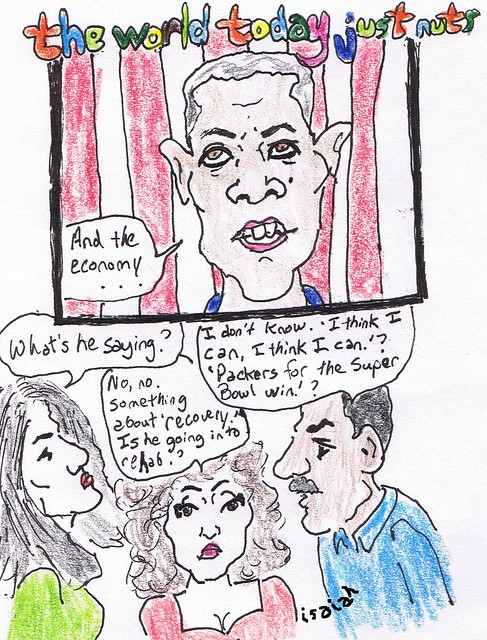
Tuesday, January 24, 2012

Peel away the happy face sticker

"US Steps Outside the Law as the War on Terror Drones On" (Justin Randle, ICH):
The CIA recently launched its first drone attack of 2012. Three people in North Waziristan were killed. If you haven't yet heard of these Terminator-style US drones, it is likely you will soon. Their usage in surveillance, modern warfare and covert ''counter-terrorism'' measures is rapidly expanding.


Drones, or unmanned aerial vehicles, are the new face of the war on terror and the latest attempt by the United States to circumvent international law in pursuit of its alleged enemies. After failing to fulfil his promise to close the military prison at Guantanamo Bay, President Barack Obama spent New Year's Eve signing the National Defense Authorisation Act (NDAA). The NDAA codifies the indefinite detention, without trial, of US citizens. The third part of this trinity is the increase in a multi-agency network of drones carrying out secret extrajudicial assassinations of suspected militants. In his inauguration speech, Obama said: ''As for our common defence, we reject as false the choice between our safety and our ideals.'' Yet these policies enshrine just such a false dichotomy.
Advertisement: Story continues below


Equipped with Hellfire missiles, Predator drones operate mainly in north-west Pakistan. New America Foundation has attempted to map the strikes, which have hugely escalated under Obama's presidency. Between 2004 and 2011, the foundation conservatively estimates 1717 deaths have resulted from drone strikes in Pakistan. It also estimates a 32 per cent civilian death rate.

Drones.  To continue the wars.  To continue the wars and pretend that they're something else.  To make murder and assassination into a game.  That's been the goal forever and a day.

Under Barack it becomes a possibility.  Were Bush in office, we'd be rallying and marching and filing lawsuits and so much more.

But it's precious little Barack.  You know, the little boy who's 'special' and can't match the accomplishments of other boys his age so all the adults just applaud and say, "Good job!"

He has put a happy face sticker on the bloody and dead.

That may be the most disgusting thing about him.

"Iraq snapshot" (The Common Ills):
Tuesday, January 24, 2011.  Chaos and violence continue, Baghdad is slammed with bombings, Nouri goes after Turkey (again), the political crisis continues, executions in Iraq continue, and more.
Today bombs slammed Baghdad.  Aswat al-Iraq states, "These explosions remind the people of the 2006-2007 events."   Alsumaria TV quotes an unidentified police source stating of the aftermath of a Sadr City car bombing, "Ambulance cars rushed to the incident site and transported wounded to a nearby hospital for treatment and the corpse to the department of forensic medicine."  Yasir Ghazi and Duraid Adnan (New York Times) quote bombing victim Emad Jasim asking, "Where are my legs? Tell me where my legs are. Why are they not there?"  Peter Cave (Australia's ABC News) notes that in addition to the bombing in the Sadr City section of Baghdad, the capital saw three other bombings and quotes Ahmed Ali on the Sadr City bombing, "We were all standing waiting to earn our living and all of a sudden it was like a black storm and I felt myself thrown on the ground. I fainted for a while then I woke up and hurried to one of the cars to take me to the hospital." Press TV notes two Sadr City bombings, the first targeting workers, like Ahmed Ali, the second "outside a bakery half an hour later." Of the other two bombings in Baghdad, Al Manar explains that a Shula car bombing claimed 2 lives and left sixteen people dead and a Al-Hurriya bombing claimed 1 life and left thirteen people injured. BBC News adds, "Officials said a roadside bomb also exploded on the Muthanna airport road in central Baghdad, wounding at least six people."

In all of the Baghdad bombings, the Telegraph of London counts 14 dead. AP counts 11 dead in Sadr City. Sadr City is a Shi'ite neighborhood of Baghdad, often referred to by the press as "a slum," inhabited by followers of Moqtada al-Sadr. Reportedly approximately one million people live in Sadr City (Iraq has not had a census in decades). Reuters notes 14 dead and seventy-six injured.  Dan Morse and Aziz Alwan (Washington Post) report that there was also a home invasion in the Abu Ghraib section of Baghdad, police Captain Hassan Abdulla al-Timinimi was killed and so was "his family."
Outside of Baghdad, Reuters notes a Ramadi roadside bombing which claimed 2 lives and left three people injured, a Shirqat roadside bombing claimed 1 life and left another person injured, 1 person was shot dead in a barber shop and the owner was left injured, 1 corpse was discovered in Mosul, a Mosul roadside bombing injured one person, a Kirkuk sticky bombing left two police officers injured and, dropping back to last night for the rest, a Jalawla sticky bombing left one police officer injured, a Baquba mortar attack injured one child and a Tuz Khurmto sticky bombing claimed the life of 1 Sahwa.
This and other recent violence is said to have spoiled plans for Iraq to be a heavy point in tonight's State of the Union address so Sir Talks A Lot will have to find something else to spin.  But not everyone's silent on Iraq. "Far from being 'too soon'," argues Phyllis Bennis, "the U.S. troop withdrawal from Iraq came more than eight years too late -- and still, the war isn't over.  This war should never have been launched, so it can't be ended soon enough."  Bennis was part of Monday's Debate Club at US News & World Report. Michele Dunne argues that the US military left too soon (the US military remains in Iraq, Marines with the State Dept, soldiers as 'trainers,' Special Ops, etc.).  She insists that the country was not stable enough for the US to leave, "Knowing that Americans would expect Iraq to become a success within a few years -- and that this most likely would not happen -- was one reason why I was not in favor of the 2003 invasion.  But invade we did, and the question at hand now is whether US forces staying longer than eight years would have made a difference in how stable, peaceful, and democratic Iraq ultimately will be."  Also arguing yes is Helle Dale:  "For the Iraqi people, the consequences of the premature American withdrawal will be instability, resurgence of terrorism and an uncertain future for Iraq's fledgling democracy.  On December 22, a wave of violent, coordinated attacks killed at least 57 people, and just days after the December 15th withdrawal ceremony, the dominantly Shiite government of Prime Minister Nouri al-Maliki purged many Sunni Arab leaders. Political instability is sure to follow.  The Iraqi army and air force training will suffer as will air operations, the Iraqi air force having few helicopters and planes."  Danielle Pletka is another on the it was a mistake to pull troops, "Here's what success in Iraq looks like: democratic elections, sectarian comity, independence in foreign policy, al Qaeda stymied, cooperating with the United States, and self-sufficiency.  Iraq didn't look completely like that in early 2011, but it was headed in the right direction.  Here's what Iraq looks like now: en route to Shia autocracy, sectarian fighting, substantial and rising Iranian influence, al Qaeda resurgent, and an almost certain economic downturn rooted in instability."  Like Bennis, Christopher Preble argues the US should have left sooner (and argues the US should never have invaded),  "No amount of additional sacrifice by our brave men and women in uniform would change the final fundamental truth about Iraq: The Iraqis wanted their country back. Now they have it. I wish them well."  US House Rep Dennis Kucinich agrees with Bennis and Preble and Kucinich notes the financial costs and the costs in lives (including over a million Iraqis killed) before concluding with this, "The war was supposed to last only a few months. Nearly nine years later, it still isn't over, as weapons are now wielded by a different agency and private contractors. Because there has been no accountability for the lies that killed millions, it is now easier than ever for America to start wars for spurious reasons. The war in Iraq should never have happened." That's six arguments -- three for, three against -- and the Debate features 12 arguments.  You can also vote on your favorite argument.  Currently Phyllis Bennis is at number one with 42 votes in favor of her argument.  (All women making arguments were feature in the above excerpts.  This isn't NPR where they disappear women from their live primary coverage. Had there been six women, as a tonic to NPR, the six excerpted would have all been women.)  Congratulations to US News & World Reports for hosting a serious discussion on the Iraq War.
Back to Iraq and back to violence, Navi Pillay, the United Nations' High Commissioner for Human Rights registered her dismay today over learning that Thursday, January 19th, Iraq executed 32 men and 2 women.  She stated, "Even if the most scrupulous fair trial standards were observed, this would be a terrifying number of executions to take place in a single day.  Given the lack of transparency in court proceedings, major concerns about due process and fairness of trials, and the very wide range of offences for which the death penalty can be imposed in Iraq, it is a truly shocking figure."  The UN notes that in the last seven years, Iraq is thought to have executed 1,200 people. Pillay stated, "Most disturbingly, we do not have a single report of anyone on death row being pardoned, despite the fact there are well documented cases of confessions being extracted under duress.  I call on the Government of Iraq to implement an immediate moratorium on the institution of death penalty."  Iraq is among a number of other countries that carry out executions.  (The United States also carries out executions.)  Amnesty International notes, "The worldwide trend towards abolition of the death penalty recorded further progress in 2010.  One more country, Gabon, abolished the death penalty for all crimes and the President of Mongolia established an official moratorium on executions. For the third time, the UN General Assembly adopted with more support than ever before a resolution on a moratorium on the use of the death penalty.  In 2010, 23 countries carried out executions and 67 imposed death sentences in 2010.  Methods of execution in 2010 included beheading, electrocution, hanging, lethal injection and shooting.  Countries that retain the death penalty defended their position by claiming that their use of the death penalty is consistent with international human rights law.  Their actions blatantly contradicted these claims."
You might think violence like the above would get Nouri focused on nominating people to head the security ministries or addressing the political crisis, but you would be wrong.  When violence rises in Iraq, Nouri sees the answer as attacking neighbors.  Nouri's again creating problems with Turkey.
Again? From the January 13th snapshot:
In Iraq, the political crisis continues. Nouri started it and now he wants to expand it, apparently, to go beyond Iraq's borders. How else to explain his attacks today on the Prime Minister of Turkey? Today's Zaman reports, "Iraqi Prime Minister Nouri al-Maliki has harshly criticized Turkey for its what he said 'surprise interference' in his country's internal affair, claiming that Turkey's role could bring disaster and civil war to the region -- something Turkey will itself suffer." Interfere? Prime Minister Recep Tayyip Erdogan has cautioned that the political crisis could lead to a civil war in Iraq and has called on parties to start a real dialogue to resolve the issues. That's really not "interfering." But what has Nouri so ticked off is that Erdogan also stated the very plain fact that Nouri started the political crisis. It's a fact, Nouri doesn't like facts, but that doesn't change the status. AFP quotes Nouri stating, "Recently, we noticed their surprise interventions with statements, as if Iraq is controlled or run by them. Their latest statements interfered in domestic Iraqi affairs . . . and we do not allow that absolutely. If it is acceptable to talk about our judicial authority, then we can talk about theirs, and if they talk about our disputes, we can talk about theirs. Turkey is playing a role that might bring disaster and civil war to the region, and Turkey itself will suffer because it has different sects and ethnicities." It's always funny when Nouri unleashes his crazy in public. That was what bothered the French government the most about the White House backing Nouri in 2010, that Nouri was clearly unstable and that's who Barack wanted to rule Iraq? Crazy Nouri. KUNA reports Nouri and Erdogan were on the phone Thursday discussing the situation in Iraq. And now, today, Nouri's parading the crazy. At this rate, the bullet to the head so many observers feel is in Nouri's immediate future just may come from his own gun.
While Nouri was showing the world how unhinged he is, the Turkish Press reports that Erdogan was speaking on the phone with US Vice President Joe Biden about Iraq: "Reportedly, Erdogan said to Biden that if Iraq distances itself from the culture of democracy, efforts previously exerted for peace and stability will be wasted. Sources added that Erdogan and Biden also indicated that authoritarian and sectarian policies will never benefit Iraq and that Turkey and the US consider benefit in holding dialogue and consultations regarding the developments in Iraq."
The war of words continued. From January 15th:

Not content at lashing out at politicians in his own country, Nouri appears determined to expand the political crisis into the entire region. Al Mada notes that Nouri is stating the remarks of Turkish Prime Minister Recep Tayyip Erdogan will cause a catastrophe. Hyperbole's always been a part of Nouri's make up. Kitabat also notes Nouri's attack on Erdogan and how he accuses Erdogan's call for Iraq to resolve the political crisis as Turkey interfering in Iraq's domestic affairs. You've heard of a pep squad? Well Nouri has a thug squad. And Al Mada reports that State of Law, on Saturday, joined Nouri in attacking Edrogan and the country of Turkey.

Following days of those public and bullying remarks, Nouri's thugs decided to grab the rocket launchers.   Wednesday the Turkish Embassy in Baghdad was attacked. Though Nouri could and did bully, he had no public remarks to make on the embassy being attacked.
World Bulletin explains Turkey's Prime Minister Recep Tayyip Erdogan declared today, "The idea that 'Turkey is interfering in our domestic affairs' is a very ugly and unfortunate one.  Mr. Maliki should know very well that if you initiate a period of clashes in Iraq based on sectarian strife, it is impossible for us to remain silent."  He also stated, "We expect the administration in Iraq to display a responsible stance that will stem sectarian clashes." Thus began today's call in response, what AGI terms the "war of words."  Jonathon Birch (Reuters) quotes Nouri's official statement, "This is not acceptable in the dealings between officials or different states and especially from heads of state.  Mr. Erdogan has to be more careful in handling the usual protocols in internationl relations."  Catherine Cheney (World Politics Review) offers, "According to Henri Barkey, a Turkey expert at Lehigh University, the recent escalation in tensions is simply the latest and most pointed in a series of diplomatic divergences between Turkey and Iraq, which have found themselves on opposite sides of a growing number of issues since the beginning of the Arab Spring."
Sammy Ketz (AFP) reminds, "At the weekend, Iraq said that Turkey, Iran and unnamed Arab countries were trying to 'intervene' in Baghdad's month-long political crisis and not respecting its sovereignty."  Saturday, Saud al-Zahid (Al Arabiya) reported, "Commander of Iraqn's Quds Force, Brig. Gen. Qasem Soleimani has said that the Islamic Republic controls 'one way or another' over Iraq and south Lebanon and that Tehran is capable of influencing the advent of Islamist governments in order to fight 'arrogant' powers, ISNA student agency reported on Thursday." Following that announcement, there were four responses. Alsumaria TV reported, "Iraqi Sadr Movement headed by Cleric Sayyed Muqtada Al Sadr rebuked, on Friday, Iranian Quds Forces Commander Qassim Suleimani for declaring that Iraq is subject to Iran's will and that there is a potential to form an Islamic government in Iraq. These statements are unacceptable, Sadr Movement argued assuring that it doesn't allow any pretext to interfere in Iraqi internal affairs." KUNA noted that Iraqi Foreign Minister Hoshyar Zebari released a statement which includes, "Iraq has not and will never be affiliated to anyone and will not be a toy in others' game or a place to settle scores between different parties." Alsumaria TV also noted Kurdistan Alliance MP Mahmoud Othman objecting to the statements and terming them "a blatant interference in the affairs of Iraq." And Aswat al-Iraq reported: the Iraqiya's spokesperson Maysoon al-Damalouji condemned the statement and called for the Iraqi government to officially respond to it.  But Nouri had no statement on Saturday or since.  However, he has managed to pick a fight with Turkey repeatedly in the last two weeks.
The United States Institute of Peace released "Iraq, It's Neighbors, and the United States: Competition, Crisis, and the Reordering of Power."  Among other things, it notes the increased trade between Turkey and Iraq, how Iraqi oil will likely influence the relations between Iraq and Turkey (and Iraq and Syria and Iraq and Jordan), and that water issues "complicate Iraq's ties with Iran, Syria, and Turkey for the forseeable future."
Again Baghdad was slammed with bombings today and Mohammed Tawfeeq (CNN) observes, "The latest attacks raised concerns among ordinary people about the ability of Iraqi security forces to ensure security in this country, particularly after the United States withdrew troops by the end of 2011. However, Iraqi people are more concerned now about the political crisis." The ongoing political crisis was started by Prime Minister Nouri al-Maliki who demanded that Deputy Prime Minister Saleh al-Mutlaq be stripped of his post and that Vice President Tareq al-Hashemi be arrested for terrorism. al-Mutlaq and al-Hashemi both belong to Iraqiya which came in first in the March 2010 elections (Nouri's State of Law came in second). The two men are also Sunnis. Nouri appears to be targeting both Sunnis and Iraqiya as evidenced by several arrests last week. (Iraqiya is a political slate made up of Shi'ites -- such as leader Ayad Allawi, Sunnis and others. It's success in the 2010 elections echoed the main thread of the 2009 provincial elections which was that Iraqi voters wanted to move away from sectarian politics.) Along with arresting various politicians, Nouri's also decided that he can toss out members of his Cabinet who are members of Iraqiya. He's decided he can do that even though the Constitution is clear that a prime minister can only remove a member of the Cabinet with the approval of Parliament. Parliament's held no vote but Nouri insists he's removed members.

The chief task of the prime minister is building a strong Cabinet. That's why when the president of Iraq names a prime minister-designate they have 30 days to name their Cabinet (propose nominees and have Parliament vote on them). If, per the Constitution, they're not able to do that within 30 days, then the president is supposed to select another prime minister-designate. In November 2010, Nouri was named prime minister-designate. As December 2010 drew to a close, he was illegally moved to prime minister. He had not proposed a full Cabinet. Most noticeable, the security ministries (Ministry of Interior, Ministry of National Security and Ministry of Defense) were empty. The US press rushed to assure it was only a matter of weeks (as if the 30 day deadline in the Constitution didn't matter?) while his critics declared Nouri would not name anyone to the posts, that this was a power-grab on Nouri's part and he intended to control the ministries by refusing to name real ministers. (His so-called 'acting' ministers are not real ministers. They have not been approved by Parliament for those positions so they have no real power and are merely rubber stamps for Nouri.)

It's one year and a month later and Nouri still hasn't managed to name people to those posts. His inability to do so speaks to his failure as a leader and underscores that the Constitution had a 30 day requirement for a reason. One who is so indecisive and laid back to security should not be put in charge of a country that has seen violence inflicted by foreigners as well as by native persons.

The Constitution does not allow a prime minister to -- all on their own -- remove a minister and that's because they're supposed to have used their best judgment when proposing the Cabinet. If they didn't, it's up to the prime minister to persuade the Parliament to strip a minister of his/her post.

Nouri's repeated violations of the Constitution are setting a very dangerous pattern should Iraq ever, under the current system, get a new prime minister. If the Constitution's not going to be the supreme law of the land, then there are no checks and balances on the three branches of government. The only thing more appalling than Nouri's failure to follow the Constitution is the US press refusing to call out these violations.

Since mid-December, President Jalal Talabani and Speaker of Parliament Osama al-Nujaifi have been calling for a national conference to address the the political crisis. Two Sundays ago, there were a meet-up of major blocs to outline some aspects of the conference. Last Sunday was supposed to see a second meeting that would firm up the details; however, Talabani had to go to Germany for spinal surgery so the meeting was postponed. Hossam Acommok (Al Mada) reports the National Alliance is of differing views on the issues and that Nouri held a meeting yesterday with a few invited players where he insisted that (a) "political crisis" not be used (the Islamic Supreme Council of Iraq rebuked the notion that the situation should not be described as a "crisis"), (b) that it not be called a "national conference" and other details to obscure reality of the mess he caused.

The political crisis has been building for months. The March 2010 elections were followed by eight months of Nouri refusing to surrender the prime minister post or allow Iraqiya the first shot at forming a coalition government. Nouri had the White House's backing or he wouldn't have survived those eight months. To end the stalemate, the US government helped broker an agreement known as the Erbil Agreement in which Nouri was allowed to remain prime minister but he would need to create an independent security commission headed by Allawi and he would need to honor the Constitution's requirement for a referendum on Kirkuk (per the Constitution, that was supposed to have taken place by the end of 2007 but Nouri ignored it in his first term).

Nouri used the Erbil Agreement to become prime minister -- it can be argued the Erbil Agreement was why he was moved from prime minister-designate to prime minister even though he failed to meet the Constitutional requirement -- and then trashed it. These days, Nouri and his sycophants (including those who pass themselves off as 'independent analysts' but are really just part of the Nir Rosen Locker Room) insist the Erbil Agreement is unconstitutional. If that's the opinion that will prevail then Jalal Talabani needs to explain Nouri was illegal and unconstitutionally moved from prime minister-designate to prime minister.


Al Sabaah notes that Nouri also spoke with Ibrahim al-Jaafari yesterday. The two are political rivals so that should have been interesting. (al-Jaafari was the choice in 2006 to be prime minister, to, in fact, continue as prime minister -- but the White House overruled the Parliament and insisted on Nouri.) al-Jaafari's office issued a statement stating that they had discussed ways to address the country's national priorities. Meanwhile Bahaa al-Araji of the Sadr bloc met with Iraqiya members and they addressed the issue of the charges against Tareq al-Hashemi agreeing that politicians should not be making charges in the media -- Nouri -- and that the matter should be left up to the judiciary. Alsumaria reports that Tareq al-Hashemi has referred to Nouri's nonsense statements a few weeks back as a "joke" and not believable.   Isaiah's The World Today Just Nuts "Here's Nouri" illustrated that moment -- Nouri whining, "Wah! They made me go after Tareq al-Hashemi!"  When even Nouri realized he'd gone too far and was ticking off Iraqis -- regardless of their sect or ethnicity -- he began insisting to the press that he didn't want to arrest Tareq al-Hashemi but the judiciary insisted he do so or he would be arrested himself! (If that's true -- no, it's not true -- then shouldn't the judiciary have arrested Nouri by now? Not only is al-Hashemi a guest of President Jalal Talabani's and not arrested but Nouri waited until after al-Hashemi left Baghdad to issue the warrant. So shouldn't Nouri be arrested?)
Trend reports that the "Turkish Foreign Minister Ahmet Davutoglu criticized Iraqi internal policy, saying that the events in Iraq show that the country's stability is threatened and Turkey excludes the possibility of Iraqi Vice President Tariq al-Hashimi's involvement in terrorist acts in the country."
In the United States, a film is about to get its NYC debut.  David Zeiger directed the award winning documentary Sir! No Sir! about resistance within the ranks during Vietnam. His new documentary is This Is Where We Take Our Stand about the 2008 Winter Soldier hearings. Iraq Veterans Against the Wars notes a benefit screening ($15 a ticket) in NYC on February 1st, 7:00 pm, at the IFC Center and:

The film will also air on PBS around the country, thanks to generous support from the National Educational Television Association. Due to the controversial nature of the film, many local PBS stations will relegate 'This is Where We Take Our Stand' to their smaller and less widely available affiliates. We urge you to contact your local PBS station and encourage them to air the film on their major channel. http://thisiswherewetakeourstand.com/?p=376

Monday, January 23, 2012

Grab bag

Isaiah's The World Today Just Nuts "State of the Union"

state of the union


I do enjoy that.  I think we're all growing immune to Mr. Pretty Speeches.

In the snapshot today, C.I. points out that if people care about people, they don't trash women or render them invisible.

She notes various patterns among these types.

I'm going to grab Laura Flanders who will always pretend to care about the people.

But she will always betray women.

Perfect examples?

1) She couldn't cover Abeer, she wouldn't cover Lara Logan and she ridiculed Hillary in the most non-feminist terms (going so far as to refer to her laugh as a cackle).

Laura's in the boys club because she never upsets anyone.  She's the perfect token.

"Media: The uninformed boosting ad revenues" (Ava and C.I., The Third Estate Sunday Review):
What we're seeing isn't reporting. It's not even "commentary" by the historical understanding of the word. What we're witnessing is what Rob Lowe describes in St. Elmo's Fire as "a bit of self-created drama."

Who's the winner in Florida? For a brief moment, that was asked on NPR and a meaningful answer was actually given: TV stations which will carry tons of ads.

The media makes a ton of money off elections if they can build up the drama. Notch it up, make some more money. So they treat it as if it's amazing and unheard and novel and new.

When it's all so damn predictable and, yes, so damn drawn out. Other countries don't spend a year and a half gearing up for an election. Not only do we do that in the US, but we have so-called journalistic outlets on the left eager to serve not news but the Democratic Party. Which is why The Nation is unreadable today. As we've noted before, the 2006 mid-terms hadn't even taken place when John Nichols decided to start writing about the 2008 election. That's all the magazine is now and to say it may be good fodder for political junkies is insulting to political junkies.

"Campaign junkies."

That's what it is, get the term right.

And that's what our media hopes to turn the country into. That's among the many reasons that we're pretty much set on not voting in the 2012 presidential election. Maybe we'll follow Emily's example and instead come up with a revenge list. Wait and hope.


If you don't get the last sentence of Ava and C.I.'s piece, I suggest you pick up The Count of Monte Christo and examine the last page. When Jim read it out loud, I was the only one who got that.

"Iraq snapshot" (The Common Ills):
Monday, January 23, 2012.  Chaos and violence continue, we explore the silence on the political crisis and the connection to the silence on Iraqi women, and more.
 
Actions do have consequences and the decision by the White House to back Nouri al-Maliki as prime minister in 2010 has had very serious consequences for Iraq and that becomes more obvious each day.  Along with the ongoing political crisis, now there's a new report with observations on Iraq was issued.  The Associated Press quoted Human Rights Watch's Sarah Leah Whitson stating, 'Iraq is quickly slipping back into authoritarianism. Despite U.S. government assurances that it helped create a stable democracy (in Iraq), the reality is that it left behind a budding police state'." She was referring to what Human Rights Watch found and documented in their [PDF format warning] World Report: 2012.  We'll emphasize the focus on Baghdad protests:
 
 
On February 21, Iraqi police stood by as dozens of assailants, some wielding knives and clubs, stabbed and beat at least 20 protesters intending to camp in Tahrir Square in Baghdad, the capital.  During nationwide demonstrations on February 25, security forces killed at least 12 protesters across the country and injured more than 100.  Baghdad security forces beat unarmed journalists and protesters that day, smashing cameras and confiscating memory cards.
[. . .]
On June 10 in Baghdad government-backed thugs armed with wooden planks, knives, iron pipes, and other weapons beat and stabbed peaceful protesters and sexually molested female demonstrators as security forces stood by and watched, sometimes laughing at the victims.
Authorities also used legal means to curtail protests.  On April 13, Iraqi officials issued a new regulations barring street protests and allowing them only at three soccer (football) stadiums, although they have not enforced the regulations. In May the Council of Ministers approved a "Law on the Freedom of Expression of Opinion, Assembly, and Peaceful Demonstrations" that authorizes officials to restrict freedom of assembly to protect "the public interest" and in the interest of "general order or public morals." At this writing the law still awaited parliamentary approval.
[. . .]
On September 8 an unknown assailant shot to death Hadi al-Mahdi, a popular radio journalist often critical of government corruption and social inequality, at his Baghdad home.  The Ministry of Interior said it would investigate his death, but at this writing no one has been charged.  Immediately prior to his death al-Mahdi received several phone and text message threats not to return to Tahrir Square.  Earlier, after attending the February 25 "Day of Anger" mass demonstration in Baghdad, security forces arrested, blindfolded, and severely beat him along with three other journalists during their subsequent interrogation.
 
In January 2012, Human Rights Watch observed that Iraqi authorities had successfully curtailed the Tahrir Square anti-government demonstrations by flooding the weekly protests with pro-government supporters and undercover security agents. Dissenting activists and independent journalists for the most part said that they no longer felt safe attending the demonstrations.
"After more than six years of democratic rule, Iraqis who publicly express their views still do so at great peril," Whitson said. "Al-Mahdi's killing highlights what a deadly profession journalism remains in Iraq."


Dan Morse (Washington Post) reports on the report and also carries a response from Nouri al-Maliki's spokesperson including this statement, "Their number [Baghdad protesters] is gradually decreasing and they do not reflect strong opposition to the government."  The denial might be more convincing were there not so many reports which already demonstrate Nouri's thugs are shutting down protest and attempting to intimidate free speech.  Yesterday  Jane Arraf (Al Jazeera -- link is video) reported on the ever-closing society in Iraq.

Jane Arraf: These days at Baghdad's Liberation Square, there are more soldiers and police than protesters. Not just these but dozens of riot police waiting just under the grid. But they won't have any trouble from these demonstrators. With the killings and arrests of anti-government protesters, these young men chanting support for Nouri al-Maliki have taken over the square. A few won't give up.

Iraqi female protester: I can talk freely, right? This is Tahrir Square. And it's about freedom.

Jane Arraf: But it's not. These men drown her out when she starts criticizing Maliki. They won't give their names. Here at Radio al Mahaba, an independent women's radio station, the staff used to see all their friends at the Friday protests. That's until Hadi al-Mahdi, a controversial radio host, was arrested and badly beaten and then killed at home. And before the first set in the station's cafeteria last fall.

Kamal Jabar (showing the remains of the bombing): This was an in door.

Jane Arraf: One of the founders of the station who was beaten up after a protest last year says they've had enough.

Kamal Jabar: And we got the message. We are moving out of here. I don't feel secure. I don't want to be responsible for any death or injury or harm to any of the staff.

Jane Arraf: There were high hopes for the democracy meant to take root in Iraq after Saddam Hussein was toppled. But in between the fall of Saddam and an increasingly authoritarian government, the freedom to say what you want has been shrinking. Hundreds of activists have either left the country or gone underground. While some of the radio staff have quit, Ahlam al-Daraji wants to continue her show at a new, safer location.

Ahlam al-Daraji: Life is meaningless if you remain afraid and worried all the time. And if I say, "I can't say this because someone might object"? If that's the case, why are we living? Maybe I should leave Iraq?

Jane Arraf: They're staying for now. With fewer voices left, they believe they need to speak up for the rest. Jane Arraf, Al Jazeera, Baghdad.

January 10th, Jomana Karadsheh (CNN -- link is video) reported:
Jomana Karadsheh: Last month, Oday al-Zaidy and a small group of people gathered in a Baghdad square to celebrate the US media withdrawal planning to burn the US flag. But more than 200 security forces swarmed around them, banned us from filming and stopped the protests because they said the group had not obtained a permit. But they still managed to burn the flag. Oday and others were beaten up and detained for a day. Security officials say, they assaulted policemen, something the group denies. "Democracy in Iraq is an illusion," Oday says. "An American illusion and an American lie. Whoever wants to see that for themselves, should come and see what's been happening in Iraq since February 25th." That's when thousands of Iraqis -- partly influenced by the Arab Spring -- took to the streets of cities across the country protesting against corruption and a lack of basic services. [Gun shots are heard and security forces move in.] But from the start, they were met by a fierce crackdown. The government denies an orchestrated effort to put down protests, saying there were just minor violations committed by to put down protests by individual security officers. Activists groups disagree. Human Rights Watch says the violations have been systematic and ongoing documenting dozens of cases where protesters were beaten up, detained and, in some cases, even tortured.
 
 
Human Rights Watch's Samer Muscati: People are afraid to go to demonstrations, are afraid of being rounded up, of being assaulted, of being beat up, of being followed to their own homes.

 
And we can drop back to December 30th when Jomana Karadsheh captured a Friday Baghdad protest in a series of Tweets:
 
 
JomanaCNN jomana karadsheh
demo organized by brother of Bush shoe thrower to celebrate #US withdrawal. 12 people turned up & more than 200 security forces. #Iraq

 
JomanaCNN jomana karadsheh
demo organized by brother of Bush shoe thrower to celebrate #US withdrawal. 12 people turned up & more than 200 security forces. #Iraq
 
JomanaCNN jomana karadsheh
Police Gen. there said gathering was "unauthorized" &kept asking them 2 leave. Hrs later, protesters set #US flag on fire &were beaten up
 
 
JomanaCNN jomana karadsheh
Protesters down to 8 ppl at the end kept asking us not leave, saying our presence stops security forces from detaining them. #Iraq
 
JomanaCNN jomana karadsheh
Camera of 1 Iraqi channel confiscated, our cameraman prevented from filming& my cell phone almost confiscated after taking one still. #Iraq
 
JomanaCNN jomana karadsheh
protesters surrounded as we left, 1 telling me now 3 were detained after being beaten up. cant reach them 2 confirm, their phones off. #IRAQ

 
We can go back further and further. What Nouri's spokesperson wants to deny is in the public record, has been in the public record for some time.  Iraqi's suffer and they suffer because of an illegal war and occupation and because of decisions imposed upon the Iraqi people by the US government.  In March 2010, Iraqis voted. At great risk to themselves. Candidates ran for office -- at great risk if they were Iraqiya because Iraqiya candidates were banned, they were arrested, they were assassinated in the lead up to the March elections.  Nouri and his thugs insisted that Iraqiya was "Ba'athist" and "terrorist" and would destroy Iraq. State of Law, his political slate, was supposedly going to destroy all the other choices. But that didn't happen, Iraqiya came in first.
 
These were serious issues and some people treated them as such in real time.  But most outlets either looked the other way or resorted to cretins as 'trusted voices.'  It was a cabal of men, men who didn't like women, promoted by other men and by women who backstab other women because that's what Queen Bees do (Amy Goodman is but one good example).
 
Recently, video surfaced of US service members urinating on corpses.  While disrespectful, it's not the end of the world for the corpses.  The end of the world for them was how they were killed.  Yet Diane Rehm, to name other example of a Queen Bee, will waste forever on the urination and then take calls on the urination and the shock and the dismay.  Maybe the shock should be that Afghans in their own country were killed by foreigners?
 
Now if you're confused -- and much of the American media is -- urination and killing?  Most people if givien the choice would say, "Piss on me."  But if it's too much to grasp, let's bring up a War Crime that resulted in actual convictions as well as some US soldiers agreeing to admit guilt.  Felicity Arbuthnot (Global Research) noted the incident earlier this month:
 
Nuri Al Maliki made his groveling subservience to Washington clear, when on the 12th December he requested to go to the city's Arlington Military Cemetery and jointly lay a wreath with President Obama, at the Memorial to the Unknown Soldier, to pay his respects to US service personnel who lost their lives, decimating the country of which he is -- for now -- Prime Minister.
Thanking the murderous, marauding, illegal, infanticide-addicted, raping and pillaging invader, must be a historic first.
An extensive search has found no record of Maliki visiting Iraq's lost and bereaved -- from Falluja to Basra, Mosul to Mahmudiyah -- the latter, where fourteen year old Abeer al Janabi was multiply raped by US troops, then murdered and set fire to, with all her family. Presumably, they were also Obama's "unbroken line of heroes", to which he referred, in another defeat ceremony at Fort Bragg.
 
Diane Rehm devoted how many shows to Abeer al-Janabi?  Zero.  Democracy Now! devoted how many shows to Abeer?  Zero.
 
The 14-year-old caught the eye of Steven D. Green.  He and other soldiers decided to invade her home and gang-rape her.  They'd also decided that everyone residing in the home would die, so that there would be no witnesses and the crimes could be blamed on Iraqi insurgents.
 
So they left base, forced their way into the home, started the gang-rape of Abeer with Green leading Abeer's parents and her five-year-old sister into another room where he shot them dead.  And Abeer heard it as she was gang raped.  She heard her parents murdered, she heard her little sister murdered.  And the guys in the room took turns until Green joined them and he went last.  At which point, he then shot Abeer dead.
 
To destroy evidence, they attempted to set her body on fire.
 
These were disgusting War Crimes.  And the media remained silent.  Even when soldiers were standing up in open court and admitting what they did, the media really wasn't interested.  I slag on Arianna Huffington for a number of things but, to her credit, when Green went on trial, she made sure her site (The Huffington Post) covered it.  Arianna took the trial more seriously than did any US outlet with the exception of the Associated Press.
 
Diane Rehm wanted to grand stand on the horror of dead people being pissed on but chose to ignore the gang-rape and murder of a 14-year-old girl by US soldiers. 
 
Again, what took place with the urination was disrespectful.  It does not, however, rise to the level of War Crimes.  (Though the continued US occupation of Afghanistan may rise to the level of War Crimes.)
 
CBS News' Lara Logan was sexually assaulted while reporting from Egypt.  For those who've forgotten, trashy Nir Rosen elected to mock her, to say she deserved it, to turn around and wish it on Anderson Cooper and much worse.  (See Ava and my "The Damned Don't Apologize" if you've forgotten what he did or if you're new to the topic.)  People who don't respect women don't usually respect people.  That's why Nir could attack Lara and then, when called on it, think he could expand it beyond women by attacking Anderson.
 
People like Nir Rosen don't respect women and don't respect the people.  Nir was 'brave' we were told, Nir was 'wonderful.'  And when he finally got called out for his garbage, Amy Goodman and his other little friends avoided the issue.  Amy Goodman, who please remember, is one of the few female broadcasting personalities who has ever elected to appear in Hustler magazine.  They didn't call out their little buddy for the same reason that they didn't cover Abeer, they just don't care about women.  And people like Nir never cared about the Iraqi people.
 
While some people were sounding alarms about Nouri's attempt to remain prime minister, others were excusing Nouri.  In 2010, ahead of the elections, Nir was declaring that it really didn't matter and the Iraqi people didn't really care.  Let's check those keen observations:
 
 
The government is in Shiite hands and now it's a question of whether it will remain in the relatively good Shiite hands of Maliki, who provides security and doesn't bring down an iron fist on you unless you provoke him (sort of like Saddam), or the dirty corrupt and dangerous Shiite hands of Maliki's rivals -- Jaafari, Hakim, etc. I think these elections mean a lot more to Americans (as usual) and maybe to Iraqi elites than they do to Iraqis.
[. . .]
I hate to admit that I hope Maliki wins. He's the best of all the realistic alternatives. It's not like a more secular candidate is likely to win, so if it's not Maliki it will be Jaafari or Chalabi. Frankly this is a rare case where I hope Maliki violates the constitution, acts in some kind of authoritarian way to make sure he wins the elections, because the alternative is fragmentation, or a criminal, sectarian kleptocratic Shiite elite taking over, and then Iraq might unravel.
 
You may notice that the winner isn't even mentioned in Nir Rosen's crazy.  Ayad Allawi makes no appearance.  So much for the wisdom of Nir.  He was also wrong about the turnout.  But his beloved Nouri did stay on.  And has violated the Constitution.
 
You know it takes a real asshole to publicly declare that they hope someone violates a constitution.  But it takes a bigger asshole to provide Nir Rosen an outlet.
 
Who provided the outlet?  Thomas E. Ricks.  The same Thomas who could never even recognize Deborah Amos's book on Iraqis (Eclipse of the Sunnis) or the work of any women.  Excuse me, one woman got recognized.  She took off her top and posed for a picture and Thomas E. Ricks was more than happy to run that photo at Foreign Policy -- in violation of Foreign Policy's own guidelines.  And Thomas E. Ricks has written how many times about Iraq and avoided the plight of Iraqi women how many times in the process.
 
If you pay attention, not only do the creeps reveal themselves, but you also begin to see a pattern emerge, a profile in fact, of those who are never about We The People.
 
As Hillary Clinton rightly observed at the close of the 90s, women's rights are human rights. She and that speech were mocked by Laura Flanders in 2008.  Laura Flanders never managed to call out Nir Rosen for his Lara Logan remarks.  Lara Logan never managed to address the War Crimes against Abeer.  Are you seeing the pattern?  If they dispresect women, if they ridicule or ignore women, then they really aren't about the people.  You can't be willing to attack and/or ignore half the population and be about We The People.
 
When women are ignored, half the population is ignored.  When you're willing to do that, you're really not about "the people."  And the gas bags that Iraq's had to depend upon in the US have repeatedly ignored Iraqi women.  It's no surprise that when Nouri made his power-grab in 2010, when he demanded to remain prime minister in spite of the results, in spite of the will of the people, in spite of the Constitution, that these gas bags didn't sound the alarms.  They didn't care.  They identify with the ruler and dismiss the people, the same way (and for the same reasons) that they dismiss women.
 
While they remained silent, a message was sent by the White House when it elected to back Nouri -- after warnings from human rights group and, reportedly, warnings from the CIA.  If everything that was going on in Iraq right now was going on under Prime Minister Ayad Allawi, the US could say, "Well, that's who the Iraqis picked when they went to the polls." But everything's going on right now -- the political crisis, the increase in violence -- with Nouri al-Maliki as prime minister and he's only prime minister because he was the White House's choice, the Iraqi people chose someone else.

Nouri got the political crisis really going in December when, among other things, he declared Tareq al-Hashemi a terrorist and ordered his arrest.  al-Hashemi was already in the KRG and has remained there as a guest of President Jalal Talabani's. Yesterday was to have been a meet-up in Iraq among political blocs to plan a national conference to address the political crisis Prime Minister Nouri al-Maliki started. Last month, President Jalal Talabani and Speaker of Parliament Osama al-Nujaifi began calling for a national conference. Two Sundays ago, some political blocs met up to work on preliminary details of such a conference. The plan was to meet up again yesterday; however, Talabani had to leave the country instead. Aswat al-Iraq notes that the Patriotic Union of Kurdistan's Adel Murad states, "President Jalal Talabani shall return to Iraq within one week after his successful spinal surgery in Germany; he is feeling well now."
 
 
Dar Addustour reports Tareq al-Hashemi filed a formal request with Baghdad's Supreme Judicial Council to transfer the case to Kirkuk.  Saturday there were rumors that the KRG was sending a delegation to Baghdad to discuss the case.  Al Mada reported Sunday that the spokesperson for the Supreme Judicial Council of the KRG stated that no delegation was sent.  Hossam Acommok (Al Mada) adds that there are rumors that al-Hashemi will be tried in absentia and that the Parliament has formed a seven-member committee to review the charges and the investigation.
 
Reuters notes 1 soldier was shot dead in Mosul, 1 Sahwa was shot dead in Rashad (three other Sahwas were injured -- "Sahwa," "Awakening" and "Sons of Iraq" are all the same term for resistance fighters the US government put on the payroll to get them to stop attacking the US military; Nouri was supposed to have brought them into the system via government jobs but has not done so) and a Falluja roadside bombing which left two people injured.
 
 
Turning to the US, Senator Patty Murray is the Chair of the Senate Veterans Affairs Committee.  Her office notes:
 
FOR IMMEDIATE RELEASE Contact: Murray Press Office
January 23, 2012 (202) 224-2834

GAO Report Shows VA's Shortcomings in Dealing with the Rising Number of Homeless Women Veterans

In new report requested by Senator Murray, data shows that the number of homeless women veterans MORE THAN DOUBLED from 1,380 in 2006 to 3,328 in 2010 but that more data is needed
READ THE FULL REPORT HERE

(Washington, D.C.) – A Government Accountability Office (GAO) report released today showed that the Department of Veterans Affairs (VA) has had difficulty in planning for and meeting the unique needs of a growing number of homeless women veterans. The study, which was requested by U.S. Senator Patty Murray, Chairman of the Senate Veterans Affairs' Committee, is one of the first of its kind to examine the troubling rise in homelessness among women who have served.

Among the key findings in the report the GAO found that:

· VA has limited data on the number and needs of homeless women veterans, and therefore has difficulty planning to meet their unique needs;

· Homeless women veterans are not always aware of the services available to them;

· VA is unevenly implementing its process to refer homeless veterans to emergency shelter until they are admitted into transitional or permanent housing programs;

· Facilities have difficulty providing for the children of homeless veterans, and

· VA lacks minimum standards for the privacy, safety, and security of women veterans in mixed-gender housing facilities.


"While we have seen a decrease in the overall number of homeless veterans, the number and needs of homeless women veterans across the country are growing and the VA is struggling to keep up," said Chairman Murray. "I've been sounding the alarm that these veterans, many of whom are also struggling to provide for their children, are going to need unique attention from the VA. But as this report shows, the VA has not properly planned for or met the unique needs of these veterans. I'm going to be working to ensure that the recommendations in this report, including increased collaboration between VA and HUD, are followed. I'll also be working to make sure that as more women return from Iraq and Afghanistan, the VA is keeping pace with the need to track and provide the services that they need."


Senator Murray has been a leader in calling for increased services for women veterans, including those who have become homeless. Last Congress, she enacted legislation to create an employment program for
homeless women veterans, including those with children. This year, she passed legislation, which extends VA's transitional housing programs for special populations, including women with children. She is also continuing to advocate for a legislative provision, included in S. 914, that authorizes VA to pay for the children of homeless veterans in the Grant and Per Diem program. Senator Murry intends to explore this issue, and others at a hearing on veteran homelessness shortly.


###
 
Meghan Roh
Deputy Press Secretary
Office of U.S. Senator Patty Murray
202-224-2834


Friday, January 20, 2012

The failure

"A Failure for the 'Progressive' Peace Movement: New Hampshire Primary" (John V. Walsh, Dissident Voice):

For the Left, the big news of the New Hampsire primary has been greeted with an embarrassed silence. For there the progressive wing of the Democratic Party, for example “Progressive” Democrats of America, failed completely to put forward a candidate for peace. This failure was not unexpected since the candidate of the progressives was and is Barack Obama who is out-Bushing Bush in the war and empire department. Nor did the wing of the progressive peace movement not formally associated with the Democratic Party raise its voice in any discernible way in New Hampshire. Here is a primary which is carefully watched in a state small enough so that a grassroots effort cam have a genuine effect and reverse the tide of war as happened in 1968 and 1952. Where were UFPJ, Veterans for Peace, Peace Action, Code Pink? Missing in action. What an abject failure, a profound indictment of what is called the “Peace and Justice” movement.
Lenin once remarked that each generation comes to socialism in its own way. It might also be said that each generation comes to oppose war and Empire in its own way. For the present generation of 20 and 30 somethings, libertarian philosophy is the vehicle to oppose war, as was evident in the New Hampshire primary. In part they chose Libertarianism, but in part Libertarianism chose them since the progressives have largely abandoned anti-interventionism, preferring instead Obama’s “humanitarian” imperialism. Many in fact are pro-war when you scratch the surface.


John V. Walsh has a powerful column.

It raises a number of important issues even in the excerpt above.  How the peace movement of the Bush administration was fake for the most part.  There are only a few of us today who feel that the same beliefs that mattered under Bush matter now and that, just as we protested Bush, we should be protesting Barack.

Instead, they're okay with the drone war and the Libyan War and what looks like the Syrian War.  The thought of an Iran War makes them a little nervous, just a little nervous.
 
They've got no ethics at all.  They've destroyed the left.  I agree with what Walsh says later on regarding support for Ron Paul, so be sure to check that out as well.
"Iraq snapshot" (The Common Ills)>
Friday, January 20, 2012. Chaos and violence continue, Grand Ayatollah Sistani is worried about an outbreak of civil war in Iraq, Nouri orders more Iraqiya members arrested, the political crisis continues, and more.
Iraq is a young nation. The years of war and sanctions have ensured that. If you never grasped how young it was, understand that it has a CIA estimate of roughly 26 million people currently and Aswat al-Iraq reports, "The Iraqi Education Ministry announced today that about 8 million students of primary, intermediate and secondary schools will have their mid year examinations tomorrow." A little less than a third of the population will be taking exams in Iraq tomorrow. The CIA figure for the country's median age is 20.9 years -- for Iraqi males it's 20.8 years and for Iraq females it's 21 years.

Which is why the hatred Nouri al-Maliki fosters is all the sadder. Unlike the exile the Americans put in charge, most Iraqis aren't carrying decades old grudges. They simply aren't old enough to have done so.

You've got to be taught
To hate and fear
You've got to be taught
From year to year
It's got to be drummed
In your deaf little ear
You've got to be carefully taught
-- "You've Got to be Carefully Taught," written by Rodgers & Hammerstein, first appears in their musical South Pacific

And though he's a failure as a prime minister, Nouri excells at teaching hate.

And teaching fear by constantly screaming about "Ba'athists" all around just waiting to overthrow the government. Referring to his rivals as "ants" that he must apparently crush.

Always with the melodrama, like last October when Nouri repeatedly commented on the "terrorists" and "Ba'athists" that he was 'forced' to arrest because they were plotting an overthrow of the government. His spokesperson insisted the information was solid and had come from the newly installed Libyan government. Dropping back to the October 27th snapshot:


But back to those eyes and ears al-Asadi was claiming,
Al Mada reveals that the government is stating their source for the 'tips' about the alleged Ba'athist plot to take over Iraq came from the Transitional Government of Libya. The so-called rebels. A number of whom were in Iraq killing both Iraqis and US troops and British troops, several years ago. And supposedly prepping to rule Libya currently so you'd assume they had their hands full.


Tim Arango (New York Times) maintains that "secret intelligence documents" were discovered by the so-called 'rebels' that provided a link between Libya's late president Muammar Gaddafi and Ba'ath Party members and that Mahmoud Jibril made a trip to Baghdad to turn over the info. Jibril was acting prime minister who stepped down October 23rd. (We're back to when puppet regimes meet!) One would have assumed he had other things to focus on. It's also curious that this 'rebel' would have 'learned' after the fall of Tripoli of a plot. Curious because, unlike a number of 'rebel' leaders in Libya, Langley didn't ship Jibril in from Virginia, he was Gaddafi's hand picked head of the National Economic Development Board (2007 to 2011). One would assume he would have been aware of any big plot long before the so-called rebels began the US war on Libya.


Yet January 5th, Al Mada reported that hundreds of those arrested were now being released. And that officials say the government is expected to release every one arrested. When the arrests started taking place weeks ago, the press estimate was over 500, with some noting over 700 but most going with the lower figure. Dar Addustour informed 820 Iraqis were arrested in that crackdown..


Critics of the arrests noted that it appeared Nouri was targeting Sunnis. Of those recent mass arrests, McClatchy Newspapers states "Western diplomats scoff at the idea that the arrests were aimed at thwarting a coup" and quotes one unnamed diplomat stating, "This is just paranoia." AP notes that a spokesperson for Grand Ayatollah Ali al-Sistani declared that the country "cannot bear further tensions among politicians."

The Bush administration was wrong to install him as prime minister in 2006 (the Iraqi Parliament wanted Ibrahim al-Jaafari) and Barack Obama's administration was deadly wrong when they chose to insist that he be given a second term in 2010.
He fled Iraq and Saddam Hussein and lived in exiles for years, decades. Nursing his hatred, telling himself that some day he had his vengeance. And when he got what he wanted, the death of Saddam Hussein, he still couldn't move forward. Fahad Abdullah tells Jasim Alsabawi (Rudaw), "Maliki should have used the opportunity after the withdrawal of the US forces to begin a new era for the rise of Iraq and embrace everyone under one Iraq." There is nothing left in him but the hatred as he chases ghosts.

It's just the ghost of what you really want
And it's the ghost of the past that you live in
And it's the ghost of the furture you're so frightented of
-- "Ghosts," written by Stevie Nicks and Mike Campbell, first appears on Stevie's The Other Side of the Mirror
All he has are the ghosts of the past. He goes after political rivals and threatens Iraq's internal safety. Already he's declared Vice President Tareq al-Hashemi a terrorist and demanded Deputy Prime Minister Saleh al-Mutlaq be stripped of his title. al-Hashemi and al-Mutlaq are both Sunni and members of Iraqiya. The Iraqiya aspect goes to the political rivalry (Iraqiya bested State of Law in the March 2010 elections -- Ayad Allawi heads Iraqiya, Nouri heads State of Law). The Sunni aspect could further the divisions between the sects and, some fear, return Iraq to the days of 2006 and 2007 when the sects were in an open war against one another.

Ali al-Tuwaijri (AFP) reports that Nouri's forces arrested Ghabdan al-Khazraji, the Deputy Governor of Investments Diyala Province, and attempted to arrest the Deputy Governor of Administrative Affairs Talal al-Juburi.but he's now in the Kurdsitan Regional Government. The two are Sunni and they are also members of Iraqiya. The arrest follows Wednesday's arrest. Margaret Griffis (Antiwar.com) explained, "Baghdad Provincial Council Vice President Riyadh al-Adhadh was arrested on terrorism charges and stands accused of financing a terrorist group in Abu Ghraib. Adhadh is a Sunni doctor who founded a free clinic in Adhamiya and is the focus of an English-language documentary on Iraq. The Iraqi Islamic Party condemned the action and called it an "unprecedented escalation" in the political arena."
As the political crisis continues, Roy Gutman, Sahar Issa and Laith Hammoudi (McClatchy Newspapers) report:


Prime Minister Nouri al Maliki's security services have locked up more than 1,000 members of other political parties over the past several months, detaining many of them in secret locations with no access to legal counsel and using "brutal torture" to extract confessions, his chief political rival has charged.
Ayad Allawi, the secular Shiite Muslim leader of the mainly Sunni Muslim Iraqiya bloc in parliament, who served as prime minister of the first Iraqi government after the Americans toppled Saddam Hussein, has laid out his allegations in written submissions to Iraq's supreme judicial council.


The reporters call the above "the second major broadside this week" and note: "London's Guardian newspaper reported Monday on an extortion racket involving Iraqi state security officials who systematically arrest people on trumped-up charges, torture them and then extort bribes from their families for their release." From the Guardian article by Ghaith Abdul-Ahad:


"Look," he added, "the system now is just like under Saddam: walk by the wall, don't go near politics and you can walk with your head high and not fear anything. But if you come close to the throne then the wrath of Allah will fall on you and we have eyes everywhere."
He described the arrest of the Sunni vice-president Tariq al-Hashimi's bodyguards who, it was claimed by the Shia-dominated government, had been paid by Hashimi to assassinate Shia officials. (Hashimi was on a plane heading to Kurdistan when government forces took over the airport, preventing him from leaving. After a standoff, he was allowed to fly but his men where detained.)
"Look what happened to the poor bodyguards of Hashimi, they were tortured for a week. They took them directly to our unit and they were interrogated severely. Even an old general was hanging from the ceiling. Do you know what I mean by hanging?"
In the constricted space of the car he pulled his arms up behind his back.
"They hang him like this. Sometimes they beat them with cables and sticks and sometimes they just leave them hanging from a metal fence for three days. They are torturing them trying to get them to confess to the bombing of the parliament."


Al Mada reported, yes, another secret prison run by Nouri. The Human Rights Committee in Parliament declared Wednesday that another secret prison ("Briagde 56") exists and it is run by Nouri (as were the others). They do not yet know the location of the prison.

Al Sabaah reports that the National Alliance is studying a list of requirements President Jalal Talabani has made for the national conference with the apparent intent of discussing them in Sunday's pre-national conference meet-up. Al Mada reports that the Sadr bloc is stating Moqtada al-Sadr might -- only might -- attend the national conference. Whether he does or not, the Sadr bloc stated Moqtada is following all the developments. Islamic Supreme Council of Iraq leader Ammar al-Hakim is calling for a return to political parternership and a return to Constitutional rule. Aswat al-Iraq quotes Kurdish Alliance MP Shwan Mohammed Taha stating, "If Iraqi politicians differ on the venue of the conference, how they will be able [to] find the solutions to the present crisis.[. . .] We, as the Kurdish Alliance, have no problem withwhere it shall be convened, but we welcomefor it to be held in Kurdistan." They also quote Kurdish Alliance MP Ashwaq al-Jaff stating there is a need to "finalize the agenda before entering the conference to avoid any surprises, which may lead certain bloc to withdraw."

al-Hakim and al-Sadr's groups are part of the National Alliance and Al Mada notes rumors that the National Alliance is calling for Mahmoud al-Mashhadani to become the new Deputy Prime Minister. He would replace Saleh al-Mutlaq whom Nouri has insisted since December must be stripped of his post. Ibrahim al-Jaafari heads the National Alliance and he states that they would be happy for Nouri and al-Mutlaq to resolve the matter themselves. If not, al-Jaafari expresses the opinion that al-Mutlaq should announce his resignation.

Mahmoud al-Mashhadani was Speaker of Parliament from 2006 until the end of 2008. After initially praising him, the Bush administration decided they did not care for the Sunni politician and launched a public relations war against him (which the New York Times enlisted in portraying him as depressed and hiding in his father's home when he was, in fact, in Jordan on a diplomatic trip). The US backed off somewhat after 2007 came to a close and they'd been unable to force him out as Speaker of Parliament. Considering the charges against some Sunni politicians, it's strange that he'd be accetable. Damien Cave and Richard A. Oppel Jr. (New York Times) wrote in June of 2007, "Iraq's leading political blocs agreed yesterday to remove the Sunni speaker of Parliament, Mahmoud al-Mashhadani, from his position. The move came after accusations arose that his bodyguards assaulated a Shiite lawmaker yesterday as al-Mashhadani cursed him and then dragged him to the speaker's office." Despite that assertion, al-Mashhadani remained as Speaker of Parliament for the rest of 2007, through 2008 and only left in December 2008 by his own choice.

Elliott Woods (Businessweek) surveys the business prospects and, in doing so, notes recent violence, "The wave of violence that has rocked the country since the last U.S. troops rolled back across the border into Kuwait on Dec. 18 began with a dozen coordinated attacks in Baghdad on Dec. 22 that killed upwards of 60 people; then there were the Jan. 5 bombings in Kadhimiya and Sadr City and another attack on a bus full of Shiite pilgrims the same day, near the holy city of Karbala. All 30 passengers died. Fifty-three more pilgrims were killed near Basra on Jan. 14, and 10 died in attacks on a police station in Ramadi the next day. Add the victims of drive-by shootings and bombings at military and police checkpoints from Fallujah to Mosul, and the total number of dead in the month since the withdrawal tops 250." Today's violence? Reuters notes 1 police officer shot dead in Mosul, 1 person shot in front of his Mosul home and a Hawija roadside bombing which claimed 2 lives and left five people injured. Aswatl al-Iraq adds that 1 man was kidnapped in Kirkuk on Thursday and another today (the one today by assailants wearing Iraqi military uniforms), that the Kirkuk home of two brothers (who were members of Sahwa) was bombed (no one was hurt), and a Kirkuk bombing claimed 2 lives.

This week's violence included an attack on the Turkish Embassy in Baghdad Wednesday. Hasan Kanbolat (Today's Zaman) observes:

Iraqi Prime Minister Nouri al-Maliki keeps creating tension in the bilateral relations between Turkey and Iraq in a systematic way. By pointing to Turkey as a target, the Iraqi government ensured the issuance of an arrest warrant for Iraqi Vice President Tariq al-Hashemi.
Maliki has been making offensive statements against Turkey. Most recently, the tension was escalated by a new attack on the Turkish Embassy in Baghdad on Jan. 18, 2012. In this way, we see there are attempts to ensure the artificial tension is replaced by a new crisis.
Turkey is the only country that did not close its embassy in Iraq after 2003. Even though there have been three attacks against the embassy in Baghdad. Turkey still remained committed to its work in the country. The Turkish Embassy in Baghdad is one of only a few diplomatic missions outside the Green Zone which is known for its heightened security and surrounded by tall walls in downtwon Baghdad. The protection of the Turkish Embassy, located in the al-Wazireya neighborhood, where high-level executives used to live in the city, is the responsibility of Iraqi security forces. The Turkish Embassy is visibly
connected to the neighborhood in which it is located; the embassy's relationship with nearby residents is such that the embassy supplies electricity to them. And the neighborhood also serves as the natural protector of the embassy. This is why it won't be too difficult to determine where and how the attack was staged.
McClatchy's Sahar Issa filed a very throrough report on the attack. KUNA notes today that Iraqi Foreign Minister "Hoshyar Zebari contacted his Turkish counterpart Ahmet Davutoglu and strongly condemned the criminal act."

On the topic of the continued occupation of Iraq, Dar Addustour reports that Sadr bloc MP Ali al-Tamimi told Alsumaria that the position of Moqtada al-Sadr and the bloc is that the presence of the US Embassy on Iraqi soil as well as all the contractors staffing the US mission are as threatening and dangerous as the military and that these are "occupation forces." Drexel University's professor Robert Zaller explains (at The Triangle), "There will be residual forces in Iraq as trainers and advisers, but these will be private contractors and black-ops types. We are not leaving behind any potential hostages we cannot disavow if necessary. There will also be security for the mega-sized embassy -- the world's largest -- we leave behind in Baghdad's Green Zone. In addition, the U.S. retains a consulate of 1,320 people, which will remain in the port of Basra; a staging base should we ever return; and a tripwire for future hostilities with Iran. In short, the American occupation of Iraq is not over. As long as that is the case, we cannot say the war is over, either."

In the US new data on military suicides has been released. Elisabeth Bumiller (New York Times) reports, "Suicides among active-duty soldiers hit another record high in 2011, Army officials said on Thursday, although there was a slight decrease if nonmobilized Reserve and National Guard troops were included in the calculation." Bumiller notes, "Asked if he was frustrated by the jump last year in suicide by active-duty soldiers, General [Peter] Chiarelli said no." That resonse should tag Chiarelli and follow him around for the duration of his service. Anna Mulrine (Christian Science Monitor) covers the data and emphasizes what it found on self-medicating and the military's assertion that now they can deal with the problems (as opposed to looking the other way at other times). It'll be interesting to see in a year or so if, indeed, the military is helping service members get help or if, as has often been the case, they're just using self-medication as an excuse to drum them out of the service.

Also in the US, Feminist Majority Foundation issued the following today:
FOR IMMEDIATE RELEASE
Friday, January 20, 2010
Contact:
Francesca Tarant, 703.522.2214 media@feminist.org
Annie Shields, 310.556.2500, ashields@msmagazine.com
Statment of Eleanor Smeal On The Decision of Kathleen Sebelius and the Obama Administration Not to Broaden the Religious Exemption for Contraceptive Coverage
The Feminist Majority Foundation applauds the decision of Kathleen Sebelius, Health and Human Services Secretary, and the Obama Administration not to broaden the religious exemption for contraceptive coverage under the Preventive Care package of the Affordable Care Act. This request, primarily by the National Conference of Catholic Bishops, would have denied millions of American women contraceptive coverage, including students, teachers, nurses, social workers, and other staff (and their families) at religiously-connected or associated schools, universities, and hospitals, as well as institutions, such as Catholic Charities.
At last -- concern for women's health trumps pressure from the Catholic Bishops. Millions of women who may have been denied access to birth control with no co-pays or deductibles will now have full access. I am especially pleased that college students at religiously affiliated institutions will now have coverage for birth control without co-pays or deductibles under their school health plans beginning in Auust 2012.
Birth control is the number one prescription drug for women ages 18 to 44 years. Right now, the average woman has to pay $50 per month for 30 years for birth control. No wonder many low-income women have had to forgo regular use of birth control and half of US pregnancies are unplanned. This decision will help millions of women and their families.
Insurance plans that cover employers and employees must cover contraception with no co-pays or deductibles starting August 2012, and non-profit religious institutions under this new rule that do not currently cover contraception must do so with no co-pays or deductibles beginning August 2013. Moreover, student insurance plans at religiously affiliated universites must cover contraception with no co-pays or deductibles beginning August 212. Only women who work directly for a house of worship, such as for a church, synagogue, or mosque itself, are exempted from this required coverage.
Women's rights and pro-choice groups, including Feminist Majority Foundation, Planned Parenthood Action Fund, the National Women's Law Center, the National Council of Jewish Women, the National Organization for Women (NOW), and NARAL Pro-Choice America, urged the Obama Administration not to consider the broader religious exemption.
In August, the US Departmentof Health and Human Services (HHS) announced new guidelines, developed by the Institute of Medicine, that will require private insurance plans under the Preventive Care packageofthe Affordable Care Act beginningon or after August 1, 2012 to cover without co-pays or deductibles as a variety of services, such as an annual well-woman visit and cancer screenings, counseling, such as for domestic and interpersonal violence, and testing for HIV and STIs, as well as all FDA-approved contraceptives, breastfeeding support, lactation service, and supplies.
###