Tuesday, December 27, 2011

Heard it before

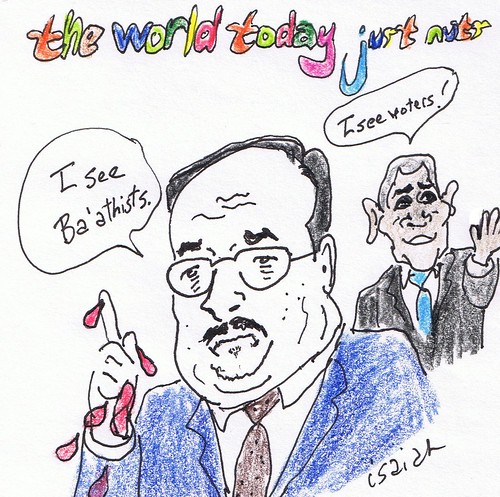
Isaiah's The World Today Just Nuts "I See Ba'athists" went up Christmas Day.

I see Ba'athists

Harretz (Isaraeli newspapers) has a story about Ron Paul:


Republican presidential hopeful Ron Paul supports calls for the abolishment of Israel as a Jewish state, and the return of it in its entirety to the Arabs, though he is not an anti-Semite, a former senior aide of the libertarian Texan congressman wrote in a blog on Monday.

“He wishes the Israeli state did not exist at all,” Eric Dondero wrote in his blog on the RightWing News website. “His view is that Israel is more trouble than it is worth, specifically to the America taxpayer.”

“He sides with the Palestinians, and supports their calls for the abolishment of the Jewish state, and the return of Israel, all of it, to the Arabs,” Dondero added.

Responding to the column, CBS News quoted Ron Paul's spokesman Jesse Benton as saying that, "Eric Dondero is a disgruntled former staffer who was fired for performance issues. "

"He has zero credibility and should not be taken seriously," Benton added.


I'm sorry but I think I've heard these attacks before.  (I'm not accusing Harretz of attacking, they're covering a story.)  Usually we hear it from our 'pals' at US Socialist Worker.  You know the rag that pretends to hold people accountable but whored the last bits of their good name for War Hawk Barack in 2008?

Sharon smith and others will show up and insist that Ron Paul is this or that.

He has disowned the statements.

I don't know what else he can do.

If someone can prove something, than they need to.  But at present, I've heard this story many times before. The newsletter story is old news.  (I know some are only learning about it now.  I saw a blogger claim Paul had never been vetted and thought, "Oh, honey, stick to your bad blogs about non-politics.")

"Iraq snapshot" (The Common Ills):
Tuesday, December 27, 2011.  Chaos and violence continue, Iraq's political crisis continues, did someone "close" to Nouri murder a journalist, Barack may not be the new Jimmy Carter (but he may be a new version of another recent one-term president), and more.
 
How bad are things in Iraq right now?  The editorial board of the Hindu Times insists, "It has also exposed the hollowness of Washington's claim that Iraqi democracy is now stable enough to justify the December 18 removal of the remaining U.S. combat troops."
Alsumaria TV reports that Iraqi Prime Minister Nouri al-Maliki has pronounced calls to dissolve Parliament as "untruthful and delusive."  Calls to dissolve the Parliament? Yes, things got even wilder over the weekend.  Mustafa Habib (Al Mada) observed Saturday that Nouri al-Maliki's targeting Iraqi Vice President Tareq al-Hashemi with terrorism charges and calling for Deputy Prime Minister Saleh al-Mutlaq to be stripped of his office have many noticing that both are members of Iraqiya (which came in first in the March 2010 elections; Nouri's State of Law came in second) and, therefore, political opponents of Nouri and that, while the political crisis has revealed a diminished role for the US, it has underscored that the Kurds remain the heart of the country's political process. Dar Addustour reported that Speaker of Parliament Osama al-Nujaifi announced the postponement of the scheduled meeting last Friday of the political blocs while Nouri's spokesperson floated the notion that there are other charges waiting in the wings. Reportedly this includes charging the Minister of Finance, Rafie al-Issawi, with terrorism, specifically with killings in Falluja back in 2006. Like Tareq al-Hashemi and Saleh al-Mutlaq, Rafie al-Issawi is a member of Iraqiya.  al-Hashemi was meeting with Kurdish officials in the KRG when Nouri made his charges and al-Hashemi has remained in the KRG since the charges were made.
 
And opinions flew right and left. Dar Addustour zeroed in on Hoshyar Zebari, Foreign Minister, issued a statement declaring the matter should have been resolved by the political blocs but has instead played out in the press. Zebari is Kurdish and a member of the PDK political party -- KRG President Massoud Barzani is the head of the PDK.  Al Mada added that Kurdistan Regional President Massoud Barzani and US Ambassador James Jeffrey spoke Friday and were calling for a meeting among the political blocs.   Rudaw has quoted the KRG President's chief of staff Fuad Hussein stating, "There's no way we would hand over Hashimi to Baghdad. He is our guest."  Al Mada noted that State of Law was whining about the Friday meet-up, about having one and including Iraqiya because Iraqiya is boycotting Parliament and so Nouri's political slate does not feel that Iraqiya should be included in the dialogue.   Aswat al-Iraq noted, "Iraqiya bloc leader Iyad Alawi described recent events in Iraq as 'liquidation of differences', warning an explosive era waiting Iraq in the coming days, according to an interview with Arabia TV late yesterday (Friday)."  And throughout the weekend, as  Aswat al-Iraq reported, Iraqiya floated that Parliament to withdraw trust from Nouri.  On the topic of Iraqiya, the game Nouri's decided to play can play both ways.  Journalist Hadi al-Mahdi was assassinated September 8th. Earlier in the year, he had a run in with Nouri's goons.  February 26th,  Stephanie McCrummen (Washington Post) reported:


Four journalists who had been released described being rounded up well after they had left a protest at Baghdad's Tahrir Square. They said they were handcuffed, blindfolded, beaten and threatened with execution by soldiers from an army intelligence unit.
"It was like they were dealing with a bunch of al-Qaeda operatives, not a group of journalists," said Hussam al-Ssairi, a journalist and poet, who was among a group and described seeing hundreds of protesters in black hoods at the detention facility. "Yesterday was like a test, like a picture of the new democracy in Iraq."
NPR's Kelly McEvers interviewed Hadi for Morning Edition after he had been released and she noted he had been "beaten in the leg, eyes, and head." He explained that he was accused of attempting to "topple" Nouri al-Maliki's government -- accused by the soldiers under Nouri al-Maliki, the soldiers who beat him.  Excerpt:
 
Hadi al-Mahdi: I replied, I told the guy who was investigating me, I'm pretty sure that your brother is unemployed and the street in your area is unpaved and you know that this political regime is a very corrupt one.
 
Kelly McEvers: Mahdi was later put in a room with what he says were about 200 detainees, some of them journalists and intellectuals, many of them young protesters.
 
Hadi al-Mahdi: I started hearing voices of other people.  So, for instance, one guy was crying, another was saying, "Where's my brother?" And a third one was saying, "For the sake of God, help me."
 
Kelly McEvers: Mahdi was shown lists of names and asked to reveal people's addresses.  He was forced to sign documents while blindfolded.  Eventually he was released.  Mahdi says the experience was worse than the times he was detained under Saddam Hussein.  He says the regime that's taken Sadam's place is no improvement on the past. This, he says, should serve as a cautionary tale for other Arab countries trying to oust dictators. 
 
Hadi al-Mahdi: They toppled the regime, but they brought the worst -- they brought a bunch of thieves, thugs, killers and corrupt people, stealers.
 
And then Hadi ended up killed in his own home and many felt Nouri was responsible.  Al Mada reports that Maysson al-Damalouji, Iraqiya spokesperson, held a press conference in which she stated that they have files showing the involvement of someone close to Nouri in the assassination. Dar Addustour adds that the official minutes of the investigation into Hadi's assassination features witnesses stating they had been sent threatening letters from a close associate of Nouri's but that the investigation did not follow up on that.
 
 
That covers many of the political blocs weighing in over the weekend but not all.  In the midst of the political crisis, radical cleric Moqtada al-Sadr strode in striking a pose of leadership (genuine or not, I'll leave for others to decide).  It started, as Sinan Salaheddin and Qassim Abdul-Zahra (AP) reported, with Moqtada proposing a "14-point 'peace code'."
No one in Iraqi or US media seemed to interested in going over the 14 points (or any of them actually) but they became less important as Moqtada and his bloc made more proposals.  Monday  Suadad al-Salhy (Reuters) reported cleric Moqtada al-Sadr declared  that new elections are needed. Dan Morse (Washington Post) adds that Moqtada wants elections "within six months" That's not all Sadr's calling for. Aswat al-Iraq notes:

The Leader of the Shiite Trend, Muqtada al-Sadr, has called Sunday for the trial of Iraq's Vice-President, Tareq al-Hashimy, under the auspices of the Parliament, warning at the same time from the single-party power on the political process in the country.
Answering a question by one of his followers in Baghdad, about the fate of Tareq al-Hashimy, Sadr said: "The issue of Hashimy's trial should take place under
the auspices of the Parliament and the people," adding that "even the sacking of politicians from their posts must take place in a legal manner."
"The issue of confessions against Vice-President, Tareq al-Hashimy and the raising of this issue at the current period may harm the country, its unity and security, including the downfall of the current political process and the security situation, along with harming the political process as well," Sadr said.


What's going on? Moqtada only supported Nouri for prime minister when Tehran told him to. Early on, he'd declared he'd abide by the wishes of his followers and they voted in their own poll in the spring of 2010. They rejected Nouri. Dropping back to the April 7, 2010 snapshot for the results of the referendum Moqtada called:
Moqtada al-Sadr's bloc won 40 seats in the Parliament. Kadhim Ajrash and Caroline Alexander (Bloomberg News) report that Ibrahim al-Jaafari "won 24 percent of the 428,000 ballots cast in the internal referendum, ahead of al-Sadr's second cousin, Jafar Muhammad Baqir al-Sadr, who obtained 23 percent, Sadrist spokesman Salah al-Ubaidi said today in the southern city of Najaf." Al Jazeera notes that Nouri al-Maliki received 10% of the vote and Ayad Allawi 9%. The US military invaded Iraq in March 2003 (and still hasn't left).

 
Following the results, Moqtada kept his anti-Nouri stance for months. Has he broken with Nouri?  Earlier, he was among those calling for the Erbil Agreement to be followed.  After coming in second in the March 2010 elections, Iraq went into eight or so months of Political Stalemate I in which Nouri refused to allow the Constitution to be followed because he was not willing to give up the post of prime minister.  Iraq's current crisis didn't just emerge this month, they have deep roots.  Today AP observes, "In the week since the last American troops left Iraq, Shiite Prime Minister Nouri al-Maliki ordered an arrest warrant for the country's highest-ranking Sunni official, threatened to exclude the rival sect's main political party from his governmt and warned that 'rivers of blood' would flow if Sunnis seek an autonomous region."  Going back to the roots of the current problems . . .
 
Political Stalemate I ended in November of 2010 with the Erbil Agreement hammered out in Erbil between the major political blocs (and the US) whereby every one was supposed to make concessions. The Kurds would get to keep Jalal Talabani as president. They thought they would get three vice presidents. Iraqiya won the elections in March 2010 and the political bloc was headed by Ayad Allawi. Nouri wasn't stepping down and the White House was backing Nouri. For Nouri to remain prime minister, Allawi was promised he would head a new, independent council over security issues. He was also promised that the Iraqiya candidates demonized as Ba'athists and forced out of the 2010 elections by Nouri's friends would have their names cleared.

On November 11th, the new Parliament held their first real session. They voted Osama al-Nujaifi Speaker of Parliament (he was from Iraqiya and that was part of the Erbil Agreement), Jalal was named president and Nouri was named prime minister designate (but we were all informed in the following days that this was 'unofficial' -- once named prime minister-designate, you have 30 days, per the Constitution, to put together a Cabinet and get the Parliament to sign off on each member). But what of the security council? What of clearing the names of the falsely accused?

That would come, State of Law insisted, in time.

Allawi and a number of Iraqiya members walked out. They should have refused to participate from that day forward. Instead, they foolishly believed promises (from both State of Law and the White House). Nobember 25th, Jalal 'officially' named Nouri prime minister-designate.

Nouri had created Political Stalemate I by refusing to surrender the prime minister post. He'd done that for eight months. In that time, he should have had some ideas about a Cabinet. But Nouri's problem was he over-promised to get support. So when it was time to name a Cabinet, suddenly the Cabinet had more ministers and deputy ministers than it had previously (from 37 in 2006 to 42 in 2010). And he still couldn't keep his promises to everyone.

December 21, 2010, the Constitution was tossed by the wayside and Nouri was allowed to move from prime minister-designate to prime minister because he'd assembled a kind of Cabinet. He named 31 out of 42 ministers and people pretended that was good enough. He had failed to meet the Constitutional mandate of naming a Cabinet but everyone looked the other way.

He refused to name the security posts: National Security, Interior and Defense. His defenders (including the White House) swore those posts would be named in a matter of weeks. His detractors saw the refusal as part of a pattern of power grabs on Nouri's part and stated he wouldn't fill the posts. This is the start of Political Stalemate II.
 
 
He may now feel it is time for him to become prime minister -- allegedly, for backing Nouri in 2010, Tehran promised to back him (Moqtada) the next go round. Printing ballots and other issues would take at least six weeks. While most would be scrambling during such a short period, Moqtada's group wouldn't be. They demonstrated that when they had millions vote -- they allowed non Sadrists to vote as well if they wanted -- on whether or not Moqtada should back Nouri. They were able to print ballots, count ballots and release a total in an orderly fashion that really drove home the foot dragging of Nouri and company. To have a strong say in Parliament, they'd also have to expand outside of their traditional areas (focusing just on the areas they dominate population wise would result in no more than 40 seats (there are 325 seats in the Parliament).

Wolf Blitzer (anchor of CNN's Situation Room) sees Iraq going the way of Yugoslavia, "But with U.S. troops now out of the country, I suspect we could be on the verge of seeing Iraq spiral into civil war. We already have seen a series of terrorist attacks in recent days. My fear is that this will only get worse. The Sunnis clearly don't trust the Shiites, especially Shiite Prime Minister Nuri al-Maliki. Some of his recent actions, including an arrest warrant for the Sunni vice president, have fueled this fear of a civil war." AFP, however, speaks with the UN Secretary-General's special envoy to Iraq, Martin Kobler, who insists that despite "significant security problems," he does "not expect the outbreak of civil war."
Whether he expects it or not, violence is garnering attention.  Last night Nightline (ABC) featured a report from Iraq.
 
 
Martha Raddatz: They could be scenes from the height of the US war in Iraq, at least a dozen explosions tearing across Baghdad in the last few days, car bombs and improvised explosive devices targeting schools, markets and today the Interior Ministry leaving more than 60 dead and hundreds wounded. And in halls of power, a different kind of crisis. The Shi'ite dominated government issuing an arrest warrant for the Sunni Vice President accusing him of ordering attacks on government on government officials and police officers.
Thursday's Baghdad bombings resulted in over 70 dead and over 200 injured.  The attack on the Ministry of the Interior was Monday and  Reuters noted it was a Baghdad suicide car bombing which claimed 7 lives and left thirty-four people injured.  Today Reuters notes a Hawija car bombing claiming 2 lives (two more injured) and a Mussayab roadside bombing injuring one Iraqi soldier.
 
The violence has not helped the economy.  Iraq is seeing even more inflation and there is concern about the dinar (Iraq's unit of currency).  In other financial news, Roy Gutman (McClatchy Newspapers) explains, "To understand the economic shambles that is Iraq, look no further than the banking sector.  There are no electronic funds transfers for payroll or bills and almost no checking accounts or credit cards.  ATMs are few and far between.  There are no home improvement loands and few mortgages.  For most Iraqis, banks serve only as a safety deposit bank."
 
 
As Iraq goes into chaos, Barack Obama has to worry.  The comparison to Jimmy Carter was apt.  (And, again, Elaine made it back in 2007 before anyone.  Good call on her part.) It would be even more so if a hostage situation emerged in Iraq (something many believe is possible).  But what it really looks like right now, we're on US domestic politics, is Barack's not Jimmy Carter.
 
He's George H.W. Bush.   Gallup and all the other meaningless polls gave Bush -- er, Barack a bump in their just released polls.  Just like at the end of the Gulf War.  Bush couldn't connect with average Americans (patrician, just like Barack) and didn't appear to understand their concerns (ibid) and was stiff (ditto).  Now his 'achievement' crumbles.  Now Barack finds out that Iraq's really the angry john that's going to slap him in the face with its penis.
 
Why they were ever stupid enough to believe that they could manage what no one else could is a question for the history books.  But they truly thought they could turn Iraqi into election fodder.
 
And certainly the media has, yet again, been in the tank for Barry O.  As the Iraqi political crisis deepend all last week, ABC World News, the CBS Evening News and NBC Nightly News never said "boo" -- not one word about it, not one word about the arrest warrant Nouri put out on the country's vice president.  Not one damn word.    (If you're late to the party on that NEWS BLACKOUT, refer to "TV: News on the 'news'" and "ABC, CBS and NBC placed on academic probation" and "How do you spell 'lie'? ABC, CBS and NBC.")
 
And as Americans were kept -- intentionally kept by broadcast commercial news -- from the realities of Iraq, it was feel-good, pump those polls and that approval rating.  But as someone who saw the Iraq rise and fall of George H.W. Bush, the 'messaging' seems really familiar and so does the outcome. And what may be most scary is that even the saddest simpleton, watching the last years play out, should have known the chances that Iraq was going to roll over and fetch for you just because you were the president of the United States, those chances were always going to be zero.  Because, though still occupied, Iraqis are independent people and they will not be harnessed to serve some foreign country.  Their leaders may betray them (as leaders of all countries can do), but the Iraqi people themselves are fiercely independent and will never be a serene backdrop for the ambitions of any foreigner.  Again, that should have been obvious to even the most simple minded observer of the last few years.
 
Peter Feaver (Foreign Policy) observes of the political crisis:
 
Besides, it is Bush's fault, the bitter-ender Obamaphiles say, because he saddled Obama with the 2008 framework agreement that  set the 2012 troop exit deadline.  Of course, to cling to this view requires ignoring that both sides, U.S. and Iraqi, viewed the 2008 agreement as an interim step, one that would be renegotiated after the Iraqi elections to allow for a longer-term U.S. presence.  More problematically, it requires ignoring the lengthy but ultimately failed negotiations by Obama-appointed representatives to accomplish just such an extension.
So the Obama spin involves a remarkable double twist.  Anything favorable that happens in Iraq is due to Obama's courageous decision to end U.S. involvement.  Anything unfavorable that happens cannot be blamed on Obama because he had no choice but to do what he did.  I have encountered Obama supporters who flip back and forth between these two lines multiple times in one conversation.

The only way Barack didn't own Iraq -- and all the tragedy that could end up following -- was to immediately begin withdrawing brigades from Iraq upon being sworn in and to have them all out before the end of 2009.  That is what he misled voters into believing was his plan, was his promise.  By refusing to do that, by attempting to negotiate a US presence beyond 2011 and by keeping the forces there under Bush's agreement, he bought the Iraq War.  And don't forget that negotiations are ongoing on the US troops in Iraq issue.  And the current climate really lights a fire under the administration -- especially to get a quick fix on damage control -- to push through some form of an agreement for troops on the ground.  If they're going to make a deal they need to announce it quickly -- and they know that -- because the Republicans like John McCain look psychic right now to many paying attention.  (The senator is not psychic.  Nor is he right but Barack chose to play the game on McCain's court and now he has to put up a defense to hold back McCain.)
 

Turning to radio, on this week's Law and Disorder Radio -- a weekly hour long program that airs Monday mornings at 9:00 a.m. EST on WBAI and around the country throughout the week, hosted by attorneys Heidi Boghosian, Michael S. Smith and Michael Ratner (Center for Constitutional Rights) -- topics explored include Bradley Manning's Article 32 hearing, Mumia, and Lynne Stewart.

Lynne Stewart is an attorney, grandmother and political prisoner in the United States. There is no law on the books that Lynne broke but she is in prison. Her 'crime'? Allegedly breaking an order -- not a law -- by issuing a press release for a client in the 90s. The Clinton administration reviewed the actions and saw there was no point in prosecuting. Lynne's the people's lawyer, a radical who stands up for the oppressed. You just knew Bully Boy Bush was going to dig back in during his administration and they did. A hearing took place in NYC where they attempted to scare the jury with false 9-11 linkage. Lynne was sentenced to twenty-eight months. The government -- by this time the Barack administration (July 2010), not the Bush administration -- wasn't pleased and had a higher court order the judge to resentence Lynne. She was sentenced to ten years. The 72-year-old political prisoner has now been in prison for two years -- with many medical conditions. Among other things, Lynne has suffered from breast cancer. Excerpt from the broadcast:

Michael Ratner: We had Lynn in the seat you're sitting in, I don't know, when was it, two years ago?

Ralph Poynter: She has served two years in November.

Michael Ratner: Oh my gosh.

Ralph Poynter: And she is looking forward to her attorney Herald Fahringer presenting to the court once again testing the law in February, that will be February 29th at Federal Court and we are planning a Occupy the Courtroom -- and Occupy the Park the night before, the 28th through the 29th, the date of her -- not her appearance, the day that there will be a hearing of her case. And she says you take each struggle as it comes. And she has a way of being funny, her spirits are good. She said to me, "Little did I ever think that I would be putting my hopes in the hands of Clarence Thomas." And I say, "Lynne, that is funny, but not in your circumstance."

Heidi Boghosian: Right. Ralph, tell us exactly what the lawyer will be asking for.

Ralph Poynter: He will be talking about the sentencing. The change from the 28 months to the 120 months. Nothing changed [there was no new hearing on new charges, the jury had already rendered their verdict years prior] and the laws that Judge [John G.] Koeltl used to extend his rationale for extending it was as ridiculous, you might say, as the Weapons of Mass Destruction but they got over with that, so they might get over with these two ridiculous cases that he used. One where they didn't know about a sex offender putting on video of a 10-year-old that he was offending sexually and another one where the government, when the sentence was given, did not know that the person being sentenced had stolen far more money, federal money, than they had imagined. So they used that as an example of being able to extend sentences.

Heidi Boghosian: So you're saying those examples don't work at all?

Ralph Poynter: They don't work whatsoever.

We'll be noting more from the segment this week. More information on Lynne can be found at Justice For Lynne StewartCindy Sheehan (Cindy Sheehan's Soapbox) is calling for people to write Lynne letters of support (Ralph tells Heidi and Michael that all the letters mean so much to Lynne).  And Cindy interviewed Ralph on her radio show here.


Saturday, December 24, 2011

Iraq

Isaiah's The World Today Just Nuts "The War on Social Security"
the war on social security

It is amazing to me how hard the White House has sold this 'payroll tax cut' that really doesn't provide $40 for most families.  It surprises me until I realize that this is part of the continued effort to break Social Security and destroy the program.  That's long been sought by Republicans and some Democrats.  Only under faux Democrat Barack could it happen.

"Obama Failed Iraq" (Hiwa Osman, Rudaw):

The Republicans could easily win the next election: All they would need to do is focus on Iraq, specifically President Obama's decision to withdraw and hand the country to Iran, its militias and anti-American forces.
It seems that given the anti-American nature of Iraq’s Arab population, nothing was built during America's presence in Iraq. This is simply because they either did not believe in America, did not take them seriously or hated the United States and just wanted to fool them into believing that they were listening.
Just a few days after President Obama declared that Iraq was stable and secure, a real crisis is prevailing both politically and in terms of security. The main reason for this is the very first issue that everyone in the new Iraq seems to be working on – the trust between the Shia and the Sunnis, which today amounts to zero.


Yes, Iraq has gone to hell.  It would have whenever the US finally pulled out; however, the White House could have made Iraq's chances at success stronger if they hadn't backed the thug Nouri al-Maliki.  He's the one who has terrorized the country.  He's the one doing it now.  Sending people into a panic.

The White House sent a message that the Constitution doesn't matter and that voting doesn't matter when they backed Nouri.  (His political slate came in second in the elections, not first.  Iraqiya came in first.)

"Iraq snapshot" (The Common Ills): 
Friday, December 23, 2011.  Chaos and violence continue, Christmas gets cancelled in Iraq, the Baghdad meet-up gets the axe, Nouri continues to bluster as the political crisis gets deeper, and more.
 
Stealing from Mike to name an idiot of the week:  Uma Purushothaman. who writes (Daily Pionner), "One of the ways in which the US has left Iraq a better place is that it has nudged the country towards democracy.  The country has had elections and now has an inclusive, elected government." Sorry, Uma, stupidity does not pay (unless you anchor a US commercial, broadcast TV newscast).  Iraq held parliamentary elections March 7, 2010.  But it does not have an inclusive, elected government.  Nouri al-Maliki's slate came in second in those elections, he refused to surrender the post of prime minister, the US backed him in that and he retained the office despite the will of the people, the election results and the country's Constitution.  Sorry, Uma, stupidity isn't pretty.  And for those late to the party on that, we'll ape Mike and quote this from the Independent of London editorial: "The deal Washington did between the Shia, Sunni and Kurdish sections of the Iraqi population was always uneasy.  The danger of its fragmenting, now that the nine-year US and Shia have each been quick to blame the other.  Either way, it is clear that there are strong forces in the country who have been waiting for this moment to make their move to achieve supremacy."  Or you can refer to Ruth, "Because the White House screwed over Iraqiya before. That is who the reporters mean by 'Sunni Muslim minority,' by the way. And, no, Iraqiya is not 'Sunni.' It is a mixture of Sunni and Shia and others as well. They are a non-sectarian slate and are headed by (Shi'ite) Ayad Allawi. Iraqiya came in first in the March 2010 elections so Mr. Allawi should have been given first crack at forming a government as prime minister designate. If he had been successful at forming a government within 30 days, then he would have moved from prime minister designate to prime minister."  And your first hint that there's no democracy in Iraq, or foundation for it, people don't elect exiles, they elect their own.  But, as Marcia has pointed out, the US-created government in Iraq is one of exiles (including Nouri).
 
 
Yesterday, Baghdad was slammed with bombings. All week long, ABC, CBS and NBC have chosen to ignore Iraq in the nightly news casts. This despite the fact that Nouri al-Maliki, prime minister and thug, has sworn out an arrest warrant on Vice President Tareq al-Hashemi. This despite the fact that al-Hashemi went to the KRG to meet with officials there and now remains there for his own protection. This despite the fact that Nouri is also attempting to strip Deputy Prime Minister Saleh al-Mutlaq of his office (and immunity). This despite both men are members of Iraqiya -- the political slate which won more votes than did Nouri's State of Law -- and both men are Sunni.  When they finally addressed Iraq last night, all three chose not to inform their viewers of anything that Nouri's done and focus on the bombings only.  What commercial broadcast TV wouldn't do, public radio did.  On the second hour of today's Diane Rehm Show (NPR), Diane and her guests Susan Glasser (Foreign Policy), Abderrahim Foukara (Al Jazeera) and David E. Sanger (New York Times) discussed Iraq.  Excerpt.
 
Susan Glasser: If you look at the political instability racking Iraq --
 
Diane Rehm: Exactly.
 
Susan Glasser: -- literally hours and days after the last American troop left and you can see what the scenario is going to look like potentially in Afghanistan, in a place where the threats could be even more directly to US interests.
 
Diane Rehm: Do we know who's responsible for the worst day of violence that Iraq has seen in more than a year?  Do we know who committed those acts.
 
Susan Glasser: Well you know you immediately, as in Syria, saw claims from the government that this was al Qaeda related.  And remember, this is in the context -- as David pointed out --  of the widening sort of sectarian violence that has been and will be the context for the political fight that's playing out over who controls Iraq.  Remember that Prime Minister Nouri al-Maliki who has now gone after Iraq's sitting vice president who is a Sunni, you have the rise of this Shi'ite majority in Iraq and I think that is the context of the political struggle taking place.
 
Diane Rehm: So how fragile is Iraq's government right now?
 
Abderrahim Foukara: It seems to me extremely fragile.  It seems to be a self-fulfilling prophecy that when the US was there, people were saying the-the situation currently is what it is because US presence -- because of US presence.  Now that you don't have that US presence, a lot of people are going back and saying US presence was actually the cement that was keeping superficially somewhat Iraq together.  Now that the US is out, it seems that you have to hark back to what happened the time of the surge when the Sunnis in Anbar Province -- who were actually by the way have been the most vocal in celebrating the departure of US troops.  You had the Arab "Awakenings" [Sahwa] there, you had the Arab tribes there, working with the  US government at that time to fight al Qaeda. And everybody at that time was saying, 'Okay, the surge has worked.  But it has also given various parties in Iraq time to actually reassemble their strength and once the US is out, you are going to see a surge of the violence including the sectarian violence. So right now, Iraq looks --
 
Diane Rehm and Abderrahim Foukara (together): -- very fragile.
 
Diane Rehm: And do you see that fragility really turning back into what could be described as civil war?
 
 
Susan Glasser: You know I think that has to be a real possibility.  As we're talking, I'm thinking about this conversation merging Iraq and Afghanistan, I can't help think of what happened in Afghanistan after the Soviet withdrawal in 1989 and what you had was first a political crisis and many thought that [Mohammed] Najibullah, who was the Soviet-installed ruler of Afghanistan, wouldn't last out the year.  He managed to but at the cost of literally a sort of  cycle of violence that the country has not gotten out of yet and of course ultimately with his body being dragged through the streets.  And you know, these scenarios are very real.
 
[. . .]
 
Abderrahim Foukara: Just wanting to go back to Iraq and the possibility of specter of civil war.  Yes, that's one possible scenario.  The other possible scenario -- and remember that when Saddam [Hussein, former president of Iraq] was in power, one of the main pieces of rationale that he gave for being the tough guy, dictator that he was is that Iraq could only work if it had a tough guy leading it. And I think the other scenario that we could be looking at now is Maliki turning into that tough guy to hold Iraq together which would be goodbye to any talk or any hope of a democratic Iraq even in -- even in the long future. And I think Maliki has so far shown all the signs that he wants to be another Saddam of a kind.  Whether he will actually be forced to go all the way there, we don't know.  But he's showing signs of that.
 
 
Susan Glasser: Well, you know, in fact, that's exactly what the political opposition to him is calling him already: The Shi'ite Saddam.  We had an interview this week with Vice President Hashemi who is now seeking refuge in Kurdistan in order not to be arrested by -- by supposedly his partner in the government and that's exactly what he said.  He said not only is Maliki turning into Saddam but he was making the case, and it shows you how inflammatory the rhetoric has become, he said, "Well actually Maliki's worse than Saddam," you know, in this interview with us because Saddam brought this stability.  But I have to say, take this with a grain of salt, right? This is what every tough guy says in order to justify his dictatorship.  Remember, I'm thinking about Russia and what is it that Vladmir Putin said a dozen years ago when he came to power? He said, 'Well, it's time for us to restore stability, we need to have a strong hand again to govern Russia. It's the only way to keep the state intact..'
 
Before we move further, a few things to note.  Twice this week, we quoted from Deborah Amos' "Confusion, Contradiction and Irony: The Iraqi Media in 2010," Harvard's Joan Shorenstein Center.  Deborah Amos is with NPR and the author of one of 2010's important books  Eclipse of the Sunnis: Power, Exile, and Upheaval in the Middle East which I wished we linked to.  (One day we did and there wasn't room.  Also a similar note was supposed to go in yesterday's snapshot but was cut for space.)  Second, Wednesday's snapshot included: "In other news, Arwa Damon and Wolf Blitzer (CNN) report that, yes, indeed, CIA Director David Petraeus was just in Iraq."  What rumors, a few e-mails asked?  Since it was in the first paragraph (after the introduction) of Tuesday's snapshot:
 
 
How bad are things in Iraq right now?  Reidar Visser (Iraq and Gulf Analysis) notes a rumor,  "The reported appearance of CIA director David Patraeus at a meeting of Iraqiyya yesterday seems somewhat extraordinary. If true, it could be indicative of how Washington sees the situation in Iraq after the withdrawal. Critics will claim that after two years dominated by Joe Biden diplomacy, it is perhaps somewhat late in the day to begin sending competent special envoys to Iraq."  The rumor may have truth to it, it may be completely false.  But its very existence, it merely being uttered goes to just how out of control things are in Iraq.
 
Reidar Visser had first reported the rumors that were confirmed the following day. On yesterday's bombing, Raheem Salman and Alexandra Zavis (Los Angeles Times) explain:
 
 
Sirens wailed, smoke billowed and blood pooled on the pavement.
The scenes of devastation were all too familiar after more than a dozen explosions ripped through the Iraqi capital Thursday, killing at least 60 people and injuring nearly 200, just days after the last U.S. troops left the country.
[. . .]
By nightfall, fear gripped the city and some residents were already talking about the need to arm themselves again.
 
CARBERRY: Ahmed Mahdi is a 22-year-old who's selling chickpeas from a cart outside the cafe. He says the explosions were the result of the political crisis that erupted last weekend just as the last American convoy was packing to leave. Word came out of an arrest warrant against the Sunni Vice President Tariq al-Hashemi. The government of Shiite Prime Minister Nouri al-Maliki has accused Hashemi of running assassination squads that have killed political and military officials.
 
MAHDI: (Foreign language spoken)
 
CARBERRY: Ahmed Mahdi believes that supporters of the embattled Sunni politicians carried out the bombings. Sectarianism has been on the rise and there's fear that things may be reaching critical mass.
 
Aswat al-Iraq reports, "Civil Society Forum (CSF) shouldered Iraqi politicians and the three presidencies the responsibility of the bloody explosion which hit Baghdad yesterday.  CFS regarded these explosions as a reflection of the failure of Iraqi politicans, following US forces withdrawal."
 
 
Hashemi has vehemently denied the charges against him, arguing that they are politically motivated and yet another effort by Maliki to consolidate power. When asked if Maliki has become a Saddam-like figure since assuming power in 2006, as fellow Iraqiya leaders Saleh al-Mutlak and Iyad Allawi have suggested, Hashemi noted that "many of Saddam's behaviors are now being exercised by Maliki unfortunately." But he added that Saddam rebuilt Iraq in six months after the invasion of Kuwait and the Gulf War in the early 1990s. In contrast, under Maliki's leadership, Hashemi pointed out, the consulting firm Mercer ranked Baghdad the worst city in the world in terms of quality of life.
 
That isn't saying Nouri is worse than Saddam.  There is nothing in the interview that meets that claim and Susan Glasser must have been confused.  However, those saying he is worse have many reasons to say so.  Though Diane Rehm laughed at the thought of Nouri as worse than Hussein, it's not off-base.  When Saddam Hussein had US support (as Nouri does),  Saddam wasn't repeatedly exposed as a torturer publicly.  What Saddam early on had to do in secret, Nouri's done as the world watches.  That's only one way that Nouri is worse than Saddam.  Many groups can claim a better life under Saddam (and have, check the public record) than under Nouri.  Those include Iraqi Jews which can now be counted on only two hands, Palestinians in Iraq, women in Iraq, and many more groups.  Back to the interview of Tareq al-Hashemi:
 
 
"Now everything is in his hands: the ministry of defense, the ministry of the interior, intelligence, national security," Hashemi claimed. He wants his case transferred to Kurdistan because he doesn't think Iraq's judicial system is independent. Instead of judiciary authorities responding to his appeal, the vice president notes, Maliki himself shot down the request during his press conference yesterday, calling instead for Kurdish officials to hand over Hashemi. "The judicial system is really in his pocket," Hashemi argued.
When asked if Maliki is also in Iran's pocket, Hashemi responded that the prime minister "is very close to Iran" and that Iraqiya's Allawi -- not Maliki -- would be prime minister now if not for the "interference of Iran." When Iraqi leaders agreed to a power-sharing deal last year, Hashemi said, "Iran actively supported Maliki, and we discovered in due course that the United States also supported Maliki. Whether this was a coincidence or deliberate or behind-the-scenes coordination I don't know. But this is what happened."
Hashemi says he had a brief telephone conversation with U.S. ambassador to Iraq James Jeffrey when the American diplomat cut short his holiday vacation and rushed back to Baghdad to help resolve the current standoff. "I asked him to do his best and try to reach some sort of compromises and try to accommodate this crisis," Hashemi explained. "He promised me to do his utmost and talk to Maliki." Hashemi says Ambassador Jeffrey also suggested that he would come and meet with the vice president in person, though this has yet to happen.
 
So that's Jeffrey, US Vice President Joe Biden, CIA Director David Petraeus and General Ray Odierno that have all been attempting to aid in solving the crisis.  Geoff Dyer and Borou Daragahi (Financial Times of London) note that while these people are attempting contact, it is the huge number of employees of the US State Dept's Iraq branch (militarized) that the White House is pinning their hopes on.  Aswat al-Iraq reports, "Ahrar bloc MP described the statements of US vice-president Joe Biden on Hashimi's case as 'an avowed intervention in Iraqi internal affairs'."  The Wheeling Intelligencer editorializes that the US government better have a plan for Americans who will remain in Iraq, "But as we have pointed out, many Americans remain in harm's way there. About 16,000 diplomats, contractors and security personnel remain in Iraq. At some point, anti-American terrorists probably will target them."
 
Rebecca Santana (AP) interviews al-Hashemi today and quotes him stating, "Definitely, he [Nouri] is going to concentrate on the Sunni community because they are the society, the community of Tariq al-Hashemi so they are going to suffer. He is trying to escalate the tension, making life very, very difficult for our provinces, to our people.  [. . .] He doesn't believe in compromises. He doesn't believe in peaceful solutions to the problems. He's going to use the Iraqi army and the security for more repression."
 
Ghazwan Hassan (Reuters) reports that protests took place in Baiji, Ramadi, Samarra and Qaim today against Nouri al-Maliki and his targeting of Sunnis while Aswat al-Iraq notes 500 people gathered in Baghdad's Tahir Square "calling to hadn over vice-president Tarqi al-Hashimi to justice." No reports of attacks, of course, because when Nouri sends his employees to Tahrir Square, they aren't treated the way real protesters are.  Real protesters are beaten up by the police, kidnapped, tortured.  Nouri's employees are encouraged to protest and are rewarded for it.   Meanwhile Alsumaria TV reports Nouri is calling for the US to turn over tools of destruction to him quickly citing yesterday's bmbings as one reason.  Another reason would be his ability to target enemies more quickly and deadly with such tools.
 
While Nouri's paid employees demand Tareq al-Hashemi be returned to Baghdad, Al Mada reports that Parliament is stating that the law is not clear on this issue.  Nouri has stated, "Kurdistan has to hand over the wanted. The abstention of handing Hashemi or allowing him to escape will only cause problems," Maliki stressed adding that Kurdistan should not contribute to the escape of wanted."  Last night, Trina shared her opinion that Tareq al-Hashemi could not get a fair trial in Baghdad.  Stan's also expressed his doubt on that this week when he noted "Dan Morse ('Washington Post') reports, 'Tariq al-Hashimi said he was ready to stand trial, but only in the semiautonomous region of Kurdistan, the area to which he has fled. His statement raised the possibility of the Kurds being dragged into the political battle that has broken out between Shiite and Sunni factions of the country's central government'.''  Again, Iraqi lawmakers say the law is unclear on that point.  As Ann noted last night, the Kurds are less covered in this political crisis and she noted this from Sam Dagher (Wall St. Journal):


The Kurds, mostly Sunni Muslims who are ethnically distinct from the Arabs who dominate the rest of Iraq, find themselves once more in the position of exploiting sectarian divisions among Arabs.
The Kurds also have a stake in the political conflict. They seek to maintain, and expand, their virtual state-within-a-state in northern Iraq, which they have built largely beyond the central government's control. Both sides have long been at loggerheads over a law that would govern how oil revenues are to be shared in the country.
U.S. officials have pressed Iraqi leaders to overcome their differences. On Thursday, Vice President Joe Biden called Iraqi President Jalal Talabani to offer support for his efforts to foster dialogue, the White House said.
 
Al Rafidayn reports that the scheduled meet-up of the political blocs in Baghdad today to address these issues was cancelled.
 
In other news, Alsumaria TV reports, "Iraqi Archbishop of Chaldeans in Kirkuk and Sulaymaniah Louis Sako announced, on Wednesday, that Christians in Kirkuk decided to mark the season of Christmas in church masses and cancel Christmas celebrations due to Iraq's crisis and the continuous targeting of Christians." Peter Wilson (The Australian) reports:

Human Rights Watch estimates that more than 70 per cent of Iraq's Christians have fled their homes since the 2003 invasion.
Statistics are unreliable but the Christian population is believed to have crashed from about 1.4 million to less than 500,000, with many of those who are still in the country having sought refuge in Christian-heavy parts of Kurdistan in northern Iraq.
Mr [Ra'ad] Emmanuel [head of the Iraqi Christian Endowment] said the southern city of Basra had been virtually abandoned by Christians and there had been repeated church bombings, kidnaps and assassinations in Baghdad.
Early this week, several Christian teenagers wandered quietly inside the gutted church of Our Lady of Salvation in central Baghdad, shaking their heads at the hundreds of bullet holes left by a massacre in November last year.

Aid to the Church in Need quotes the Archbishop of Kirkuk, Louis Sako, stating, "Midnight Christmas Mass has been cancelled in Baghdad, Mosul and Kirkuk as a consequence of the never-ending assassinations of Christians and the attack against Our Lady of Perpetual Help Cathedral on 31st October, which killed 57 people." Yesterday's Baghdad bombings are also impacting the way people feel in terms of safety. Marwan Ibrahim (AFP) notes the claims that Iraq could take care of its internal security now ring hollow to some Iraqi Christians and quotes Slvan Youhanna Matti -- whose sons have already sought shelter in Belgium, Lebanon and Sweden -- stating, "I am only staying in Kirkuk temporarily -- I am waiting to leave at any second. Christians who are leaving Baghdad for Kirkuk or Kurdistan consider those places just temporary stops before they leave for good. The future is unknown, and sectarian and religious conflict hurts our confidence in the situation, especially after the US departure."

Barack declared 'progress' and praised thug Nouri. This is progress?

Someone needs to ask Barack Obama exactly how Iraqi Christians not being able to publicly observe their faith's holiest day qualifies as progress?

While the evening newscasts on broadcast, commercial TV ignored the political crisis in Iraq, PBS' The NewsHour covered Iraq with two segments on Tuesday (here and here), in the news wrap on Wednesday,  an ITN report by Inigo Gilmore Thursday covering the bombings and  Jeffrey Brown moderated a discussion of whether or not the US should have remained in Iraq. Former NSC-er Meghan O'Sullivan supported a longer stay while former Air Force officer John Mearsheimer didn't.  (All NewsHour segments are text, audio and video.)  Isaiah's The World Today Just Nuts "The War on Social Security" went up today and we'll close with this from Helen Thomas' "Iraq War Ends, But Questions Remain" (Falls Church News-Press):


Obama, who followed Bush in the White House, had one chance to pull out of Iraq the day after he took over the presidency. At that time, he was very popular and he could have moved boldly to end the wars. Instead, he chose a losing policy.
The war toll for American servicemembers includes 4,700 dead and tens of thousands wounded. The American people have been passive to fact that thousands of men and women who have gone half way around the world to fight Iraqis - none of whom were involved in the 9-11 attacks.
Hussein was anathema to the United States and Israel, who targeted him as public enemy number one. Following Israel's footsteps, we have now turned our attention to Iran and its plans to become a nuclear power.
The financial cost of the war is estimated to be somewhere between $800 billion and $1 trillion.
We are leaving Iraq not with a bang but a whimper.


Wednesday, December 21, 2011

2 keen minds

Patrick Cockburn (Independent) writes, "Mr Maliki said ominously that Mr Hashemi, who has taken refuge in Kurdistan, will receive as fair a trial as that of Saddam Hussein, who was executed in 2006."  My question was when did he come up with that?


Iraqi PM escalates crisis with ultimatum to Kurds

The Independent - ‎3 hours ago‎
Will you be buying so-called 'ethical' gifts for loved ones this Christmas? The range of goods compe... Yesterday, Moody's, the credit rating agency, threatened the UK with a downgrade of its AAA rating. ... Median households are marginally worse off ...

Today's Situation Room:

CNN (blog) - ‎5 hours ago‎
Wolf Blitzer delivers the most important news and political stories of the day. Tune to The Situation Room weekdays 4-6pm ET and Saturdays 6pm ET on CNN. By Wolf Blitzer, CNN (CNN) – When I got up early Wednesday morning, I got an e-mail from CNN's ...


3 hours ago?  Good.

C.I. was sounding the alarms over Nouri's comparison of a Tareq al-Hashemi trial to Saddam Hussein's.

So at least two people were right.  More to the point, at least two people were paying attention.

A shame no one at the White House possesses the common sense of Cockburn and C.I.


"Iraq snapshot" (The Common Ills):
Wednesday, December 21, 2011.  Chaos and violence continue, Nouri continues targeting political rivals, Nouri says 700 more US 'trainers,' the White House and the State Dept continue to be asked about what's taking place in Iraq, and more.
 
Nouri al-Malik held a press conference today.  Aswat al-Iraq reports, "Iraqi Premier Nouri al-Maliki said that 700 US trianers will work to train Iraqi forces, adding that the number of US embassy in Baghdad will not exceed 2000."  Meanwhile Dar Addustour reports that Nouri's also agreed to allow US troops ('trainers') in the Kurdistan Regional Government.  Li Hongmei (Xinhua) offered an analysis yesterday which included " Iraq, however, remains dependent on Washington, as it has no frontier force, navy or airforce. Neither police nor army, now 800,000 strong, can ensure security or provide protection from external attack or meddling.  Meanwhile, there are Iraqi people who are, on the one hand, celebrating the U.S. pull-out, and on the other, believe the U.S. exit is not a withdrawal, but an act on a stage, in that the U.S. military presence and clout would never recede with the withdrawal of its troops."
 
In other news, Arwa Damon and Wolf Blitzer (CNN) report that, yes, indeed, CIA Director David Petraeus was just in Iraq.  While there he spoke to not only Nouri al-Maliki (prime minister and thugh) but also to Iraqiya members Osama al-Nujaifi (Speaker of Parliament) and Rafie al-Issawi (Minister of Finance).  For the Tehran Times, Nosratollah Tajik offers an exploration of whether or not the US is really leaving Iraq:
 
 
At a meeting with Obama  at the White House on December 12, al-Maliki was assured a second batch of 18 sophisticated F-16 fighter planes to help rebuild the country's dilapidated air force, whose helicopters and missiles the U.S. destroyed during the war which began in March 2003. The Iraqis have already indicated that their military needs will include a total of 96 F-16 fighter jets in four separate orders. He told the Obama administration that his country will depend on the U.S. not only for new weapons systems but also for training under the U.S. International Military Education and Training (IMET) Program.
There's going to be something called the Office of Security Cooperation in Iraq after the pullout of troops. It's going to be under the auspices of the U.S. embassy, so there's not going to be a military command in Iraq. It's going to be a pretty small, 150-person office that will do training --  things like helping the Iraqi air force how to operate the F-16s that the U.S. will sell them. That's a pretty typical relationship for countries who have bought American military hardware. So, now it is clear why the U.S. plans to have the largest embassy in the world in Iraq. 18,000 people are going to work for the embassy and very few of those will be diplomats. Others will be American civil service workers and mercenaries of private security contractors: around 3,500 to 5,500.
 
I'm going to disagree with him on the issue of the Office of Security Cooperation in Iraq.


Senator Kay Hagan: Well with the drawdown taking place in less than two months, what is your outlook for the ability to continue this training process to enable them to continue to do this on their own?

General Martin Dempsey: Well they will be limited. They don't have the airlift to deliver them to the target that we might have been able to provide. They don't have the ISR target to keep persistent surveillance over the top of the target. So they'll be limited to ground movement and they'll be limited to human intelligence and we'll keep -- But part of the Office of Security Cooperation provides the trainers to keep the training to develop those other areas, but we're some time off in reaching that point.

Senator Kay Hagan: We'll, as we continue this drawdown of our military personnel from Iraq, I really remain concerned about their force protection -- the individuals that will be remaining in Iraq. So what are the remaining challenges for our military personnel in Iraq in terms of managing their vulnerabilities, managing their exposures during the drawdown?

General Martin Dempsey: Senator, are you talking about getting from 24,000, the existing force now and having it retrograde through Kuwait?
Senator Kay Hagan: The ones that will remain over there.

General Martin Dempsey: The ones that will remain --

Senator Kay Hagan: Their protection.

General Martin Dempsey: Yes, Senator. Well, they will have -- First and foremost, we've got ten Offices of Security Cooperation in Iraq bases. And their activities will largely be conducted on these bases because their activities are fundamentally oriented on delivering the foreign military sales. So F-16s get delivered, there's a team there to help new equipment training and-and helping Iraq understand how to use them to establish air sovereignty. Or there's a 141 M1 Tanks right now, generally located at a tank gunnery range in Besmaya, east of Baghdad and the team supporting that training stays on Besmaya so this isn't about us moving around the country very much at all. This is about our exposure being limited to 10 enduring, if you will, Offices of Security Cooperation base camps. And doing the job of educating and training and equipping on those ten bases. Host nation is always responsible for the outer parameter. We'll have contracted security on the inner parameter. And these young men and women will always have responsibility for their own self-defense.

Senator Kay Hagan: So we'll have contracted security on the inner-paramenter?

General Martin Dempsey: That's right.
 
That's from the November 15th Senate Armed Services Committee -- covered in the November 15th "Iraq snapshot," November 16th "Iraq snapshot," November 17th "Iraq snapshot," Ava's "Scott Brown questions Panetta and Dempsey (Ava)," Wally's "The costs (Wally)," Kat's "Who wanted what?" and Third's "Gen Dempsey talks '10 enduring' US bases in Iraq."  General Martin Dempsey is the Chair of the Joint Chiefs of Staff.  A military position.  Generally speaking, the Congress doesn't ask people for testimony unless they're over something.  So someone, for example, from Health and Human Services would never be asked about loans to small farmers.  Dempsey was asked by a knowledgable senator (Hagan) about a program he should be over and one he spoke of as though he was over. 

On to an anniversary . . .
 
It was 365 days ago today
Thug Nouri got his way
 
 
Today's vote in the Council of Representatives is a significant moment in Iraq's history and a major step forward in advancing national unity.  I congratulate Iraq's political leaders, the members of the Council of Representatives, and the Iraqi people on the formation of a new government of national partnership.
Yet again, the Iraqi people and their elected representatives have demonstrated their commitment to working through a democratic process to resolve their differences and shape Iraq's future.  Their decision to form an inclusive partnership government is a clear rejection of the efforts by extremists to spur sectarian division.
Iraq faces important challenges, but the Iraqi people can also seize a future of opportunity.  The United States will continue to strengthen our long-term partnership with Iraq's people and leaders as they build a prosperous and peaceful nation that is fully integrated into the region and international community. 
 
There was nothing there to praise.  Not only had the process been corrupted -- by the US government -- but the results did not indicate a bright future for Iraq.  First of all, not one of the cabinets had a female head. While the White House was preparing their statement,  Shashank Bengali and Mohammed al-Dulaimy (McClatchy Newspapers) were reporting not one of the ministers approved was a woman.  Did that bother the White House, this step backward?  Not a bit, not a bit.   In 2006, Nouri had been able to name women. In 2006, there were 31 Cabinet ministers.  In order to keep his promises (bribes) he had to expand the Cabinet to 42 in 2010 and yet women disappeared.   Again, the White House was not worried. On that same day,  Liz Sly and Aaron C. Davis (Washington Post) reported, "Maliki appointed himself acting minister of interior, defense and national security and said the three powerful positions would be filled with permanent appointees once suitable candidates have been agreed on." Did that bother the White House?  Not a bit, not a bit.
 
And all this time later, there is still no Minister of Interior, Minister of Defense or Minister of National Security.  Not because Parliament wouldn't approve the nominees but because Nouri al-Maliki never nominated anyone lending credence to those who charged in real time that thug Nouri was making a power grab.
 
In many, many ways, the White House violated the Iraqi Constitution and the will of the Iraqi people when they backed Nouri (2010) for a second term.  (In 2006, the Bush administration backed Nouri and nixed the choice of the Parliament.)  Trudy Rubin (Philadelphia Inquirer via San Jose Mercury News) points to the multitude of mistakes by the Bush and Barack administrations in her latest column but we'll zoom in on her commentary about 2010:
 
The White House followed a hands-off policy on Iraqi politics, allowing Maliki to slip back into sectarianism and the eager embrace of Iran's ayatollahs.
When Maliki cracked down on Sunni candidates before March 2010 elections, a visiting Vice President Joe Biden gave him a pass. When a Sunni coalition called Iraqiya edged out Maliki's party and he used Iraq's politicized courts to nullify some Sunni seats, U.S. officials didn't push back.
When Maliki failed to honor a power-sharing deal the United States had brokered between his party and Iraqiya, we failed to press him.
 
 
Last week, Iraq's former Deputy Ambassador to the UN Feisal Istrabadi, discussed Iraq with host Warren Oleny on KCRW's To the Point and Oleny asked what was the biggest mistake the Obama administration had made?

 
Ambassador Feisal Istrabadi The critical mistake the Obama administration made occurred last year when it threw its entire diplomatic weight behind supporting Nouri al-Maliki notwithstanding these very worrisome signs which were already in place in 2009 and 2010. The administration lobbied hard both internally in Iraq and throughout the region to have Nouri al-Maliki get a second term -- which he has done.
 
Istrabdi was a guest on The NewsHour (PBS) last night as the program devoted two segments to the political crisis in the country. In the first segment, Judy Woodruff went over the basics of what's been taking place since Friday.   Judy Woodruff noted (link is text, audio and video), "An arrest warrant was issued for Vice President Tariq al-Hashemi on charges that he had run death squads during the sectarian bloodbath of 2006 and 2007. As proof, the purported confession of a man named Ahmed was broadcast. He said Hashemi spoke to him through an intermediary." The second segment on this story (again, text, audio and video) found Judy exploring the events with former Ambassador Feisal Istrabadi and Abbas Kadhim. Excerpt:


FEISAL ISTRABADI: Well, let me start with the proposition that what Iraq needs is a strong leader. With all respect to my very good friend, I think that what we need are rulers in Iraq who are dedicated to the principles of constitutional democracy. Their strength lies not in the elimination or in the harassment of political adversaries, but, on the contrary, in encouraging constitutional discourse. What has been happening in Iraq in the last 24 hours cannot be seen in isolation. For the past 12 months, Prime Minister Nouri al-Maliki has refused to appoint a permanent minister of defense. That was supposed to be one of the portfolios that went to the Iraqiya coalition. They have nominated six people for that position. Each one of them has been rejected. He has appointed a member of his own coalition, the prime minister's own coalition, as acting minister of defense. He is acting as minister of the interior. And one of his cronies is acting minister of state for national security. He has cashiered career officers and appointed cronies to senior officer positions in the armed and security forces in Iraq. In other words, the prime minister has under his control as we speak all the instrumentalities of state security in Iraq. I'll remind your viewers that, in the early 1970s, this is precisely how Saddam Hussein came to power at the time. What we -- I think Iraqis, with our history, we have to be overly cautious when we see similar actions occur as have occurred in our relatively recent past. Strength in the new Iraq must be through constitutional democracy, and not through harassment and intimidation.
 
The story was ignored by the other three networks as noted this morning.  Also see Rebecca's "smelly scott pelley and the sucky cbs evening news."

Jim Muir (BBC News) explains, "Iraq's most senior Sunni Arab politician, Tariq al-Hashemi, is effectively a fugitive. While he hides out under Kurdish protection in the north, the entire al-Iraqiyya political bloc to which he belongs has pulled out of both parliament and the cabinet." (Jim Muir offers a detailed analysis here.) Al Rafidayn reports that Nouri al-Maliki, prime minister and chief thug of Iraq, has held a press conference in Baghdad today insisting that Iraqi Vice President Tareq al-Hashemi leave the KRG and come to Baghdad to stand trial for charges (brought by Nouri) of terrorism. Nouri says that Tareq al-Hashemi must not leave the country and that he should not fear a trial because Saddam Hussein was given a trial. It was fair, Nouri insists. Fair? That's in dispute. The outcome is not. Saddam Hussein was put to death. As noted in yesterday's snapshot, the sentence for the charges (Article IV terrorism) if found guilty are either life in prison or execution. As Anne Barker (AM, Australia's ABC, link is text and audio) explains, "The charges were made by Iraq's Interior ministry, which comes under the control of the Shiite prime minister and al Hashemi's long-time rival Nouri al-Maliki." The charges were made by the ministry -- not the minister because there is no Minister of Interior. Nouri refused to nominate someone to Parliament. So Nouri retains (illegal) control over the ministry.
Yesterday, the White House released the following statement:


The White House
Office of the Vice President

For Immediate Release December 20, 2011 Readout of Vice President Biden's Calls to Iraqi Leaders
The Vice President today spoke on the phone with Iraqi Prime Minister Nouri al-Maliki and separately with Iraqi Council of Representatives Speaker Osama al-Nujaifi to discuss the current political climate in Baghdad. The Vice President told both leaders that the United States is monitoring events in Iraq closely. He emphasized the United States' commitment to a long-term strategic partnership with Iraq, our support for an inclusive partnership government and the importance of acting in a manner consistent with the rule of law and Iraq's constitution. The Vice President also stressed the urgent need for the Prime Minister and the leaders of the other major blocs to meet and work through their differences together.

At the White House today, Nouri's attacks again resulted in questioning during the press briefing by White House spokesperson Jay Carney.
 
 
Q    On Iraq, the Vice President made a couple of phone calls yesterday, and I guess I'm just wondering, is the President -- has the President or has Vice President Biden spoken with the Vice President of Iraq?  What is -- what was the point of those calls?  How does President Obama feel about the arrest and the charges against this Vice President?  And what, if anything, at this point can the U.S. do about it?  Are you considering pulling aid?  If you're not -- if we're not --
 

MR. CARNEY:  Well, Margaret, let me stop you there.  First of all, I think we read out some of the calls that the Vice President made.  Separately, this kind of political turmoil has been occurring in Iraq periodically, as they have taken steps forward and, occasionally, steps backward, but generally made progress towards political  reconciliation, towards democracy, and away from the use of violence in pursuit of political ends.  That has been progress, but it has often been hard won. That will continue.  We certainly expect that there will be difficult days ahead in Iraq.  But the progress has been substantial.  What is utterly nonsensical is the suggestion that somehow we should have left troops in there, and that would have had any impact on the political disputes.  Because maybe folks weren't paying attention, but political disputes have been happening while there were 40,000 troops, 80,000 troops, 150,000 troops.  The key metric here is that those political disputes have increasingly been resolved through negotiation, not through violence, and elections were held, a government was established -- these are all signs of important progress -- all while violence declined significantly.
 
Jay Carney's head has apparently gotten as fat as his ass (keep stress eating, Jay, you look awful).  This is not about US troops staying or going.  This is about the White House backing Nouri al-Maliki for a second term.  Take accountability for that.  Yes, Senator John McCain is calling out the White House.  And calling them out for taking out the bulk of US troops (not all troops).  That's not the only criticism but focusing on that criticism does allow you to ignore the critical failure of the Barack Obama administration with regards to Iraq.  And the elections were a joke and became that when the US government refused to respect the results of the elections -- that's under Barack Obama.  Jay's a disgrace. 
 

Jay Carney: We will continue to have a robust and important relationship with Iraq.  We will continue to have frequent, I'm sure, discussions with Iraqi leaders.  And we will continue to weigh in and encourage Iraqi leaders to make smart decisions as they continue to move forward with the development of their democracy. I wanted to -- as long as we're on foreign policy, I just want to be clear on a question that Kristen had about Afghanistan.  I just want to say, on 2014, the President will make his decisions on the size and shape of our post-September 2012 presence, after the reduction of the surge forces, at the appropriate time in consultation with our Afghan and NATO partners.  Any post-2014 presence would of course be at the invitation of the Afghan government, and would ensure that we will be able to target terrorists and support a sovereign Afghan government so that our enemies cannot outlast us.  I just want to be clear about that.  But the framework that I discussed at the top was laid out at Lisbon. I think I owe you -- yes, Lesley.

Q    Can I ask a quick question, following on Margaret's question?  Do you have any reaction to the Prime Minister's sort of suggestions today that he wants to shed some of the members of the coalition government that he might not sort of get along with?

MR. CARNEY:  Look, we have -- I would refer you -- I don't have it in front of me -- to -- we did a readout of the Vice President's calls, yes -- to that statement.  And we have worked, the Vice President has and other members of the President's team have, with Iraq on the political process.  It is very important, and has been, and will continue to be, that Iraqi leaders pursue a representative government so that everyone's interests are properly represented.  And beyond that, I would just refer you to the statement we put out.

Q    He also said that the U.S. has asked him to free some of the Hashimi guards that he had jailed.

MR. CARNEY:  Who did?

Q    He said that the U.S. government had asked him to free some --

MR. CARNEY:  Maliki did?  I don't -- I just don't have anything more on that for you today.
 
Looking at the war,  George S. Hishmeh (Gulf News) notes a number of details and we'll include this regarding Anthony Cordesman's analysis:
 
Cordesman believes that the US has mistakenly "tied itself to exiles whose claims and ambitions were not in line with the hopes and needs of the Iraqi people, and were often linked to Iran".
He also points out that the Obama administration has not provided "any picture of the strategy it now intends to adopt in the Gulf region as a whole, or how it will deal with any aspect of the threat posed by Iran".

HDS Greenway (GlobalPost) argues the current events can be seen through the prism of the war itself, "What the invasion of Iraq did do was unleash all the pent-up rivalries that had been suppressed, Sunni versus Shia, and Kurds against the rest. And despite almost a decade of occupation, none of these issues have been resolved. Sunnis still long for their lost ascendency. Shiites want to consolidate their new-found power, and the Kurds still want to be masters of their own region without interference from Baghdad. The current accusations against Vice President Tariq al-Hashimi are a case in point. Either he did organize death squads, as charged, or the case against him is trumped up to intimidate Sunnis. Either way Iraq's fragile power-sharing arrangements suffer."

Iran's Fars News Agency notes, "Commander of Baghdad Police Operations Brigadier General Qassem Ata called on the security officials of the Iraqi Kurdistan region to extradite the country's Vice-President, Tariq al-Hashimi, to Baghdad to be tried for accusations of masterminding the recent bomb attacks on a number of parliamentarians."  Aswat al-Iraq adds, "Kurdish Alliance MP [Shwan Mohammed] described the charge against Vice-President Tariq al-Hashimi as 'political, not criminal'."

Al Mada notes that the Parliament is calling for a meeting with Nouri's Cabinet. In addition to going after Tareq al-Hashemi, Nouri is also targeting Iraq's Deputy Prime Minister Saleh al-Mutlaq. Both al-Hashemi and al-Mutlaq are Sunnis and members of the Iraqiya political slate. The Telegraph of London notes, "Legislators are also due to consider a call from Maliki to sack Sunni Deputy Prime Minister Saleh al-Mutlak, who has decried the Shiite-led national unity government as a 'dictatorship'." Al Mada reports that Parliament decided Monday that they would not consider Nouri's motion to dismiss al-Mutlaq until after the next year. Al Mada quotes Iraqiya head Ayad Allawi pointing out the al-Mutlaq's position was part of the power sharing agreement and that attempts to remove him besmirch the agreement. Dar Addustour reports there is now a move to request that confidence be withdrawn from Nouri.


Like Marcia, we'll note Roy Gutman, Lesley Clark, Sahar Issa and Laith Hammoudi's McClatchy Newspapers report the latest on the Iraq crisis that finds Nouri targeting political enemies:

However, U.S. officials were aware of at least one previous attempt by Iraqi security forces to coerce confessions that implicated Hashimi, a longtime Maliki critic. A November 2006 diplomatic cable obtained by WikiLeaks reported a meeting between U.S. officials in Iraq and a former Iraqi prisoner named Ahmed Mohammed Sami, who said he'd been tortured with electric shocks and other methods while in Iraqi army custody in Diyala province.
"In total he counted seven times that he lost consciousness during episodes of torture in which he was told to agree to statements implicating Vice President Tariq al-Hashimi ... and Deputy Governor of Diyala Auwf Rahoumi al-Rabai ... in terrorist activities," the cable reports. The cable didn't specify U.S. officials' reaction to the comments.


If the White House -- under either administration -- had given a damn about Iraqis, they wouldn't have backed Nouri for a second term. Especially after knowing he was repeatedly torturing and running secret prisons. The article also notes that Nouri elected to air the 'confessions' on Iraqiya TV -- that's not related to the Iraqiya political slate -- it's Nouri's own personal channel, as it demonstrated in the 2010 parliamentary campaigns.  From Deborah Amos' "Confusion, Contradiction and Irony: The Iraqi Media in 2010," Harvard's Joan Shorenstein Center:
 
[Immediately after the March 2010 elections] Prime Minister Maliki charged widespread fraud and demanded a recount to prevent "a return to violence." He pointedly noted that he remained the commander in chief of the armed force. 
Was Maliki threatening violence? Was he using the platrform of state-run media to suggest that his Shiite-dominated government would not relinquish power to a Sunni coalition despite the election results?  His meaning was ambiguous, but his choice of media was widely understood to be part of the message.  Iraq's state-run news channel, Iraqiya, is seen as a megaphone for Shiite power in Iraq, which is why Maliki's assertion of his right to retain power raised international concerns.
 

The issue of Iraq was also raised in today's US State Dept press briefing by spokesperson Victoria Nuland:
 
 
QUESTION: (Inaudible) about Iraq?
 
MS. NULAND: Yeah.
 
QUESTION: Prime Minister Maliki's news conference today? In talking about the Vice President, he said if Kurdish authorities don't release him or if he were to manage to flee the country that there may be problems, I think is how he put it. Is that not sort of a threatening tone? What was the readout here on that? 
 
MS. NULAND: Well, as you know, the [US] Vice President [Joe Biden] did have good conversations yesterday. I think the White House reported on those yesterday. We do note what the prime minister said in his press conference, and I would say that he also spoke about the need for the parties to get together. I think he called it a summit of political leaders that he wanted to have to discuss the political process and discuss power sharing, and we continue to urge all the sides in Iraq to work through their differences peacefully and within international standards of the rule of law. That's the message that we've given to the prime minister; it's the message that we're giving to all of the political actors in Iraq.
 
 
QUESTION: Does the Ambassador continue to make phone calls and meet with the various parties?
 
MS. NULAND: He does.
 
QUESTION: Do you know when the last meetings or talks were and who they were with?
 
MS. NULAND: He had more talks today. I don't have a list here with me, but as the White House reported, the Vice President spoke to Prime Minister Maliki and Speaker al-Najafi yesterday. I think that Jim Jeffrey -- Ambassador Jeffrey -- over the last couple of days has seen the -- seen or spoken to the leaders of every major group in Iraq.
 
 
QUESTION: Do you have any position on the prime minister's demand that the Kurds essentially return the vice president? Do you think that's the right way to go?
 
 
MS. NULAND: They need to work this out within the rule of law. They need to respect the Iraqi constitution on all sides. If there are charges, they need to be processed appropriately within the Iraqi judicial system, as we said yesterday, and all sides need to cooperate in that.
 
QUESTION: But would releasing the Vice President be -- as the prime minister has requested, be essentially doing that, working within the Iraqi legal framework?
 
MS. NULAND: I think there are conversations going on inside Iraq that we're not going to get into the middle of about how this process ought to move forward. It's  --– release implies that he's being held or prevented from fulfilling the demands of the court, and I don't think that's the stage we're at right now.
 
QUESTION: And just a final one: Also, apparently the prime minister has extended the Camp Ashraf deadline by six months.
 
MS. NULAND: Yeah.
 
QUESTION: Did they let you know about this formally, and what's your -- do you think that's a good thing?
 
MS. NULAND: We do think it's a good thing. We do think it's a good thing that the Iraqi Government is engaged. We're encouraging those living in Ashraf to also be engaged. The UN, as you know, is in the process of trying to broker an agreement where the residents of Ashraf could be moved safely and securely to another location and where they could take advantage of some of the international offers for resettlement. And so, obviously, that process is going to take a little bit more time. So we're gratified to see that the Iraqi Government's going to give it a little bit more time, and that they are particularly cooperating well with the UN process.
 
QUESTION: And are you confident that the six months would be a sufficient time to get that agreement done?
 
MS. NULAND: Well, we would certainly hope so, and we are encouraging all sides to keep working on it.
 
QUESTION: Well, what's your understanding of that extension? When did it take effect? Because he seemed to suggest that he had actually done this in November.
 
MS. NULAND: Well, as of two days ago, we were still understanding that we had a December 31st --
 
QUESTION: So you guys didn't know anything about it until today? Or maybe not when he spoke, but today was the first time you knew of an extension.
 
MS. NULAND: Well, it was one of the options that we had been discussing, was to extend the deadline that the UN had also been discussing to buy more time for this. In terms of an actual decision of the Iraqi Government and a public announcement of it, I think we became aware shortly before the public announcement.
 
QUESTION: So your understanding is that this six months expires six months from now and not six months from November, when he said that --
 
MS. NULAND: Yeah. I don't have a sense of the final calendar time. But again, the UN is working assiduously to try to come up with a roadmap for the residents of Ashraf. In the best case scenario, it won't take six months, and we'll be able to get them settled in before.
 
QUESTION: Right. And then the other thing, you said that there were outstanding offers for resettlement for these residents? Are you -- can you -- are you aware of any specific -- can you provide names of countries that have offered to take in -- other than Iran, which would like to see some of them back, I'm sure?
 
MS. NULAND: The UN is working on this issue with a number of countries in Europe. I think there is an issue of whether some of the residents of Camp Ashraf would be willing to take up those offers, particularly some of them who have relatives abroad.
 
QUESTION: Victoria?
 
MS. NULAND: Yes.
 
QUESTION: As a matter of fact, European countries, many of them refuse to repatriate -- many of these people are their citizens and, in fact, they failed time and again a UN suggestion that they should return to their countries in the Netherlands and Germany and other places. Are you urging the European countries to take at least their own citizens that are in Camp Ashraf?
 
MS. NULAND: Again, the UN has the lead on this. They are working both with – they are working with the Iraqis, they are working with the residents of Ashraf, they are also working with some of these other countries of citizenship. So we are obviously looking for a settlement that gives these folks a better quality of life and security while maintaining international peace and security.  Please.
 
QUESTION: On Vice President al-Hashimi, are you concerned about his safety? Or has he contacted either Ambassador Jeffrey or any other U.S. official expressing concern about his own safety considering that the immediate members of his family were actually assassinated three or four years ago?
 
MS. NULAND: I'm not aware of conversations of that kind of concern. There is a question about how and whether these Iraqi judicial processes will be carried out.
 
QUESTION: Has there been any discussion with President Talabani of Iraq and President Barzani of Kurdistan as to the safety or maintaining safety and security for Vice President Hashimi?
 
MS. NULAND: Well, the Ambassador has been in touch with both of those leaders in the -- in recent days. I'm not going to speak to the details of those conversations.
 
QUESTION: Just a follow-up on Vice President Hashimi: You just said that it should be solved through Iraq judicial system and rule of law. So does it mean you have confidence in the rule of law if he were to go back, and do you think that there''s going to be a fair trial? You have that confidence?
 
MS. NULAND: We went through this conversation exhaustively yesterday. I don't think we need to go through it today.
 
QUESTION: It was (inaudible).
 
MS. NULAND: It was pretty exhaustive, so -- all right.
 
 
Turning to reported violence, Reuters notes a Baghdad sticky bombing claimed the life of 1 Sahwa leader, an attack on a Baquba mayor left him injured, 2 Kirkuk sticky bombings claimed the life 1 judge and left the judge's son injured and, dropping back to last night, an attack on a Samarra police checkpoint left two police officers injured.  Aswat al-Iraq notes 1 man was shot dead in Mosul.