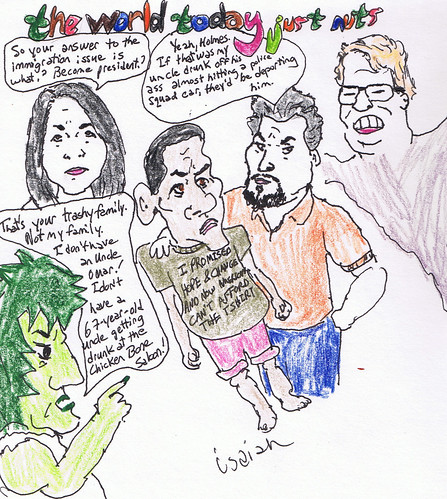
Tuesday, August 30, 2011

Glen Campbell

Simon Hattenstone (Guardian) reports on Glen Campbell. He's 75 and he's put out what is said to be his final album due to the fact that he's been diagnosed with Alzheimer's.

Glen Campbell wasn't someone I listened to as in played their records. But he was huge with a large section of America and was forever on the radio.

He seemed to market a joy for the past, a fondness for a simpler time. His songs like the one that went "These are the dreams of the every day housewife . . ." By that time, the term being used by a number of Americans was "home maker." (One bad ABC TV show and suddenly everyone thinks it's alright again to use the song.)

He sang of simpler times, he was groomed for simpler times. His hair was short and well tended and this was the age of the hippie. He could have been a Beach Boy.

He was very good looking. He knew that and he dressed for it in tighter clothes than you'd expect for a conservative. (He was a Republican.)

I'm very sorry that he has the illness. In the article, it's noted that you sort of picture him young and going on forever. I would agree with that. Without being an airhead, I think he got across a certain kind of California vibe. Yes, it was conservative but California has its conservative streak. That's how they ended up with Ronald Reagan as a governor.


"Iraq snapshot" (The Common Ills):

Tuesday, August 30, 2011. Chaos and violence continue, Danny Schecter offers up some reflection, a journalist is attacked in the KRG, additional info out of England about Blair's pre-war planning, and more.
Danny Schechter pens a piece at ZNet where he admits he snorted the Kool-Aid. But while I hope Danny will return to the real world, it's very much true that time makes 2008 a little hazy for Danny.
He writes, "I was denounced as a super sexist by a few for not buying into her [Hillary] centrist Clintonista crusade."
Actually, I think you were called a sexist for the use of terms like: "Clintonista." Hillary ran for the Democratic Party's presidential nomination and did win the popular vote and you're belittling her as a "Clintonista"? Ruth can (and I'm sure will) respond at her site. She posted on Danny's sexism resulting in an e-mail exchange with Danny (that he initiated). Unless he's got amnesia, he knows exactly why he was called a sexist. He's an alleged media critic, a self-proclaimed "News Dissector," and yet he refused to call out the constant sexist attacks aimed at Hillary? (While engaging in his own.)
That's not a minor point. If you're a media critic, you call out press attacks -- and, yes, that includes sexism. Things got worse at News Dissector after Barack became the nominee. Suddenly, we're getting a ton of e-mails here from his readers about what the hell happened? Danny had created a space, they thought, where various views were welcome. You didn't have to be a Democrat or even vote to be welcome at Media Channel. Then suddenly he was Uber Partisan. He ran off his audience.
And I keep stopping and saying, "Delete that," as I dictate this. Pulling punches. When I really shouldn't. Barack's position on Iraq was always known. Bill Clinton rightly termed it a "fairy tale." Long before Bill did that, I had heard similar from US House Rep Bobby Rush. Danny claims he had no way of knowing the truth about Barack. I believe Glen Ford and Bruce Dixon were documenting truths about Barack in 2008 at Black Agenda Report (including the DLC membership which Danny feels he had no way of knowing).
The "News Dissector" was silent on sexism and he was silent on homophobia. I like Danny, despite the 2008 crazy, and the column makes me more likely to link to him in the future. But we paid for telling the truth here. We were delinked by many sites -- including Danny's -- and that's fine -- sites that repeatedly asked us to promote them and that we repeatedly promoted. But when push came to shove, we told the truth and we did so in real time. And the thanks for that was that we were attacked and trashed and delinked from a number of sites -- sites that still send things to the public account wanting links. And having paid for being the Cassandra, I won't just say, "Great job, Danny!" I'll note that he's been more honest than anyone thus far --- and I'll applaud him for that sincerely, but I'll note there's not full honesty.
I was talking to a friend about this last week -- someone who knows Danny from his ABC days -- and I said -- of this entire period and of much more than just Danny, "A part of me wants to let go of it. And if I weren't doing stuff online, I probably would. But this was such a breakdown for the left, this was such a pivotal moment. And to act as if it didn't happen would encourage it -- and beg for it -- to happen again."
Danny has gone further than any of his crowd in taking accountability and I say, "Good for him." And I mean that. But I also mean that what happened never should have. And I keep remembering the e-mails, like from the guy who had followed Danny since 2003, heard him speak somewhere (I'm blanking on the location) and just couldn't believe that the Danny of 2008 was the same Danny he'd been reading all that time. And I remember the shock of so many LGBT-ers on the left who refused to drink the Kool-Aid and couldn't believe that Barack's constant use of homophobia was not being called out. That's where the thrown under the bus usage comes from. Bit by bit, Barack threw (while people like Danny looked the other way) one segment of the left under the bus, one segment after another.
I would love to read Danny writing a piece -- even a paragraph -- explaining how he justified ignoring the use of sexism and homophobia by the campaign. Or of giving delegates to a candidate not on the ballot. Or stopping a floor count at the convention when Nancy Pelosi was afraid that the vote would be too close and Barack might not be the winner. Do we believe in count every vote or not? Was our outrage over Bush v. Gore motivated solely by a dislike for Bush? Or we rightly offended that the will of the people was thrwarted? Until those issues are addressed, the same thing could happen in five more years. (I doubt it will happen next year just because so many have realized how badly they've damanged their repuations.) And, to be clear for those late to the party, Danny wasn't the only one and I don't think he can even be termed the worst or the top twenty worst. But he's the media critic, he's the News Dissector, he's the one who's written books about people coming together to overcome. And he got taken in by a media creation -- one John Pilger was calling out in real time as a media creation.
So how did it happen and how do we make sure it doesn't happen again?
It's not a minor issue to me. The only reason I'm still stuck online is because of Barack and the idiotic notion that he was going to end the Iraq War. Still hasn't happened, has it? Support for him had real life implications especially for the Iraqi people. Repeating, how do we make sure that "2008: The Year of Living Hormonally" never happens again? Last night Betty quoted Joan Didion on the 2008 crazy and we should note it again because a lot of people have forgotten Joan's remarks:
What troubled had nothing to do with the candidate himself.
It had to do instead with the reaction he evoked.
Close to the heart of it was the way in which only the very young were decreed of capable of truly appreciating the candidate. Again and again, perfectly sentient adults cited the clinching of arguments made on the candidate's behalf by their children -- by quite small children. Again and again, we were told that this was a generational thing, we couldn't understand. In a flash we were sent back to high school, and we couldn't sit with the popular kids, we didn't get it. The "Style" section of The New York Times yesterday morning mentioned the Obama t-shirts that "makes irony look old."
Irony was now out.
Naivete translated into "hope" was now in.
Innocence, even when it looked like ignorance, was now prized.
Partisanship could now be appropriately expressed by consumerism.
I could not count the number of snapshots I got emailed showing people's babies in Obama gear.
Now I couldn't count the number of terms I heard the terms "transformational" or "inspirational." The whole of election night I kind of kept dozing on and off and the same people were on always on television and every time I woke up
to them they were saying "transformational."
I couldn't count the number of times I heard the sixties evoked by people with no apparent memory that what drove the social revolution of the sixties was not babies in cute t-shirts but the kind of resistance to that decade's war that in the case of our current wars, unmotivated by a draft, we have yet to see.
It became increasingly clear that we were gearing up for another close encounter with militant idealism by which I mean the convenient redefinition of political or pragmatic questions as moral questions -- which makes those questions seem easier to answer at a time when the nation is least prepared to afford easy answers.
As Danny rightly notes, "He took an anti-war stance on pragmatic grounds only, preferring Afghanistan to Iraq. He hasn't extricated us from either battlefield." And that's due to the Cult of St. Barack. As we noted at Third in December 2008, alleged leaders of the peace movement were disgracing themselves. In that piece, we quote one of the only people who can hold their head high today:
Debra Sweet (World Can't Wait) noted of UPFJ's recent session:

Not to directly challenge Obama's escalation of the war in Afghanistan is shameful. On the anniversary of "Shock & Awe," and under a new president, the anti-war movement needs to be in Washington. And many of us WILL be there.
World Can't Wait wrote a
letter to the anti-war movement. We posed:

"We in this country, and those of us in this movement, have a choice. We can side with our government, with the "good war" fought in our names, and act like American lives are more important than anyone else's lives.Or we can show the people living in the Middle East, and the world, that in the U.S. there is a difference between the people and their government, and that the people are taking responsibility to end an unjust war and the war crimes that have been carried out in our name. We can act like we care about the whole planet."
If everyone had shown the same courage and determination as Debra Sweet and World Can't Wait, you better believe all US troops would be out of Iraq and the administration wouldn't be in negotiations with Nouri al-Maliki today to figure out how many troops they're both comfortable with keeping beyond 2011.
The decision to 'block for Barack' and abandon demands like "OUT OF IRAQ NOW!" had real world consequences. For example, Iraq Body Count is considered a conservative count. For 2010, they count 4,045 Iraqis killed. The dead aren't coming back. In this Antiwar Radio segment, Angela Keaton talks with Scott Horton about the efforts to build a left-right antiwar movement. Those working on that issue have done real work in the last years and deserve real credit (including Angela Keaton). (And Scott Horton who's made it a big and reoccuring topic on his radio program.)
John Glaser's overseeing Antiwar.com's Blog and he's also posting on the main site including about a newly released US State Dept cable, released by WikiLeaks:


The cable excerpts a letter written by Philip Alston, Special Rapporteur on Extrajudicial, Summary, or Arbitrary Executions, addressed to then Secretary of State Condoleeza Rice. American troops approached the home of Faiz Harrat Al-Majma'ee, a farmer living in central Iraq, to conduct a house raid in search of insurgents in March of 2006.
"It would appear that when the MNF [Multinational Forces] approached the house," Alston wrote, "shots were fired from it and a confrontation ensued" before the "troops entered the house, handcuffed all residents and executed all of them." Mr. Faiz Hratt Khalaf, (aged 28), his wife Sumay'ya Abdul Razzaq Khuther (aged 24), their three children Hawra'a (aged 5) Aisha ( aged 3) and Husam (5 months old), Faiz's mother Ms. Turkiya Majeed Ali (aged 74), Faiz's sister (name unknown), Faiz's nieces Asma'a Yousif Ma'arouf (aged 5 years old), and Usama Yousif Ma'arouf (aged 3 years), and a visiting relative Ms. Iqtisad Hameed Mehdi (aged 23) were killed during the raid.

And that may remind some of the 2007 killing Michael Ware observed. And one may wonder why the US government thought they had any right to conceal this news from the American public. That makes them as guilty as those who shot and killed that family. And when the US government knows about the killing of a five-month-old baby, they better be able to say someone was punished. Maybe Condi & crew can write about that in their little no-tell-alls? Refusal to do so should result in every interview starting with a reference to the above cable that no-one-could-have-guessed should have read. It might take a little pressure. As I remember her 9-11 commission testimony, it took a lot of pressure to get no-one-could-have-guessed to identify the PDB's title "bin Laden determine to strike in the US."

And, to be clear, most likely no one was punished. You never heard about the slaughter until WikiLeaks released the cable. Any good defense attorney would have been aware that the US govenrment wanted to keep a lid on the story and if his or her client was being prosecuted would have floated the threat of going public.
Yesterday's snapshot included, "Today Chris Ames and Richard Norton-Taylor (Guardian) report that in October 2002, Bush and Blair decided they need not seek a second resolution to declare war on Iraq. This comes via an October 17, 2002 letter Tony Blair's secretary Matthew Rycroft wrote to then-Foreign Minister Jack Straw's secretary Mark Sedwill." I also disagreed with their summarization of a section of the letter (with the "That was the only way they could persuade the Bush administration to . . .") and noted the letter might be posted at Chris Ames' Iraq Inquiry Digest. He has posted it [PDF format warning] here. Here's the section they summarized yesterday:
The meeting concluded that the only way to keep the US on the UN route was for there to be a clear understanding that if Blix reported an Iraqi breach of the first Resolution then Saddam would not have a second chance. In other words, if for some reason (such as a French or Russian veto) there were no second Resolution agreed in those circumstances, we and the US would take action.
That fits with the interpretation that seemed to emerge from the Iraq Inquiry -- at least Roderic Lyne's line of questioning. The letter has stronger wording than the article's summary of that section. That may be due to the press narrative of Tony Blair as weak poodle. The problem with those media characters of Blair and Bush was always if Bush was such an idiot, how did he keep Blair on a leash? What's emerged in testimony to the Iraq Inquiry fits with the letter: Blair led Bush. "The meeting concluded that the only way to keep the US on the UN route . . ." Whose leading in that sentence? It's not the White House, it's not Bush. Blair's getting his way. They're both War Criminals and this interpretation (which could be completely wrong -- I'm often wrong) doesn't change that. But there's been, in the US, a desire to demonize Bush but look at Blair with pity. Blair wasn't tugged along, Blair was leading the way. And his desire for regime change, established in the public testimony, predates Bush being given the White House by the Supreme Court.
Chris Ames offers an indepth analysis on the meaning of that letter especially when combined with a statement by Michael Wood:
But the recently published statement of Michael Wood, who was in October 2002 and subsequently the Foreign Office's (top) legal adviser, to which the story also refers, may turn out to be as significant as the Rycroft letter in demolishing Goldsmith's explanation for changing his mind about the legality of the war. Wood makes very clear that everyone, including the Americans, knew that the proposed resolution did not provide legal cover for war and that talk of American red lines was smoke and mirrors.
On page 8 of his statement Wood describes the various diplomatic exchanges in mid October 2002 concerning the "new American compromise language" for the resolution and specifically for what became "virtually unchanged" operational paragraph 12 (OP12) of the resolution that would be unanimously agreed three weeks later. He reveals that on 16 October Britain's UN ambassador (Jeremy Greenstock) repeated to his American counterpart what foreign secretary Jack Straw had said to his American counterpart, Colin Powell, "that we needed a second resolution and that it was extremely unlikely that we could find a legal base without it". Greenstock also said that after the resolution was passed "the explanations of vote were likely to make it unequivocally clear that there needed to be a second resolution". On 17 October, Straw told his French counterpart, Dominique de Villepin, that the Americans acknowledged that the wording of the resolution "implied that there needed to be a second SCR".
David Owen is a former UK Foreign Secretary (1977 - 1979) he currently leads the Social Democratic Party and is a member of the British Parliament's House of Lords. Richard Norton-Taylor (Guardian) reports that Owen is calling for the Rycroft letter to be turned over to the Iraq Inquiry and for the Inquiry to make the letter public.
In Iraq, protests return to Tahrir Square in Baghdad on September 9th (protests were halted during Ramadan). The Great Iraqi Revolution notes today, "In an attempt to sabotage the coming demonstrations, the deputy of PM Maliki's party, the State of Law Coalition, stated that 'there are internal and external parties that will try to use the demonstration in 9/9 to overthrow the government, calling on all political forces to unite to thwart these external and internal challenges' !!" Meanwhile Political Stalemate II continues and gets closer to nine months. At this rate, it may end up surpassing Political Statement I in terms of length of time. Al Mada reports that Iraqi President Jalal Talabani is again planning on hosting the leaders of the various political blocs at his home in an attempt to end the ongoing political stalemate. Their last meeting was August 2nd and the major leaders -- including Speaker of Parliament Osama al-Najaifi, Iraqiya's Ayad Allawi and State of Law's Nouri al-Maliki -- attended that meeting. It is said that the recent series of meetings culminating with the August 2nd meet-up led the blocs to all agree to resume the Erbil Agreement which would mean, among other things, creating a national council which Allawi would serve on and head. However, the problem with that last time was Nouri (who ignored the Erbil Agreement after he got what he wanted) and no sooner was Talabani receiving praise in the press at the start of this month than members of State of Law were publicly complaining about the proposed national council.
While we're on the topic of Iraqi politics, let's not the ongoing scandal from Nouri's Cabinet. Alsumaria TV reports, "Iraq Ministry of Oil said on Sunday that it found falsified correspondences in order to provoke international companies. The letters use the names of Petroleum Contracts and Licensing Directorate and the Ministry of Finance over the fourth round of bids. The Ministry stressed that these letters aim at undermining the work of the Ministry and stressed that it will follow the parties who are involved in this issue. Iraq Minister of Oil Assem Jihad told Alsumarianews that Petroleum Contracts and Licensing Directorate found a number of falsified papers used to exploit its name and that of the Ministry of Finance addressed to international Oil Companies that qualified to the fourth round of bids asking for money from these companies. However, these parties are still unknown he added."
And still the Iraq War continues. AFP notes Nouri al-Maliki has declared, "The agreement on the withdrawal of American forces will be implemented on schedule by the end of the year, and there will not be any bases for US forces here." Nouri's word never carries much weight -- especially after yesterday when he tried to lie about what the United Nations was saying forcing the UN to issue a press release correcting the record. In another AFP report, one reflecting on Iraq since 9-11 (it's a theme, 9-11 had nothing to do with Iraq but everyone's going to ram 9-11 down your throats for the next two weeks), it's noted that Bagdhad and DC agree Iraq's "unable to secure the country's airspace, borders or waters" and that they are open to keeping "trainers" (US soldiers) in Iraq beyond 2011. David Dayen (Firedog Lake) points out, "It's important to make this clear: call them trainers, call them troops, they would still be military forces, they would presumably still have guns, and they would still be used in the event of raids or firefights or other dangerous missions. They would be troops in everything but name."

In today's violence, Reuters notes that a Baquba roadside bombing injured three police officers and that in Hilla (yesterday) two corpses were discovered ("a government employee and his wife." Aswat al-Iraq reports a Kirkuk bombing left "a woman and her daughter" wounded and the Baquba bombing left five police officers injured.

AFP reports that journalist Asos Hardi was attacked and beaten with the butt of a pistol. The wire service notes that Human Rights Watch sees this as part of a continued and increasing wave of attacks on journalists in the Kurdistan region. Human Rights Watch issued the following news release on the attack:


(Beirut) -- The Kurdistan Regional Government should conduct a prompt, thorough, and impartial investigation into the attack on the prominent journalist Asos Hardi on August 29, 2011, and prosecute whoever is responsible, Human Rights Watch said today.
Hardi is the director of the Awene Press and Publishing Company, which publishes the independent newspaper Awene in Iraqi Kurdistan, and a member of Human Rights Watch's Middle East and North Africa advisory committee. He told Human Rights Watch that a young man dressed in black attacked him as he was leaving the newspaper office at 7 p.m. The assailant, who was waiting near Hardi's car, knocked him to the ground with a blow to the back of the head with a pistol and continued beating him as he lay on the ground. Hardi was hospitalized and received 32 stitches for six wounds to his head.
"The attack on the respected journalist Asos Hardi is the latest example of the grave risks faced by independent media workers in Iraqi Kurdistan," said Sarah Leah Whitson, Middle East director at Human Rights Watch. "Kurdish authorities should act decisively to bring whoever is behind this attack to justice."
Hardi told Human Rights Watch that he believes he was targeted for his work as a journalist. "I have never had any personal problems with anyone my whole life," he said. "It is very clear that this attack is related to my job as an independent journalist and my vocal support for freedom."
Xendan news media, a local news organization, reported on its website that Prime Minister Barham Salih of the Kurdistan Regional Government had ordered authorities in Sulaimaniya to investigate the attack. Police said they are investigating the incident and took a statement from Hardi.
Since the start of protests in Sulaimaniya on February 17 over widespread corruption and violations of civil and political rights, journalists in Iraqi Kurdistan have faced escalating attacks and threats, including from members of the government's security forces. In March, Human Rights Watch interviewed more than 20 journalists in Kurdistan and found that security forces and their proxies routinely repress journalists through threats, arbitrary arrests, beatings, and harassment, and by confiscating and destroying their equipment.
Hardi expressed concern that the government's promised investigation will go nowhere. "There are many cases like this in Kurdistan," Hardi told Human Rights Watch. "Police always say they investigate the attacks but no one is captured or tried."
AFP's Prashant Rao Tweets:
prashantrao Just spoke to Asos Hardi, #Iraq #Kurd journo beaten outside his office last night. Was 'confident' police would not catch assailant.

Hardi told Reporters Without Borders that his assailant pointed a gun at him and then hit him repeatedly. The gunman acted alone but a car was waiting nearby.

"I had to be rushed to hospital and I have 32 stitches and six bruises on my

head, but my condition is now stable and I was able to leave the hospital

during the night," he said.

The autonomous Kurdistan region's authorities said they were investigating the attack in order to identify "the motives and those responsible."

Despite repeated pledges by Kurdistan President Massoud Barzani, the number of cases of physical violence and abusive treatment of journalists has been increasing steadily ever since a wave of protests began in mid-February. Reporters Without Borders urges the authorities to do everything possible to shed light on this case in order to realize their declared desire to improve the safety of journalists.

The latest wave of the Turkish military bombing the KRG continues. Alsumaria TV notes, "Kurdistan Parliament called to close all Turkish military and intelligence bases in Kurdistan. Kurdistan Parliament rebuked Turkish violations against Kurdistan territories, a source told Alsumaria." Sebnem Arsu (New York Times) notes the Kurdish military continues to boast of its kills -- or at least some of them, others they deny (such as two Sundays ago when they killed 8 civilians while bombing a village) -- and how they rushed out the boast of 150 dead on Monday. Today's Zaman reports, "A leading executive of Iraq's Kurdistan Democratic Party (KDP) has stated that the Kurdish administration in northern Iraq has been planning to deploy peshmerga troops along the borders with Iran and Turkey -- two neighbors that have launched operations inside northern Iraq targeting Kurdish terrorist organizations that have bases there."
Meanwhile, what's going on at Baghdad airport? Al Rafidayn, citing a customs source, reports that a US service member was stopped at Baghdad International yesterday as he was trying to leave the country and is being detained for attempting to smuggle $80,000 out of Iraq. Iraqi Oil Report Tweeted:

iraqoilreport #Baghdad airport closed for about an hour today for unnamed "security threat." Re-opened without incident.
But Aswat al-Iraq says that the airport has remained closed and that the US military also closed "all Iraqi air space" and, "The source told Aswat al-Iraq that the Iraqi side received instructions from the American forces to close Baghdad International Airport until further notice, without giving any explanation or reasons for such closure."
Turning to the US, I agree with every word John Walsh says in this piece at CounterPunch. We are not excerpting because the one being called out by Walsh is someone I don't want to give publicity too. A few weeks back, I noted that after our excerpt of an exchange on Law & Disorder Radio, co-host Michael Ratner made a point on that I strongly agree with, so to listen for that. It was a critique of the same person. We have called him out for over five years here and at Third and, six or so months ago, I made the decision we just weren't going to mention him. But we will highlight the critiques of him by others. John Walsh has a great one. I'll throw it out to a community vote. If you'd like Walsh's column excerpted in tomorrow's snapshot, weigh in at one of the two private e-mail addresses (just "Yes" or "No" so people working the accounts aren't overloaded -- and put "Yes" or "No" in your subject heading).
Back to the topic we started with, someone else (besides Debra Sweet) who never lost his way in 2008, never lost his voice, never whored, Chris Hedges. This is from his "The Election March of the Trolls" (Information Clearing House) and let's hope everyone reads it and grasps it:


We have begun the election march of the trolls. They have crawled out of the sewers of public relations firms, polling organizations, the commercial media, the two corporate political parties and elected office to fill the airwaves with inanities and absurdities until the final inanity -- the 2012 presidential election. Journalists, whose role has been reduced to purveyors of court gossip, whether on Fox or MSNBC, descend in swarms to report pseudo-events such as the Ames straw poll, where it costs $30 to cast a ballot. And then, almost immediately, they blithely inform us that the Iowa poll is meaningless now that Rick Perry has entered the race. The liberal trolls, as they do in every election cycle, are beating their little chests about the perfidiousness of the Democratic Party and Barack Obama. It is a gesture performed not to effect change but to burnish their credentials as moralists. They know, as do we, that they will trot obediently into the voting booth in 2012 to do as they are told. And everywhere the pulse of the nation is being assiduously monitored through polls and focus groups, not because our opinions matter, but because our troll candidates understand that by parroting back to us our own viewpoints they can continue to spend their days lapping up corporate money with other trolls in the two houses of Congress, the White House, the Supreme Court and television studios where they chat with troll celebrity journalists.

The only commodity the troll state offers is fear. The corporate trolls, such as the Koch brothers, terrify the birthers, creationists, militia lovers, tea party militants, right-to-life advocates, Christian fascists and God-fearing red-white-and-blue patriots by proclaiming that, unless they vote for Perry or Mitt Romney or Michele Bachmann or some other product of the lunatic fringe of our political establishment, the American family will be destroyed, our children will be corrupted and the country will turn socialist. Barack Obama, who they whisper is a closet Muslim, will take away their guns, raise their taxes and bring homosexual couples into kindergartens.

For those, usually liberals, still rooted in a reality-based world, one that believes in evolutionary science, the corporate trolls offer a more refined, fear-based message of impending doom. If you abandon the Democrats we will be governed by Bible-thumping idiots who will make us chant the Pledge of Allegiance in mass rallies and teach the account of Genesis as historical and biological fact in our nation's schools.

And underneath it all runs the mantra chanted in unison by all the trolls—terror, terror, terror. The troll establishment spins us like windup dolls and laughs all the way to the bank. What idiots, they think. And every election cycle we prove them right.

Monday, August 29, 2011

This and that

Isaiah's The World Today Just Nuts "Great Billy Carter's Ghost!"

great billy carters ghost

I do enjoy this one, don't you? Billy Carter pops up just as needed. Barack really has turned into Jimmy Carter, hasn't he?

When I predicted that in 2007, who knew?

Kat's "Kat's Korner: It's not easy being assembly lined" went up yesterday and she covers the very disappointing new Muppets album where various 'rockers' destroy Muppet songs.


"Evidence mounts of atrocities by Libyan 'rebels'" (Patrick Martin, WSWS):

A series of reports from journalists on the ground in Tripoli have provided evidence of mass killings by the NATO-backed forces in the Libyan civil war. These reports, which appear in publications largely supportive of the US-NATO intervention to overthrow the regime of Muammar Gaddafi, further expose the fraudulent claim that the imperialist war against Libya is driven by humanitarian motives and the desire to protect civilian lives.

The Washington Post carried a prominent report Saturday, headlined, “Revenge Killings Mount in Libya, Extrajudicial Attacks by Rebels Cast Shadow Over New Freedom.” The headline refers to the contradiction between the claims by the National Transitional Council (NTC), the new NATO-backed regime in Libya, as well as the Obama administration that what is taking place is a new birth of freedom in Libya and the reality of politically directed and in some cases racially motivated slaughter.

Post reporter Simon Denyer asserts that Gaddafi’s troops “executed scores or even hundreds of political prisoners this week, even as victorious rebel fighters appear to have carried out their own abuses.” He cites the testimony of Diana Eltahawy, Libya researcher for Amnesty International, who “described a record of abuse, torture and the extrajudicial killing of captured pro-Gaddafi fighters that has followed the rebels from east to west as they have taken over the country.”


I really don't think it's too much to ask who we're backing before the US government decides to back them and back them in our name.

"TV: Where's the money?" (Ava and C.I., The Third Estate Sunday Review):
And some may bicker, "It's only a game show."

Yes and in this economy it may be the only way to make money. The most recent numbers from the Bureau of Labor Statistics put national unemployment at 9.1% (next set of numbers are due out this Friday) -- some areas see higher rates (traditionally, rural areas have higher unemployment rates than do urban areas). NPR reported Thursday on foreclosures making "up roughly one-third of all home sales this spring" which is "six times the percentage of foreclosures in a healthy housing market." Earlier this month, Judy Woodruff (The NewsHour, PBS) spoke with the Annie E. Casey Foundation's president Patrick McCarthy on their latest study which found "that the official child poverty rate rose by nearly 20 percent from 2000 to 2009. And, in 2010, 11 percent of children lived with at least one unemployed parent." The inability to improve the economy may be part of why Pew Research's recent study found 79% of respondents staing they're dissastisified with the direction the country is headed in and 86% state they are "either angry or frustrated" and 49% of respondents disapprove of Barack's job performance (a record in disapproval for Barack -- only 43% approve). Scott Horsley (NPR's Morning Edition) recently offered this description of where things are, "Expectations are high precisely because the economy has been laid so low. Hiring has slowed sharply since the beginning of the year. Manufacturing appears to be losing steam. "

If you don't get how bad the economy is, any episode of Take The Money And Run makes that clear very quickly. What's going to happen with the $100,000 if Beau and Ron win? They're "doing it for Mom." Ron's mother can be moved closer and she's over eighty so this is important. And if the police officers win? Michele Wood explains her mother has a lousy job and "her retirement isn't good" while John Korolis adds, "My wife was laid off a year and a half ago and this could help pay the bills."

Game shows that give away money are no longer mere escapism, they also end up becoming social commentary as well. In a lousy economy, that's always going to be their fate.

I really enjoyed their piece this week. I also had a very difficult day so I'm not really 'here' for this post. I am sorry.

"Iraq snapshot" (The Common Ills):

Monday, August 29, 2011. Chaos and violence continue, Tony Blair knew Iraq was not a threat to England before he started the illegal war, Blair and Bush agreed six months before the start of the war not to try for a second UN resolution, Nouri tries to distort the UN, the UN corrects the record, and more.
The lies of war, the war of lies. Bit by bit, the lies of the Iraq War are slowly exposed. As we noted in our conclusions on the Iraq Inquiry, it was obvious that Bully Boy Bush and then-British Prime Minister Tony Blair had agreed not to seek a second United Nations resolution (the first covered weapons inspectors, it did not allow for war, which is why then-UN Secretary-General Kofi Annan called it an "illegal" war). Today Chris Ames and Richard Norton-Taylor (Guardian) report that in October 2002, Bush and Blair decided they need not seek a second resolution to declare war on Iraq. This comes via an October 17, 2002 letter Tony Blair's secretary Matthew Rycroft wrote to then-Foreign Minister Jack Straw's secretary Mark Sedwill. Ryscroft cautions, "This letter is sensitive." And he underlines that. He goes on, "It must be seen only by those with a real need to know its contents, and must not be copied further." Ames and Norton-Taylor note:
The Downing Street letter is particularly significant against the background of the government's repeated emphasis in public at the time on the need to get UN approval before any invasion of Iraq. The "first resolution" referred to in Rycroft's letter was number 1441, passed unanimously in November 2002. Goldsmith and most of the government's legal advisers insisted a second UN resolution was needed before military action could lawfully take place.
While not quoting from the letter, they summarize: "That was the only way they could persuade the Bush administration to . . ." Provide the letter. Provide the quote. It's not a minor issue. Everyone should be reflecting on February 2nd of this year when Jack Straw appeared before the Inquiry (again) and Committee member Roderic Lyne asked very specific questions and made very specific points. Including that it would appear Straw (and the Cabinet) already favored regime change. For those who've forgotten, not only did Lyne pursue what Straw spoke of with then-US Secretary of State Colin Powell, what papers were forwarded on (and if regime change was not favored, why a paper on it was forwarded), Lyne told Straw, "I am very curious you didn't react to the second paper by saying regime change cannot be an objective of the UK foreign policy. Warn the Prime Minister." Lyne summarized (in the form of a question) Blair's approach, "Get on side of President Bush but presumably not get ahead of President Bush on this issue or encourage President Bush to push it ahead at high speed?"
Possibly Chris Ames will post the letter at his Iraq Inquiry Digest. But ignoring their single sentence summary of the letter regarding Bush, what the letter does is back up to point Lyne was making: The Cabinet wanted regime change and had signed on for it. Blair was not pulled into this by Bush, he was an active participant.
Related, Sunday the former head of England's spy agency (MI5) Eliza Manningham-Buller is in the news cycle. BBC News reports she told BBC Radio Times that it was known in 2003 that Iraq was not threat, that a war with Iraq would likely increase domestic threats and that an Iraq war would be "a distraction" from the then-pursuit of al Qaeda. The Daily Mirror observes, "Britain's former spy boss has given her strongest condemnation yet of Tony Blair's ­decision to go to war in Iraq, saying he was told it posed no threat to the UK." Paddy McGuffin (Morning Star) adds:

Stop the War Coalition convener Lindsey German said: "It may well be that, in advance of Chilcot, which is due to publish its findings in the autumn, various people are distancing themselves from the decision to go to war.
"I'm glad she has said what she has as it is a vindication of the anti-war campaign but the decision to go to war was a failure not just of Blair but the whole Establishment including the security services and Parliament itself.
"There was no serious attempt by any of them to stop Blair. The only attempt came from the streets."

Tim Ross (Telegraph of London) observes, "Her comments, in an interview to mark the start of her three Reith Lectures, which will be broadcast on BBC Radio 4 this week, represent the most outspoken criticisms to date of the 2003 conflict by such a senior figure in the intelligence services." You can read about her remarks in the British press (not the Guardian) and in La Nueva Espana, in Santiago's El Mercurio and in El Norte De Castilla. Lots of luck finding it in US outlets. They sold us the lies of war, the war of lies, they had plenty of time to front page all of that. And now they can't make time for what the head of British intelligence was actually telling Tony Blair in the lead up to the Iraq War? Amy Goodman didn't have time for it either. Telling.
Jason Ditz: It's a good story for the media to cover about, you know, instead of covering all the failures in Afghanistan and the fact that the Iraq War isn't going to end as scheduled again, they can focus on the great success of Libya.
Scott Horton: (laughing) Yeah. I'm so sorry. I'm just stuck on Iraq 2003, where Baghdad had fallen, it had been a week since Saddam Hussein had been in power and all the War Mongers are going, "See, everything went great. All your antiwar excuses and reasons didn't come true and whatever." When they hadn't even given it a chance at all. And as you just said, we're still in Iraq right now. Ain't going no where either. Giant war, a million people died somewhere between here and there. And this is how all these Democrats sound now, talking about what a great victory they have. Let's see what a victory it is when there's an insurgency against the new democracy and whatever else we're headed towards in a year, two years, three years from now

Over the weekend, Al Rafidayn reported that the Grand Ayatollah Ali al-Sistani has refused to meet with Nouri al-Maliki and other politicians. For the last 8 weeks, al-Sistani has refused them. Why? His clerics say that he feels the people's needs are not being addressed and that the government has failed to deliver basic services and to reduce corruption. In related news, Alsumaria TV notes, "Head of Al Sadr Front Sayyed Moqtada Al Sadr called for mass demonstrations in all Iraqi provinces and cities after Eid Al Fitr marking the end of the six month deadline granted to the Iraqi government in order to improve services, a source told Alsumaria. Speaking on behalf of Al Sadr, Sadr Front Sheikh Abdul Hadi Al Mahmadawi reminded the Iraqi government of Arab leaders' fate who were toppled due to people's demonstrations in Tunis, Egypt and Libya." Annie Gowan (Washington Post) adds that Moqtada delivered his call in a letter (the article doesn't note it but the letter repeats the same charges Sistani made) and reminds, "Elsewhere, activists in Baghdad are using Facebook and other social media to plan a Sept. 9 rally in the capital, also to protest the lack of services and poor security. Dozens of people were killed in February during protests [. . .] and Maliki's government has been criticized for rough treatment of many who took to the streets during those days."
Staying with politics, more than anything the Bush administration wanted an Iraqi oil law. Lucky for the greedy, Barack Obama wants that too. Aswat al-Iraq reports that Nouri's Cabinet has forwarded an oil and gas draft law onto Parliament. This has happened before. It has yet to move beyond the referral to Parliament. Platts notes that Ali al-Dabbagh, Nouri's spokesperson, states this draft supersedes all others. Like it matters, the country's in a stalemate.
Political Stalemate I is the period of paralysis that followed the March 10, 2010 elections when a stalemate prevented the naming of a prime minister, the holding of Parliamentary sessions and more. For a little over nine months the first stalemate went on. What ended it was the Erbil Agreement in early November 2010, when the political blocs met and hammered out an understanding, a series of concessions, including that Nouri would remain prime minister while a national security council would be created and headed by Ayad Allawi. Nouri, once named primed minister, quickly went back on the agreement. December 25th, he was moved from prime minister-designate to prime minister. That should not have happened. He had failed to name a full Cabinet. Per the Constitution, someone else should have been named prime minister-designate. December 25th begins Political Stalemate II. This is the period where Iraq has no heads to the security ministries -- Ministry of Interior, Ministry of Defense and Ministry of National Security. More recently, Nouri has 'named' 'acting' ministers to two of the ministries. Minsiters are only minister if they are confirmed by Parliament. If they are confirmed, only Parliament can fire them. "Acting" ministers serve at Nouri's discretion and have no real power.

Al Mada reports that the National Alliance is supposedly going to get the post of Minister of Interior (a real position, not 'acting') while it appears Iraqiya's Raad al-Tikriti will become the Minister of Defense. This could change, rumors have abounded throughout the eight month and counting period that is Political Stalemate II.
As Iraq's security ministeries have been leaderless, violence has increased in Iraq. Reuters notes a Baghdad shooting today which left 3 police officers dead, a Falluja car bombing which injured sixteen people (seven were Iraqi soldiers), a Mosul car bombing which claimed the life of 1 Iraqi soldier and left nine people injured, 1 corpse was discovered in Mosul, a Baghdad roadside bombing left five people injured and, dropping back to last night, a Baghdad car bombing targeted a mosque and claimed 1 life while leaving eight people injured.


In addition, Sunday's major violence was a second Baghdad mosque bombing. Raheem Salman (Los Angeles Times) reported a suicide bomber took his own life while targeting "Baghdad's largest Sunni mosque" and killing 28 people. Sheik Abdul Ghafour Samaraie is quoted stating, "What hurts me is that the criminal came in as a beggar, he was putting the explosives under bandages. We were thinking that this poor man deserves our help, as he is sick." Michael S. Schmidt and Duraid Adnan (New York Times) added, "Security guards quickly became suspicious of the man, though, and threw him out, but he managed to re-enter and detonate his belt among a group of people, the imam said." Laith Hammoudi (McClatchy Newspapers) reported, "Police said the suicide bomber [. . .] tried to be as close as possible to the head of the Sunni endowment, Ahmed Abdul Ghafour al-Samarrai, who was injured in the attack." Hammoudi also notes that lawmaker Khalid al-Fahdawi was killed in the attack. Lara Jakes (AP) addressed the death toll, "Two security officials and medics at two Baghdad hospitals put the casualty toll at 29 dead and 38 wounded. All spoke on condition of anonymity because they were not authorized to release the information." Annie Gowen and Assad Majeed (Washington Post) quoted teacher Omar Saad stating, "Everybody was in shock, pushing and trying to leave. I saw a child with a [wounded] arm crying over the body of his dead father." Ahmed Rushdi (Al Jazeera -- link is text and video) observes that Nouri al-Maliki Cabinet continues to lack ministers to head the security ministries ('acting' ministers, not confirmed by Parliament, are not ministry heads), "So everything concerning security it's now under under the hand of al-Maliki. So al-Maliki is now responsible for what's happening according to Iraqiya." Iraqiya is the political slate, headed by Ayad Allawi, which came in first in the March 10, 2010 Parliamentary elections. Xinhua (link is text and audio) notes that the victims included children. Zaid Sabah and Danielle Ivory (Bloomberg News) add, "The building is the largest Sunni mosque in Baghdad." Sinan Salaheddin (AP) reports that funerals have already begun including one for a five-year-old and his father.
Turning to the topic of Camp Ashraf, the United Nations issued the following today:
29 August 2011 -- The United Nations today stressed that residents of a camp in Iraq housing Iranian exiles must be protected from deportation or expulsion, and pledged to continue helping the country's Government to find a peaceful solution that conforms with international law.
Situated in the eastern Iraqi province of Diyala, Camp Ashraf houses members of a group known as the People's Mojahedeen of Iran.
The UN Assistance Mission for Iraq (UNAMI) and the UN High Commissioner for Human Rights have sought the protection of the camp's residents, while exploring ways of assisting the Iraqi Government to find a resolution that is consistent with the country's sovereignty rights and international humanitarian and human rights law.
An Iraqi military operation in the camp in April left more than 30 people dead and dozens of others injured.
"The UN continues to advocate that Camp Ashraf residents be protected from forcible deportation, expulsion or repatriation, expulsion or repatriation contrary to the non-refoulement principle," UNAMI said in statement.
"UNAMI's mandate includes the promotion of human rights in Iraq and the mission's human rights office regularly assesses the situation in and around Camp Ashraf from a purely human rights and humanitarian perspective," it added.
That position has been consistently reiterated by UNAMI's leadership, including during yesterday's meeting between Ad Melkert, the outgoing Special Representative of the Secretary-General, and Iraqi Prime Minister Nouri Al-Maliki as part of the UN envoy's farewell calls on Government officials at the end of his assignment, the mission's statement said.
Why did the UN issue the statment? Because Nouri al-Maliki struggles with the truth and was insisting he had just received UN approval to deport the residents of Camp Ashraf. Lara Jakes (AP) reports Melkert "bluntly disputed" the version of events Nouri was insisting took place in their final meeting (the UN Secretary-General has a new special envoy to Iraq) . Jakes notes, "The public disavowal was rare for the U.N. office in Baghdad, which goes to great lengths to avoid engaging in political disputed.
Alice Fordham (Washington Post) reports, "Politicians, former national security officials and thousands of others gathered outside the State Department on Friday to call for the removal of the Mujahedin-e Khalk, an Iranian opposition group, from the list of foreign terrorist organizations." Michele Kelemen (NPR's All Things Considered -- link has audio and text) reports on the rally and notes that the residents of Camp Ashraf in Iraq belong to the group and their safety is at risk:


Michele Keleman: Some members of congress and former officials echo that argument. Among them, former Vermont governor, Howard Dean, who says the U.S. promised to protect the people of Camp Ashraf. In a recent interview on NPR, he shrugged off news that he and others have taken speaker fees from groups tied to the MEK.

Howard Dean: This is not a scary group of people and, in the past, who knows what they did? But the fact of the matter is they're not a terrorist group. That's been ascertained by the FBI. We disarmed them. We promised to defend them. They are unarmed and 47 of them over a two year period were mowed down by Maliki's people and I don't think the United States should be permitting those kinds of human rights abuses.

Michele Keleman: There is a moral obligation to help those in Camp Ashraf, says Robert Hunter of the National Defense University, but he says that's a separate issue from the terrorism designation.


Along with Howard Dean (former Vermont Governor and former head of the DNC), others, including former Pennsylvania Governor Ed Rendall, spoke at the rally. Josh Rogin (Foreign Policy) quotes former US House Rep Patrick Kennedy:


One of the greatest moments was when my uncle, President [John F.] Kennedy, stood in Berlin and uttered the immortal words 'Ich bin ein Berliner.' Today, I'm honored to repeat my uncle's words, by saying [translated from Farsi] 'I am an Iranian,' 'I am an Ashrafi. [. . .] To my friends in the State Department behind us, who continue to hold fast to an old policy that is supported by Tehran, you are on the wrong side of history. To [Iraqi Prime Minister] Nouri al-Maliki, your brutal and deadly assault on Camp Ashraf will land you in the International Criminal Court, where you will be held accountable.

When the US invaded Iraq in 2003, the residents of Camp Ashraf agreed to disarm and the US government offered them protected status. That protection continued throughout the Bush administration. As part of the planned drawdown (drawdown, not withdrawal), the Bush administration extracted a promise from Nouri al-Maliki that the residents of Camp Ashraf would be protected. In January 2009, the new administration (Barack) was sworn in and by July 28th of that year an assault on Camp Ashraf by Nouri's 'troops' began. During Saddam's time, Iranian exiles were allowed safe harbor in Iraq. The exiles were leftists who were opposed to the religious fundamentalist leaders following the toppling of the Shah (the exiles did not favor the Shah). They utilized violence and are known as the People's Mujahedeen Organization of Iran or the MEK. They remained in Iraq in the 80s, the 90s and this decade. The European Union and England are among the organizations and countries that listed the MEK as a terrorist group -- past tense. The MEK has renounced violence and was removed from the terrorist listing. The US still has the MEK listed as a terrorist organization.


April 8, 2011, Nouri again ordered an attack on Camp Ashraf. Mark Tran, James Ball and Melanie Newman (Guardian) reported:

The raid was the latest in a series of interventions at the camp since jurisdiction was passed from the US to the Iraqi government in 2009. A WikiLeaks cable identified by the
Bureau of Investigative Journalism at City University in London shows the US was aware the Iraqi government planned to crack down on the MEK, with potentially grave humanitarian consequences.
"If the government of Iraq acts harshly against the MEK and provokes a reaction," warned the US deputy chief of mission in Iraq, Patricia Butenis, in a cable in March 2009, "the USG faces a challenging dilemma: we either protect members of a foreign terrorist organisation against actions of the Iraqi security forces and risk violating the US-Iraq security agreement, or we decline to protect the MEK in the face of a humanitarian crisis, thus leading to international condemnation of both the US government and the government of Iraq."
Phil Shiner of the UK law firm Public Interest Lawyers, which represents some Ashraf residents, said: "I have not seen these cables. However, from what I can gather their content is quite astonishing and shows that the US -- and by implication the UK -- knew Iraqis were treating residents inhumanely, foresaw the possibility of serious injuries in clashes at the camp, and knew what was happening at the time of the deaths but did absolutely nothing."
International law requires other states to take positive action to protect innocent civilians in these circumstances, he added.

During what Senator John Kerry would late pronounce "a massacre," Stephanie McCrummen (Washington Post) reported that Iraqi forces are saying one thing and Camp Ashraf spokespeople another while "Journalists were prevented from entering the sprawling settlement, known as Camp Ashraf, which is home to about 3,000 people and has polished representatives in Paris and lawyers and congressional allies in Washington." And Tim Arango (New York Times) reported that Nouri's forces refused to allow "the delivery of American humanitarian aid" to Camp Ashraf according to the US military and that "some reporters" were permitted to visit the camp today; however, they were prevented from speaking to the residents. CNN added, "Camp dwellers staged angry protests, hoisting banners and inviting journalists to talk to them. 'Please journalists -- come visit us and check on our people,' one sign read."
Yesterday co-chairs of the Committee on Wartime Contracting Chris Shays and Michael Thibault published a column in yesterday's Washington Post noting:

At least one in every six dollars of U.S. spending for contracts and grants in Iraq and Afghanistan over the past decade, or more than $30 billion, has been wasted. And at least that much could again turn into waste if the host governments are unable or unwilling to sustain U.S.-funded projects after our involvement ends.
Those sobering but conservative numbers are a key finding of the bipartisan Commission on Wartime Contracting in Iraq and Afghanistan, which will submit its report to Congress on Wednesday. All eight commissioners agree that major changes in law and policy are needed to avoid confusion and waste in the next contingency, whether it involves armed struggle overseas or response to disasters at home.

The co-chairs make recommendations as well. Tony Capaccio (Bloomberg News) notes, "One recommendation calls for setting up a permanent inspector general's office for wartime contracting staffed by a team of investigative personnel ready to deploy 'to monitor preparedness' to enter into contracts."
$30 billion wasted, at a time when the country is supposedly concerned with the deficit. $30 billion wasted, at a time when people aren't sure where to make cuts? On more war spending waste, Tom Vanden Brook (USA Today) reports, "The Pentagon has spent more than $720million since 2001 on fees for shipping containers that it fails to return on time, according to data and contracts obtained by USA TODAY. The containers -- large metal boxes stowed on ships and moved from port on trucks -- are familiar sights on bases in Iraq and Afghanistan where troops use them for storage, shelter and building material. Yet each 20-foot container returned late can rack up more than $2,200 in late fees. Shipping companies charge the government daily 'container detention fees' after the grace period ends for the box to be returned." David Alexander (Reuters) reports the Pentagon is on the defensive over the findings by the Commission on Wartime Contracting and over another report: "The Center for Public Integrity, a nonprofit investigative news group, said in a separate report on Monday that noncompetitive contracting at the Defense Department had nearly tripled since 2001, to more than $140 billion from $50 billion." Felicia Sonmez (Washington Post) adds that the Post column has prompted House Minority Whip Steny Hoyer to declared "that the country needs to strengthen its oversight of defense spending to preven federal dollars from going to waste." Mike Lillis (The Hill) notes Hoyer said the findings "should be a wake-up call for lawmakers pushing back against any Defense Department cuts."

Saturday, August 27, 2011

The Libyan War

"Iraq snapshot" (Thursday's snapshot, The Common Ills):
Luis Martinez (ABC News) reports, "The cost of U.S. military intervention in Libya has cost American taxpayers an estimated $896 million through July 31, the Pentagon said today." A matter of weeks, Barack Obama told the American people (via the foreign press since he wasn't even in the US when he started the Libyan War). We're also told that there must be cuts, cuts, cuts to US government spending. An unpopular war -- an illegal war -- that the American people never supported and almost one billion spent on Barry's little adventure. $896 million could have been spent on schools, seniors, children, jobs programs, you name it. Yesterday on KPFA's Flashpoints Radio, one of the segments was a broadcast of a talk Michael Parenti gave on his book tour to promote his latest book The Face of Imperialism.
Michael Parenti: Now what does Libya teach us? I mention Libya in this book but I didn't say that much about it because this book was in production and all before this stuff started here. It came out in April. Libya shows us just what I've been trying to say. Libya's sin was that it had charted a different course. It had a leader, "dictator," as everybody called him. Nobody in the west, by the way Now you tell me in the last 20 years how many of you read and heard [Hosni] Mubarak of Egypt described as a dictator? He was always President Mubarak, isn't that right? That's right. President Mubarak. How many -- how many here hear the Saudi Arabia family described as dictators? No. Saudi Arabia. Man, come on. Libya is like Athens compared to Saudi Arabia. Yeah. It's run -- it's run by the Saudi family with their Wahhabi fanatical Islamics who, you know, throw acid in a woman's face if it is uncovered -- and creepos like that. Okay. So what we had in Libya is a 'humanitarian intervention' -- and I'll end it right here, if you read this book I hope you can anticipate these things --- sponsored by the UN which becomes aerial and ground war against the existing government and the people. Even when the government -- and this is what happened in Yugoslavia, which is in the book, and Iraq -- Even when the government calls and Libya too did it in the second month and offers to negotiate, the attacks continue because the goal is really not a negotiated settlement. The goal is to unsettle. And so they bombed Libya for six months just as they bombed Yugoslavia for two and a half months, almost three months. The bombing is sponsored by the United Nations, not the bombing of Iraq or Yugoslavia. With Yugoslavia, China and Russia vetoed it. This time China and Russia, not that close to or friendly with Libya, just abstained. But even with the UN going in, the attacks in each of these cases is not carried out by the UN, it's carried out by NATO. And behind NATO, it's carried out essentially by the US. And that means massive bombing, destruction of facilities, ports, houses, hospitals, food supply depots and the like. Drones, helicopter gunships strafing civilians. The loss of life estimates 20, 30, 40 a day of Libyan civilians who were the civilians that the NATO forces were 'protecting.' They came in to rescue them -- but to save you, we had to blow you up and kill some of you. Pretenses and lies about atrocities? I remember in the first week, somebody being interviewed -- and I think it was on Amy Goodman to -- and he said, "Yes, 10,000 have been slaughtered by Gaddafi." What? 10,000? The fight had just begun, these small 'rebel' groups, we hear. But somehow Gaddafi had gone out there and he had killed 10,000. Who? Where? What locales? For what motive? What were the disturbances that led him to do that? But these kind of things come up. What you do is you demonize the leader -- whether it's a [Slobodan] Milosevic, a [Manuel] Noriega or Saddam Hussein -- who was a butcher. Saddam Hussein was a killer and a murderer and a torturer. But when he was doing that, they loved him in Washington. They adored him. He was -- he was a staunch ally. They loved him. It's when he got out of line on the oil quotas, that's when they started. It's when he refused to privatize his economy, he kept it state run, and he started training Iraqis in engineering and sending them abroad -- men and women. It's when he kept some of the reforms that the previous democratic government had had. Remember, it was a democratic government back then. And when the US went in and said, "We're going to teach these poor wittle Iraqi-wakis what democracy is, teach them how to do democracy because they don't know." Five thousand year civilization, they don't know how to do democracy. But the Americans, we know how to do democracy. Look at our democracy. Isn't it great? Don't you feel good? I mean, it's the most expensive democracy in the world. We spend 20 billion dollars every four years to elect the president, I mean who wouldn't want to match that democracy? And then the role of the media --again so predictable. Massive demonization of the leader gives license to bomb his people. But not concerned about democracy in Egypt. Not concerned about democracy in Saudi Arabia. See, it's here. Let me go back to the first points of this talk, I'll be wrapping it up now. It's here that the liberal critics come in and say, "You see how confused they are. They're going against Libya because it's not a democracy, but they're giving aid to Saudi Arabia and to the dictator Mubarak for 30 years in Egypt. How confused." They're not confused, you're confused, you stupid ass. They know which democratically elected presidents are theirs and which ones are not that are really, sincerely trying to make changes like [Salvador] Allende was doing and people like that and those are the ones they target. They know which dictators they like and support and work with and which ones they dislike. And you can also see now the death squads will be coming in as in Kosovo and in Iraq. The IMF and the World Bank which Gaddafi kept out of Libya for forty years, they're already getting ready to come in. Oil companies are coming in but that was going to happen anyway because Gaddafi, in the last seven or eight years, he saw what happened to Iraq and he started softening and making overtures and saying, "Okay, SAPs, you can bring them in." Structural Adustment Programs -- meaning cutting back on the social wage, letting private capitol take over some of the oil companies and all that. He was -- He was beginning to. But not enough. Not enough. He was not a real vassal state. He was not leaving that thing wide open. He was still had certain protections in there and he also had abuses and the like to. The goal is privatization deregulate everything, every body's poorer, every body's weaker. Wipe out the social wage -- that is the social services and the communal needs that are there. The potential enemy state becomes a vassal state. That is just some of the things the book is about.

I don't blog on Thursdays but I wanted to include that because it's Michael Parenti and he's really saying some important things.


"The rape of Libya" (Bill Van Auken, WSWS):

Five days after “rebels” entered Tripoli, under the cover of NATO bombing and led by foreign special forces, the abject criminality of imperialism’s takeover of Libya is becoming increasingly evident.

Fighting continues to rage throughout the Libyan capital, whose two million residents have been made hostages of the armed gangs and Western special forces troops that have seized control of the city’s streets.

The focus of NATO operations has become a frantic effort to hunt down and murder Muammar Gaddafi, who has ruled the country for 42 years. A $2 million bounty has been placed on his head, and the British media now openly boast that SAS special forces troops are leading the search for him and his family. A vast array of US armed Predator drones, AWACS spy planes and other surveillance equipment has been concentrated on the North African country to facilitate the manhunt.


The Libyan War continues. The 'rebels' have not won. They would never have made it into Tripoli were it not for the non-stop NATO bombings. This was not a civil war, it was a war on the people of Libya brought to you primarily by the United States, England and France.

"The Fall of the Qaddafi Regime in Libya . . . and the Hand of the U.S. and NATO" (Larry Everest, World Can't Wait):
The day the Tripoli fell to the anti-Qaddafi forces, the New York Times reported: "Through Saturday, NATO and its allies had flown 7,459 strike missions, or sorties, attacking thousands of targets, from individual rocket launchers to major military headquarters. The cumulative effect not only destroyed Libya's military infrastructure but also greatly diminished the ability of Colonel Qaddafi's commanders to control forces, leaving even committed fighting units unable to move, resupply or coordinate operations." ("Sharper Surveillance and NATO Coordination Helped Rebels Race to Capital," August 22)
This assault has had not been about liberating Libya or ensuring self-determination for the nation of Libya. Instead, it has been aimed at strengthening imperialism's grip on Libya.

Of all the facts in this post, I'd say the two most important are the number of strike missions and the cost of the Libyan War.

"Iraq snapshot" (The Common Ills):

Friday, August 26, 2011. Chaos and violence continue, Turkey enters World's Biggest Liar contest with a laughable denial, the Kurdish Parliament demands an apology from the Turkish government, US forces in Iraq beyond 2011 is explored, Iraqi youths get ready for the return of Tahrir Square protests next month, and more.
Starting with the Libyan War. Wednesday's snapshot included:
Monday on KPFA's Flashpoints, Kevin Pina spoke with journalist Mahdi Darius Nazemroaya and he was then trapped in his hotel with shooting going on all around. Kevin Pina noted, "We're asking all of our listeners to please call the Canadian Foreign Affairs Ministry at 1-800-267-8376 and demand that Canada contact the Transitional National Council of Libya and tell them to respect the right of international journalists especially Canadian journalist Mahdi Darius Naemroaya. Again that number to contact the Canadian Foreign Affairs Ministry at 1-800-267-8376." There are, at best, jokes being made about the safety of unembedded journalists and, at worst, threats being made. On Tuesday's show, Dennis Bernstein featured an interview Mahdi gave RT.
And Wednesday night came Richard Boudreaux's "After Six Days, Journalists Freed in Libya" (Wall St. Journal). That article didn't include Mahdi's name but he and others at the Rixos Hotel were moved to another one. Instead of reporting on that -- a minor story -- or on the actual suffering the Libyans are experiencing.
Instead, we have a bunch of pampered little children who are now showing their soiled diapers to the public. And if that seems harsh, so does playing the victim insted of the journalist. No Matthew Chance and Jomana Karadsheh, you are not the story, you are the reporters. And CNN was never going to allow you to be harmed. The most 'damage' you experienced was a bunch of bad pay-per-view TV (or, as Matthew Chance whines, "an old DVD of Point Break" -- oh the tragedy!). Your continued histionics make you sound less like saps and more like tools of imperialism really reaching to sell the notion of 'my hard times under Gaddafi!'
Matthew Chance is such an idiot. Explaining their five-day ordeal -- Gaddafi had assigned youths to watch the foreign journalists. When Gaddafi disappears (to wherever) the youths are unsure what to do. No surprise there, they were flunkies of the lowest level on the chain (meaning independent decisions were not among their strengths so when those issuing orders began to flee Tripoli, the youths were left stupified). That's why they were the ones selected to protect the journalists. So everyone's in a holding pattern for five days (the so-called ordeal). Listen to the 'torture' the 'journalists' experienced: "The hotel's generator, which kept the electricity supply going, ran out of fuel. Then the lights kept going off." Oh, my goodness. Who knew that a war zone wouldn't be the New York Palace in Manhattan!!!! You mean to tell me that going into a war zone means you might not have electriticy around the clock and the lights might keep "going off"? The tragedy. In the future, all wars should only take place at four-star resorts with adequate room service.
And personal trainers!!!!! 'Brave' Matthew confesses, "We survived in the end on crisps and chocolate. It sounds odd but I actually managed to put on weight during my five-day ordeal." No, it doesn't sound odd, it sounds pathetic. Grow the hell up and stop trying to pretend that you were in any danger. You clearly weren't. Young men on orders to protect you didn't know what to do when Gaddafi disappeared so they made you remain at the hotel, which was not invaded, which was not hit by any bombs, which was the safest place you could have been in Triopoli because everyone knew journalists were present. As Matthew tries to paint a picture of himself as the next Patty Hearst, the reality is that, as he lets slip throughout, they weren't in prisoners in their rooms, they roamed through the hotel day and night. They (the journalists) decided they'd all share a common space and not individaul rooms. They (the journalists) they'd check out the basement. On and on it goes, this is not a hostage situation.
At best Matthew Chance had an amusing tale to share. Instead, these pathetic 'reporters' are trying to equate their little adventure with the serious danger that the citizens of Libya have been put into with the Libyan War. And, Jomana, when you're in the Red Cross vehicle, it's no time to cry. And when you know a camera's present, stop the waterworks and try to act like a reporter. As the only woman -- or 'girl' -- pictured, your little waterworks do a disservice to female journalists all over the world. Though you were never in any danger up to that point, acting like a cry baby once you're being escorted by the Red Cross makes you look unfit to cover any story (but may distract from the fact that you've clearly put on many pounds since leaving Iraq to mis-cover the Libyan War -- which, please remember, found Jomana repeatedly lying to various reporters about where she was actually from and her ethnicity -- apparently forgetting that she had Tweeted repeatedly about her background in the past and anyone could do a quick computer search and expose her myriad of lies). Your constant cry for sympathy refuses to acknowledge your silence on NATO's bombing of Libyan TV which targeted and wounded and killed journalists. Refused to cover it, refused to cover Amnesty International calling out that attack. Now you want sympathy because you stuffed your fat ass with candy and chips for five days while watching movies and roaming through the halls of the hotel in some sort of pathetic homage to The Breakfast Club. Susan Glasser on today's Diane Rehm Show (NPR -- second hour) stated that the 'journalists' were without food and water. That is incorrect. It is flat out wrong. And she needs to stop saying that.
It is a posh hotel with an indoor swimming pool and much more. It had 24 hour room service. For less than a week, food deliveries stopped. New food being delivered stopped. However, canned food was plentiful. Though some cry babies may not like to eat it, US troops in Iraq eat far less fashionable foods as do the people of Iraq. The cry babies had tons of canned food, Matthew even notes that in his report on the 'ordeal.' They were obviously sugar cravers (looking at the photos of them) and they chose to instead gorge on potato chips and candy. They were never without water. Were they horribly parched to the point of dehydration at any point (they weren't),they could've drawn water from the large, indoor swimming pool. They were in more danger of dehydrating in the hotel's sauna than they were from lack of water. (The hotel had a gym, a health center, two on site restaurants. That's why the claim of running out of food is so laughable. Two food establishments and room service? Food deliveries could have stopped for a month and the remaining guests would not have starved.) They're in far more danger in their new hotel (under 'rebel' control) than they were at the Rixos Al Nasr.
Yesterday on KPFA's Flashpoints Radio, the first segment focused on the hotel issue.
Dennis Bernstein: We're going to take it to Canada now and be joined by Michel Chossudovsky -- he's with the Centre for Research on Globalization. He's been communicating with Mahdi throughout the day, Michel, are you with us?
Michel Chossudovsky: Yes, the situation is extremely serious because what happened is the independent journalists left the Rixos Hotel, that was yesterday. They were escorted to a new hotel under the auspices of the International Organization for Migration which is a UN body and the Red Cross and they were under the protection of these organizations and then they arrived in the new hotel, the Corinthia. The Corinthia turned out to be, in fact, a hotel which was under rebel control. They celebrated their 'liberation' so to speak, they had the promise to leave the following morning at twelve noon, 6 ED, in other words, six o'clock in the morning. And that was cancelled. And then what happened is you had rebel gunmen going around the rooms, using the pretext that they were going after the son of Gaddafi. And the whole place is, in fact, a new prison, and this time more seriously because the rebels control it and they are particularly the journalists who had the courage, determination and commitment to tell the truth about NATO atrocities. Particularly the bombing of the last few days which was devestating resulting in more than a thousand deaths and several thousand wounded.
Let's remember that the last time Mahdi spoke on Flashpoints was Monday and he made a point to stress what Libyans were experiencing and that he wanted out and felt bad for focusing on that when so many Libyans didn't have that option. The soiled diaper crowd never acknowledges the Libyan people, they just whine about the 'horrors' of Keanu Reeves DVDs and the food available in a war zone. Let's also remember the August 16th broadcast of Flashpoints included a segment with Dr. Khaled Al Bazelya is the head of Libyan Television's LEC division (their English language channel):
Kevin Pina spoke with him about the NATO attacks on Libyan TV for the last three weeks, resulting in the deaths of 3 journalists, with twelve more injured. "We are professional journalists. We have nothing to do with -- We are not politicians. We just transfer the news," Dr. Khaled Al Bazelya explained. "[. . .] We report what we see. We ask the International Journalist Association and Human Rights to look into this issue because journalists should be protected all over the world." Kevin noted the silence on the attacks.
Reviewing recent events in Iraq today, James M. Lindsay (Council on Foreign Relations) predicts, that whether the US departs or not, "don't be surprised when Iraq returns to the front pages later this year." While we wait to see if that forecast is correct, AP reports there will be a send-off ceremony this afternoon for approximately 160 Alabama Army National Guard members deploying to Iraq. This as the US and Iraqi governments continue to debate the details of extending the US stay in Iraq beyond December 31st. Dar Addustour reports that there is agreement on both sides regarding tanks, helicopters and armored vehicles but the number is still being debated (Iraq now wants no more than 8,000 troops while the US would like 20,000) and there is disagreement regarding immunity for US troops. From yesterday's snapshot:

Those who still need to believe in fairy tales should avoid the interview Josh Rogin (Foreign Policy) did with Iraq's Ambassador to the US Samir Sumaida'ie who states, "The principle that there will be some military presence [in Iraq beyond 2011] to help train Iraqi military and police has been largely agreed upon." This jibes with both what US Secretary of Defense Leon Panetta said on Friday and what Ali al-Dabbagh (Nouri al-Maliki's spokesperson) said over the weekend. Sumaida'ie addes, "You'll see it when you see it. Americans want everything now or yesterday. We don't do it like this. We do it in our own sweet time." Rogin adds:
Sumaida'ie tried to explain what's really going on here. He said that there is a consensus among all political players, with the exceptions of the followers of Shiite cleric Muqtada al-Sadr, that Iraq needs some American military support, particularly when it comes to training, past the end of this year. "However, the form that this will take and the legal details are still being debated," he said.
He said the debate over the number of U.S. troops to remain in Iraq has ranged between 8,000 and 20,000, and that they would be non-combat forces limited to the training of Iraqi military and police forces.
In Iraq, whatever troop draw downs have occurred have been coupled with increases in private military contractors. Replacing American troops with government contracted for-profit troops (we used to call these mercenaries) does not mean we're actually getting out of Iraq.
The issue of extending US troops on the ground in Iraq beyond 2011 was addressed on WBEZ's Worldview when Jerome McDonnell spoke with the RAND Corporation and Pepperdine University's Joseph Kechichian today. The discussion started with McDonnell noting that when they spoke about the Iraq War in 2003, Kechichian had predicted it would last a decade and McDonnell was dubious but, here it is, nearly nine years later. Excerpt.
Joseph Kechichian: During WWII and the Korean War, if we remember, we put hundreds of thousands of soldiers in both theaters. Eventually we would bring the vast majority back to the United States leaving behind core forces in both European theater and South Korea, obviously, under the demilitarized zone. In Iraq, the same situation applies as well. We've put, at one point, over a hundred and fifty thousand soldiers plus 150,000 mercenaries that were not technically soldiers but nevertheless they were Americans for the most part. So we had about 300,000 people there. We're down now to 48,000 or so. We're pulling most of the combat troops out. But we're going to leave behind -- as you said, in a new security forces agreement with the Iraqis -- a new SOFA, if you'd like, as it is known in its acronym -- between 10,000 and 20,000 soldiers for a very long time. I think that an accord will be signed between the two governments very soon. And we're going to have a longterm presence in Iraq for decades to come --
Jerome McDonnell: Now there are folks who think that's not -- There are folks who think that's not a great idea and that, really, we'd be doing better off just going to zero because of what a screwed up mess it is but there are a lot of people in Washington who want to stay there because of Iran and things.
Joseph Kechichian: Well in addition to Iran, Iran obviously is a very serious issue for us in the region for the foreseeable future but I think that there are -- I don't know the merits of leaving any soldier behind are worth contemplating at this point. Simply stated, we have invested way too much in Iraq right now. A pullout, a complete pullout, without having any kind of residue left there will essentially mean one thing and only one thing: That the war for Iraq was for naught and that we made a mistake.
It was a mistake, most illegal wars are (they're also crimes, which is why they're called "illegal wars"). Learning to admit that publicly and to speak it would go a long way in preventing future illegal wars. Or at least make the War Hawks and their media whores have to work a little harder -- or did no one else hear echoes of "He gassed his own people!" of Saddam Hussein and "using foreign mercenaries against his own people" about Muammar Gaddafi? (Here for a New York Times report by David D. Kirkpatrick and Rod Nordland going over that false assertion and others.)

US troops frequently pop up in Moqtada al-Sadr's online advice column "Mama Moqtada" -- in fact, you never know what will pop up as Moqtada attempts to both free style and ramble away in free-association. Al Mada reports that in the midst of a reply in which he wrote of the problem with the security ministries (they lack heads -- two of the three have 'acting' ministers), the threat of a withdrawal of confidence in the government, widowhood, bombings, spiritual love and everything but his recipe for potato salad, Moqtada suddenly launches into the need to "put an end to this farce" and the Iraqi army and police all get shoved aside as he quickly switches -- as if on a manic high -- to the issue of Turkey and Iran bombing Iraq.
Turkey's bombing of Iraq is a popular news item. Especially with the Turkish government's response to their bombing of the Zar Kali village Sunday -- some reports say 7 dead, the mayor of the area has said eight people were killed. Hurriyet Daily News reports, "Turkish General Staff released a press statement on Friday, refuting claims that it killed seven civilians during the bombing campaign against the outlawed Kurdistan Workers' Party, or PKK, on Aug. 21, daily Hürriyet reported on its website." Today's Zaman adds that Turkey's Foreign Ministry "said in a statement released on Friday that reports of the alleged deaths of the civilians do not reflect the truth and that published images of people allegedly killed during the raids were fabricated."
Ivan Watson (CNN) notes, " Iraq's foreign ministry summoned the Turkish ambassador in Baghdad on Thursday to deliver a diplomatic letter protesting Turkey's aerial and artillery bombardment of northern Iraq." Sevil Kucukkosum (Hurriyet Daily News) reports, "Diplomatic relations between Baghdad and Ankara have become strained due to Turkey's cross-border military operations against terrorist bases in northern Iraq." Reuters quotes the Kurdis Parliament stating, "We demand an end to the presence of Turkish military bases and their intelligence agencies in Kurdistan's territory. We demand the Turkish government make a formal apology to the people and the Kurdistan government."
In other attacks, A. Saleh (Kuwait Times) reports, "Three rockets have hit the border area between Kuwait and Iraq, Al Arabiya TV reported yesterday quoting diplomatic sources. The pro-Gaddafi TV channel Al Orouba reported the rockets had targeted Kuwait?s Mubarak port, which is under construction and has been the subject of arguments between oil-producing Iraq and Kuwait, which share a small border." Alsumaria TV reports, "The office of Armed Forces General Commander Prime Minister Nuri Al Maliki denied reports saying that Iraqi territories were used to launch attacks on Kuwaiti Mubarak Port, a source told Alsumaria. Security sources in Basra Province revealed on Thursday that unknown gunmen launched three missiles from inside Iraqi territories on the project's site in Kuwaiti Boubyan Island. The missiles landed in Gulf waters, the sources reported." DPA provides this background, "Kuwait began constructing the port in April near Iraq's territorial waters close to the Gulf, which has been a subject of dispute between the two oil-producing states. Iraq says the port interferes with shipping lanes to its own ports. But Kuwait says the port is being built on its land and within its territorial waters." Of the Iraqi government assertions about the rockets, Aref Mohammed (Reuters) reports, "Ali al-Maliki, head of the Basra provincial council's security committee, said the rockets were aimed at the former U.S. prison camp Bucca and had a range of only one kilometre." The Great Iraqi Revolution declares: "The youth of the revolution will not be carried away with emotions in dealing with the issue of Port Mubarak, nor will they fall prey to th the devious schemes which are bent on using public anger against the building of the port agreed upon by the traitor government in the Green Zone.We will not walk into the Iranian - Kuwaiti trap which aims at fabricating a new crisis in the region where we will be the timber to maintain its fire like before. What is important for us now is to bring down the illegal sectarian government which is the epitome of the much hated quota system; and to get the American occupation which is the source of all evil out of the country."
Eight months after the Constitution required Nouri al-Maliki to name a full Cabinet, he's still not named a Minister of National Security, a Minister of the Interior or a Minister of Defense. Two of the positions have 'acting' ministers that Nouri put in those spots -- they're not real ministers. They are Nouri's puppets. Nouri can nominate but the Constitution requires that the Parliament approve (or not) of any nominee. While Nouri and his puppets have been in charge, the violence has gotten worse in Iraq. Reuters notes a Tarmiya roadside bombing injured three children, a Baghdad roadside bombing injured two people, a Baghdad mortar attack left three people injured and a Jbela armed attack claimed the life of council member Thamir Ubaid, "his son and his uncle, and wounding one other relative."
Though Nouri can't name a Cabinet (as he should have by December 25th and had it voted on by Palriament), Al Rafidayn reports that MP Mohammed Chichod is blaming Iraqiya for all delays. The National Alliance politician not only blames them for delays in filling the three security posts, he also accuss them of leading a "regionally funded scheme attempting to overthrow Nouri al-Maliki's government.


In Wednesday's snapshot we covered the issues facing foreign workers in Iraq -- subcontractors promising to take care of paperwork that ends going unfiled, subcontractors bailing the country and not paying the workers' the wages they have earned, the awful living conditions, the Iraqi government's decision to not only fine the workers but also to begin deporting them, etc. Rebecca Murray (IPS) reports:


Ukrainian and Bulgarian workers are currently camped out on a construction site of half-built luxury villas in Baghdad's elite "Green Zone" – a vast security enclave housing government offices, embassies and international NGOs - demanding their salaries before being shipped back home.
Although the 2005 Iraqi constitution bans human trafficking, Iraq has no anti-trafficking law that prosecutes offenders on the books. Since 2008 an inter-ministerial task force has been negotiating a draft law for parliamentary approval.
Over 200 foreign labourers began work on the prestigious Arab League Summit housing site at the beginning of the year, but construction was halted in April due to turmoil throughout the Middle East.
However, 35 workers have stayed on, desperate to receive their unpaid wages. Crowded into a rudimentary hall where they live and sleep, they have no legal working papers and little food and water in Iraq's intense summer heat.
Their handmade signs posted on the construction site fence a couple weeks ago begged attention. "Please help we are in trouble", said one, while another pleaded: "SOS Ukrainian Workers".
Ben van Heuvelen and Jewdat al-Sai'di (Iraq Oil Report) explore the issues and note, "
Many foreign firms cut costs by outsourcing work to local or regional subcontractors, some of whom seek profits at the expense of both the quality of their work and the fates of their workers. In a country with few regulatory safeguards against such neglect, it's up to investors to vet their potential partners. It's been a problem for not only private companies but also the Iraqi government and foreign governments, including the United States." Aymenn Jawad al-Tamimi (Daily Star) explains the deportations would come under a law that remains a draft and hasn't yet been passed. He adds, "Curiously, however, the addiction to foreign labor has not featured among the declared grievances of protestors who continue to gather (admittedly in smaller numbers) in Baghdad's Tahrir Square every Friday." Protests have not continued every Friday. Most protesters took Ramadan off. The plan is for a new wave of protests to be launched Friday, September 9th, at 11:00 a.m. Al Mada reports that the activists are mibliizing currently and that they will be calling attention to the failure to resolve the security crisis, the failure to provide basic services, the political stalemate and more. A spokesperson for the rally states that it ends the 30 days the protesters gave Nouri al-Maliki's government to resign and apologize (the 30 days is the period when they stopped protesting) and that they return to the streets in the names of the milliions of Iraqis who have suffered from the lack of security, of the Iraqi children whose dreams have been stolen, of the Iraqi youth who cannot find employment, of the Iraqi women who are widows or divorced and live on tiny meager sums, of the Iraqis locked away as detainees or prisoners with no legal recourse. They are calling for a legitimate and responsive government.
Sherwood Ross' "FBI/CIA TRIED TO GET AMERICAN LAWYER TO BETRAY ARAB AND MUSLIM CLIENTS" (Veterans Today):


Federal agents from the FBI and CIA/FBI Joint Terrorist Task Force tried to get a distinguished international lawyer to inform on his Arab and Muslim clients in violation of their Constitutional rights to attorney-client privilege, this reporter has learned. When the lawyer refused, he said the FBI placed him on a "terrorist watch list."
Law professor Francis Boyle gave a chilling account of how, in the summer of 2004, two agents showed up at his office (at the University of Illinois, Champaign,) "unannounced, misrepresented who they were and what they were about to my secretary, gained access to my office, interrogated me for about one hour, and repeatedly tried to get me to become their informant on my Arab and Muslim clients."
"This would have violated their (clients) Constitutional rights and my ethical obligations as an Attorney," Boyle explained. "I refused. So they put me on all of the United States government's 'terrorist watch' lists."
Boyle said his own lawyer found "there are about five or six different terrorist watch lists, and as far as he could determine, I am on all of them." Despite a legal appeal to get his name removed, Boyle said, "I will remain on all of these terrorist watch lists for the rest of my life or until the two Agencies who put me on there remove my name, which is highly unlikely."
Scott Horton: I have to wonder too about the fact that, just the fact that you're Francis Boyle, professor of international law. So that means you know better, you understand the ins-and-outs of all the legal processes and you know when to not say anything and you know when to wait for the supervisor to come over and what to answer, what not to answer. But what does a non-expert do under that same ammount of pressure that they put you on.
Francis A. Boyle: That's right. I mean, obviously, my guess is that a lot of people -- I was, as far as I can figure out, Scott, just researching this, that summer 2004, I was on a special list of 5,000 Arabs, Muslims and their supporters to be interrogated and I suspect they tried to turn all 5,000 into informants. Now, of course, being a lawyer and a law professor, it's a sacrilege this was done at a law school. Now there are supposed to be special guidelines. You need permission from the Attorney General to mess around with lawyers. But apparently they didn't care. Maybe they had approval from the Attorney General? I don't know. But the bottom line is that I didn't become an informant. How many on that list of 5,000 did become informants? Yeah.
Scott Hoton: Yeah.
Francis A. Boyle: Subjected to that kind of pressure.
Scott Horton: Well really you got off easy compared to say Jose Padilla He refused to become an informant and they turned him over to George Tenet to be tortured.
Francis A. Boyle: Well something like that could happen, Scott. As far as I could figure out, this list of 5,000 is probably the list they will use for a mass round-up after the next major terrorist attack. We know that those plans are in place. We know that after 9-11, Ashcroft rounded up 120 Arabs and Muslims and many of them were abused. So my guess is that the 5,000 is the working list for the next time and I'm on that list.
Scott Horton: Well and news this week has it that at least as of 2004, an FBI agent did a threat assessment recommedning further investigation into Antiwar.com.
And we'll stop there (Antiwar.com and the FBI are not pursued as topics in what follows) to note that Justin Raimondo wrote Sunday about being informed of the spying
According to a memo stamped "Secret," marked as "routine," and dated April 30, 2004, we apparently drew the attention of the feds when we posted a copy of a "terrorist suspect list" [.pdf] which had been supplied by the US government to various corporate and governmental agencies, both here and abroad. These documents – including one posted on the web site of an Italian banking association – contained the names of those on a "watch list," the product of an FBI operation dubbed "Operation Lookout." The memo acknowledges the list "was posted on the internet" in "different versions," but says the FBI "assessment was conducted on the findings discovered on www.antiwar.com."
These guys are using us a resource – so why haven't they contributed to our fund drive?
The April 30 memo – which was issued to FBI counterrorism offices in New York, Philadelphia, St. Louis, and San Francisco – is prefaced with the following rather ominous "administrative" note:
"This document contains information obtained under the authority of the Foreign Intelligence Surveillance Act (FISA), 50 U.S.C., Section 1801. Such FISA derived information shall not be used in any criminal proceeding, including grand jury proceedings …"
FISA created a special secret court, to which the feds have to go to get approval from a judge to tap your phone, open your mail, and rifle through your garbage. This accounts for the large number of lengthy redactions that pepper the pages of this report. Sneaking around corners, and spying on Americans engaged in peaceful and legal activities, they don't want anyone to know how closely they mimic the methods of totalitarian governments,
Justin's piece remains the only straight-forward piece. All week long I thought we'd get an understanding via Antiwar Radio. But we didn't. Marcy Wheeler did the best job here; however, she was working with the information not explained and with new information she'd unearthed and attempting to explain both with little set up or context. She's written about the issue here. Is it wrong for the government to spy on antiwar groups? Of course it is. But are we going to get beyond that? There were multiple interviews on Antiwar Radio last week and there was no attempt to shape the information or to provide the listener any kind of narrative to understand the story. FBI spying bad. Yes, I get that. I got that before this week. Can we try to expand upon what happened, can we put it within the context of the continued spying on peace groups? The FBI raids just last fall?
Friday, September 24th FBI raids took place on at least seven homes of peace activists -- the FBI admits to raiding seven homes -- and the FBI raided the offices of Anti-War Committee. Just as that news was breaking, the National Lawyers Guild issued a new report, Heidi Boghosian's [PDF format warning] "The Policing of Political Speech: Constraints on Mass Dissent in the US." Heidi and Michael S. Smith and Michael Ratner covered the topic on WBAI's Law and Disorder Radio including during a conversation with Margaret Ratner-Kunstler which you can hear at the program's site by going into the archives and the program has also transcribed their discussion with Margaret and you can read it here. The Antiwar.com spying was initiated in 2004 (it may or may not be continuing). Context needs to be provided for the listeners in some form. It would be great if Scott could book Heidi Boghosian, Michael S. Smith or Michael Ratner (Center for Constitutional Rights) -- in a perfect world all three for one segment -- and if they could bring him (and Justin) on Law & Disorder to discuss the spying. The programs shares some listeners but they each also have listeners who only listen to one of the two. It would allow the word to get out on what was happening and provide a context for the spying on Antiwar.com -- spying that is part of the criminalization of dissent in this country.