Monday, June 14, 2010

Isaiah, Gulf, Ava and C.I.

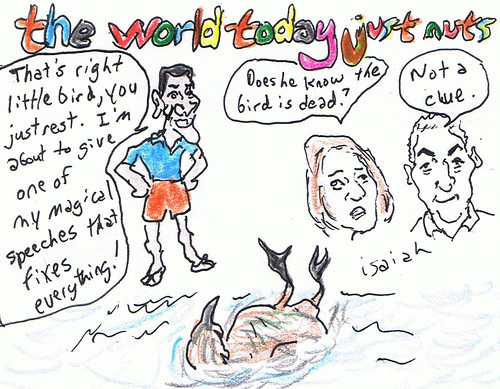
Isaiah's The World Today Just Nuts "Not A Clue"

not a clue

Yes, Barack is back in the Gulf. This AP article notes that he will be on TV tomorrow night yacking yet again. Is there no escaping the over-exposed celebrity. During the summer, we're supposed to be in repeats.

"The Sad Case of Alabama's Perdido Bay" (Jonathan Weisman and Mike Esterl, Wall St. Journal):
Last month, as oil began spreading eastward from Louisiana, Alabama Gov. Bob Riley made it a top priority to stop oil infiltrating the scenic Perdido Pass, a waterway near the Florida border that leads into Perdido Bay, one of the centerpieces of the fishing and tourism industry for both Alabama and Florida.
In mid-May, Riley and Coast Guard officials worked out a plan to hold the oil back, using a reverse funnel design to deflect the currents. Alabama authorities scoured the globe looking for the thick, heavy ocean boom to make the funnel, said Todd Stacy, a spokesman for the governor.
In the third week of May, they finally found it in Bahrain, and had it flown from the Persian Gulf to a staging area on the Alabama coast. Then, in the last week of May, just before Obama’s second trip to the region, the Coast Guard took the boom from Alabama and gave it to Louisiana, Alabama and Coast Guard officials acknowledge.
Tony Russell, a spokesman for U.S. Coast Guard Admiral Thad Allen, the leader of the federal oil spill response, said today the boom was rushed to Louisiana’s Terrebonne Parish to protect Terrebonne Bay from oil in Barataria Bay, adjacent to it.
Riley was furious. At a June 4 meeting with the president and Allen, the governor sat seething as the admiral went over the materials that had been deployed throughout the Gulf, including Alabama. He told Allen he knew full well the ocean boom had been taken from his state, according to officials at the meeting.


Does anyone plan on asking when Barack found out about the Gulf Disaster (April 22nd) in terms of how bad it was and why he did nothing except go off on date weekend? Anyone?

It's worth asking especially since he plans on boring us with another lengthy, never ending speech tomorrow night.

"Media: Let's Kill Helen!" (Ava and C.I., The Third Estate Sunday Review):
Yochi wanted to talk about the Israeli press and stated he would leave it to someone else to address the Arab press because he doesn't follow it. The obvious question for Yochi is why are you, a Wall St. Journal reporter covering the State Dept, following the Israeli press?
Because you care about international issues? Then shouldn't you also follow the Arab press? And, if you don't -- and he admitted he didn't -- does that go into the attacks you launch on Helen?
He insisted it wasn't a surprise, Helen's remarks, to the Israeli press, "In part because, with Helen Thomas, this was not the first that was anti-Israel, verging on anti-Semitic Her political biases have never really been in question and as time has passed and she's gotten older and as her role ["segued" is the word Yochi mispronounced] totally into that of a columnist rather than a reporter, her questions were always -- in the White House briefing room -- were always harshly anti-Israel."Always?
Yochi, are you a damn liar or are you trying to tell us that the Iraq War was all about Israel? We seem to remember Helen asking Ari Fleischer February 26, 2003 why Bully Boy Bush was "going to bomb them?" And "them" was Iraqis. She continued, "I mean, how do you bomb people back to democracy? This is a question of conquest. They didn't ask to be 'liberated' by the United States."
If you need more than text -- and Yochi probably does -- click here for a series of video clips The New York Times posted last week of Helen asking questions and you'd have to be Yochi to watch them and claim that all Helen ever did was ask "harshly anti-Israel" questions at the White House press briefing.
Shame on that little liar Yochi. Shame on Diane Rehm, Roy Gutman and Abderrahim Foukara for refusing to correct Youchi's obvious lie.
Youchi wasn't done distorting reality, "Now the question of whether that ever verged over into anti-semitism is a different one and a difficult one to answer. But it was not a surprise. In the Israeli press it was not covered as 'Shock News Flash Helen Thomas may pose anti-Israel views.' But it was surprising all the same because of the Holocaust reference and the idea that people should go back to Poland or Germany which is a mainstay of some of the rhetoric you hear from [begins required Yochi slam on Iran]."
Really? And again, shame on Diane, Roy and Abderrahim. Yochi, as usual, lied. He lies to get his "Holocaust reference" in. Can't very well admit she noted America and elsewhere and still pimp that lie.
Some people are saying Helen needed to retire because she was 'old.' Diane turns 74 this year. After Friday's embarrassment maybe it's time for Diane to step down with grace?

That is from Ava and C.I.'s amazing article that I plan to highlight again this week. There are two more parts that I want to highlight. I urge you to read it in full. It is their finest article this year. Helen Thomas was targeted by her peers. They are the ones who did her in.

"Iraq snapshot" (The Common Ills):
Monday, June 14, 2010. Chaos and violence continue, Iraq's MPs take oaths and do roll call (and little else), Nouri's vanity continues to be a sticky point in his most recent alliance, the weekend sees an assault on a Baghdad bank robbery, the US State Dept issues a report on human trafficking, and more.

Today Iraq's semi-newly elected Parliament convened.
Ned Parker (Los Angeles Times) reports, "Two men, both of them seated in the parliament's first row, loomed over the session: Prime Minister Nouri Maliki and Iyad Allawi, the former prime minister whose coalition won a narrow plurality in the new assembly. Neither man has budged in insisting that he should be the one to head the next government." March 7th, Iraq concluded Parliamentary elections. Three months and two days later, still no government. 163 seats are needed to form the executive government (prime minister and council of ministers). When no single slate wins 163 seats (or possibly higher -- 163 is the number today but the Parliament added seats this election and, in four more years, they may add more which could increase the number of seats needed to form the executive government), power-sharing coalitions must be formed with other slates, parties and/or individual candidates. (Eight Parliament seats were awarded, for example, to minority candidates who represent various religious minorities in Iraq.) Ayad Allawi is the head of Iraqiya which won 91 seats in the Parliament making it the biggest seat holder. Second place went to State Of Law which Nouri al-Maliki, the current prime minister, heads. They won 89 seats. Nouri made a big show of lodging complaints and issuing allegations to distract and delay the certification of the initial results while he formed a power-sharing coalition with third place winner Iraqi National Alliance. Together, the two still lack four seats necessary (or so it is thought) to form the government. Jane Arraf (Christian Science Monitor) observes, "More than three months after the election and a manual recount of more than 2 million ballots, there is still no agreement between political leaders as to who actually won. Former Prime Minister Iyad Allawi's secular coalition maintains that the two-seat lead he won in the election entitles him to head a government while Prime Minister Nouri al-Maliki's new Shiite alliance formed after the poll argues that its greater number of seats gives it that right."

Nayla Razzouk and Caroline Alexander (Bloomberg News) reports that the "majority of lawmakers [. . .] took the oath in the two official lanagues, Arabic and Kurdish, before the elder lawmaker, Fuad Massum, closed the session. Iraq's constitution stipulates that the house elect a speaker, two deputy speakers and a new president, who asks the leader of the largest bloc to name a new prime minister." Ned Parker (Los Angeles Times) adds the MPs were "dressed in Western suits, tribal robes and clerics' turbans". Anne Barker (Australia's ABC News) notes, "After the national anthem, a recitation from the Koran and the oath of allegiance, the acting speaker declared the session still open but suspended indefinitely." Reuters explains that Fouad Masoum is a Kurd and "one of the chamber's oldest members and picked to open the session." Jomana Karadsheh (CNN) quotes Massoum stating, ""The voters who risked their lives and the lives of their families to cast their votes are looking forward to us speeding up the process of government formation and then being completely dedicated to serving the public and providing their security and stability ...needs." Zhang Xiang (Xinhua) adds, "Legislator Fouad Masum opened the session at about 11:15 a.m. ( 0815 GMT) [. . .] About 20 minutes later, Masum adjourned the session until further notice to give the political blocs more time to agree on a new speaker and his two deputies." Anthony Shadid (New York Times) observes, "Given the deadlock, the brevity of the session was expected. It was recessed until an unspecified date, possibly when a broader agreement on a coalition is reached. The most optimistic prediction for a deal was a week; the more pessimistic said months." Leila Fadel (Washington Post) adds, "The deeper issues of the nation were apparent in the short session. The followers of fiery Shiite cleric Moqtada al-Sadr, who strongly opposes the U.S. military role in Iraq, threatened to walk out in the days before Monday's session to protest the presence of U.S. Ambassador Christopher R. Hill." Fadel goes on to quote Iraq's Foreign Minister, Hoshyar Zebari, and note that he is "a Kurdish member of the new parliament." Apparently with him, Nouri and assorted others present today, the issue of the Constitution barring members of Parliament from holding "an executive post in the government" has been ignored. Shadid noted it might be months, Jane Arraf (Christian Science Monitor) quotes Sadr bloc member Baha al-Araji stating, "We need time to sort it out. We have two We need time to sort it out," says Baha al-Araji, a senior member of the Sadr bloc. "We have two problems – one inside the new bloc and the other with Iraqiya and the Kurds -- I think we need at least two months to settle that." Moqtada al-Sadr's bloc makes up the most seats in the Iraqi National Alliance followed by Ammar al-Hakim's bloc. Sami Moubayed (Gulf News) explains al-Hakim also has trust issues when it comes to Nouri and that he "was visibly angry with Al Maliki's insistence that no one but he was entitled to the Iraqi premiership" and quotes him stating, "I speak to the politicians and tell them: Come down from your ivory tower and [do away] with your personal ambitions!" Saturday, Muhanad Mohammed (Reuters) reported that the Council of Ministers' office was the location of a meeting between Ayad Allawi and Nouri al-Maliki whose political slates came in first and second respectively in the March elections. No major issues are thought to have been resolved in the meeting. The National Newspaper explains, "Saturday's much-anticipated meeting between the head of the Iraqiya bloc, Iyad Allawi, and the incumbent prime minister Nuri al Maliki, who leads the State of Law faction, has yielded no tangible outcome." Meanwhile Spencer Swartz (Wall St. Journal) explains that Barham Salih, Kurdish Prime Minister, is holding out for "written guarantees from Iraq's main political leaders that key Kurdish issues, such as the region's right to oversee its oil resources, will be protected before it backs a new Iraqi government". Damiem McElroy (Telegraph of London) quotes Salih stating, "It cannot be the Kurds and Shia going it alone and a protracted struggle would not be good for Iraq. The country's needs an inclusive and competent that address the stagnation of the economy, the mismanagement of the oil revenues and failure to restore electricity supplies and other services to the people." Meanwhile the always oblivious (and stoned?) US Ambassador to Iraq Chris Hill held a press conference in Baghdad. Alsumaria TV gets praise for enduring the yawnfest and reporting that (no surprise), "US ambassador to Iraq Christopher Hill said he is optimistic over the dialogue between the Iraqi political parties which aim at forming a new government."

Today on Morning Edition (NPR),
Steve Inskeep noted that over 65% of the MPs "are newcomers" as he introduced Lourdes Garcia-Navarro's latest report from Iraq. In this one, she's interviewing former MP's who paint a picture of immense corruption. Mithal al-Alousi states that neighboring countries have bought off MPs with bribes. Former MP Wathab Shaker adds that the corruption was widespread, "Unfortunately, a big number of them built houses outside Iraq. Politicians would use their influence to push certain deals through. The proof is that there has been so much money spent on reconstruction in Iraq, but where are the buildings, the hospitals, the schools, the electricity, the water? We could be the richest country in the world, but our people are digging through the trash." Jomana Karadsheh (CNN) notes, "Only 64 of the 325 representatives served in the previous parliament."

From law makers to law breaking,
Oliver August (Times of London) reports:An investigation by The Times in five Iraqi provinces has found that hazardous material from US bases is being dumped locally rather than sent back to America, in clear breach of Pentagon rules.North and west of Baghdad, engine oil is leaking from 55-gallon drums into dusty ground, open acid canisters sit within easy reach of children, and discarded batteries lie close to irrigated farmland. A 2009 Pentagon document shown to The Times by a private contractor working with US soldiers mentions "an estimated 11 million pounds [5,000 tonnes] of hazardous waste" produced by American troops.

Sean Alfano (New York Daily News) and UPI picked up on August's report. August files an update noting that the paper's report (his report, but he credits the paper) has led to the US military announcing there will be an investigation into how hazardous material was disposed with prosecution looming for anyone found guilty: "Three American generals faced a barrage of questions on environmental damage at a press conference called to explain the closure of US bases during the troop withdrawal that started last January and will end in December 2011."

A bank was attacked Sunday. Yesterday
Martin Chulov (Guardian) reported, "Militants wearing Iraqi military uniforms stormed Baghdad's Central Bank today after using a suicide bomber and at least four other bombs to blast their way into one of the city's most heavily-fortified buildings." Counting 15 dead and "dozens wounded," Suadad al-Salhy and Muhanad Mohammed (Reuters) explained, "The attack occurred as bank employees were leaving work, sending a thick plume of smoke over Baghdad after the bank's generator was set ablaze." Anthony Shadid (New York Times) provided more specifics of the scene of the attack, "The scene itself was reminiscent of the strife that the country experienced during the worst sectarian bloodshed in 2006 and 2007, when Iraq teetered on the edge of anarachy. In the pandemonium, bystanders, employees and shoppers ran for cover. Witnesses said many were killed or wounded in the crossfire between attackers and the police. For hours, ambulances ferried the wounded from the neighborhood." Liz Sly and Nadeem Hamid (Los Angeles Times) counted 24 dead and add, "According to Maj. Gen. Qassim Atta Moussawi, spokesman for security forces in Baghdad, no apparent attempt was made to steal money, but several floors of the building were set ablaze after the gunmen entered." Before Sly and Hamid filed, Jinan Hussein and Leila Fadel (Washington Post) were already noting, "Despite his assertion, it was unclear whether al-Qaeda in Iraq was responsible or whether the robbery was simply a criminal attack. The Central Bank houses sensitive documents." Today Kim Gamel (AP) notes the increased death toll from Sunday's Baghdad bank attack (bombs and gunfire): at least 26 dead.
Turning to violence reported today.
Daren Butler and Mark Heinrich (Reuters) note overnight clashes on or near the border Iraq shares with Turkey resulted in the death of 1 Turkish soldier with an additional four injured. Sahar Issa (McClatchy Newspapers) reports a Mosul market bombing claimed 1 life and left twenty-seven injured (the bomb was in a wheel barrow). AFP reports that a Baghdad bombing claimed the life of 1 police colonel and 1 police officer with three more injured and a Diyala Province bombing which claimed the life of 1 Sawha and the man's wife. Sahwa are also known as "Awakenings" and "Sons Of Iraq." Nouri has pulled the Diyala Province Sahwa's right to carry firearms.

"War forced them to leave their country, now a number of Iraqi refugees in Europe are being forced to return," declared Mike Hanna last week on
Inside Story (Al Jazeera). He was noting the forced deportations from England, Norway, the Netherlands and Sweden.


Mike Hanna: The Iraqi diaspora is one of the largest in modern times. The UN has described it as a humanitarian crisis. To date, more than 4.5 million Iraqis have been uprooted. While 2.5 million of them are internally displaced, over 2 million found refuge abroad. Out of that, only some hundred-thousand submitted asylum claims within the EU and most of them have been unsuccessful. Germany has close to 40,000 Iraqi refugees. Sweden is home to another 40,000 according to the government. 460 Iraqis have been deported in the last two years while over 4,000 have returned voluntarily after being denied asylum. The Netherlands has more than 15,000 Iraqi refugees. But the government has tightened its policy after public opinion became increasingly opposed to integration.

The shameful forced deportations take place as the US State Dept issues a new report, "
Trafficking in Persons Report 2010." Secretary of State Hillary Clinton explains the report:

I am pleased to celebrate and reflect upon the last decade of progress identifying and fighting the phenomenon of modern slavery. Ten years ago, the United Nations negotiated the international standards against trafficking in persons and the United States enacted the Trafficking Victims Protection Act. Since then, the international community has witnessed tangible progress in the effort to end the scourge of trafficking in persons. More victims have been protected, more cases have been successfully prosecuted, and more instances of this human rights abuse have been prevented.
Countries that once denied the existence of human trafficking now work to identify victims and help them overcome the trauma of modern slavery, as well as hold responsible those who enslave others. Although progress has undoubtedly been made against this global phenomenon, there is more work to do. This annual assessment is an opportunity to diagnose the world's efforts to implement the "3P" paradigm of prevention, protection, and prosecution. Based on lessons learned, we must work together with civil society, the corporate sector, and across governments through the "fourth P" -- partnership -- toward a world in which every man, woman, and child is safe from the hands of traffickers and can realize their God-given potential.
The 10th annual Trafficking in Persons Report outlines the continuing challenges across the globe, including in the United States. The Report, for the first time, includes a ranking of the United States based on the same standards to which we hold other countries. The United States takes its first-ever ranking not as a reprieve but as a responsibility to strengthen global efforts against modern slavery, including those within America. This human rights abuse is universal, and no one should claim immunity from its reach or from the responsibility to confront it.

The section of the report on Iraq includes:

Some Iraqi boys from poor families are subjected to forced street begging and other nonconsensual labor exploitation and forced commercial sexual exploitation. Some women from Ethiopia, Indonesia, Nepal, and the Philippines who migrated to the area under the jurisdiction of the Kurdistan Regional Government (KRG) experienced conditions of involuntary domestic servitude after being recruited with offers of different jobs. An Iraqi official revealed networks of women have been involved in the trafficking and sale of male and female children for the purposes of forced prostitution. There were reports some Iraqi boys were trafficked internally for the purpose of organ donation; Baghdad hospitals did not question the "voluntary" donation because often the father of the boy was present. There have been isolated cases of Iraqi border forces intercepting older men and young girls attempting to travel together out of Iraq using fake documents; NGOs contend these are cases of trafficking. Anecdotal evidence and media reports suggested some trafficking victims were taken from orphanages and other charitable institutions by employees of these organizations. The Government of Iraq does not fully comply with the minimum standards for the elimination of trafficking; however, it is making significant efforts to do so in spite of resource and capability constraints. The Iraqi government continued to move its draft anti-trafficking bill through its legislative structures. Because the determination that Iraq is making significant efforts is based on indications of a commitment to take additional future steps over the next year, particularly the passage of the anti-trafficking law, Iraq is placed on Tier 2 Watch List for the second consecutive year. Despite these overall significant efforts, the government did not show progress over the last year in punishing trafficking offenses using existing laws, identifying and protecting victims of trafficking, or preventing trafficking from occurring.

The report finds that the Iraqi government has made little-to-no progress on enforcing anti-trafficking. While not listing punishments for the crime, the Constitution makes clear that human trafficking is not allowed. A bill is winding its way through the process. The report finds that the victims of human trafficking are not being provided with needed services and that males and females forced into sexual slavery will most likely themselves be punished in courts due to the fact that "coercion is not recognized in Iraqi courts as a legal defense for engaging in an unlawful act". In addition, when the Iraqi government has known of forced labor, they've failed to assist the victims and have instead deported them back to their countries of origin such as with 14 Ugandan women.

On the subject of the US State Dept,
Richard Lardner (AP) reports that the Department wants its own military force to protect its embassy staff after the US military drawsdown or departs or 'departs'. Which translates as? Their wish list, Lardner reports, includes 24 Black Hawk helicpoters as well as "50 bomb-resistant vehicles, heavy cargo trucks, fuel trailers and high-tech surveillance systems".
Monday April 5th, WikiLeaks released US military video of a July 12, 2007 assault in Iraq. 12 people were killed in the assault including two Reuters journalists Namie Noor-Eldeen and Saeed Chmagh. Monday June 7th, the US military announced that they had arrested Bradley Manning and he stood accused of being the leaker of the video. Philip Shenon (Daily Beast) reported Friday that the US government is attempting to track down WikiLeaks' Julian Assange. Mike Gogulski has started a website entitled Help Bradley Manning. Dave Lindorff (This Can't Be Happening) notes the US government's dragnet for Julian Assange:
How is it (mainstream journalists ought to be asking but aren't), that the Pentagon can unleash its vast intelligence resources to hunt down the Australian-born Assange, but cannot bring itself to devote those same resources and commitment to hunting down Osama Bin Laden, the man they claim is behind not only the attacks on the World Trade Center towers and the Pentagon itself, but also the resistance to US forces in Iraq and Afghanistan?I'm not sure which is the bigger scandal here: the Pentagon's grotesque misallocation of resources, or the media's unwillingness to point it out.There is no indication or claim by the government that Wikileaks has paid anyone anything to reveal US secrets -- in fact the government claims it isn't even interested in arresting Asange, just in "trying to convince him" not to release those cables. (Yeah, sure. I believe that like I believe the government wants fair hearings at its secret military tribunals in Guantanamo.) The secrets he has disclosed have been volunteered to Wikileaks by government and military whistleblowers, one of whom, Army intelligence specialist Bradley Manning, is now under arrest in Kuwait, a US client state where there are no protections against torture. Note that even what Manning did should not be considered a crime in any just, open society. He didn't endanger US security as claimed; rather, he revealed a possible crime -- the killing of civilians by US forces -- that the government itself was covering up and refusing to investigate. (He says he tried to pursue justice within the military chain of command and was ignored, which is why he turned to Wikileaks.) The man is not criminal or traitor. He's a hero.

Friday a bombing attack on US service members resulted in the deaths of 2 US soldiers. Today US Senator Blanche Lincoln's office issued the following:

U.S. Senator Blanche Lincoln today released the following statement upon learning of the passing of Specialist William C. Yauch, 23, of Batesville. Specialist Yauch died in Jalula, Iraq, in support of Operation Iraqi Freedom.
According to initial reports, Specialist Yauch died of injuries sustained when a vehicle-borne improvised explosive device detonated near his patrol. He is survived by his wife of Batesville, his mother of Cave City, and his father of Saint Charles, Missouri.
"My heart goes out to the family of Specialist Yauch who made the ultimate sacrifice on behalf of our nation," Lincoln said. "Along with all Arkansans, I am grateful for his service and for the service and sacrifice of all of our military service members and their families. I am committed to ensuring they have the full support that they need and deserve. Our grateful nation will not forget them when their military service is complete.
"More than 11,000 Arkansans on active duty and more than 10,000 Arkansas reservists have served in Iraq or Afghanistan since September 11, 2001. These men and women have shown tremendous courage and perseverance through the most difficult of times. As neighbors, as Arkansans, and as Americans, it is incumbent upon us to do everything we can to honor their service and to provide for them and their families, not only when they are in harm's way but also when they return home. It is the least we can do for those whom we owe so much."
Specialist Yauch was assigned to B Company, 5th Battalion, 20th Infantry Regiment, 2nd Infantry Division, Joint Base Lewis-McChord, Washington.
The other soldier killed in the attack was Sgt Israel Obryan of Newsbern, Tennessee who was twenty-four years old and on his second tour of Iraq. A friend with the DSCC gave me the heads up to Senator Lincoln's statement above. Tennessee has two Republican senators (Bob Corker, Lamar Alexander) but, for the record, their websites were checked for statements on Obryan. There were none. Tennessee' governor is a Democrat, Phil Bredesen, and his website was also checked (and his office was checked with). There was no statement at present on Obryan. If any of the three Tenn. officials issues a statement, we'll note it.

Staying with service members,
Hal Bernton (Seattle Times)reports, "Seattle researchers, with the aid of sophisticated scanning technology, have found long-term changes in brain functions of Iraq veterans exposed to blast shock waves." Iraq War veteran and police officer Timothy E. Carson faces charges in the US for a January 6th bank robbery attempt. Sarah Lemagie (Minneapolis Star Tribune) reports his attorney, Andrea George, told the court Friday that Carson "was under severe stress from financial problems, a deceptive wife, a sick child and nightmares about his military service in Iraq". Hart Van Denburg (Minneapolis City Pages) adds he "was evidently hoping for a suicide-by-cop confrontation the day he robbed a bank". AP notes that Carson entered a plea of guilty back in March and that current court proceedings are over the sentencing with the prosecution wanting at least nine years prison time and George arguing for less prison time for her client (seven years) and for psychological treatment.

"They gave me a gun" he said
"They gave me a mission
For the power and the glory --
Propaganda -- piss on 'em.
There's a war zone inside me --
I can feel things exploding --
I can't even hear the f**king music playing
For the beat of -- the beat of black wings."
[. . .]
"They want you -- they need you --
They train you to kill --
To be a pin on some map --
Some vicarious thrill --
The old hate the young
That's the whole heartless thing
The old pick the wars
We die in 'em
To the beat of -- the beat of black wings."
-- "The Beat of Black Wings," words and music by
Joni Mitchell, first appears on her Chalk Mark In A Rainstorm.

Moving over to a UK service member, Danny Fitzsimons continues to await trial in Iraq. He served in the British military for eight years and was stationed in Afghanistan and Kosovo as well as Iraq. He returned to Iraq last fall as a British contractor, or mercenary,
accused of being the shooter in a Sunday, August 9th Green Zone incident in which 1 British contractor, Paul McGuigan, and 1 Australian contractor, Darren Hoare, died and one Iraqi, Arkhan Madhi, was injured. His family has explained that he suffers from PTSD and have asked that the trial be moved to England. Eric and Liz Fitzsimons (his father and step-mother) spoke to the BBC (link has video):
Liz Fitzsimons: You see, when he came out of the army because the army had always been his life, it was then at a real crossroads in his life and where some people might be able to cope, unfortunately, Daniel didn't cope well because he did enjoy army life. It was all he ever wanted, he loved it. And you come out and you live Middleton, which is where he ended up, and he couldn't find a path that suited him, he couldn't find a job although he tried very hard. And a testament to Daniel is that he joined a gym and kept himself -- Daniel likes routine. Daniel goes to the gym every day almost, I would suggest, every day, goes jogging he's a very clean young man. You know, he's not sort of gone wayward and just gone to the dogs kind of thing. And he met a girl, like you want your children to do, but then he wanted the normal life and he wanted the money that would go with a normal life. How does he do that when he can't find a job? And unfortunately becoming a security --
Eric Fitzsimons: He went back into doing security.
Liz Fitzimons: -- person in Iraq. [. . .] Oh, awful. Awful. The situation in Iraq isn't good, is it? We all know it's not good. But he would be out in convoys I believe their main job is to escort to --
Eric Fitzsimons: Oil [workers? Second word isn't clear.]
Liz Fitzsimons : Yes but they do escort people to jobs. And they do ride shotgun basically. They ride around --
Eric Fitzsimons: He's told us quite a lot of --
Liz Fitzsimons: Yeah.
Eric Fitsimons: -- tales
Liz Fitzsimons: He saw some awful things. The person in the cab next to him was blown up.
Eric Fitzsimons: Yeah.
Liz Fitzsimons: Next to him. At the same he had a bullet in his foot.
Eric Fitzsimons: Bullet in his foot, yeah, he's seen all sorts of IEDs you know, sorts of explosions at the side of the road. Loads and loads of them. And seen lots and lots of his friends killed.
In an article published today by Fleetwood Weekly News, Liz Fitzsimons states, "It's a nightmare. By August it will be virtually a year since the incident happened. We are quite worried about Danny now. It's a struggle for him. We already know that he's suffering from PTSD. He's on medication but it must be very difficult for him. The case has been adjourned so many times now but we hope on August 4 they'll actually start the trial. Even when it starts, it'll still be a long time..." He was supposed to go on trial last January. It was pushed back. Today it was pushed back again. BBC News reports the trial is now set for August 4th. Richard Spencer (Telegraph of London) adds that this is true barring any "further medical reports which contradict the assessment" that Danny's fit to stand trial.
Winding down,
Ann notes that singer-songwriter Jackie DeShannon is Terry Gross' guest on today's Fresh Air. Audio is up at the program's website. Wally asked me to note this press release Madre sent to him:


FOR IMMEDIATE RELEASEContacts: New York: Yifat Susskind, Policy and Communications Director, MADRE (available through Diana Duarte, Media Coordinator, MADRE) (212) 627-0444; email:
media@madre.org Geneva: Malya Villard-Appolon (available through Lisa Davis, Human Rights Attorney, MADRE) 078 / 7991892; email: ldavis@madre.org Geneva: Blaine Bookey, Attorney, Institute for Justice & Democracy in Haiti(415) 515-8956 (US number in Geneva); email: blaine@ijdh.org
Haitian Women's Rights Activist Leaves Camp for Displaced People to Testify before the UN Human Rights Council
**Additional information will be presented at a press meeting on Tuesday, June 8 at 9:45 am, in the Library of Press Room 2, Palais des Nations (Main UN Building in Geneva, Avenue de la Paix)**
June 7, 2010- Geneva, Switzerland -Today, as the United Nations Human Rights Council gathers in Geneva, its representatives will hear testimony from Malya Villard-Appolon, a Haitian women's rights activist and MADRE partner who has lived in the camps for displaced people since the earthquake destroyed her home in January. Ms. Appolon, a leader of KOFAVIV, a Haitian grassroots women's organization, has witnessed the skyrocketing incidence of rape in the camps and the lack of a coordinated or effective response to these persistent threats. Also testifying will be lawyers from MADRE, the Institute for Justice & Democracy in Haiti (IJDH), and the law firm of Morrison & Foerster LLP, who recently returned from a delegation to Haiti and will be accompanying Ms. Appolon in Geneva. Today, Malya Villard-Appolon of KOFAVIV said, "We want to tell the Human Rights Council that the systems for protecting women in the camps are broken. We get no protection from the police, or the peacekeepers. We feel we do not have access to the rooms where decisions about our safety are made. We need the support and commitment of the international community." In her testimony, Ms. Appolon will call for increased security measures to prevent rape within the camps in repeated attacks against women sleeping in their tents, walking to the latrines, or otherwise left vulnerable. She will also demand that grassroots women's groups - often the only source of support for rape survivors and other women subsisting in the camps - be included in decision-making related to the United Nation's work in Haiti. Furthermore, she will insist that funding from UN member states for the response efforts be conditioned on meeting these basic requirements to uphold women's rights. Lisa Davis, a human rights attorney with MADRE, said, "During our time in Haiti, we observed a troubling failure by Haitian and UN officials and large non-governmental organizations to adequately address the rampant levels of rape in the camps. Malya's testimony will force this issue into the spotlight, and the UN member states will face the necessary reminder of their responsibility to protect the human rights of women living in the camps." "It is totally unacceptable for these rapes to continue to go unpunished and undeterred," asserted Blaine Bookey, an attorney with IJDH, and coordinator of the delegation. "Women in the camps have suffered enough. The organizations running the camps and the United Nations have raised enough money to provide basic protections to vulnerable women." Erica J. Richards, an attorney with the law firm Morrison & Foerster added that "Not only do our findings from Haiti show that women face a grave lack of security necessary to prevent and respond to the sexual violence crisis, but medical services are overwhelmed and unable to meet women's healthcare needs stemming from the assaults." Yifat Susskind, MADRE Policy and Communications Director, said today, "Malya's testimony has few precedents. Rarely are the voices of displaced women heard by those in the halls of power. The Human Rights Council must seize the opportunity to benefit from her expertise." For more information about MADRE's work in Haiti, visit our website at
http://www.madre.org/index/press-room-4/news/key/haiti.html About the Organizations Coordinated by the IJDH-organized Lawyers' Earthquake Response Network (LERN), the delegation to Haiti, met with grassroots women's organizations, including KOFAVIV and FAVILEK, and larger NGOs including Kay Fanm and SOFA. IJDH fights for human rights and justice in Haiti and for fair and just treatment of Haitians in the United States. KOFAVIV, a MADRE sister organization established by and for rape survivors, has long served as a lifeline for countless women who face sexual violence in Haiti. Since the earthquake, they have organized emergency support services for people living in the camps, including medical aid for rape survivors, neighborhood watch patrols and human rights trainings.


iraq
the los angeles timesned parker
the christian science monitor
jane arraf
bloomberg newsnayla razzoukcaroline alexanderxinhuazhang xiangthe new york timesanthony shadidthe washington postleila fadelnprmorning editionlourdes garcia-navarro
abc newsanne barker
sami moubayed
jomana karadsheh
the times of londonoliver august
the telegraph of londondamien mcelroy
bbc newsthe telegraph of londonrichard spencerthe minneapolis star tribunesarah lemagiethe minneapolis city pageshart van denburgfleetwood weekly newsjoni mitchellthe seattle timeshal bernton
mcclatchy newspaperssahar issaalsumaria tv

Friday, June 11, 2010

All This Time Later

"New Orleans Oyster Processor Runs Out Of Oysters" (Tamara Keith, Morning Edition, NPR):
The fallout from the BP oil spill continues to ripple through the Gulf economy. This week, it caught up to P&J Oyster Co. in New Orleans.
The owners say it's the oldest continuously operating oyster processor in America. But thanks to the oil, they now have no oysters to process.

Oysterman Mitch Jurisich first spotted oil floating on the water above his beds at 7:30 in the morning. It was just yards away from where his grandparents first settled after emigrating from Croatia almost a century ago.
"This is the last of our areas that we had open from our family to harvest oysters," Jurisich says. "We were fortunate enough to have one little slice of pie left that we were still farming from, and that slice of pie now is gone."


That Gulf Disaster story had a human point and was worth hearing. The nonsense PBS offered tonight on The NewsHour?

I'm sorry, are we supposed to cry for BP?

Is that what corporate funded PBS wanted us to do?

I cannot think of a greater waste of time than what PBS aired tonight.

I also think it's rather troubling that we can fret over BP when so many human and wildlife stories haven't been told. Still. All this time later.

"Iraq snapshot" (The Common Ills):
Friday, June 11, 2010. Chaos and violence continue, 2 US service members are killed in Iraq, rumors of a plot to kill Ayad Allawi circulate in Iraq, the US Pentagon is on the hunt for WikiLeaks, and more.

On NPR today,
The Diane Rehm Show had plenty of time to trash Helen Thomas (including Yochi Dreazen insisting Helen only ever spoke at the White House press briefings to attack Israel -- and not one guest nor Diane bothered to correct him). They just didn't have time for Iraq. No, two sentences of refusing to shoulder the blame for the illegal war they sold -- two sentences from Yochi Dreazen -- does not count as addressing Iraq (especially when even that only came up due to a caller holding the Gang of Useless accountable). No time for Iraq. Good thing nothing happened in Iraq all damn week, right?


Mohammed Tawfeeq and Jomana Karadsheh (CNN) report a Diyala Province bombing which has claimed the lives of 2 US soldiers with six more left injured, 6 Iraqis left dead and twenty-two more left injured. Leila Fadel (Washington Post) adds, "Jalawla lies in the restive Diyala province, a mixed region of Shiite Arabs, Sunni Arabs and Kurds that once was one of the most dangerous places in Iraq." The two deaths bring the number of US service members killed in Iraq to 4405. Anthony Shadid (New York Times) provides this context, "The attack was the deadliest on the American military here in more than two months. It was also a grim reminder that while violence has diminished remarkably across Iraq, hundreds of people are still killed each month here. So far this year, 35 American soldiers have died in Iraq in combat or in what the military terms 'non-hostile' incidents." Hannah Allam (McClatchy Newspapers) explains there have been three other attacks on US forces this week, "In the first, a roadside bomb exploded as a U.S. convoy traveled on a highway through predominantly Sunni Anbar province. No casualties were reported, but the blast left a large crater, and a McClatchy reporter at the scene saw a crane lifting a heavily damaged U.S. armored vehicle onto a flatbed truck. American forces cordoned off the area, blocking traffic, and didn't allow even Iraqi security forces near the scene. Later Thursday afternoon, a roadside bomb targeted a U.S. convoy as it headed toward Abu Ghraib, west of Baghdad, an Interior Ministry official said. Iraqi authorities said they had no information on casualties because American forces didn't allow their Iraqi counterparts near the scene. At about 2:30 p.m. on Thursday, just south of Baghdad in Yusifiya, another roadside bomb exploded near U.S. forces. No casualties were reported." Two US service members killed in a bombing in Iraq? Sorry, Diane and NPR had others to cover, important things, trashing an outstanding journalist, for example. What a proud moment for them.

The attackers of Helen missed the violence in Iraq today . . .

Bombings?

Sahar Issa (McClatchy Newspapers) reports a Baghdad roadside bombing claimed 2 lives and left nine people wounded, a second Baghdad roadside bombing injured five people (two were Iraqi soldiers), a Mosul University bombing claimed the life of 1 military officer and, dropping back to yesterday, a Baghdad suicide car bombing claimed the life of the driver and the lives of 1 Sahwa commander, 1 woman, 1 military officer and 1 other man while wounding ten people. Reuters notes a Thursday Tikrit car bombing which claimed 1 life.

Shootings?

Sahar Issa (McClatchy Newspapers) reports 1 police officer shot dead in Mosul. Reuters notes 1 woman was shot dead in Kirkuk last night.

Corpses?

Reuters notes 2 corpses were discovered in Kirkuk.

Fang Yang (Xinhua) observes, "Sporadic attacks and waves of violence continue across Iraq three months after the country held its landmark parliamentary election on March 7, which is widely expected to shape the political landscape of the war-torn country." March 7th, Iraq concluded Parliamentary elections. Three months and two days later, still no government. 163 seats are needed to form the executive government (prime minister and council of ministers). When no single slate wins 163 seats (or possibly higher -- 163 is the number today but the Parliament added seats this election and, in four more years, they may add more which could increase the number of seats needed to form the executive government), power-sharing coalitions must be formed with other slates, parties and/or individual candidates. (Eight Parliament seats were awarded, for example, to minority candidates who represent various religious minorities in Iraq.) Ayad Allawi is the head of Iraqiya which won 91 seats in the Parliament making it the biggest seat holder. Second place went to State Of Law which Nouri al-Maliki, the current prime minister, heads. They won 89 seats. Nouri made a big show of lodging complaints and issuing allegations to distract and delay the certification of the initial results while he formed a power-sharing coalition with third place winner Iraqi National Alliance. Together, the two still lack four seats necessary (or so it is thought) to form the government. Yesterday Muhanad Mohammed (Reuters) reported that the State of Law slate and the Iraqi National Alliance had officially "announced their merger". This morning Caroline Alexander (Bloomberg News) adds, "It still has to be formally approved by lawmakers when they convene for the first time on June 14." Reuters notes they intend to operate "under a new name, National Alliance, but have yet to resolve differences over their nominee for prime minister". BBC News adds, "The BBC's Jim Muir in Baghdad says that both the Shia and secular-Sunni blocs will now be claiming the right to be asked to form a government. The constitution is unclear on the issue." In other political news, Maad Fayad (Asharq Alawsat Newspaper) reports, "Senior Arab and Iraqi security officials revealed to Asharq Al-Awsat what it described as an 'elaborate plot' to assassinate the head of the Iraqiya List, Iyad Allawi. The sources said that 'local groups are involved in this plot and it is also backed by a regional party'." Meanwhile how much do Iraqi citizens pay their government officials? Guess what? They aren't supposed to know. So much for 'democracy' in Iraq. At Inside Iraq, an Iraqi correspondent for McClatchy notes Al Alam Newspaper has published possible salaries:Iraqi president: About 700,000 USD a year Iraqi Vice presidents: 600,000 USD a year but Iraqi news agencies said that Vice President Adel Abdul Mahdi said he receives a One Million USD a month, in total. Prime Minister office said that Al Maliki receives 360,000 USD a year. But some official sources said that the Prime Minister's salary is equal to the Iraqi President's - so they should receive the same salary. Head of the Judiciary council makes about 100,000 USD a month (not clear on allocations).

Sahwa are also known as "Awakenings" and "Sons Of Iraq." They are, as former US Ambassador to Iraq Ryan Crocker and then-top US commander in Iraq Gen David Petraeus explained to Congress (repeatedly) in April 2008, Sunni fighters who were put on the US payroll so they wouldn't attack US troops and equipment. Actually, Petreaus claimed they were "Shia as well as Sunni" when appearing before Congress on
April 8, 2008 and discussing the "over 91,000" "Awakening." He insisted, "These volunteers have contributed significantly in various areas, and the savings in vehicles not lost because of reduced violence -- not to mention the priceless lives saved -- have far outweighed the cost of their monthly contracts." Nouri was supposed to take over payment of them and bring them into the government. Nouri does very little he promises. Over the weekend, he pulled their right to carry firearms in Diayala Province. Salah Hemeid (Al-Ahram Weekly) reports, "Leaders of the Sahwas controlling around 10,000 personnel in Diyala warned that they would stop cooperating with government security forces if their weapon permits and special badges were withdrawn. In other provinces, members of the Sahwas warned that they would not obey if they were ordered to disarm." Late 2005 through 2007 (or often reduced to 2006 and 2007) saw Iraqis attacking other Iraqis on a huge scale and is popularly known as the "civil war." This level of violence dropped as it had to when a large number of Iraqis fled the country or fled their homes to other parts of the country. (A large number? One-sixth of the population. Over four million Iraqis became refugees.) In the Senate Foreign Relations Committee hearing on April 8, 2008, Joe Biden noted, "Violence has come down, but the Iraqis have not come together. Our military played an important role in the violence. So did three other developments. First, the Sunni Awakening, which preceded the surge. Second, the Sadr cease-fire. Third, sectarian cleansing that left much of Baghdad segregated, with fewer targets to shoot or bomb." Joe Biden was then Chair of the Committee. Today he's the US Vice President. And that's changed. But what about the situation he was describing? If the three developments led to a decrease in the violence, what happens when one of the developments is no longer present? Something to think about as Nouri continues his war on the Sahwa.

And as the Iraq War continues -- long after the promise candidate Barack Obama repeatedly made while campaigning for the Democratic Party's presidential nomination -- people begin to ask if it ever ends.
Peter Symonds (WSWS) outlines a number of disturbing trends:

In his comments last Friday, General Odierno declared that the "drawdown" was ahead of schedule -- 600,000 containers of gear and 18,000 vehicles moved out; and the number of bases down from 500 last year to 126 and set to decline to 94 by September 1. What is actually underway, however, is not a withdrawal, but a vast consolidation in preparation for the long-term occupation of the country by US forces.
The Stars and Stripes newspaper noted in an article on June 1 that the ratification of the US-Iraq security agreement in November 2008 governing the drawdown was followed by a massive expansion of base construction work. "In all, the military finished $496 million in base construction projects during 2009, the highest annual figure since the war began and nearly a quarter of the $2.1 billion spent on American bases in Iraq since 2004. An additional $323 million worth of projects are set to be completed this year."
While the number of US bases may be declining, the Pentagon is establishing what are known as "enduring presence posts" -- including four major bases: Joint Base Balad in the north, Camp Adder in southern Iraq, Al-Asad Air Base in the west and the Victory Base Complex around Baghdad International Airport. These are sprawling fortified facilities -- Balad alone currently houses more than 20,000 troops. In addition to the 50,000 troops that will remain, there will be up to 65,000 contractors after September 1.Under the 2008 agreement, the US military handed over internal security functions to Iraqi forces last year, but, under the guise of "training" and "support", retains tighter supervision of the army and police. Moreover the Iraqi government can always "request" US troop assistance in mounting operations. As Odierno explained in a letter to US personnel on June 1, even after all US combat troops leave, "we will continue to conduct partnered counter-terrorism operations and provide combat enablers to help the Iraqi Security Forces maintain pressure on the extremist networks."
The 2008 agreement sets December 31, 2011 as the deadline for all US troops to quit Iraq, but the construction of huge new US bases indicates a long-term US military presence under a Strategic Framework Agreement that is yet to be negotiated.

Another one noticing realities is Pentagon Papers whistle blower
Daniel Ellsberg and he shares them with Marc Pitzke (Der Spiegel):

Ellsberg: I think Obama is continuing the worst of the Bush administration in terms of civil liberties, violations of the constitution and the wars in the Middle East.

SPIEGEL ONLINE: For example?

Ellsberg: Take Obama's explicit pledge in his State of the Union speech to remove "all" United States troops from Iraq by the end of 2011. That's a total lie. I believe that's totally false. I believe he knows that's totally false. It won't be done. I expect that the US will have, indefinitely, a residual force of at least 30,000 US troops in Iraq.

SPIEGEL ONLINE: What about Afghanistan? Isn't that a justifiable war?

Ellsberg: I think that there's an inexcusable escalation in both countries. Thousands of US officials know that bases and large numbers of troops will remain in Iraq and that troop levels and bases in Afghanistan will rise far above what Obama is now projecting. But Obama counts on them to keep their silence as he deceives the public on these devastating, costly, reckless ventures.

Daniel Ellsberg was Scott Horton's guest for yesterday's
Antiwar Radio. They're discussing Bradley Manning. Who? Monday April 5th, WikiLeaks released US military video of a July 12, 2007 assault in Iraq. 12 people were killed in the assault including two Reuters journalists Namie Noor-Eldeen and Saeed Chmagh. Monday June 7th, the US military announced that they had arrested Bradley and he stood accused of being the leaker of the video. Philip Shenon (Daily Beast) reports the US government is attempting to track down WikiLeaks' Julian Assange: "Pentagon investigators are trying to determine the whereabouts of the Australian-born founder of the secretive website Wikileaks for fear that he may be about to publish a huge cache of classified State Department cables that, if made public, could do serious damage to national security, government officials tell The Daily Beast."

Today
WikiLeak's Twitter feed has noted:


Pentagon manhunt for WikiLeaks staff declared:
http://bit.ly/cN1Kl8 just say no: http://bit.ly/ctRxAV via bitly

Any signs of unacceptable behavior by the Pentagon or its agents towards this press will be viewed dimly.
via bitly

Debra Sweet (World Can't Wait) notes the real crimes and WikiLeaks:

The
Crimes Are Crimes statement has been published in The New York Review of Books, The Nation, and now, will next be placed in The Humanist. You can help spread this message and challenge the conscience of people by signing, donating and printing it out for your community (ask store owners if they will display this poster!).
The more I've shown the 17 minute version of Collateral Murder -- even to seasoned anti-war activists -- the more I see how important it is that people
SEE this video.
And the more outrageous it is that a 22 year old Army enlisted man, Bradley Manning, is being charged with leaking the footage to
WikiLeaks.org. The war crimes, and criminal acts the whole world can see in this footage are justified and excused by the US government. And a person who they say leaked it is criminally charged?!?
Today the
Iraq Inquiry announced that their next set of hearings will "run from 29 June to 30 July 2010, at the QE II conference centre in London" and the following will be witnesses:

*Cathy Adams (Legal Counsellor, Legal Secretariat to the Law Officers, 2002 to 2005)
*Geoffrey Adams KCMG (HM Ambassador to Iran, 2006 to 2009)
*Rt Hon Bob Ainsworth MP (Minister of State for the Armed Forces, 2007 to 2009 Secretary of State for Defence, 2009)
*Andy Bearpack CBE (Director Operations and Infrastructure in the Coalition Provisional Authority, 2003 to 2004)
*Dr Hanx Blix (1st Executive Chairman of the United Nations Monitoring, Verification and Inspection Commission, 2000 to 2003)
*Rt Hon The Lord Boateng (Chief Secretary to the Treasury, 2002 to 2005)
*Douglas Brand (OBE) (Chief Police Adviser to the Ministry of Interior, Baghdad, 2003 to 2004)
*Dr Nicola Brewer CMG (Director General Regional Prorammes, Department of International Development, 2002 to 2004)
*Jonathan Cunliffe CB (Managing Director, Financial Regulation & Industry, 2002; Managing Director, Macroeconomic Policy and International Finance, HM Treasury, 2003 to 2007)
*Richard Dalton KCMG (HM Abassadort to Iran, 2003 to 2006)
*General Richard Dannatt GCB CBE ME (Assistant Chief of the General Staff, 2001 to 2002; Commander in Chief Land Command, 2005 to 2006; Chief of the General STaff, 2006 to 2009)
*John Dodds (Team Leader - Defence, Diplomacy and Intelligence; HM Treasury, 2003 to 2005)
*Lt Gen James Dutton CBE (General Officer Commanding Multi National Division - South East - 2005; Deputy Chief of Joint Operations 2007 - 2009)
*Lt Gen Andrew Figgures (Deputy Chief of Defense Staff -- Equipment Capability -- 2006 - 2009)
*Ronnie Flanagan GBE QPM (HM Chief Inspector of Constabulary, 2005 - 2008)
*Lt Gen Robert Fulton KBE (Deputy Chief of Defense Staff Equipment Capability 2003 - 2006)
*John Holmes GCVO KBE CMG (HM Ambassador to Paris 2001 - 2007)
*Martin Howard CB (DIrector General Operational Policy MOD 2004- 2007)
*General Mike Jackson GCB CBE DSO DL (Commander in Chief Land Command 2000 - 2003; Chief of the General Staff 2003 - 2006)
*Sally Keeble (Minister of State, Department for International Development 2002 - 2003)
*Paul Kernaghan CBE QPM (International Policing portfolio lead, Association of Chief Police Officers for England, Wales & Northern Ireland, 2001 - 2008)
*Iain Macleod (Legal Counsellor to the United Kingdom's Mission to the United Nations, 2001 - 2004)
*Tom McKane (Director General Resource & Plans, Ministry of Defence, 2002 - 2006)
*Bruce Mann CB (Director General Financial Management, Ministry of Defence 2001 - 2004).
*Manningham Buller DCB (Deputy Director General, Security Service, 2001 - 2002; Director General, Security Service, 2002 - 2007)*Carolyn Miller (Director Europe, Middle East and Americas, Department for International Development, 2001 - 2004)
*General Kevin O'Donoghue KCB CBE (Deputy Chief of Defence Staff Health, 2002 - 2004; Chief of Defence Logistics 2005 - 2007; Chief of Defence Material 2007 - 2009)
*Rt Hon John Prescott (First Secretary of State and Deputy Prime Minister, to 2007)
*Carne Ross (First Secretary, United Kingdom Mission to New York, 1998 - 2002)
*Maj Gen Andy Salmon CMG OBE (General Officer Commanding Multi National Division South East, 2008 -2009)
*Michael Wareing CMG (Prime Minister's Envoy for Reconstruction in Souther Iraq and Chairman of the Basra Development Commission, 2007 - 2009)
*Stephen White OBE (Directof of Law and Order and Senior Police Adviser to the Coalition Provisional Authority, 2003 - 2004)
*Vice Adm Peter Wilkinson CVO (Deputy Chief of Defense Staff Personnel, 2007 to present)
*Trevor Wooley CB (Director General Resources & Plans, Ministry of Defence, 1998 - 2002; Financial Director, Ministry of Defence, 2003 - 2009)

The Iraq Inquiry is Chaired by John Chilcot and they believe a report will be completed by year's end and that there might also be a round of hearings in the fall.
Chris Ames (Iraq Inquiry Digest) observes, "Hans Blix is the headline name and there are some other witnesses who might not toe the government line." Though Blix should offer some very interesting testimony, he's not the only name of interest on the list. For example, Carne Ross will probably pull in a number of the press when he testifies. A 2008 Time magazine profile by Jumana Farouky opened with:

As Carne Ross talks about how he resigned from the British Foreign Office in 2004 after Britain's decision to go to war in Iraq proved more than he could abide in a frustrating 15-year diplomatic career, the phone rings. "That'll be Kosovo," Ross says. Probably calling to say thanks.

A 2006 report by Colin Brown and Andy McSmith (Independent of London) on the push for the Iraq War noted:

A devastating attack on Mr Blair's justification for military action by Carne Ross, Britain's key negotiator at the UN, has been kept under wraps until now because he was threatened with being charged with breaching the Official Secrets Act.
In the testimony revealed today Mr Ross, 40, who helped negotiate several UN security resolutions on Iraq, makes it clear that Mr Blair must have known Saddam Hussein possessed no weapons of mass destruction. He said that during his posting to the UN, "at no time did HMG [Her Majesty's Government] assess that Iraq's WMD (or any other capability) posed a threat to the UK or its interests."
Mr Ross revealed it was a commonly held view among British officials dealing with Iraq that any threat by Saddam Hussein had been "effectively contained".

Click here for the BBC video of Carne Ross explaining how the Inquiry should have questioned Tony Blair. Chris Ames has covered the Iraq Inquiry forever and a day -- and on the issues at the heart of the inquiry before Gordon Brown was even agreeing to allow a commission. Iraq Inquiry Digest is Chris Ames' site (his writing appears at the Guardian, The New Statesman and other outlets). At the Guardian today, he takes on Nick Clegg:

In opposition, Nick Clegg had some harsh criticism for the way that Gordon Brown's government restricted the ability of the Iraq inquiry to uncover the truth. Clegg's appointment as deputy prime minister seemed to promise a new attitude of openness and at the weekend
he seemed to be promising to put this into practice. In particular, he promised that the inquiry will only be prevented from publishing documents for reasons of national security. But it looks as if nothing is going to change any time soon, if at all.
What
Clegg said the Hay festival on Sunday -- as Today programme listeners will have heard this morning -- was true as far as it went, but his language about how to solve the problem is intriguing. He said that the inquiry's openness would be the key to determining its legitimacy and: "The battle that needs to be fought is to make sure in the final Chilcot report the presumption is towards real, meaningful, thorough disclosure." He added that "the challenge is to make sure there is real disclosure when they publish their findings." But Nick, you are the deputy prime minister. It's up to you.

The Guardian's
Richard Norton-Taylor has been covering the Inquiry at length as well and he reviews the witness list and emphasizes Eliza Manningham-Buller who "told the Guardian last year that she had warned ministers and officials that an invasion of Iraq would increase the terrorist threat. Amid Anglo-US preparations to invade Iraq, she asked: 'Why now?'"


In the United States, the Arlington National Cemetery scandal continues to garner (deserved) attention.
Richard Sisk (New York Daily News) sums it up very well in two sentences, "They didn't arrive at Arlington National Cemetery as unknown soldiers. The Army just treated them that way." Julian E. Barnes (Los Angeles Times) offers this overview, "The inspector general, Lt. Gen. R. Steven Whitcomb, found one case involving personnel killed in Iraq or Afghanistan. In that instance, two grave markers had been switched. Other cases involved areas of the cemetery used to inter personnel from earlier conflicts. [. . .] The extent of the problems at one of the nation's most venerated memorials was not entirely clear. In some cases, grave markers had been knocked over and not properly replaced, the report said. Other reported cases involved poor record-keeping. Whitcomb said there was no indication of mistakes at the point of burial." Michael E. Ruane (Washington Post) adds, "The investigators found that these and other blunders were the result of a 'dysfunctional' and chaotic management system at the cemetery, which was poisoned by bitterness among top supervisors and hobbled by antiquated record-keeping." Those looking for a strong audio report on the story should refer to The Takeaway where Salon's Mark Benjamin is one of the guests and Dorothy Nolte (her sister is buried into Arlington Cemetery).

TV notes. On PBS'
Washington Week, John Dickerson (CBS News, Slate), Alexis Simendinger (National Journal) and Karen Tumulty (Washington Post) join Gwen around the table. This week, Bonnie Erbe will sit down with Jehan Harney, Eleanor Holmes Norton, Melinda Henneberger, Tara Setmayer and Genevieve Wood on the latest broadcast of PBS' To The Contrary to discuss the week's events. And at the website each week, there's an extra just for the web from the previous week's show and this week's online bonus is on drilling for oil. And turning to broadcast TV, Sunday CBS' 60 Minutes offers:
Cyber WarCould hackers get into the computer systems that run crucial elements of the world's infrastructure, such as the power grids, water works or even a nation's military arsenal, to create havoc? They already have. Steve Kroft reports.
Watch Video
The Great ExplorerRobert Ballard discovered the Titanic, the Bismarck and the PT 109 and now 60 Minutes cameras are there for his latest discovery, 1,500 feet down in the Aegean Sea off Turkey. Lara Logan reports. Watch Video
60 Minutes, Sunday, June 13, at 7 p.m. ET/PT. Radio. Today on The Diane Rehm Show (airs on most NPR stations and streams live online beginning at 10:00 am EST), Diane is joined the first hour (domestic news roundup) by Byron York (Washington Examiner), David Corn (Mother Jones) and Dayo Olopade (Daily Beast). For the second hour (international), she's joined by Yochi Dreazen (Wall St. Journal), Roy Gutman (McClatchy Newspapers) and Abderrahim Foukara (Al Jazeera).


iraq
nprthe diane rehm showcnnmohammed tawfeeqjomana karadsheh
the washington post
leila fadel
the new york timesanthony shadid
mcclatchy newspapershannah allem
sahar issa
xinhuafang yang
bloomberg newscaroline alexanderpress tval-ahram weeklysalah hemeidinside iraqmcclatchy newspapers
asharq alawsat newspapermaad fayad
the new york daily newsrichard siskthe los angeles timesjulian e. barnesthe washington postmichael e. ruane
antiwar radioscott hortondaniel ellsberg
the guardianchris ameswswspeter symonds
60 minutescbs newsto the contrarybonnie erbe
washington week

Wednesday, June 09, 2010

The disgusting Ann Compton

"Women Won Big In Tuesday Primaries" (NPR's Talk Of The Nation):
RUDIN: But the labor unions and the net roots and the left, you know, the progressives spent up to $10 million to defeat her in the runoff, but she won pretty handily, by four points, considering most of us thought she would go down to defeat.
CONAN: And a big night for women elsewhere, beginning, I guess we have to say, in California.
RUDIN: Well, California was big. For the first time in history for the first time in California history, Republicans have nominees for both the governorship and the Senate seat. The Senate seat, of course, is the one held by Barbara Boxer, and Carly Fiorina, the former chief executive at Hewlett-Packard, is the nominee there.
And for the governor's race against Jerry Brown, the former governor, will be Meg Whitman, who spent $80 million, $71 million of her own money, to win the nomination there.
CONAN: And no surprises on the Democratic side. As you said, the people we expected would be...
RUDIN: Brown and Boxer, right.


Well Neal and company were a little less clueless this afternoon. I would still steer you away from the program and suggest you instead read "The Genderquake Quakes Again (Ava and C.I.)." Sticking with the NPR theme, C.I. recommended Alicia Shepard's blog:

Nor should the White House remove the small plaque on the chair she occupied for 50 years. Other seats bear a news organization’s name; but Thomas' seat in the front row right under the press secretary's podium declared her name.
Female journalists owe a lot to Thomas. It is on her shoulders and those of a few other female reporters of her generation (including AP’s
Fran Lewine and the New York Times' Nan Robertson), that we were able to stand and be recognized as equally capable, and often better at, reporting the news.

You know who pissed me off the most during all of this? The answer will surprise you.

Ann Compton. Ann Compton, for those who don't know it, had huge problems with ABC for years. They kept insisting she diet. Even when her legs were sticks, she still looked like she was storing nuts in her cheeks for the winter. That was in the good times. They long ago faded. She got pushed from ABC TV over to ABC radio (that's a demotion) years ago.

You might think she'd be sympathetic to Helen. No, she's used Helen to draw attention to herself. She's run from one outlet to another serving up quotes.

This is probably the most attention she's received since she wore a skirt and showed off those newly stick legs.

It is not a proud moment for Ann nor for journalism.


"Iraq snapshot" (The Common Ills):
Wednesday, June 9, 2010. Chaos and violence continue, Nouri says only he can save Iraq (Christ complex), US military identifies a fallen, the race for Labour Party leader in the UK has its candidates, a US House committee is informed failure to implement two Inspector General findings has cost over $81 million tax payer dollars, and more.

Today the
DoD released the following: "The Department of Defense announced today the death of a soldier who was supporting Operation Iraqi Freedom. Sgt Steve M. Theobald, 53, of Goose Creek, S.C. died June 4 near Kuwait City, Kuwait, of injuries sustained in a military vehicle roll-over. He was assigned to the 287th Transporation Company, Livingston, Ala. For more information, media may contact the 143rd Sustainment Command (Expeditionary) at 407-856-6100, ext. 1132." The number of US service members killed in Iraq since the start of the war currently stands at 4403.

March 7th, Iraq concluded Parliamentary elections. Three months and two days later, still no government. Iraqiya is the political slate which won the most seats in Parliament in the March elections. It is headed by former prime minister Ayad Allawi. They won 91 seats. 163 seats are needed to form the executive government (prime minister and council of ministers). When no single slate wins 163 seats (or possibly higher -- 163 is the number today but the Parliament added seats this election and, in four more years, they may add more which could increase the number of seats needed to form the executive government), power-sharing coalitions must be formed with other slates, parties and/or individual candidates. (Eight Parliament seats were awarded, for example, to minority candidates who represent various religious minorities in Iraq.) Second place went to State Of Law which Nouri al-Maliki, the current prime minister, heads. They won 89 seats. Nouri made a big show of lodging complaints and issuing allegations to distract and delay the certification of the initial results while he formed a power-sharing coalition with third place winner Iraqi National Alliance. Together, the two still lack four seats necessary (or so it is thought) to form the government.


Baby, I see you've made yourself all sick again
Didn't I do a good job of pretending?
You're saying that the victim doesn't want it to end
Good. I get to dress up and play the assassin again
It's my favorite
It's got personality
[. . .]
Baby, you can open your eyes now
And please allow me to present you with a clue
If I inflict the pain
Then baby only I can comfort you
-- "When We Two Parted," written by
Greg Dulli and Rick McCollum, first appears on the Afghan Whigs' Gentlemen album


Who knew Nouri was an Afgan Whigs freak?
Anthony Shadid (New York Times) sits down with Little Nouri today who insists that only he can be the new prime minister and, if it's anyone else, the country will descend into madness. Little Nouri also states that he has no interest in curtailing any powers (including those he's pretended existed) for the prime minister post. Looking beyond Nouri, Francis Matthew (Gulf News) notes, "Three months after the inconclusive March 7 elections, Iraq appears to be heading for a broad-based coalition. The danger is that it will be so broad-based that although a government may well be formed, it will lack the determination or focus to allow it to take the difficult decisions that will certainly come its way." Suadad al-Salhy, Jim Loney and Samia Nakhoul (Reuters) report that the country's Constitution bars any member of Parliament from also holding "an executive post in the government" which means Nouri, "vice presidents Tareq al-Hashemi and Adel Abdul-Mahdi, Deputy Prime Minister Rafie al-Esawi and at least nine cabinet ministers including Oil Minister Hussain al-Shahristani" may not be able to take a seat in Parliament Monday when the legislative body is set to hold their first meeting. Jomana Karadsheh (CNN) adds, "The new parliament must name a president, who would then have 15 days to designate a candidate for prime minister. That candidate would then have 30 days to assemble a government -- and if no deal is reached, another candidate would get a shot."

Shot? Turning to some of today's reported violence . . .

Bombings?

Reuters notes a roadside bombing targeting Abdul Rahman Dawood of Iraqiya which injured him and another person, a Baghdad roadside bombing claimed 2 lives and left five people injured, a Muqdadiya suicide bomber took his/her own life and the lives of 2 other people with an addition five injured, a Samarra roadside bombing injured a police officer and a bodyguard and a Basra sticky bombing (targeting a police officer) injured four people (two were police officers).

Shootings?

Mazin Yahya (AP) reports 3 jewelers were killed in their Basra stores by six unknown assailants. Aref Mohammed, Ahmed Rasheed, Jamal al-Badrani, Matt Robinson and Ralph Boulton (Reuters) adds four people were left injured and reminds that May 25th saw another "major attack on a gold market". Reuters notes 1 police officer was killed in a Mosul attack (he was on his farm -- another police officer was wounded by a Mosul grenade attack), an Abu Ghraib home invasion claimed the lives of 1 police officer and his wife (their five sons were injured), an assault on a Kirkuk Sahwa checkpoint in which 1 person was killed (two more were injured) and, dropping back to last night, 1 police officer was shot dead. AFP reports 2 Sahwa members were shot dead in Sharqat.


Over the weekend, Nouri's forces revoked Sahwa's right to carry guns.
Muhammed Abdullah (niqash) reports, "because leaders of the council were accused of being behind the assassination of some religious figures in the province" and quotes Sahwa Abu al-Fawz al-Iraqi stating "disarming us is an explicit attempt to dissolve our organisation. It will only expose us to al-Qaeda which issued a fatwa legitimising attacks against us and on our property."


As noted
yesterday, England, the Netherlands, Norway and Sweden all are planning to deport Iraqi refugees despite the Geneva Conventions, despite the United Nations public opposition to the plan, despite Amnesty International and Iraqi LGBT objecting to the deportations. BBC News adds, "The flight from the UK was jointly organised by European Union governments and was also scheduled to pick up failed asylum seekers at Halmstad in Sweden." Nigel Morris (Independent of London)reports, "Ministers faced a wave of anger last night after ordering the forcible return of failed asylum-seekers to Baghdad despite the violence that continues to plague the Iraqi capital." Norway's The Foreigner notes, "The deporations contravent UNCHR (the UN's High Commissioner for Refugees) recommendations about refugees from Baghdad, Diyala, Ninewa, Salah al-Din and the Kirkuk province safety.In accordance with the UN's 1951 Refugee Convention, the UNHCR believes these groups of people should continue to enjoy international protection by being classed as DPs (Displaced Persons)." England's new prime minister, David Cameron was asked about the issue today. Owen Bowcott (Guardian) reports, "The prime minister told MPs that he had discussed the situation in Iraq with US general David Petraeus, overall commander of American operations in the Middle East." News On News had the transcript of the questions to the prime minister and we'll note this section:


Greg Mulholland (Leeds North West) (LD): The legacy of the former Government's disastrous decision making in Iraq is still plain to see. Will the Prime Minister look at the existing Home Office guidance on the deporting of asylum seekers to Baghdad? A plane has left today. May I ask the Prime Minister to consider the matter again, personally and compassionately, to ensure that we have a firm immigration policy, but remain a bastion for people fleeing
political persecution?


The Prime Minister: I will certainly look into my hon. Friend's point. However, I think we should recognise that whatever view we took of the Iraq conflict -- and I supported it -- at least Iraq now has some chance of stability and democracy. We are actually seeing some progress there. This morning I had a meeting with General Petraeus, who brought me up to date on what he considers to be the latest situation. It is important to remember that one of the reasons why our brave servicemen and women fought and died in Iraq was that they were trying to make it a more stable country, and a country to which people who had fled it would be able to return. Yes, of course I will look at the specific issue raised by my hon. Friend, but in general, while we are here to offer people asylum when they are fleeing torture and persecution, if we help to make their country safe they should be able to go home.


Elsewhere in news from England,
James Macintyre (New Statesman) reports, "Diane Abbott will within minutes be in a position to declare she has the 33 nominations to feature on the ballot for the Labour leadership to be decided in September, NS.com has learned. David Miliband has in the past hour nominated her, joining other big party figures such as Harriet Harman and, before her, David Lammy. The remaining MPs required are signing her nominations during Prime Minister's Questions." England's former Ambassador to Uzbekistan Craig Murray reviews Abbott's record:Voted moderately against a stricter asylum system. Voted very strongly against the Iraq war. Voted moderately against an investigation into the Iraq war. Voted moderately against Labour's anti-terrorism laws. Voted a mixture of for and against allowing ministers to intervene in inquests. Voted moderately against greater autonomy for schools. Voted a mixture of for and against introducing ID cards. Voted a mixture of for and against laws to stop climate change. Voted moderately for removing hereditary peers from the House of Lords. Voted very strongly for a wholly elected House of Lords. Voted strongly for more EU integration. Voted moderately for equal gay rights. Voted very strongly against replacing Trident. Voted moderately against introducing student top-up fees. Voted a mixture of for and against a transparent Parliament.Voted strongly against introducing foundation hospitals. Voted moderately for the hunting ban. Diane Abbott is the only possible candidate left who was against the Iraq War, against Trident and for civil liberties. All the other candidates are deeply steeped in Iraqi blood and strongly associated with New Labour's viciously authoritarian agenda. The frontrunner, David Miliband, spent most of his tenure as Foreign Secretary engaged in numerous legal attempts both to keep secret and to justify Britain's complicity in torture under New Labour.Mary Riddell (Telegraph of London) says of Abbott making the ballot, "The field is less white and less male than it was yesterday. That can only be good." Philip Webster (Times of London) offers, "The other reason for propping up Ms Abbott was self-interest. David Miliband, who nominated her himself even though he is a million miles from her politically, needs a left-wing candidate in the battle so that he can better define himself. Four Oxbridge blokes being nice to each other does not make for much of a public spectacle, let alone a serious political contest." Philippe Naughton (Times of London) pursues the same thread, "Responding to concerns about the lack of diversity in a contest in which all five candidates went to Oxbridge - Ms Abbott studied at Cambridge - Mr Miliband said: 'In the end, what matters is not where you come from but what you want to do for the country and what you've got to say to the country. That's the way the British people are going to judge us and that's the right way to judge people'." Helene Mulholland (Guardian) profiles Abbot and the four other candidates Ed Balls, Andy Burnham, David Miliband and Ed Miliband. [Disclosure reminder: I know and like the Milibands.] Balls and Ed Miliband have spoken out against Labour's support of the Iraq War in their campaign for the leadership post. For some New Labour is seen as a failure, a neoliberal turn that betrayed the party's roots. David Miliband has taken to insisting that what's at stake is Next Labour -- a clumsy phrase that, nevertheless, indicates there will no examination of the pros or cons of New Labour from him. Don't expect any deep thoughts from Paul Richards either. At the Guardian, Paul huffs in text, "These were battles to defeat the kind of leftism that Diane Abbott represents, not because Labour activists lacked socialist zeal, but because they knew that that kind of politics would keep Labour in opposition for ever and ever." Paul goes no to fret that Abbot could win. Wait, if she wins, Paul, that means what she represents is popular. So it's not really about winning elections, is it, Paul? Maybe it's time New Labour tried getting honest. Tomos Livingstone (Wales Online) quotes "the party's acting leader," Harriet Harman, stating, "Over the next few months over 4 million people will have the chance to help shape Britain's progressive future by choosing the next leader of the Labour Party."

If you live for very long without ever saying something stupid, there are three possibilities: (1) You're very lucky; (2) You can't speak; (3) You're kidding yourself. Most people will fall into the third category. I don't kid myself, I say stupid things all the time. And I know Ike Skelton who says many smart things many times. But the Chair of the House Armed Services Committee has said something so incredibly stupid that prizes should be handed out for it.
Brian Montopoli (CBS News) reports that Skelton is couching his objection to repealing Don't Ask, Don't Tell on, and this is a quote from him, "What do mommies and daddies say to their 7-year-old child?"Well, Ike, they talk about rimming and they talk about blow jobs and they -- What world is Ike living in? Do you talk to your seven-year-old child about sex to begin with? For most of us, the answer is "no." Not in any graphic terms.I'm failing to see how an openly gay service member requires a sex talk with seven-year-old children since a presumably straight service member has never demanded the nation discuss sex with children.Ike's lived a long time and long enough to absorb many prejudices. He's smart enough to reject them and hopefully he will. If not, he needs to be voted out of office. I really like Ike but is that going to be his excuse for objecting to everything? Certainly it might to object to same-sex marriage. But for all we know, he may next object to a health proposal on the grounds that it would require seven-year-olds be told, in explicit detail, what two men or two women might do together in bed."What do mommies and daddies say to their 7-year-old child?" asked Ike. Presumably worried for all the straight children in the world and unaware that the population isn't 100% straight. Some of those children will be gay and some of those children will have gay parents. Ike, when you see two animals on the farm -- of the same gender -- making out in front of kids, what do you tell them about that? You offer the simplest explanation that's age-appropriate. And it's not difficult to do."In the first half of fiscal year 2010," stated Chair Bob Filner at today's House Committee on Veterans Affairs hearing, "from October 2009 to March 2010, the OIG [Office of Inspector General] issued 120 reports, identified nearly $673 million in monetary benefits and conducted work that resulted in 232 administrative sanctions." Is there compliance?

To get everyone on the same page, US House Rep Cliff Sternes referenced the amended 1978 Act for the Office of Inspector General and quoted The head of a federal agency shall make management decisions on all findings and recommendations set forth in an audit report of the Inspector General of the agency within a maximum of six months after the issuance of this report and should complete final action on each management decision within 12 months after the date of the Inspector General's report." You must take action within six months and you must have completed it within one year. Sternes noted that over 11 requests remain open and over a year old.

The Committee heard from two panels. The first was the Deputy Inspector General from the VA's Office of Inspector General Richard J. Griffin. The second panel was VA's Under Secretary for Health Robert A. Petzel. In his opening statement, Griffin provided the basics on OIG's role:

Once a final report is issue, OIG follow-up staff in the Office of Management and Administration begin tracking the recommendation until they are fully implemented. For each report, we separately list recommendations and related monetary impact we expect VA to derive from implementation. In each status request we seek a description of what actions have occurred toward implementing the recommendations during the preceding 90 days. We set a 30-day deadline for VA officials to respond in writing. The response must contain documentary evidence such as issued policies, certifications, or other material supporting any request to close recommendations.

That is the statement as delivered, not as typed ahead of the hearing (there are slight differences between the written statement and the way he read it to the Committee -- and, yes, he read the thing). He explained the finanical aspect of some of this (and here I'm using the written statement):

As of March 31, 2010, we had two reports with open recommendations that represented over $81 million in monetary impact. One report from September 2007, Audit of the Acquisition and Management of Selected Surgical Device Implants, with over $21 million in monetary impact, involved an open recommendation to improve the acquisition and management of selected surgical device implants (stents, aortic valves, and thoracic grafts). The other report from September 2008, Audit of Veterans Health Administration Noncompetitive Clinical Sharing Agreements, with over $59 million in monetary impact, has multiple unimplemented recommendations related to noncompetitive clinical sharing agreements.

We'll note this exchange which provides an overview:

US House Rep Michael Michaud: A couple of quick questions -- and I want to thank the panel for coming -- my first is, why do you have a centralized follow up staff rather than having the auditors or investigators who did the origianl report do the follow up? Wouldn't it make more sense to have those that did the original report do the follow up?

Richard Griffin: It-it -- In reality, it's a collaborative effort. The follow up staff that-that uh really are the traffic cops for the receiving of the report from VA with-with the policies they've implemented or the procedures they've put in place or the training programs that they've created -- those things don't require the absolute 100% attention of the audit staff or the health care personnel who did the job. Certainly there's collaboration if there's question as to whether or not a recommendation should be closed based on the feedback that we've been given. we will consult with the expert who did the job and make sure that everyone's in agreement that it can and should be closed.

US House Rep Michael Michaud: Thank you. My second question, actually it's a follow-up to Congressman Stearns' interest in exactly how is -- does the VA stack up to other departments you look at completing the recommendations?

Richard Griffin: Well from time to time, the Counsel of Inspector Generals on Integrity and Efficiency submit a report that goes to the Congress and goes to the White House and it -- and it lists a number of different performance measures involving the IGs' activities and, as indicated in our testimony, we feel like the 94% rate that has been demonstrated in the last 12 months by VA puts it on the high end of performance compared to some of the other departments.

Later in the hearing, US House Rep Ann Kirkpatrick would pursue a similar line of questioning to Michaud's including his opening question. When she suggested that inventories needed to be on a more timely basis and that certain staff needed to be included in the reviewing process to determine whether recommendations were being met or not, she was told by Griffin it was "a matter of resources."

With a one year limit for requests to be completed and closed, you may join US House Rep Jeff Miller in expressing confusion.

US House Rep Jeff Miller: I was looking in your testimony, you talk about the 2005 report recommendations to implement more effective project management oversight. Uhm -- We're talking about five years that this oversight did not take place and corrective action should have been done, you say, five years earlier in your -- in your comments. My question is what type of system of accountability can [be] put in place to prevent a five year lag of implementing recommendations?

Richard Griffin: Is that the major construction report you're referring to? [Miller nods.] Seven of the ten recommendations in that report address the need for a quality assurance program in order to make sure that we had proper oversight and proper program management for major construction. A quality assurance group was established and this group was supposed to have addressed those things. When we went back and looked at it a second time, which we will do from time-to-time just to validate, we found that, yes, the group was created but it wasn't properly staffed, it didn't have adequate policies and procedures in place so it was -- it really wasn't a functional program oversight activity. The other two recommendations simply were not addressed during that time period.

Chair Bob Filner: [To Miller] You're yielding back when he didn't answer the question. You said: What can you do to make sure they don't go for five years without doing something? He said, 'Yes, indeed, they went five years without doing something.' So how do we make sure that there's that oversight? If I may follow up on your question, Mr. Miller.

Richard Griffin: I think there are a number of things we do. We spotlight anything that hasn't been accomplished in one year and it goes in our semi-annual report so that the Committee can be aware when we've got a report. I believe very strongly that hearings like this one are very helpful based on the flood of documentation that we've received in the last 72 hours addressing various items that needed closure. So again, I do thank you for the hearing. We do meet --

Chair Bob Filner: We should schedule one every week.

Richard Griffin: We will be here. We do meet on a monthly basis with VA and certainly those issues that are the most difficult and are the most dated are the subject of those discussions also.

As the first panel drew to a close, Chair Bob Filner asked Griffin to identify one problem area and Griffin went with procurement which "represents a huge dollar area for the department, acquistions" for drugs and contracting and stated there was too little oversight of contracts and "the people who write the policy are back in Washington and where the rubber meets the road are out in the field."

Turning to peace news. Last March, Peace Mom Cindy Sheehan was arrested for peacefully protesting. Today she was suppose to go before the judge. That did not happen.
Cindy explains:

All together with the judge, defendants, prosecutor, and defense lawyer, we picked the date of June 10th. We didn't just pull that rabbit out of a hat -- EVERYONE agreed on that date. We arranged a legal team; and I raised money for my travel expenses and legal fees for the Peace of the Action defendants (three of us). As of Monday of this week, our lawyer had been in touch with the judge and everything was hunky-dory and the trial was on.
I had an early flight out of Sacramento this morning and on my way to the airport at 6am, I got a message from one of our lawyers that the trial was going to be continued because a judge couldn't be found due to some "judge'' conference." So, from Monday to Wednesday, a Judge Convention (golf games?) arose which necessitated the postponement of our trial? I would like to believe that's true, but with all of the other harassment and outright lies put together, I logically doubt the integrity of the court system. Not to mention, the officer at the Park Police station who practically admitted that I was being singled out for harassment when he said, "If you would stop protesting this stuff would stop happening to you."
Not only all of the above,
but I am calling for more protests in DC from July 4th to July 17th and I have a "stay away order" from the perimeter of the White House which includes the sidewalk in Lafayette Park that borders Pennsylvania Avenue. The order is in place until our trial -- whenever that is going to be. This stay away order will seriously hamper and limit my right to free speech.

We'll close with this is from Tim King's "
The Bigot on Comedy Central: Jon Stewart and the Crucifixion of Helen Thomas" (Salem-News):There is a reason Jon Stewart has such an intact comedy news throne. He's well educated, always current, a sharp wit; he's funny, and he's the right religion. In my mind's eye, Stewart's face keeps blurring with Ted Nugent's, and those of other heroes who have eventually shown their real colors. The reason is simple: these are the pop culture sellouts."Never Forget" Salem-News.com stands for the rights of Palestiniansand all the world's oppressed peopleI could care less what religion he or anyone else is, until it starts getting in the way of the human race, which it did in last night's program where he rips into veteran White House reporter Helen Thomas.No, I did not include the clip, that's on the Daily Show site, though I did include some video to illustrate why blind support of Israel's systematic elimination of the Palestinian people is a goal that only brings great reprisal and retaliation.It takes comedy down a dreary road in my opinion, when people like Stewart speak in terms so ignorantly offensive to Palestinians, journalists, and all people with half a brain in on-air jobs, who have some control over their final script. But all comedy aside, Stewart is heartless for attacking nine generations of American journalism and history, a person who knew Presidents when Stewart was still a baby playing in his poop.Helen Thomas, the only real voice in her league with the guts and fortitude to tell the truth about what Israel has become; a cruel gatekeeper for a whole population that owned the land Israel now comprises, only 60 years ago.


iraqthe new york timesanthony shadid
the gulf news
jomana karadsheh
the new statesmanjames macintyrecraig murray
the guardianhelene mulholland
the times of london
philip webster
the telegraph of london
philippe naughton
cbs newsbrian montopoli
cindy sheehanpeace movement