Tuesday, July 21, 2009

Dualism lectures from a dualist

"The Iranian Election and Its Aftermath" (Sasan Fayazmanesh, CounterPunch):

We often have a tendency to reduce complex social situations to simplistic scenarios, where there is only black or white and no shades of gray, only heroes or villains and nothing in between. Such seems to be the attitude of many Iran analysts, particularly those on the progressive side, toward the recent election in Iran and the turmoil that followed it. The analysts can be divided mostly into two groups. The first sees the “reformist” candidate, Mir-Hossein Mousavi, as the undisputed winner of the Iranian election and points to irregularities during the election, statistical discrepancies and the biased nature of those in charge of the election to vindicate its position. The second sees exactly the opposite. It views Mahmood Ahmadinejad, the “conservative” candidate, as the winner of the election, even if there were some irregularities and fraud, and points to the pre-election polls to prove its point. For the first camp, Mousavi is nearly a hero and Ahmadinejad a villain. For the second, it is perhaps the opposite. Also, the first sees the violence that followed the election as inspired largely by internal forces and, the second views it as orchestrated or manipulated mostly by forces outside of Iran.

Mostly? Let me explain where I stand re: Iran elections, it's not the US' business. Iran is its own country and has its own people. They will decide about their elections and the US media has no reason to attempt to inflame tensions. That is what they did and your first clue is that the New York Times sent their managing editor, Bill Keller, to Iran to 'report.' That doesn't happen, children.

My objection was to the mock outrage we, the entire world, was supposed to feel over an election. An election, I might add, where neither of the two claiming to have won had much to offer.

Mostly? I think a large number of people felt as I did. I am equally sure that there are other feelings by other groups of people.

But I do find it interesting that in a piece that will argue against dualism and either/or thinking chooses to open by insisting that there are only two responses on the left to the Iran nonsense.

To the author, I say: Teacher, teach yourself.

"The Kurdish Issue Flares Up" (Dan Senor, Wall St. Journal):

Providing the Kurds with a protected region made perfect moral and geopolitical sense. Saddam had repeatedly attempted genocidal campaigns against them: the Anfal depopulation campaign in 1987-88, in which the Baathist regime killed or expelled hundreds of thousands of Kurds; the expulsion of thousands of Fayli (Shiite) Kurds from northern Iraq into Iran; and the 1988 slaughter of 5,000 Kurds with chemical weapons in Halabja.
In April 2003, the peshmerga helped the U.S. fight Saddam—not just in the Kurdish area but also south of the Green Line. When it came to Kirkuk, however, the Kurds moved in during the war and never left. With Saddam gone, the Kurds quickly set up Kurdish Regional Government (KRG) offices in the city and began to establish facts on the ground.
From the Kurdish point of view, all this was natural and just. Before Saddam’s brutal expulsions during his Arabization campaign, Kirkuk had a Kurdish majority.
Iraq’s post-Saddam interim constitution—which we in the Coalition Provisional Authority helped the Iraqis draft—recognized Kurdish authority only over the territories that the Kurds controlled before the fall of the regime. The permanent Iraqi Constitution went a step further in requiring a referendum to determine the future status of Kirkuk. While both articles clearly left Kirkuk outside the jurisdiction of the KRG in the near term, the language also conceded that Kirkuk and other nearby areas were “disputed territories.” In the eyes of the Kurds, this ambiguity left the door open.
At that time, resolving the Kurdish issue was subordinated to the urgent need to address the Sunni insurgency and the growing power of Moqtada al-Sadr’s Mahdi militia. Today the threats from Iraqi al Qaeda and the Sadrists are significantly diminished.

I'm not a fan of Dan Senor's -- for obvious reasons. He's a right-winger and has a struggle with the truth. However, the section above is a summary of what was going on and I will note it. I'm also aware that a lot of people aren't covering Iraq currently and if Dan Senor wants to write another column on it, I'll scan through it to see if there is anything I can share here.

The Kurds and the Arabs, the tensions between them are flaring up. The Kurds have waited and waited for the issue of Kirkuk to be settled. Like C.I., I'm not taking a position on who deserves it -- the KRG or the central government out of Baghdad -- but fair is fair and the law is the law. Meaning this issue should have been settled in 2007 as the Iraqi Constitution ordered it to be.

The United Nations is yet again expecting the KRG to play 'good guy' and back off their claims. That's why C.I.'s got a lengthy section in the snapshot today on how the Kurds shouldn't back down if they're trying to protect their own interest. A mutual friend at the UN was calling and leaving messages over and over at work but I was in the middle of a session. When it was over and I had the eight messages dropped off by Sunny, the friend was on the phone again. Explaining C.I. was ticked but the Kurds always wait and the Kurds will wait again and what's the big deal?

What's the big deal?

The big deal is that the UN keeps catering to Nouri -- who they know is a thug. The UN knows he's a thug. They keep catering to him and the Kurds keep losing out. Fair is fair. A referendum may toss Kirkuk over to the central government. That's fine. I don't care. But I do care that the law is followed and I do care that one group is expected to be mature and patient and the other (Nouri) throws one tantrum after another and gets rewarded for it.


"Iraq snapshot" (The Common Ills):
Tuesday, July 21, 2009. Chaos and violence continue, reporters remain imprisoned in the 'free' Iraq, the UN whines about the Kurds, Robert Gates explains the US army will be expanded, and more.

Yesterday on NPR's Morning Edition, Quil Lawrence filed a story on Iraqi journalist Ibrahim Jassem:

Quil Lawrence: Ibrahim Jassam was 29-years-old when he began filming news for Reuters wire service. That was 2006 and the towns southwest of Baghdad had earned the name Triangle of Death because of the violence between Shi'ite militias and Sunni insurgents. His brother Waleed says Jassam took his work very seriously.

Waleed Jassam: When there was an explosion Ibrahim was always the first one to be in the location filming. He felt whatever was happening on the ground, he wanted to be seen on the television.

Quil Lawrence: But, as with many cases in the past, the US military apparently thought Jassam's photos looked a little too close to the action suggesting a connection to insurgents. One morning last September, a combined US and Iraqi force cordoned off Jasam's neighborhood hours before dawn. They broke down the door of the house where he lived with his parents and siblings and dragged Jassam away in his underwear, handcuffed. They brought dogs inside the house said his sister Iman as she points out Jassam's room. Iman says she tried to tell the soldiers her brother had done nothing wrong.

Iman Jassam: One of the Iraqi soldiers said, "Why are you still talking? If you only knew what we are going to do to your brother, you would be crying." These words are still echoing in my ears.

Quil Lawrence: It took months before the family got word that Jassim was in a US military prison and they eventually visited him. What they're still waiting for is any kind of criminal charge against him.

Capt Brad Kimberly: Ibrahim Jassam is still in detention because he's classified as a high security threat

Quil Lawrence: Capt Brad Kimberly is a US military spokesman. He says starting this year with the new US-Iraqi security agreement, all American arrests require an Iraqi warrant but, since Jassam was arrested last year, no warrant was needed. Kimberly said the only obligation is to transfer him sometime after December. But Kimberly offers no evidence.

Capt Brad Kimberly: Prior to the first of January, all detainees were held as wartime security threats, no legal charges were assigned.

Quil Lawrence: In fact, an Iraqi court document from last November says that, since the Americans provided no evidence or confession, Jassam should be released. Michael Christie is the Reuters bureau chief in Baghdad. He says Jassam did a good job in a dangerous city.

Michael Christie: We have to assume he has been detained because of the work he was doing as a journalist. Until we see otherwise, until the evidence is declassified, he deserves the presumption of innocence.

Quil Lawrence: Iraqi journalists have been regularly detained by US forces through the course of the American occupation. Several have been killed when mistaken for insurgents. According to Mohamed Abdel Dayem of the New York-based Committee to Protect Journalists, Jassam is the only one still in US custody.

Mohammed Abdel Dayem: No charges have been brough against any of the journalists. Journalists, if and when they are detained, their cases should be reviewed in a quick and timely way and they should either be charged with a recognized crime or be released.

Quil Lawrence: After a few months in a prison near Baghdad, Jassam was transferred to Camp Bucca, a massive US prison camp near the border with Kuwait. It's an eight or nine hour drive south from his home but the family was able to visit him last month. Ibrahim Jassam's sister Iman says he isn't eating enough and looks thing. She says her brother knows the Iraqi court cleared him in November and he can't understand why the Americans keep holding him for ten months now and counting. Quil Lawrence, NPR News, Baghdad.

From the
December 1, 2008 snapshot:

In other news, Reuters photographer Ibrahim Jassam has been a prisoner in Iraq since Sept. 1, 2008 when US and Iraqi military forces drug him from his Mahmudiyah home. He has been held a prisoner since then at Camp Cropper.
Reporters Without Borders and Journalistic Freedom Observatory have been calling for his release. Reuters reported yesterday that Iraq's Central Criminal Court has ordered that Ibrahim be released because "there was no evidence against" him; however, "There was no immediate response from the U.S. military to the ruling." Daryl Lang (Photo District News) adds, "Jassam's case resembles those of several other Iraqi photographers and cameramen working for Western news organizations, all of whom were eventually freed. And the decision comes as the U.S. is releasing thousands of security detainees and preparing to turn its much-maligned detainee system over to the Iraqi government."

December 9, 2009,
Reuters reported that US Maj Neal Fisher stated all the Iraqi court order meant was that when he is released Ibrahim "will be able to out-process without having to go through the courts as other detainees in his threat classification will have to do." Why is that? Because the court has found no reason to hold Ibrahim. So while others will go on to have their day in court, Fisher is admitting that Ibrahim's had his but the US military just doesn't want to release him. In June of this year, the Committee to Protect Journalists sent a letter to Nouri al-Maliki and they noted Ibrahim and requested, "Press the U.S. military to respect the decision of the Iraqi courts and immediately release Ibrahim Jassam." Last September, Reporters Without Borders pointed out that over "20 journalists have been arrested in Iraq in similar circumstances since 1st January 2008, all of whom have been released after spending days or even months in custody without any charges being made against them." CPJ notes him here (note that Adel Hussein, whose profile follows, has been released and shouldn't even be on the current list of journalists imprisoned). Reporters Without Borders notes that three journalists are currently detained in Iraq, there's Ibrahim starting September 1, 2008; Mountazer al-Zaidi starting December 14, 2008 (he's the one who threw his shoes at Bully Boy Bush and Nouri's joint-press conference in December) and Jassem Mohamed who has been imprisoned since February 2009. Meanwhile, last week Reporters Without Borders declared, "Iraqi security forces working with Sahwa militias seem to be taking advantage of the withdrawal of the US forces to physically target journalists. The Iraqi authorities must do what is necessary to put a stop to this and to ensure that there are independent investigations into these two recent incidents." The first incident involved Ali Al-Juburi (Ifaq) Ahmad Omad (Biladi TV) and Karim Al-Qasimi (Al Fiha) outside Ramadi, traveling in a car clearly marked as press being pulled over by Sahwa and Iraqi police and physically attacked. The second is Haydar al_Qotbi (Radio Sawa) attacked in Baghdad by Sahwa after he displayed his press credentials ("dragged from the car and badly beated by six men").

Staying with the topic of Iraqi reporters, one year ago today, Soran Mama Hama was assassinated in Kirkuk Province.
From the July 22, 2008 snapshot:

Reuters notes "an Iraqi journalist working for a Kudrish magazine" was shot dead in Kirkuk Monday and 5 people wounded in shootings in Haswa while Tirkit was the site of an attack today "on the convoy of Khalid Burhan, head of health office of Salahudding province" that left his guards wounded. The journalist was Soran Mamhama. He was 23-years-old and AP states he worked for the "magazine Leven and often covered government corruption." Reporters Without Borders issued a statement condeming the murder and stated, "We call on the Kudristan authorities to carry out a thorough investigation into the circumstances of Hama's murder. He wrote hard-hitting articles about local politicians and security officials and had received threats from people telling him to stop his investigative reporting. The authorities should therefore give priority to the theory that he was killed because of his work." Xinhua notes Soran was shot dead outside his home and quotes Journalist Freedoms Observatory's Ziyad al-Ajili stating, "The first step to halt the assassinations against journalists is to capture those culprits." Iran's Press TV quotes Latif Satih Faraj (Kurdish Journalists Union in Kirkuk) stating, "If the government can't protect Kurdish journalists in Kirkuk, we might adviste them to withdraw from this city." Iraq's The Window reports Leveen is calling for an investigation and that "Leveen, which is an independent Kurdish magazine founded 6 years ago in Sulaimani, is known as a muckraking journal in Kurdistan and Iraq."

The
Committee To Protect Journalists is calling for his murder(s) to be brought to justice, "Authorities in Kirkuk province must bring to justice those responsible for the 2008 murder of journalist Soran Mama Hama . . . the Committee to Protect Journalists said on the eve of the anniversary of the reporter's slaying. . . . Mama Hama published an article in Livin before his death about the alleged complicity of the police and security officials in prostitution rings in Kirkuk. He claimed in the article that his sources had provided him with names of 'police brigadiers, many lieutenants, colonels, and many police and security officers,' who were clients. The shooting occurred at around 9 p.m. in the dominantly Kurdish neighborhood of Shorija, a relatively safe area in Kirkuk." They note that Soran was one of 139 journalists killed in Iraq since the start of the illegal war.

A year ago today, Nouri was gearing up for his trip to Berlin where he'd meet with German Chancellor Angela Merkel. This as thug and puppet of the occupation
Nouri al-Maliki gears up for his media stop in the US, just in time for Barry O's prime time address Wednesday night. July 25th, three provinces in Iraq hold their provincial elections and to steal attention (what little's been given) for the KRG, Nouri plans to announce an education plan that would put 10,000 Iraqis in Australia, Canada, the UK and the US for college study. Of course, that 10,000 wouldn't come anytime soon. He plans to do 500. He'll make his announcement of the program in DC Saturday morning. Ned Parker's "Maliki remakes himself ahead of elections" (Los Angeles Times) covers the region's Madonna as he prepares to embark on his Blonde Ambition tour and notes of self-promoter Nouri:Iran has played a king-making role in Iraqi Shiite politics since 2003 because of its ties to many Shiite lawmakers, who spent years in exile across the border."In the period of 2006 and 2007, there were moves to remove Maliki. It was Iran who stopped it. Maliki has to remember this. They can make his life harder," said Sami Askari, a Shiite legislator and confidant of the prime minister.Still, Askari warned that Maliki would not be hemmed in; he would set the conditions for any list of candidates he might join."Maliki will not accept to be marginalized. . . . Some may have ambitions to surround Maliki. I doubt they will succeed," Askari said. "Everyone understands Maliki is an asset."Noting the visit is Jake Kurtzer (Refugees International) who stresses the ongoing Iraqi refugee crisis -- internal and external displaced persons -- and offers:President Obama can convey this message by urging Al-Maliki to take a few basic steps. First and foremost, the Iraqi government must continue to improve its own response to the displacement crisis. Reports that the Iraqi government plans to close the IDP file at the end of this year indicate a desire on their part to gloss over this humanitarian emergency. This is unacceptable. The Iraqi government, with U.S. support, must continue to improve its legal framework for supporting returnees and must ensure that all returns are voluntary, and conducted with dignity to areas that are safe and suitable for return. In urging Al-Maliki to take these steps, President Obama should reiterate America's commitment to meeting the basic needs of Iraq's displaced, through financial support for humanitarian agencies and through diplomatic engagement with host countries. The announcement of a potential return of an Ambassador to Syria is a welcome and overdue step that RI has been calling for since 2007. This will ensure that the U.S. can engage with the Syrian government on issues relating to the basic needs of Iraqi refugees. Finally, the President can continue to affirm the U.S.'s commitment to resettle those most vulnerable Iraqi's who will never be able to return home. Refugees International's latest report is [PDF format warning] entitled "IRAQI REFUGEES: WOMEN'S RIGHTS AND SECURITY CRITICAL TO RETURNS" and it's covered in yesterday's snapshot.

Nouri's first stop will be the United Nations. No surprise, the UN is suddenly interested in Iraq again. The same UN that's shutting down offices and websites. (Didn't you notice? Try to visit
UNHCR's Iraq page. It's gone.) Tim Cocks (Reuters) reports that an unnamed UN diplomat is swearing that the KRG needs to stop their demands on Kirkuk and just wait because, "We (all) believe that would lead to war and the U.N. has . . . told the Kurds that." And the response of the Kurds should be: Who the hell cares? The referendum on oil-rich Kirkuk was supposed to have taken place no later than December 2007. It's 2009 and they're still being told to wait? The UN claimed in the summer of 2008 they'd work on a solution. It's a year later and the solution is: Wait?

No. If you were a Kurd you wouldn't support waiting one more moment. They've waited. They've listened. It's really past time for something to be done about the situation. Iraq's Constitution has not been followed and if the United Nations wants to help, they might try actually helping instead of being the joke to every NGO and charity in Iraq right now. They made themselves that joke. They did it when they let a man WHORE out the good name of the UN to appease al-Maliki. Yeah, back when they said that host countries shouldn't consider Iraqi citizens refugees from a dangerous country. Under huge protests internally, the UN issued a statement saying that, of course, the situation in Iraq was still too dangerous for a return. But they'd already made a joke of themselves and they'd yet again proven that they will LIE for Nouri. They did last fall when they allowed their spokeswoman to lash out at Iraqi women in a press conference, to blame Iraqi women for the cholera outbreak. That's wasn't public health, it wasn't anything but take the heat off Nouri. The United Nations has played the fool for Nouri one time too damn many and their reputation is in tatters in Iraq. It's their own fault and it will require real work to build it back up. Until they do, the Kurds should tell them to butt the hell out of an issue in a supposedly soveriegn country. What's the United Nations doing butting in yet again anyway? The Kurds didn't invite them into the conversation.

Oh, Nouri invited them in. Well it's not all about Nouri and the KRG doesn't have to listen to the UN and shouldn't at this point in time. Read Tim Cocks' report and grasp that the unnamed diplomat is WHORING for Nouri. (Cocks has written an excellent report, the embarrassment is the UN diplomat.) It's all, "Bad Barzani!" from the diplomat. First off, July 25th is when the KRG holds provincial elections and presidential. It's funny how many times I've heard friends at the UN excuse Nouri's alarmist rhetoric with, "He's just trying to drum up support for the elections." Yet, Barzani faces an election on Saturday and he's not given the same benefit of the doubt? The UN has embarrassed themselves and the problem has been from day one that no one person is in charge. This group (usually on the ground in Iraq) goes off and does what it wants. The UN attempts to fix it by using an agency spokesperson from outside Iraq. But they never punish their staff in Iraq that continually causes these problems. Instead of fretting over Kirkuk, the UN should work on getting their own damn house in order. The United Nations needs to be seen as an honest broker. It gave that up due to on the ground staff repeatedly distorting to benefit Nouri al-Maliki. Those people were not disciplined (and it took forever just to get two of them removed from Iraq). Now the UN wants to tell the Kurds to wait? After it gave up the right to be seen as an honest broker?

If I were Baghdad, I'd wait. I'd wait happily. If I were the Kurds, I'd grasp that maybe a little violence will come in the already violent Iraq if I move but if I don't move the issue will continue to be postponed while the US government gets closer and closer to Nouri. I'd grasp that Nouri's violence usually leads to the US Embassy appeasing him. I'd grasp that maybe setting off my own violence might get me some of Kirkuk or Nineveh. I'd grasp that the United Nation's diplomat is trashing me to the press when Nouri is the one who has held up the Kirkuk issue. When the Iraq Constitution mandated that he commission a census and schedule a referendum before the end of 2007, when the White House benchmarks included that he resolve the issue of Kirkuk. Nouri didn't do that. But the one causing the problem is the Kurds? I'd grasp that any UN staff that turned around and trashed me to the press wasn't worth working with and I'd decide what I wanted to do and when I wanted to do it. Two and a half years after the Iraq Constitution mandated this issue be settled, it's still not and the United Nations wants to say "WAIT!" and blame the Kurds? And they want to be seen like they are being fair to both sides? It's nonsense. And that's demonstrated by the fact that Iran's
Press TV provides perspective the UN diplomat seems not to grasp:The Kurds say that parts of the majority Arab Nineveh belong to their ancient homeland and want them included in Iraq's semi-autonomous region of Kurdistan. Kurds represent 16 of Nineveh's 37 seats in the parliament. They complain that Arab Governor, Atheel al-Nujaifi has marginalized them in the provincial council since he was elected on January 31, restoring Arabs to power.Should the problem fail to be resolved, the Kurds will be forced to split the province into two, forming their own splinter council to run the 16 administrative units, Kurdish councilor Derrman Khitari said on Sunday.
A year ago Nouri was traveling to Berlin. Once there, he'd declare, "Iraq is able to take the security situtation into its own hands. We have achived great success." Does great success mean "large bodycount"? While various US outlets couch their statements or outright deny the increase violence in Iraq,
Alsumaria notes that "Iraq security is replapsing with violence" and that it's leading to crackdowns and curfews. Falluja now has a truck curfew. Reuters notes that "Ramadi has declared a state of emergency and imposed a vehicle ban after two bomb attacks on Tuesday". Today's violence?

Bombings?

Reuters notes a Baghdad roadside bombing which left 4 dead and thrity-nine injured, a Baghdad roadside bombing which claimed 2 lives and left thirteen injured, a Baghdad roadside bombing which claimed 3 lives and left fifteen injured, a Baghdad car bombing which claimed 2 lives and left six injured, a Baghdad roadside bombing "targeting the convoy of Water Resources Minister Abdul Latif Rasheed" which left three police officers and nine bystanders injured, a Ramadi suicide bomber and a car bombing -- one after the other, which claimed 3 lives and left thirteen injured and a Mussayab roadside bombing which injured five Sahwa.

Shootings?

Mohammed Al Dulaimy (McClatchy Newspapers) reports 1 Iraqi solider shot dead in Mosul.


Meanwhile
Steve Levy (Wired) reports on the tech meet up in Iraq:
As the CEO of
MeetUp, Scott Heiferman usually spends his days meeting with staff and brainstorming product strategy. But today the 37-year-old New Yorker, wearing a combat helmet and armored vest over a black business suit, is crammed into a battered C-130 transport plane headed for Iraq. Military and diplomatic personnel aboard are warily eyeing him and the others in his party, all similarly attired, as the C-130 begins its steep, corkscrew descent into the Baghdad airport. And Heiferman is thinking, "What am I doing here?"It's only been a few weeks since he got an email from a State Department policy planner named Jared Cohen inviting him to join the first tech delegation to post-invasion Iraq. Now he's strapped in with eight other Silicon Valley executives, mostly in their thirties, from Google, Twitter, YouTube, Blue State Digital, WordPress, Howcast, and AT&T. When Twitter cofounder Jack Dorsey got his invitation, "I just said yes," he recalls. YouTube's director of product management, Hunter Walk, had to go down to his basement to find a suit to wear, because Cohen insisted that the group dress like diplomats to show respect for their hosts. Others worked their spouses for approval, repeating Cohen's assurances that the security situation in Baghdad was much improved. Howcast CEO Jason Liebman's mother thinks he's on a trip to LA.

No word on whether they'll be staying at the Baghdad Convention Center ("All your business in one place"), but then this isn't one of the big conferences as evidenced by the fact that Iraq's Chamber of Commerce and Ministry of Labor are not promoting it. What they are promoting is the Baghdad Buusiness Expo from October 1st through 3rd, Iraq Construction Expo from October 22nd to October 24th, the Iraq Health Expo November 22 through November 24th and the Iraq Energy Expo from Decmeber 5th through December 7th. On the topic of foreign investments and business,
Susan Webb (People's Weekly World) notes Iraq's Communist Party has come out against the recent oil auction (a second auction is currently planned):
* Oil is an especially strategic commodity, especially for Iraq, with oil revenues being the main source for funding the state's budget and providing for the enormous needs for reconstruction and reviving Iraq's economy. As a result, the Communist Party said, it is essential that any formula for using this national resource must ensure Iraq's national interests and its control over oil and its revenues. * The government should give priority to its own direct national investment, re-establishing the country's National Oil Company, and utilizing Iraqi expertise. The Communist Party, whose leader Hameed Majid Mousa is himself trained as an oil economist, emphasizes that Iraq has a large pool of knowledgeable and trained oil experts who can play a big role in if their efforts are well organized and if they are provided with suitable working conditions. * Iraq's oil sector is in desperate need of developed technologies to rehabilitate its infrastructure and oil wells, to raise production in line with Iraq's increasing needs as well as to develop its unexploited huge oil reserves with technical and economic efficiency. Considering these circumstances, Iraq may seek the help of international companies and institutions in order to make use of their experience and capabilities, but but this should be done based on conditions and controls that ensure Iraqi national interests and preserve the people's right to own the oil wealth and control its destiny. * Iraq can use limited-term technical support and service contracts with foreign firms, but the party warns against long-term "partnership sharing agreements" (known as PSAs) that mortgage Iraq's oil and its revenues to foreign interests.


At ZNet, Munir Chalabi offers an analysis of the auction and the Ministry of Oil.

Turning to the United States.
Jill Dougherty (CNN) reports Iraq Foreign Minister Hoshyar Zebari, still in DC (he met with US Secretary of State Hillary Clinton last Wednesday), is stating that Iraq can "not regain full sovereignty and independence without getting rid of" the United Nations sanctions put in place after Iraq invaded Kuwait in 1990. Meanwhile US Secretary of Defense Robert Gates announced yesterday:

On the recommendation of Secretary of the Army Pete Geren and Chief of Staff of the Army General George Casey, and with President Obama's strong support, today I am announcing a decision to temporarily increase the active-duty end strength of the Army by up to 22,000. That is a temporary increase from the current authorized end -- permanent end strength of 547,000 to an authorized temporary end strength of 569,000 active-duty soldiers. I came into this job in 2006 with the belief that we did not have enough forces to properly support the extended pace of combat operations in Iraq, Afghanistan and around the world. Shortly after taking office, and mindful of the decision to surge additional forces into Iraq, I recommended and the president and the Congress approved a permanent increase in the size of the Army of 65,000 and the Marine Corps of 27,000. At the time, it was judged that these increases would sustain the projected level of deployments and lower the stress on the force. At the same time, I directed that the Army continue to reduce the size of the nondeployable or institutional part of the force.

Elizabeth Bumiller (New York Times) reports that approximately 130,000 US troops are in Iraq and that Afghanistan is expected to have 60,000. Though the expansion was the stated reason for the press conference, it quickly became clear another reason was to refute Ernesto Londono's Monday morning report "U.S. Troops in Iraq Find Little Leeway" (Washington Post). Robert Gates prattled on about no problems, no problems at all, "I received a report from General [Ray] Odierno just today that addressed this issue. And he said that the level of cooperation and collaboration with the Iraqi security forces is going much better than is being portrayed publicly and in the media. So my impression from his reporting, and just this week but over the last couple of weeks, has been that it's actually, in his view, going quite well." Gates than called on Adm Mike Mullen to back him up. He didn't have to ask twice. Insisted Mullen, "All discussions I've had with General Odierno, including one midweek last week, about this issue have been very positive." Imagine that, a Secretary of Defense insisting media reports were wrong. No, it's not uncommon but what they didn't seem to grasp is that you don't want to say that in public about Odierno. He's very hard to corral and actually feels he has to tell his truth to the press. Gates knows that. Gates really knows that. By attaching the opinions to Odierno, they make him the issue and, specifically, they make the issue: If this is true, why haven't we heard it from him? Thereby forcing them to allow Odierno access to the media at a time when they were attempting to limit that.

Friday Gates held a townhall for soldiers at Fort Drum.
Walter Pincus (Washington Post) covers it and we'll note this section:

A private first class in a support battalion, scheduled to go to Iraq, asked whether, if troops don't complete their 12-month tour in that country, they will be transferred to Afghanistan before coming home. Gates said he didn't know for sure but he hopes such soldiers would be brought home "because there is a different kind of training that goes on for Afghanistan compared to Iraq." He said the units that will go to Afghanistan to bring the total to 68,000, as authorized by President Obama, had already been identified, and thus would not include those on their way to Iraq. Gates said he hedged his answer because "there may be some specific specialties or specialized units that might be transferred" from Iraq to Afghanistan but any increase before the end of this year would not be "a lot." An artillery sergeant asked about the likelihood that Army deployments to Iraq or Afghanistan would be shortened to nine months or even six months. Gates said that Casey, the chief of staff, "would really like to do that," noting that Marines are spending seven months deployed and seven at home, Navy personnel are alternating six-month stints, and Air Force tours are even shorter. Rotating the Army's much larger number of troops in Iraq with a less-than-one-year deployment would create an unacceptable logistics problem, he said. He said a question he had with shorter rotations amid a counterinsurgency is "Do we cut our capability -- because we cut our experience level by the shorter tours?"

"The president relies on a list of handpicked reporters to call on at his formal news conferences -- and the fortunate few are not necessarily accredited reporters but include new age self-appointed journalists or anyone with a laptop," veteran White House correspondent
Helen Thomas (The Boston Channel) wrote a while back. A while back? During the Bush Administration? No, earlier this month. When Helen covered the previous administration like that, she was applauded and it seemed like Amy Goodman couldn't stop singing her praises. These days Amy sings the praises of Liar Rachel Maddow -- a TV host so stupid that, Bob Somerby explains, she has to make up things Pat Buchanan supposedly said. Grasp that. Rachel Maddow wants to do a take down on Pat Buchanan but she's so inept that she can't choose from the many, many offensive things he says on any given day, she has to make to things up. That's how stupid Rachel Maddow is, how stupid and how dishonest. It's Liar's Poker passed off as 'progressive politics' and it's why the left is in such a deep funk that it can't even rally to call out Barry O's latest cave on health care. Liar's Poker, not information you need, not news you can use, is what they're trying to shove down your throats.

Finally,
at World Can't Wait, Debra Sweet posts audio of her conversation with Candace Gorman about "the lives of her two clients, still in Guantanamo, one of whom is seriously ill" and the lack of change for the prisoners at Guantanamo.

iraq
nprmorning edition
quil lawrence
ibrahim jassam
helen thomas
the los angeles timesned parkeralsumariacnn jill dougherty press tvjake kurtzerrefugees international
the new york times elisabeth bumillerthe washington post walter pincus
debra sweetworld cant wait

Monday, July 20, 2009

Norman Solomon's on his soap box again

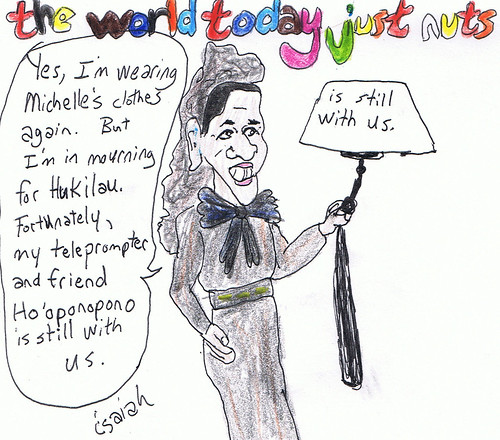
Isaiah's The World Today Just Nuts "Barry and TOTUS"

Barry and TOTUS


Isaiah's comic 'mourns' the death of one of Barack's teleprompter.

"TV: Meet The Fockers" (Ava and C.I., The Third Estate Sunday Review):
On the health care reform (singular) she insisted was coming, David Gregory stopped her to ask, "So this isn't ready?" "No," was a portion of her response. The only portion that mattered. She'd yammer on and on prior to that insisting it was and then, pinned by Gregory, admitted that it wasn't. And she's supposed to be someone the public trusts?

She seemed determined to present the worst face of the administration possible and did so when David Gregory noted that an estimated 47 million Americans have no form of health insurance. What about those people, Gregory briefly wanted to know? Selibus admitted, "It isn't the priority." Then, calm smile, "It's one of the priorities."

We honestly think that if people are paying attention, Selibus just had her Madeleine Albright moment. [Asked by CBS News' Lesley Stahl in 1996 about the half a million Iraqi children estimated to have died due to Clinton era sanctions on Iraq, Albright responded, "We think the price is worth it."] "It isn't the priority."

Gregory heard it and bore down on it asking, "So if there are millions of Americans who are left uninsured it would not stop the president from signing this bill?" Selibus tried to back peddle with, "It's not one or the other." It only made her, and the president, look weaker.

Some plans might include a public option. Some plans? Yes. Despite Healthy Economy Now's claims that Congress and the White House have "a plan," they don't. There are several plans being tossed around. Of the possibility of a public option, Selibus insisted that "competition will lower costs." Her logic is that if the public option is allowed, that version will force private insurers to lower their own costs in order to compete.

That really never made sense. They're going to lower their own costs to compete? Now we support, single-payer, universal health care and maybe, as a result, we're missing something. But Selibus' argument was that a public option would force private insurers to lower their costs. The only reason why she ever supplied was: competition.

Presumably, she's stating that the public option, run by the government, will be run at lower costs. Presumably. She never made that clear. She never made anything clear really, except for her "It isn't the priority" comment.


This was not what Ava and C.I. were planning to write about. They were going to cover Mental on Fox and mix in some news programming. But Flickr was a problem and it took almost two hours to upload the illustrations used for this edition of Third so they were waiting and waiting and Meet The Press was coming on. They wrote that as it aired and it went up six minutes after the show was over. I think they really did something amazing here. I may highlight another section tomorrow.

Walter Cronkite passed away Friday. He was a news legend. That doesn't mean he was perfect and Ava and C.I. disputed the notion of his or broadcast news perfection sometime ago (see "TV: Katie Was a Cheerleader"). But Norman Solomon shows up today to whine in "Cronkite and Vietnam" (CounterPunch):

But facts are facts, and history is history -- including what Cronkite actually did as TV’s most influential journalist during the first years of the Vietnam War. Despite all the posthumous praise for Cronkite’s February 1968 telecast that dubbed the war “a stalemate,” the facts of history show that the broadcast came only after Cronkite’s protracted support for the war.

Facts are facts and history is history? Really, Norman? I hope the innocent civilians in Pakistan remember that. As they're attacked by drones, I hope they remember that facts are facts and history is history.

Fact: Norman Solomon WHORED it for Barack Obama and 'forgot' to tell people he was supporting Barry. Even after he was a delegate for Barack (he would go on to be a pledged delegate at the DNC convention), he 'forgot,' when offering 'independent' 'analysis' on the radio to disclose.

Yeah, Normy lives in a Glass House. Pray for his neighbors.

Fact: Normy forgot to hold Barry accountable. Never put those feet to the fire. Trashed other candidates in te primary and in the general election. Cleared the field for War Hawk and Mongerer Barry O.

Facts are facts and history is history, Normy. You're responsible for putting a War Hawk in the White House.

"Iraq snapshot" (The Common Ills):
Monday, July 20, 2009. Chaos and violence continue, waves of violence claim the lives of at least 6 Iraqi police officers, the refugee crisis continues, tensions between the KRG and the centeral government in Baghdad mount, and more.

Starting with Iraqi refugees. Today the
International Committee of the Red Cross explains they "issued travel documents to 96 Palestinian refugees from Al-Waleed Camp (Anbar Governorate) to enable them to travel to Europe and the United States, where they will be resettled with the help of the office of the United Nations High Commissioner for Refugees and the International ORganization for Migration." Last week, Miriam Jordan (Wall St. Journal) reports that the US has agreed to take in 1,350 Palestinian refugees from Iraq --from among the over 3,000 refugees stuck in the 'camps' between Iraq and Syria. Jordan quoted University of California Hastings College of Law's professor George Bisharat stating, "These particular Palestinians are a fallout from the Iraq War. The Obama administration had to take some responsibility for the consequneces of the invasion." Patrik Jonsson (Christian Science Monitor -- link has text and video) had earlier reported that the refugees would "be resetteled in the US". However, Stephen Kaufman, writing at and for the US government at America.gov, doesn't say these refugees have been accepted, he states (on July 13th) that they "are being considered" for admittance to the US and sites the US State Dept as the source for that: "A State Department spokesman told America.gov July 13 that the resettlement process for the group actually began in 2008, and so far 24 Palestinians from Iraq have arrived in the United States."

While the refugees need to be offered asylum in the US, what sort of life awaits them? Not a good one if most reports are any indication.
Fields Moseley (Utah's KUTV) reports on Raida Jarjes and Taofiq Rasheed, husband and wife Iraqi refugees living in Utah after being granted asylum following many years of waiting in Syria. In Iraq, she was a journalist, he was an attorney but here in the US they are among "50 refugee families [who] might be in the homeless shelter next month." Moseley explains, "The Rasheeds are foreign professionals without jobs, a common story among Iraqi refugees. They were delivered to this apartment complex and told a job should be their first priority. They received $920 each from the state department and a couple hundred bucks follows each week. But it won't last." The State Coordinator for Refguee Resettlement, Gerald Brwon, tells Moseley, "We are not able to find people jobs at the rate we have to if they have to pay rent." Saundra Amrhein (St. Petersburg Times) reports on Hayder Abudlwahab and his family (Iman, his wife, and their two sons) who escaped Iraq, made it to Syria and finally were accepted into the US, settling in Tampa in August 2008. They left Iraq after Hayder was injured in a bombing and "awoke on a pile of bodies in a Baghdad morgue. [. . .] Paralyzed, blinded, unable to scream, Hayder lay in a jumble of bodies. Knobby bones poked him from underneath, a still-warm arm lay across his side. The smell of rot was overwhelming." Now they live in Tampa trying very hard to make ends meet and just to make rent each month. Earlier this month, Aamer Madhani (USA Today) explained there was a 3.1% increase this year in "no-shows" for Iraqi refugees granted asylum to the US who do not take make the "U.S. government-paid flights out of Iraq" and that "the reluctance is a reflection of the difficulties faced by thousands of Iraqis who have arrived in the U.S. since 2006." Not all Iraqi refugees are struggling to those extremes. Maureen Sieh (Syracuse Post-Standard) noted, In the last year, 130 Iraqi refugees have been settled in Syracuse by refugee programs run by Catholic Charities and Interfaith Works Center for New Americans." Most charity programs have dried up in the US due to the economy and/or disinterest. Mosques and churches are among the few that remain. What of the US government's obligation? Last week the Boston Globe offered the editorial
"
An obligation to refugees" which argued, "The United States should provide a haven for more refugees." Friday the International Organization for Migration announced the US State Dept had provided them $10 million "to meet the most urgent needs of Iraqi returnees." Returnees. Not refugees.

What are they doing for refugees? In it's most recent [PDF format warning]
report on Iraq, the US State Dept notes that "as many as 2 million Iraqi refugees" are being housed by "regional governments," an estimated 2.8 million are currently displaced within Iraq and then they offer a dollar figure . . . for Fiscal Year 2008. FY2008 ended months before Barack Obama was sworn in. Fiscal Year 2009, the current year, is nearly over. It ends at the end of September. March 20, 2009, much was made of the announcement of pledges by the US in excess of $141 million which was added to the stingy sum of $9 million that had already been 'committed.' Have those pledges been honored, has the money -- $90 million to UNHCR, $15.5 million to UNICEF, for example -- been paid out? Were the pledges honored? Yvonne Abraham (Boston Globe) pointed out another area of concern yesterday, "The federal government desperately needs Arabic speakers, particularly ones who know the Middle East. Hundreds of the Iraqis who worked with US forces are now here, and desperately need jobs. Yet nobody seems to have come up with a way to match our needs with theirs. Kirk Johnson, whose List Project brings Iraqis who helped American forces to the United States, said only a few have found work as government translators here. The rest are shut out because the security hurdles are too high, or because they're not citizens."

Saturday,
James Denselow (Guardian) explored "Iraq's forgotten crisis" and noting the interlocking nature of the conflicts (such as the KRG and the central government), the failed and failing infrastructure and the drought on issues including the external and internal refugees:

The consequences of the upstream damming of Iraq's rivers, when compounded with a general trend towards the reduction in rainfall entering the two river basins, is having a severe impact on the Iraqi breadbasket's ability to feed its population. The World Food Programme estimates that some 930,000 people are currently food-insecure in Iraq, with a further 6.4 million at risk of becoming food-insecure in the event of the failure of the Public Distribution System (PDS). Resettlement of internally displaced refugees and the potential return of the millions of Iraqis from Jordan and Syria all have the potential to place a further burden on this fragile system. Adam L Silverman, who worked as a social science adviser for the US army human terrain teams in 2008,
noted that lack of river discharge leads to "ongoing soil erosion that leads to further desertification and increased heat and dust storms, which has a measurable negative impact on the quality of life of the Iraqis". Reuters reported that the sandstorms that delayed Biden's trip led to several deaths and "hundreds of Iraqis seeking medical help after one of the worst sandstorms in living memory stretched beyond a week, choking throats, clogging eyes and afflicting asthma sufferers in particular".

"The Iraqi refugee crisis is far from over and recent violence is creating further displacement,"
notes Refugees International, "Iraqi women will resist returning home, even if conditions improve in Iraq, if there is no focus on securing their rights as women and assuring their personal security and their families' well being." Refugees International's latest report is [PDF format warning] entitled "IRAQI REFUGEES: WOMEN'S RIGHTS AND SECURITY CRITICAL TO RETURNS." It finds that not only are large scale returns not coming in the immediate future but that "[n]ot one woman interviewed by RI indicated her intention to return. Some women said they won't return because they are members of targeted minority groups, or because of injuries they suffered. . . . Some fear rising conservatism would restrict their ability to participate in civic and professional life. . . . Others feared they were at risk of so called 'honor killings' by family members because they refused marriages, had divorced, or were accused of prostitution." The field report found reoprts of forced marriages in Syria and the KRG. In Syria, "an Iraqi women working as a singer in a restaurant . . . was attacked by three men and raped. When she reported the crime to the police and asked for assistance, she was arrested, detained for six days, and threatened with deportation for working illegally. UNHCR finally obtained her release, but her assailants were never arrested." The report notes:

In northern Iraq, the KRG has taken some welcome steps to respond to the disturbingly high levels of reported gender-based violence (GBV), particularly so-called "honor killings," burnings and other attacks on women, often disguised as accidents or suicides. Recent higher GBV statistics in KRG may indicate a greater willingness to report such crimes, but further visible government support for women's rights is sorely need throughout Iraq.
The KRG, unlike the Government of Iraq, has supsended laws providing for "mitigating circumstances" to reduce the punishments for so-called "honor" crimes and has increased the penalties. Its Prime Minster set up a Cabinet-level Committee on Violence against Women and set up and staffed in each KRG governorate a "Directorate to Follw up Violence against Women." The offices conduct outreach and public education and investigate cases to turn over to the prosecutor. To protect women at risk of serious violence, the KRG and nongovernmental organizations operate small residential shelters. However, staff has little training or experience on security, confidentiality, or the counseling skills needed to assist clients. RI learned of recent incidents of women being trafficked from shelters.
The KRG could enhance these institutions' effectiveness and credibility by appointing experienced women to senior leadership posts in the Cabinet Committee and the Directorates, by regulating the shelters, and by ensuring shelter staff receive training and oversight. Donors should provide technical assistance through deploying specialist in investigations, witness protection, counseling, and helping to create standard operating procedures for temporary shelters. Donors should increase support to local NGOs experienced in GBV prevention and response services. Help is also needed in ensuring the wider distribution of public education materials in both Kurdish and Arabic, since higher levels of domestic violence are reported in the displaced population, which has not benefitted from any government outreach.

Moving to the Kurdistan region of Iraq. July 25th, they hold their provincial elections as well as elect a president.
Nada Bakri (Washington Post) notes the region is "simultaneously considered the most democratic in Iraq and not all that democratic. Two main parties -- [KRG President Masoud] Barzani's Kurdistan Democratic Party and the Patriotic Union of Kurdistan, headed by Iraqi President Jalal Talabani -- have for years exercised a stranglehold on the region, dividing between them politics, patronage, investments and business deals." Pakistan's The National observes that a vote was also supposed to be held "to approve the new constitution, but a hurried intervention by the US vice president Joe Biden and warnings from Baghdad have persuaded Kurdish leaders to postpone that referendum. Kurdish anxiety is understandable. . . . The Kurds now appear to feel that the goodwill they displayed when they were strong brought few benefits." All weekend the tensions between the KRG and the centeral government in Baghdad continued to increase. Mehid Lebouachera (Kuwait Times) explained the roots of the tensions as follows: "Six years after the US-led invasion in which Kurdish rebel groups were key allies, their decades-old claims to historically Kurdish-inhabited areas remain unresolved by the new Iraqi government in which they hold both the presidency and a deputy premiership. And opposition to the Kurdish demands remains as strong as ever, not only among the Sunni Arab minority that dominated Saddam Hussein's ousted regime but also among the Shiite majority community that leads the new government and among ethnice minorities such as Turkemn. As time drags on, Kurdish leaders have voiced mounting frustration at the impasse in their talks with Baghdad, sparking an increasingly heated war of words with Arab politicians."

Lebouachera explains the tensions over unresolved borders. There are a number of disputed territories but let's zoom in on oil-rich Kirkuk. Nouri al-Maliki was installed by the US over three years ago. That's important. The 2005 Constitution, which went into effect in the final third of 2005 -- mere months before Nouri was installed -- promised an independent census of Kirkuk and a 2007 referendum. Nouri came to power and didn't get on that issue. Following the 2006 mid-term elections in the US, when both houses of Congress were handed over to Democrats (November, 2006), the White House, under pressure on the never-ending illegal war, began talking benchmarks for 'success.' The White House defined those benchmarks and Nouri signed off on them. The benchmarks included resolving the issue of Kirkuk. 2007. Two years later and still nothing.Not only throughout the illegal war, but also before it began, it was always known that Kirkuk was a divisive issue. (Hence the September 1998 White House meeting with Jalal Talabani, Kurd and current president of Iraq, and Masoud Barzani, Kurd and current president of the KRG; as well as the passage of in October 2002 of legislation by the Kurdish parliament preparing for the Iraq War.) Saddam Hussein ran Kurds out of the area and installed Arabs. The Kurds see Kirkuk as their land. The land is oil-rich and the Arabs aren't eager to hand it over to Kurdish control.So despite the fact that Nouri came into office mere months after the Constitution went into effect (calling for resolution of the Kirkuk issue) and despite the fact that, in 2007, he signed off on benchmarks which included resolving the Kirkuk issue, he's done nothing. There has been no referendum, there hasn't even been a census.Last summer, lands the Kurds consider their own were nearly invaded by Iraqi forces in what some saw as an attempted take over and others saw as a 'crackdown' or assault similar to what Nouri staged on Basra in March of last year. It was a very tense situation and war could have erupted right then. Unlike the Shi'ite - Sunni conflict which was more ethnic cleansing due to the fact that the Sunnis are not in power and do not have the numbers that the Shi'ites, the KRG has its own army, has its own forces and the tensions do not cease, if these issues aren't resolved, it's not unlikely that real civil war will break out in Iraq. A real one. Not ethnic cleansing being 'prettied up' with the phrase 'civil war.' Not a bunch of powerless minorities being killed and run out of the country, but a full on war.

But that doesn't seem to be a concern to the US installed government.
Jamal al-Badrani (Reuters) reports that, as nothing is done regarding disputed territories, Kurds in Nineveh Province have issued statements threatening to secede but that's apparently not cause for concern either. And all the statements being made by KRG officials? Apparently not a concern either. AFP reports that Massud Barzani, president of the KRG, stated yesterday, "We are committed to the application of Article 140 (of the Iraqi constitution) and we rpomise that we will absolutely not compromise on this issue or on the rights of the people of Kurdistan." Article 140 requires an independent census in Kirkuk and a referendum to take place no later than . . . December 2007. This is not a minor detail nor is it something once touched on and then forgotten. Saturday, the KRG's Prime Minister Nechirvan Barzani gave a speech and it included the following:In formulating policy for our government, we have always been committed to the Iraqi Constitution and protection of the interests of the Kurdistan Region and all of Iraq.As you are all aware, recent tensions have occasionally surfaced with the federal, central government over pending issues. It is clear that, as long as those issues remain unresolved; this will threaten the stability that we all aspire to achieve in Iraq. I would like to address this matter openly. What we in the Kurdistan Regional Government want to achieve is to resolve these issues peacefully and in accordance with the terms and conditions enshrined in the Iraqi Constitution, for which 80% of Iraqis voted. We have always been ready in the past, and we are ready and willing now to sit at the negotiating table with the federal government and talk with those who possess the will to solve these issues. Sometimes we in the Kurdistan Region are accused of being too firm and insistent in our demands. But I would like Iraqis and the whole world to be aware of two things: First, our insistence on the commitment to the Constitution and its guarantees for freedom and democracy emerge directly from our history. We in the Kurdistan Region have suffered greatly as the result of agreements which were unfulfilled and promises which were ignored. In order for us to live in peace and stability, we want our rights to be protected. This will take place as a result of permanent agreements by which all concerned will abide, in accordance with Constitutional principles. We don't have any hidden agenda in Iraq.Second, for those who say that we cannot negotiate seriously, there are tangible examples of how the KRG has participated seriously in negotiations that have led to historic results. Therefore, we can engage in a similar manner with Baghdad in this regard.We want to be a reliable and cooperative partner with the federal government. Our vision of security, stability and prosperity for the Kurdistan Region requires a peaceful and cooperative relationship and coordination with all of Iraq and with Baghdad and we will continue with this policy in the Kurdistan Region. All that we ask for is to have a relationship within the framework of the Constitution, which is the highest law of the land and the greatest guarantee to us that history will not repeat itself. Our message is clear. The Kurdistan Regional Government is ready and hopeful that serious dialogue will resume with the federal government to solve the issues according to Constitutional principles and within a federal, democratic Iraq.Our insistence on resolving the issues are with the aim of guaranteeing a bright future for our people and the prevention of any repetition of our tragic history.

Meanwhile, do-nothing Nouri is headed to the US.
Liz Sly (Los Angeles Times) reports Nouri, who has been making disparging remarks about US service members lately, intends to visit Arlington Cementary while visiting the White House. Reportedly he plans to pay his 'respects' -- non-existant ones to judge by his recent remarks. She quotes Nouri al-Maliki's boy-toy Sami Askari declaring, ""The Democrats were in opposition to George Bush so they tended not to see his positive points, only to concentrate on the negative ones. So I think the prime minister needs to say this: That as a people, we are not ignoring what others did for us. Every Iraqi who goes to Washington needs to make clear that the war was not a failure." Save the fantasy talk for Nouri, Askari. Nouri made quite clear to Barack last summer what he thought of Bully Boy Bush. The idea that after running Bush down (no problem with that here), Nouri's now going to counsel Barack on the 'good' in George W.'s efforts is laughable. What's not being reported are rumors that Biden has scheduled a high-level meeting with Nouri and former Ba'athists for this visit. Those are rumors. When Biden visited Iraq, Nouri remainded non-committal to the idea and indicated he would weigh a meet up with Ba'athists and Arab neighbors. Shortly after Biden departed Iraq, Nouri began issuing fiery statements indicating otherwise. Nouri's personal press representative Mike Tharp of McClatchy Newspapers and Nouri's Ass raves like he's audtioning for Pat Newcomb: The Movie, insisting -- in a non-journalistic manner -- that Nouri is "the popular leader of an American ally, the prime minister of an increasingly independent-minded country". When Mike gets the taste of Nouri's ass washed out of his mouth, someone inform him that Nouri's a thug and a US installed puppet currently testing the length and tethering of his leash.

If Tharp's behavior seems shocking, you must have missed this weekend when he made like Eric Carmen serenading Nouri with "All By Myself" ("Don't wanna bee all by myself . . .") as
he insisted that the Iraqi forces, all by themselves, protected the pilgrims -- all by themselves! Like the Nouri publicist he's become, he was gushing about "their first big test" and how they "passed" "with flying colors"! and all by themselves . . . He quoted Iraqi military spokesmodel Qaasim Atta stating, "This is the first 100 percent Iraqi security plan to protec the pilgrims. The forces are Iraqis, even the helicopters above." Problem was Mohammed al Dulaimy already reported that US helicopters -- two of them -- were hovering over Baghdad. So Tharp buried that reality in the thirteenth paragraph of his eighteen paragraph p.r. copy. From Thursday through Saturday, Tharp babbled, no deaths and Iraqi security forces did it all by themselves! If you leave out the two helicopters. And if you leave out what Muhanad Mohammed (Reuters) reported, "Cameras on air balloons monitored the site, the surveillance provided by the U.S. military at Iraq's request." Leave that out too in order to sing "All By Myself." Leave out the fact that AP reported Saturday of the pilgrimage, "The event was a relative success, despite bombings that killed several people and injured dozens." Leave out that Alsumaria reported on Saturday's pilgrimage: "One citizen was killed and tens pilgrims were wounded as they were heading to Imam Moussa Al Kazem shrine (AS) due to roadside bomb explosions in Zaafaraniya, New Baghdad, Al Saydiya and Al Dora region." But no deaths and Iraqi forces did it all by themselves. Think we're going to need some louder voices on the chorus in order to drown out realities such as the fact that the US forces, stepping away from Iraq cities, have been doing more work along the route of the pilgrims. Baghdad's the destination. But the pilgrims don't fly in to Baghad International, step onto the tarmac and rush to the shrine. That's not how it works. But if you're stupid enough, if you're as stupid as the press hopes you are, you will be grinning and swearing, "Mission accomplished!"

Here on planet earth, we gasp at the billions of Iraqi dollars Nouri sits on while people the starve.
Aljazeera explains, "Abject poverty across Iraq is fuelling an illegal trade in human organs. Hundreds of people are believed to have sold kidneys and other organs through dealers in the capital, Baghdad, over the last year. . . . About 23 per cent of Iraqis live in poverty, meaning that they are forced to survive on $2.2 a day or less, according to government figures." Let's drop back to the July 14th snapshot:And the river dries up as Jenan Hussein (McClatchy Newspapers) reports on the poverty, "Beggars have become as visible as blast walls and checkpoints in Iraqi cities. Government ministries don't have reliable statistics, partly because those who beg fear official crackdowns on their only livelihood. It's a problem the government has yet to tackle." This happens as the Oil Ministry brags it has "acheived (59.1000) million barrels with (3.378) billion dollars incomes with daily average of (4.400) barrels per day for May and the raise was (686) million dollars. In comparison with April which achieved (54.700) million barrels with (2.692) billion dollars incomes."
We probably shouldn't begrudge Nouri having Mike Tharp as his p.r. agent -- clearly Nouri needs all the spin control he can get.

Meanwhile
Gabriel Gatehouse (BBC News) reports that tensions are escalating between the Iraqi military and the US military over their roles. Ernesto Londono (Washington Post) adds that this revolves around the security agreements (primarily the treaty masquerading as a SOFA), "The conflicting interpretations of the security agrement, U.S. officials said, have led to numerous standoffs on the ground, including cases in which Iraqi soldiers have prevented American convoys from passing through checkpoints." Help us out, US forces are still in Iraq why? It's not to protect Iraqi women, it's not to protect Iraqi Christians, it's not to protect Iraq's LGBT community, so why are they still there? To be sitting ducks? Thomas E. Ricks (Foreign Policy) offers two more examples of the unraveling of Iraq today -- here for first one, here for second.


Friday a helicopter crashed in Iraq.
CNN reported it was an "Xe" (Blackwater) helicopter and that two employees died and another two were wounded. Yesterday afternoon, the US State Dept issued the following statement:

The Department of State is deeply saddened by the deaths of two employees of Xe Consulting during a helicopter crash in Iraq on July 17 and extends our heartfelt sympathies to their families. Our thoughts are also with the two men who were injured in this incident and their families. These men played an important role in assisting the Department in protecting American diplomats and missions in Iraq. The Department's Bureau of Diplomatic Security is coordinating with appropriate U.S. and Iraqi officials regarding an investigation into the cause of the crash.

Turning to some of today's reported violence . . .


Bombings?

Reuters reports a Baghdad car bombing which left four people injured, a Mosul roadside bombing which injured a police officer and a bystander, a Mosul bombing which injured a police officer, a Mosul roadside bombing which claimed the life of 1 Iraqi police officer, a Ramadi car bombing which claimed the lives of 2 Iraqi police officers, left one injured as well as three bystanders and a Baghdad roadside bombing which left nine people injured. Mohammed al Dulaimy (McClatchy Newspapers) reports a Baghdad sticky bombing which injured Capt Humadi Othman (of Facilities Protection Services) and one other person.

Shootings?

Reuters reports 1 police officer shot dead in central Mosul, 1 police officer shot dead in southwest Mosul, 1 police officer shot dead in east Mosul and 1 Iraqi soldier shot dead in southeast Mosul.

Sunday the
US military announced: "AL ANBAR PROVINCE, Iraq – A Multi National Force – West Marine was killed in a combat-related incident as a result of enemy action here July 19. The Marine's name is being withheld pending next-of-kin notification and release through the U.S. Department of Defense official website at http://www.defenselink.mil/releases/." The announcement brought to 4327 the number of US service members killed in Iraq since the start of the illegal war.

This week in the United States, an event's being held. This is Michael Cole's "
DC Event: Help LGBT Iraqi Refugees" (HRC):
If you're in the DC area I encourage you to join the Human Rights Campaign, Human Rights Watch and the National LGBT Bar Association for a unique event in Washington, D.C. to support lesbian, gay, bisexual and transgender Iraqis who have fled their home country.
On Friday, July 24, spokesmen for a group of twenty LGBT Iraqi refugees undergoing their resettlement process will be in Washington, D.C. to bring attention to their struggle and raise money to support LGBT Iraqi refugees still in the Middle East.
Since the U.S. invasion, sectarian violence and fundamentalist religious leaders have filled a power vacuum left by the war that has made life for LGBT Iraqis increasingly unbearable. In recent months, international media have reported that LGBT Iraqis face kidnapping, torture, horrific sexual violence, death threats and murder.
Start your weekend off with a reception that may save lives. All proceeds from the fundraiser go to support
Helem, a Lebanese LGBT organization that has provided food, shelter and clothing to LGBT Iraqi refugees currently undergoing their resettlement process.
What: Fundraiser to Support LGBT Iraqi Refugees When: Friday, July 24, 2009 6:00 – 8:00 p.m. Where: Human Rights Campaign Equality Center 1640 Rhode Island Avenue NW, Washington, D.C. 20036, (at the intersection of Rhode Island Avenue and 17th Street) Cost: Please bring your checkbook or credit card and donate as you can.
For questions or more information, please contact Eric Wingerter at
iraqrefugeelgbt@gmail.com

Also in the US,
Walter Cronkite passed away Friday at the age of 92. The former anchor and managing editor of the CBS Evening News was remembered today on CBS News' online web program Washington Unplugged. Sharing their memories and evaluations were CBS News' Bob Schieffer, who hosts the program, Howard Kurtz of the Washington Post and Marvin Kalb who worked for CBS News and NBC News (and earned the honor of making Tricky Dick's enemies list). CBS News honored Cronkite last night in prime time with a special and you can find it online at CBS' website (text and video). At her website, under news videos, Carly Simon has taped the following message (currently plays after beauty tips for looking older -- a humorous video; good morning and work on mixing her forthcoming album due out later this year):

My sister Joey [opera singer Joanna Simon] and Walter Cronkite were very much in love and spent pretty much the last four years of his life together. Joey took care of him night and day when he was sick. And Walter loved her and she loved him and she will always love him -- as we all will. He never said anything that wasn't absolutely real. He was an impeccable human being and this message is for everybody who loved him and will continue to.

Peter Simon tells K.C. Myers (Cape Cod Times), "They were an adorable couple. To see them together, it was so moving. They were so in love with each other. Now she's going through a terrible loss." Kate Nocera and Erin Durkin (New York Daily News) quote Joanna Simon stating, "He loved to sail. Sometimes we would take day sails. Other times, we would go to Nantucket or Newport. One time we sailed up the coast of Maine. [. . . .] My entire life with Walter gave me such great joy. Now, without him, I'm kind of at a loss as to what to do with the rest of my life. I go through waves. Sometiimes I'm okay. Sometimes I just want to turn the clock back." In 1962, with the New York City Opera, Joanna Simon made her debut in The Marriage of Fiagaro. It was the start of a highly accomplished and praised career. Walter Cronkite is survived by his three children Chip Cronkite, Kathy Cronkite and Nancy Cronkite and by his four grandchildren John Macintosh Cronkite-Ikard, Peter Cronkite, William Maxwell Cronkite-Ikard and Walter Cronkite IV.

iraq
the wall street journalmiriam jordan
the washington postnada bakri
ernesto londono
thomas e. rickscnn
the nationalmehdi lebouacherathe kuwait timesgabriel gathehousebbc newsthe los angeles timesliz sly
mcclatchy newspapersmohammed al dulaimy
carly simon

Friday, July 17, 2009

'Poor' Sharon Smith

C.I. here filling in for Elaine who is on vacation. An e-mail came into the public account of TCI (common_ills@yahoo.com) and I don't know if the guy is a regular reader of Elaine's or what. But he wants to know why Elaine dislikes Sharon Smith or, as he calls her "poor Sharon Smith"? The community loathes Sharon Smith. The community actively loathes Sharon Smith.

Because she's a liar and a damned liar. Because she's a sexist pig.

Short of her apologizing for her behavior, this community will never forgive her. There are some the community just rolls their eyes at but there are others who are on an active s**t list and Sharon Smith put herself there.

She did that in 2008 with her non-stop sexism while pretending to be a feminist. That's when the community turned on her. However, Elaine and I were already talking about the little stunts she was pulling in 2007. Take a CounterPunch article from March 2007 attacking Hillary with the title of "Our Bleach-Blond Thatcher? Hillary's Cojones."

That's not the headline to a piece written by a feminist.

If you can't grasp that, I won't be able to help you much because you've got serious issues; however, briefly, Hillary's a "bleach-blond"? Meow, catty girl. She's calling Hillary a bleach-blond? I must have missed her piece on the careful work done for John Edwards' hair. I'm not talking about the body, I'm talking about the fact that he used a colorist (I assume he still does) to get those browns and reds and all the rest. He uses a colorist who 'paints with all the colors of the wind'. But Hillary's the one 'feminist' Sharon Smith wants to beauty-parlor trash?

Now there's the "cojones" issue.

We've covered this before when calling out Katrina vanden Heuvel. No woman has "cojones." If she did, she'd be considered a freak.

So Hillary's a cheap bimbo (bleach-blond) and a freak.

How 'lucky' feminists were to have Sharon Smith's commentaries.

Elaine could write about this at length.

Turning to Iraq. The following exchange took place between AP's Matt Lee and Robert Wood (spokesperson) at the US State Dept briefing today:


Matt Lee: There are going to be some prisoner exchanges in Iraq. You're going to be turning over detainees that you have, or the military is, to the Iraqis. And I'm just wondering if you’re confident that these prisoners, once they’re transferred, will be well treated or not mistreated.

Robert Wood: Well, Matt, I'm not aware of any additional transfers of prisoners. You might want to check with the Pentagon. But clearly, should there be that type of a transfer, we wouldn’t do so unless we were confident that the rights of these individuals were respected and that they would be treated humanely. But that’s about the best I can tell you because I’m not familiar with this particular group of prisoners.

Matt Lee: On that subject, is that required in the agreement with Iraq, that they guarantee that those prisoners will be treated humanely?

Robert Wood: I don't know that that's necessarily in the agreement, but we certainly had assurances from the Iraqis that people that are turned over will be dealt with humanely. That's what we would expect, and I'm sure the Iraqi leadership feels the same way in terms of how it will deal with individuals. But I don't remember exactly in the agreement. You might want to go back and check, but certainly we’ve been given those assurances from the Government of Iraq about the transfer of individuals to their custody.

We'll end with Lee but moving to Iraqi prisoners. AP is reporting new claims are surfacing of abuse in Iraqi prisions (Iraqi-run):

Iraqi officials acknowledge some abuse and insist improvements are being made. The issue, however, poses a thorny question for Americans: How can the United States transfer detainees into a system where abuse has occurred?
The U.S. military says it sends Iraqi prisoners only to detention facilities approved by Iraq's Ministry of Justice.
However, Iraqi lawmakers, human rights advocates and the Human Rights Ministry claim most of the abuse is not taking place in prisons run by the Justice Ministry, but in those operated by the Interior and Defense Ministries. Prisoners there are generally accused of links to Sunni and Shiite insurgent groups.


Now we're going back to Matthew Lee (AP) who reports this evening that a US State Dept helicopter has crashed in Iraq and a"two crew members were killed" and two more people wounded (all four are unidentified at present).

This is the "Iraq snapshot:"

Friday, July 17, 2009. Chaos and violence continue, the US military announces multiple deaths, at least 40 pilgrims are wounded in Baghdad bombings, US war resister Robin Long speaks, increasing tensions between the north and the central government, and more.

This morning the
US military announced: "BAGHDAD -- Three Multi-National Division-South Soldiers were killed when Contingency Operating Base Basra was attacked by indirect fire at approximately 9:15 p.m. on July 16. The names of the deceased are being withheld pending notification of next of kin. The incident is under investigation." The announcement brings the number of US service members killed in Iraq since the start of the illegal war to 4326. Liz Sly (Los Angeles Times) reports, "Shortly after the attack, the Iraqi army gave the U.S. military permission to carry out aerial searches northwest of the airport, the area from where the rockets are thought to have been launched, U.S officials said. Troops chased a car to a house, which they searched. A joint U.S.-Iraqi patrol raided another home. Three Iraqi men were briefly detained, the military said."

Violence rocked Iraq as usual today but a lot of it targeted pilgrims.
Mohammed al Dulaimy (McClatchy Newspapers) explains the pilgrimage "is expected to fill the streets of Baghdad on Saturday in the first major security challenge for Iraqi military forces" with "a limited curfew" being imposed and "thousands of additional Iraqi soldiers and police officers . . . on the streets". Alsumaria reports, "While thousands of pilgrims have poured in to Al Kazimiya to mark Imam Kazem Anniversary (AS), citizens are complaining about closing main roads which is usually caused by religious occasion." Muhanad Mohammed (Reuters) observes, "Despite intensive security, some bombers made it through." Turning to the reported violence today . . .

Bombings?

Sahar Issa (McClatchy Newspapers) reports a Baghdad roadside bombing which wounded thirteen pilgrims, a Baghdad roadside bombing which wounded eight pilgrims, a Baghdad roadside bombing which wounded five pilgrims, another Baghdad roadside bombing which injured five pilgirms, a Baghdad roadside bombing which injured three pilgrims, a Baghdad roadside bombing which claimed the life of 1 pilgrim and wounded six more, a Baghdad roadside bombing which injured two men, a Falluja roadside bombing which injured nine males who were playing football and a roadside bombing attack on the home of police chief Abdulsalam Khawarm in Anbar Province resulting in the deaths of two of his children and leaving eight more people injured. Reuters notes 1 dead in the Falluja bombing on the football players, a Mosul roadside bombing left two Iraqi soldiers injured and a Shirqat sticky bombing injured one police officer.

Shootings?

Reuters notes 1 person wounded in a Kirkuk shooting today and, dropping back to yesterday, one wounded in a Kirkuk shooting as well.

Today on the second hour of NPR's
The Diane Rehm Show, Diane and the Wall St. Journal's Youchi Dreazen, the Washington Post's David Ignatius and Foreign Policy's Moises Naim discussed Iraq.

Diane Rehm: Alright and let's turn now to Iraq and the latest on violence there, David? You had three American soldiers killed Thursday after insurgents fired mortar rounds into a US base in southern Iraq. You've also got problems with the Kurds. You've got lots of issues still going on even as the US is planning its pull-out.

David Ignatius: This was a week, Diane, that reminded us of the underlying fragility of Iraq. We've gotten in the habit of not paying much attention to it. Our troops are pulling back from the cities under the timetable we agreed to with the Iraqis. And-and, these last weeks we saw in these-these bombings and the political conflicts just how easily Iraq could spin back into a very chaotic situation. Take the bombings that happened on Wednesday. By my count, there were about eleven people killed, something like fifty or sixty wounded. But what was striking was that one of the bombs was in Ramadi -- in the Sunni heartland, the area we thought had been stabilized by our counter-insurgency work. Another bomb was in Sadr City. Another was right in the heart of Baghdad, in Sadhun Street. Those latter two were really going after Shi'ites, the first, in Ramadi, was going after Sunnis. More of these bombings are going to again make Iraqis frightened that they can't be secure without militias and then you're back in the sectarian killing game and you're going to start finding fifty bodies -- dead bodies -- every morning in the morgue.

Diane Rehm: At twenty-seven [after] the hour you're listening to The Diane Rehm Show. And what's going on with the Kurds, Youchi?

Youchi Dreazen: In many ways, this is the most dangerous aspect of Iraq right now. You've had recently [June 28th] a standoff between Kurdish fighters and Iraqi national army fighters. Last year there was an incident that did not get much attention here in which US drones that were monitoring a similar standoff saw columns of armed Iraqi army soldiers and columns of Kurdish peshmerga racing towards each other. By the account of everyone who was watching it, bruising for a fight, and they stood down only amidst much mediation by US embassy and military -- as was the case here where there was US mediation. And what you have is this very thorny issue about what will be the boundaries between Kurdistan, what will be the boundaries between Arab-Iraq? How will they divide oil? How will they divide Kirkuk? These issues have been kicked down the road again and again and again. And now they're at the end of the road. They have to at some point be resolved. I think what you've seen is, when the US invaded, there was a status quo that existed under Saddam that was toppled, there was a Sunni-led status quo. Then there was a new status quo that was not sustainable where you had fighting between Sunni and Shia Arabs and the Kurds were kind of left off to their own devices in the north. Now you have a new status quo where the Shia-Sunni tensions are much reduced -- the Arab tensions -- and now their focusing much more again on the Arab-Kurdish tensions that were there under Saddam decades ago.

Moises Naim: And the Kurdish prime minister yesterday said that the Kurdish autonomous region was closer to going to war with the central government than ever before, since 2003, since the US invasion. And that points, as Youchi said, to the tensions about the divisions -- federalism, they're trying to find out what is the divisions of authority, power between a centralized government and a regional government. And this is a region that is quite different in its governance, in its function, in its economy, in its politics, than the rest of the country.

Diane Rehm: And the United States population is certainly concerned as is the Iraqi that what if the violence continues to uptick, gets worse? Do troops reinvigorate, US troops? What do you do?

David Ignatius: Well for the administration, I think there's a recognition that, as we reduce our military presence there, it is inevitable that violence will increase. That's accepted. And it's just a price of our getting out. The Iraqis want us out, we want to get out. So some increase in violence, it's understood, will happen. And the question is: Will the Iraqi forces be strong enough to contain it within acceptable levels? And what's-what's-what's your choke point? If you're President Obama and you're seeing ten people die a day, well, what do you say? Suppose it gets up to fifty, what do you - what do you do then? And that's -- it's-it's grisly. But that's the kind of decision I fear that the-the Obama administration going to have to make about Iraq over the coming year.

Moises Naim: It's very hard to imagine that there's a political environment in the United States that will support a massive increase of troops -- of US troops -- in Iraq. The-the line their will be crossed if Iran becomes very influential country in Iraq. If Iranian influence there which it hasn't seemed to be the case but that will be then the-the political base for it.

[. . .]

Diane Rehm: To Charlie in Ann Arbor, Michigan. Good morning, you're on the air.

Charlie: Good morning. I'd like to go back to the MidEast a little bit in terms of I think that Iraq is a lost cause. I think Sadr, Ayatollah Sadr's militia has only stood down under orders from Iran and under realization that the US military would destroy Sadr City. They will res -- they will resurge and they will take over the south and if -- have this very informal reunion with Iran. The Sunnis were bought off with US money and viagra pills for their ancient sheiks -- and that's the truth, not a joke. And the Kurds, our most loyal allies, are the largest tribe, as far as I know, on earth without a homeland. And I'm afraid that they -- especially with the oil money -- do not intend to be left behind this time. I think also I'd like one more comment, on the Gaza situation again. [. . .]

What about Gaza? This isn't the Gaza snapshot. And by bringing that up, Gaza, it's what everyone quickly glommed on after David's initial remarks on Iraq.

David Ignatius: Well, I think the -- it's too early for me at least to say that Iraq is a lost cause. One interesting fact about Iraq is that our greatest potential problem -- which is Iranian influence, Iranian support for extremist militias, like Moqtada Sadr who the caller was referring to, Iran politically is imploding. That threat, the ability of Iran to destabilize Iraq, is, I think, somewhat reduced, I want to say signifianctly reduced -- becuase of the chaose following the election. And I think you can generalize that to potential Iranian clients all ove. Political parties in Iraq that are supported by Iran must be worrying, "Holy smokes our paymaster are in trouble."

As noted in Diane's discussion, things are very tense between the central government in Baghdad and the Kurdish Regional Government.
Anthony Shadid (Washington Post) reports, "In separate interviews, Prime Minister Nechirvan Barzani and the region's president, Massoud Barzani, described a stalemate in attempts to resolve long-standing disputes with Iraqi Prime Minister Nouri al-Maliki's emboldened government. Had it not been for the presence of the U.S. military in northern Iraq, Nechirvan Barzani said, fighting might have started in the most volatile regions." Quil Lawrence (NPR's All Things Considered) reported this afternoon on the tensions quoting Barzani, "Whoever wants to get ahead in Iraqi politics does so by criticizing the Kurds." On territorial disputes and what may have been an attempt by al-Maliki's government to enroach on Kurdish territories June 28th, Lawrence quotes Barzani stating, "Our problem is that we do not believe there is any political will in Baghdad to solve this problem." Gordon Duff (Salem-News) addresses the June 28th confrontation and offers his opinions:

News stories reporting on this conflict conveniently omit Kurdish history. Our NATO partner, Turkey, that refused to allow US troops access to Northern Iraq during Operation Iraqi Freedom, has long been an enemy of our Kurdish allies. If Turkey had joined with the US, the military disaster that led to years of conflict might have been averted. Instead, the US depended on Kurdish armies to defeat Saddam in Northern Iraq.
Reports of Kurdish incursions in and around Kirkuk fail to mention that the Arabs in the region are remnants of Saddam's occupation forces, not residents. The efforts by the Baghdad government to continue control of this Kurdish region is driven by need to control the regions oil revenues and continue to fuel Iraq's massive corruption.

January 31st, 14 of Iraq's 18 provinces held provincial elections. The Kurdish region did not take place in those elections. Their elections take place next week on Saturday. The Economist editorializes on the elections
here. UPI notes of the elections, "A quota established by the KRG sets aside 30 percent of the seats for female candidates." In reporting last week, the New York Times offered a very bad dispatch featuring all the US talking points and nothing resembling journalism -- just a concept of "bad Kurds!" which might make a few people feel better but doesn't really inform anyone. And that was their 'big' piece. Jay Garner called it out in a letter to the paper. Garner is interviewed by The Kurdish Globe today and he notes of the KRG that "

Elizabeth Dickinson: With [US Vice President Joe] Biden as the U.S. envoy for reconciliation in Iraq, what priorities should he be pushing for? Jay Garner: No. 1, a referendum on disputed lands, because I don't think you can ever have a stable Iraq as long as you have an unstable Arab-Kurdish border. No. 2, a resolution on the oil law because it's a thorn in everybody's side. No. 3, continue to exert whatever leverage we have on the Iraqi government to get these things done. Anything that happens here, whether it is Kurds versus Arabs or Shiite versus Sunni -- and those are huge flash points -- is not an Iraqi problem; it's a regional problem. It's huge. It's much greater than Iraq, because if it's Shiite-Sunni you are going to have Iranians on the side of the Shiites and you are going to have the Gulf region on the side of the Sunnis. If it's Arab-Kurdish, you are going to have an ethnic war, and lives will be gone and other countries will get involved because they are going to want to shape how it comes out. I don't think the [U.S.] administration wants to pull out in 2011, run for the presidency in 2012, and have this whole damned thing blow up on them, you know? So it is good that [U.S. President Barack Obama has] appointed Biden; it's good that he's made a special envoy; and it's good that Biden is drilling in on this. Biden is a guy that has studied a long time. He is more thoughtful about this than the other people, and I think that's a good first step. But you've got to have some leverage to execute that. So whatever leverage we have left, we need to make sure that those flash points are solved before we leave.

Garner mentioned the oil law (aka the theft of Iraqi law) and Nouri's sending messages on that today.
Missy Ryan (Reuters) reports that the Oil Ministry's spokesperson Asim Jihad declared today of talk that unions might stop the British Petroleum and China National Petroleum Corporation oil deal (jointly, they were awarded a contract from the puppet government in the oil auction -- that was the only awarded contract from that auction), "The government will protect the companies." 'At all costs' was left implied.

Yesterday's snapshot noted the House Veterans Affairs Disability and Memorial Affairs Subcommittee's joint-hearing with the Subcomittee on Health. Kat covered the hearing last night and noted the discussion on rape victims. That was the first panel, Service Women's Action Network's Anuradha Bhagwati, Wounded Warrior Project's Dawn Halfaker and National Association of State Women Veterans Coordinators, Inc and the Texas Veterans Commission's Delilah Washburn. Grace After Fire's Kayla Williams raised an issue during questioning about suicide rates. Asked of the number of females, she explained she didn't know that number and then explained that the military is only tracking the suicides for those on active duty and not the number of suicides among veterans. (Or, at least only releasing the data for those on active duty.) Something to keep in mind as the Los Angeles Times reports: "About 37% of veterans returning from Iraq and Afghanistan have mental health problems, a nearly 50% increase from the last time the prevalence was calculated, according to a new study published today analyzing national Department of Veterans Affairs data. The study, which examined the records of about 289,000 veterans who sought care at the VA between 2002 and 2008, also found higher rates of post-traumatic stress disorder and depression."


Turning to war resistance, last week Robin Long was released from the brig. Today he spoke on
KPFA's The Morning Show "Not for a second do I regret or wish I'd done something different."

Philip Malderi: You're listening to
The Morning Show on KPFA, I'm Philip Malderi. I'm joined in the studio by Robin Long. Robin was in the US army. He enlisted shortly after the Iraq War got under way in June of '03. He was guaranteed by his recruiter that he wouldn't be sent to Iraq but of course those promises were not exactly fulfilled. In 2005, realizing he had made a mistake, he went to Canada and decided to resist serving in Iraq. Canada ultimately sent him back and he went to a navy brig down in San Diego to serve a year in prison. And now he's out. He joins me in the studio. Robin Long, welcome to KPFA.

Robin Long: Good morning.

Philip Malderi: Uh, again why did you decide to join in the first place? Why don't we start there.

Robin Long: You said initially I'd joined in June. I'd actually signed up for the delayed entry program in about February. You know, I'd always grown up thinking I want to join the army and, you know, a lot of people in my family are in the military and I just thought it was something I would do my whole life and so I signed up for the delayed entry program. And shortly after we went and invaded Iraq. And at the time I actually thought, you know, this is the right thing to be doing, you know there's connections with al Q-al Qaeda and there's weapons of mass destruction there but by the time June came when I was actually, I was getting ready to go to basic training in October, but around June, I was talking to my recruiter and said, "Hey, I have-have some moral qualms with what's going on over there." And he, uh, at that time, he assured me that I wouldn't go to Iraq, I'd be sent to a nondeployable post and --

Philip Malderi: And you believed it.

Robin Long: Oh, yeah, I believed it. They-they kept true to their word. I was stationed at Fort Knox for two years but speaking out while I was there, saying stuff, that's when they decided to give me orders to go to Iraq -- the only person in my unit. I don't know if it was punishment or what it was but they, uh, they ended up sending me to a unit that was already in Iraq .

Philip Malderi: They pulled you out of your unit in Kentucky and only you and sent you to a unit that was already in Iraq?

Robin Long: I was --

Philip Malderi: But was going to send you actually?

Robin Long: Yeah, they were - they were going to send me. They were sending me to Fort Carson, Colorado to join up with Second Brigade, Second Infantry and they were already in Iraq at the time so I was just supposed to report there and meet up with them in Iraq. They'd already been there for like four months.

Philip Malderi: So what did you decide to do?

Robin Long: Well I told them when they told me where I was going that, "No, I'm not going to go there. You know, if you're going to give me these orders, I'm going to - I'm going to refuse them. I'm not going to show up at Fort Carson." They said, "Yeah, you are. You're going to show up." Eventually, you know when the time came to hop on the plane, I-I didn't, I didn't get on the plane to go to Fort Carson and it took me about two months to actually decide to go up to Canada. I lived underground in a friend's basement for-for a good two months.

Philip Malderi: So what happened in Canada? Was there a system of support for war resisters?

Robin Long: I initially went up there by myself. I didn't now anyone. I was up there for six months before I even found a group called the War Resisters Support Campaign. There based out of Toronto but they have chapters in cities all across Canada and they help with financial needs, finding you a place to stay. They raise money to-to pay for lawyers and stuff up there so there's like a legal avenue people are trying to do up there by applying for political refugee status and they just kind of help out with everything with that. So.

Philip Malderi: So where did you settle down?

Robin Long: Initially, I settled down in a little town called Marathon, Ontario on the most northern tip of Lake Superior. You don't know cold until you've lived there, negative forty for months at a time.

Philip Malderi: (Laughing) This was -- this was your punishment.

Robin Long: Yeah, you know, nice in summer time but the winter? It's definitely cold.

Philip Malderi: Uh, now, during the Vietnam war, those that can remember it, people who resisted going to Vietnam and went to Canada, the Canadian government of that time protected them and did not send them back to the States to be prosecuted. What changed? What happened this time?

Robin Long: Well, the -- the Canadian people and the majority even of Parliament still want the war resisters, actually all conscientious objectors from any war to be able to stay in Canada. Parliament voted -- has voted twice in the last two years to allow war resisters and their families to stay. But the Conservative government that is in charge -- you know, that Parliament votes on laws and everything, but the government that's in charge has to actually implement the laws. They're just ignoring the votes. And they're ignoring their constituents and what most people want. [C.I. note: No law has been passed. We'll go over that point at the end of the transcript.] So they're just acting like this vote never even happened. So it's really just the Conservatives, a Bush-supporting Conservative government led by Prime Minister Stephen Harper that's changed.

Philip Malderi: And how did they capture you?

Robin Long: The RNC, the Mounties, came to where I was staying and said I had a nation-wide immigration warrant, picked me up and I didn't get hand cuffed or anything, they just put me in the cop car, brought me to the Nelson city cell. I was staying in Nelson, British Columbia at the time. And took about seven days and I was handed over to the US authorities in Blaine, Washington.

Philip Malderi: And then the Army prosecuted you?

Robin Long: Yeah, they, about forty days later, they prosecuted me for desertion with intent to remain away permanently which, uh, has a maximum sentence of three years but, uh, I -- there was no refuting it. I-I had deserted. It's all paper work so to get a lesser sentence, I pled guilty to it and only received fifteen months. The judge -- because there's a pretrial agreement -- the judge what she actually does is she gives you a sentence and whichever's less, what your pretrial or what she gives you, is what you get. So she gave me thirty months and a dishonorable discharge but the pretrial gave me fifteen.

Philip Malderi: So where did you serve this time?

Robin Long: I served it down in San Diego.

To be clear, Parliament didn't pass a law. Both votes were non-binding. That's why Stephen Harper can ignore them. Harper, the Prime Minister of Canada, would be forced -- as would any future Prime Minister -- to follow the two motions passed already if either had been legislation and not a non-binding motion. Why the political parties haven't pushed for a real vote on real legislation may be due to the Senate or higher up. The only one passing anything -- another reason it couldn't be a law -- is the House. Both times that the non-binding motion was brought before a body, it was brought before the House.

Canada has a bi-cameral Parliament with an upper and lower house. The Senate is the upper house and it has never voted on it. In practice, usually the Senate goes along with what the House does becuase the House is directly elected by the Canadian people. The Senate is staffed, not elected. They are rubber stamped by the Governor General of Canada . . . on the say so of . . . the Prime Minister. Meaning, Stephen Harper's recommended people since he was in power. Once recommended, they serve until they retire (with a mandatory retirement age) or die while in office. The bulk of the Senate shouldn't be Harper supporters or even Conservative Party supporters because the last decades -- as far back as the sixties have seen the Liberal Party the primary party in power. So where's the problem in the Senate?

Noel Kinsella. Who is he? He's the Speaker of the Senate. How does someone become the Speaker? In the House, they're elected. In the Senate, they're appointed. In his position, he could refuse to allow a vote or do any number of things. But it's also true that you've got barriers above him. Say the Senate went along with the House (either out of tradition or conviction), you don't have a law yet. It has to be signed off on.

The first who could sign it into law would be Michaelle Jean. She's Queen Elizabeth II's representative. Her posts is Governor General of Canada and the queen appoints her. If a bill passed both houses, Michaelle Jean could allow it to become a law, nix it or leave the issue up to the Queen. Nixing it -- no reason needs to be given -- means no law. Passing it onto the Queen who can say yea or nay. (The Queen also has two years after the Governor General to decide, no, it's not a law. It would be a law throughout that time but the Queen can reverse it.) So if we follow all of that, the ultimate reason why the House does non-binding measures may be due to the fact that they grasp the pressure from the Bush administration and now the Obama administration (which makes their opinions known through an acting ambassador, Terry Breese, because they've not filled the post of Ambassador to Canada) on Canadian officials would also be conveyed to the Queen of England who, having refused to stop the illegal war in 2003 (she could have), wouldn't allow this to become law. While the British are largely out of Iraq (approximately 400 British troops remain), they are still in Afghanistan and have had war resisters. Queen Elizabeth II is not about to go along with that (or give Canadian troops an argument for not serving in Afghansitan). Repeating because England has kept their monarchy (Canada didn't "keep it" -- they remain endentured to England because they never had a revolution which is why Queen Elizabeth is their head of state), Queen Elizabeth could have prevented England from entering the Iraq War. She didn't. It's another reason why you have rumbles of doing away with the monarchy in England.

But Canada has no real independence. If England declares war, Canada has as well, whether they delcare it themselves or not. Which means that while Canada chose not to send soldiers to Iraq, as part of England, they officially are in support of that war. (That illegal war.) And that's the difference that Philip Malderi was asking about: England didn't take part in a war on Vietnam. Not the Indochina War or the later American conflict. That's one reason why Canada could take the stand they did during Vietnam. Also true, a strong prime minister, like Pierre Trudeau, could take that stand right now. The Queen is head of state but Harper is head of government and, in a face off on a popular issue, the Queen might go along. Harper being Harper, such a face off isnt likely to take place.

The above is a very complicated process and one that's very different from the US -- which fought a war to have their independence from England and fought the 1812 war when Canada was being a proxy for England. What's not complicated is that the Iraq War is not ending. There are over 130,000 US troops in Iraq presently. So it was amazing, on allegedly left radio, Philip Malderi tried to declare that the Iraq War was winding down. Well, as a colleague of his on campus said during 2008, "
Phil's no longer just drinking the Kool-Aid, he's drinking the urine." We wished that Phil could have been in Harlem Tuesday night so Carl Dix could have set him straight on the Iraq War (Dix was in a dialogue with Cornel West at Aaron Davis Hall). But Robin Long was present and tried to walk Philip through, "What's going on in Iraq, they say all combat troops are leaving but, if you look at it, they're just changing the name. They're being called the same thing they were being called in Vietnam. They're being called 'advisers' now. And we have 30 permanent bases in Iraq. Just because they're not being called combat troops, there's still a lot of people there."

Turning to TV notes. Tony Blair's appearance at The Hague may be delayed for a bit; however, the War Criminal can be found this week on your TV screen via
NOW on PBS:Once one of the most dangerous and violent cities in the West Bank, Jenin was the scene of frequent battles between the Israeli military and Palestinian fighters, and the hometown of more than two dozen suicide bombers.Today, however, there's been a huge turnaround. Jenin is now the center of an international effort to build a safe and economically prosperous Palestinian state from the ground up. On Jenin's streets today, there's a brand new professional security force loyal to the Palestinian Authority and funded in part by the United States. But can the modest success in Jenin be replicated throughout the West Bank, or will the effort collapse under the intense political pressure from all sides?This week, NOW talks directly with former British Prime Minister Tony Blair, the international community's envoy to the region and an architect of the plan. We also speak with a former commander of the infamous Al-Aqsa Martyrs Brigade in Jenin about his decision to stop using violent tactics, and to residents of Jenin about their daily struggles and their hopes for the future.To Blair, the Jenin experiment can be pivotal in finally bringing peace to the Middle East. He tells NOW, "This is the single most important issue for creating a more stable and secure world."A war criminal, an architect of the illegal war on Iraq, wants to tell the world what our "single most important issue" is and expects to be trusted? Tony Blair belongs behind bars, not on your TV screen. On PBS' Washington Week, Gwen sits around the table with USA Today's Joan Biskupic, the New York Times' Mark Mazzetti (aka The Little Asset Who Could), and Time magazine's Karen Tumulty and Hedda Hopper Lives!' Jeanne Cummings who will continue her efforts to be seen as the tabloids' new Jeane Dixon. Bonnie Erbe sits down with Bay Buchanan, Avis Jones-DeWeever, Tara Setmayer and Amy Siskind on PBS' To The Contrary. Check local listings, all three PBS shows begin airing tonight on many PBS stations. And turning to broadcast TV, Sunday CBS' 60 Minutes offers:
Gun Rush Americans are snapping up guns and ammunition at an increasingly higher rate despite the economic downturn. But as Lesley Stahl reports, the economic downturn, as well as the election of Barack Obama, may be the reason for the run on guns. Watch Video
Poisoned The African lion, already down as much as 85 percent in numbers from just 20 years ago, is now in danger of becoming extinct because people are poisoning them with a cheap American pesticide to protect their cattle herds. Bob Simon reports. Watch Video
Steve Wynn The casino mogul most responsible for taking Las Vegas to new heights of gaming and glitter talks to Charlie Rose about his spectacular success and the eye disease that's slowly robbing him of his ability to see the fruits of his labor. Watch Video
60 Minutes, Sunday, July 19, at 7 p.m. ET/PT.

iraq
nprthe diane rehm show
kpfathe morning showphilip maldari
the los angeles times
liz sly
mcclatchy newspapersmohammed al dulaimythe washington postanthony shadidalsumaria
all things considered
60 minutescbs news
pbsto the contrarybonnie erbenow on pbs