Monday, November 24, 2008

Bob Avakian and other things

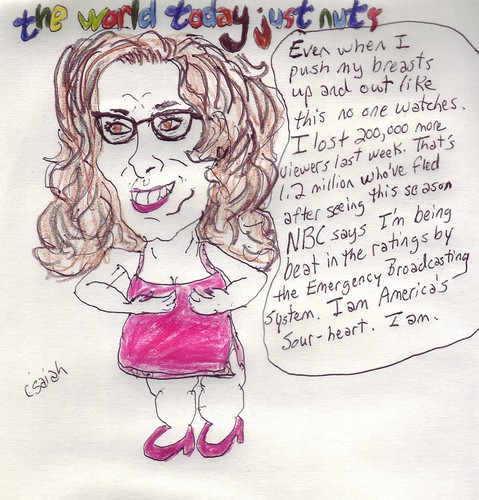
Isaiah's The World Today Just Nuts "Tina Fey: America's Sour-Heart"

Tina Fey: America's Sour-Heart


I already e-mailed Isaiah and told him I would really be thrilled if I could have the hard copy of that one. I think it's very funny.

"Obama: Playing the Trump Card?" (Bob Avakian, Revolution):
What the ruling class has just done with Obama—not only having him become a viable and serious candidate but allowing/having him actually win the presidency, and the Jack/Bobby Kennedy role of this, as well as the powerful particularity of “the first Black President”—is not something that they can do very often. In the case of a Black President, they can really do this only once—or only once with anything like this level of significance and impact. (Of course, there is more “identity politics/bourgeois style” they can come up with—the first woman president, or the first Latino president, for example; but without denying that things like that could have some social significance, it would not likely be of the same kind, or same magnitude, in terms of its impact, within the U.S. and internationally, as the “first Black president” in the United States, precisely given the particular history of Black people in this country, which many people around the world are aware of, even though they have many misconceptions about the actual nature, causes, etc., of this.) Given this, and given that (in line with the “Andrew Sullivan analysis”
2) doing this with Obama is a sign of recognition on their part that they are in for some heavy shit ahead—all of which has been taken to an even greater dimension with the whole financial/economic crisis—is there an analogy here to the game of bid whist? More specifically, is this analogous to their having—because of the heaviness of the situation and its potential to become qualitatively more so—to play what constitutes a major trump card of theirs (this role played by Obama) before they might otherwise have wanted to do so—to have, in effect, lost the ability to play this particular trump card later, when they might need it even more? Now, with this analogy, I am definitely not suggesting that they do not still have—or that they will not have if things sharpen up to a qualitatively greater degree—any more maneuvers to make and weapons to wield: they will still have resources and devices, both in terms of the carrot and definitely the stick. And, in any case, whatever the value might (or might not) be to this bid whist/trump card analogy, I believe there is something of strategic significance in the fact that the ruling class—or, to be more scientific, a powerful confluence of ruling class forces—decided at a certain point that it was necessary to go with Obama, and the fact that this is not something that they can easily replicate, even if things do sharpen up qualitatively.
So, while tactically and in the short run, the election of Obama will create (and no doubt already is creating) some new difficulties for us—and this is likely to be especially so among Black people, many of whom are not surprisingly swallowing down the “ObamaL’aid ” as Glen Ford creatively refers to it [in an article on the website Black Agenda Report
3 ]—in an overall and strategic sense there are important favorable factors in all this—provided that we continue to be grounded in and consistently apply our scientific communist outlook, method and approach, including firmness of principles and flexibility (an application of solid core with elasticity in terms of method and approach) and vigorously put forward our revolutionary-communist line and carry out revolutionary work based on and proceeding from that line, in its core elements and in all its richness (including building a culture of appreciation, promotion, and popularization around the leadership of Bob Avakian and the role of the newspaper as hub and pivot—and scaffolding—of the revolutionary movement with the Party at the core, and the full, correct—not economist—orientation and implementation of “Fight the Power, and Transform the People, for Revolution”).4

First, there are three essays by Bob Avakian at the link. I enjoyed the first one the most so I've quoted most of it above. C.I. passed that over thinking I would enjoy it and that was correct.

Barack is not "Black." Barack is bi-racial and when the reality about him sinks in, look for a lot of people (of all races) to grasp that they blew the moment on a non-first. Santita Jackson could be elected president in 2016 and though she would be the first Black person elected president, even if America was willing to admit that, they couldn't go through the motions -- not even convincingly.

I do agree with Avakian that Barack was installed to restore faith in the corrupt system. He is supposed to make all the crimes go down a little easier. He is not about change or transformation. He is about allowing the US government to continue the same cries but to get people on board with it. Sunsara Taylor, Debra Sweet and C.I. have said that far better than I could.

So read the essays. I think you will find them rewarding and be thrilled just to know that others are out there not drinking the Kool Aid.

"Iraq snapshot" (The Common Ills):
Monday, November 24, 2008. Chaos and violence continue, the treaty will not be voted on today in Baghdad, multiple bombings in Baghdad claim at least 22 lives, Joan Didion critiques the Cult of St. Barack, and more.

Starting with Iraqi refugees. Today
Anna Badkhen (Christian Science Monitor) reports on Iraqis like Khalida who was beaten and raped (by thugs with the Interior Ministry) and managed to make it to Jordan where "her Jordanian neighbor barged into her apartment and attempted to rape her." Badkhen explains:

Khalida never reported the incident. Like tens of thousands of Iraqi refugees in Jordan, she does not have a permit to live or work here, and she is afraid that if she turns to authorities for help she will get deported. So instead of seeking punishment for her assailant, she latched the flimsy metal door of her apartment and stopped going outside.
Her story sheds light on a problem that is little researched, poorly understood, and largely ignored: Iraqi rape victims who now live in Jordan illegally and without protection. Sexual assault is heavily stigmatized in the Middle East, and victims are often afraid to talk about it to anyone, fearing that their families will abandon them. And their shaky status in Jordan leaves them afraid to seek help and vulnerable to new assaults and abuse. They fear persecution by Jordanian immigration authorities almost as much as they fear returning to Iraq.

Jordan is home to an estimated 500,000 to 750,000 Iraqi refugees while approximately two million have settled in Syria. Friday the
Jordan Times reported that the country's "Foreign Minister Salah Bashir on Thursday urged the international community to help countries hosting Iraqis shoulder increased economic and social burdens." He made that appeal at last week's meeting in Amman on the issue of Iraqi refugees. Iraq's Foreign Ministry notes that the Foreign Ministry's Dr. Mohammed Al Hajj Himoud represented Iraq along with a "delegation from Human Right Ministry and Education Ministry" and that they met with "permanent members of [UN] Security Council, Eight states group, United Nations, Arab League, Islamic Conference Organization, Red Cross and Red Crescent Socities." On the conditions many refugees face, Jalil Medhi (Rising Kashmir) uses the gang-rape and murder of 14-year-old Abeer by US soldiers to explore the refugee crisis and explains that "incident is just a glimpse into what is happening inside Iraq. The story continues with the Iraqi refugees in Syria. Many of the Iraqi women fleeing the war in Iraq are turning to prostitution. In Syria alone an estimated 50,000 refugee girls and women, many of them widows, are forced into prostitution. And this is the only way for them to survive. These refugees are selling the only thing they have left of any value: their bodies . . . In the clubs, the waiters act as dealmakers between clients and the Iraqi prostitutes." And there are the ones who managed to sort-of get out of Iraq but not into another country. Olivia Ward (Toronto Star) reports on the approximately 3,000 refugees trapped on the border between Iraq and Syria, Palestinians welcomed during Saddam Hussein's reign (but given no shot at citizenship) whose fate is still tragic and she notes the countries which once took them in, no longer will. Amnesty's Gloria Nafziger explains to Ward, "The problem is that nobody wants the Palestinians. Countries in the region feel that giving them access is opening up a Pandora's box." While Iraq is the leading refugee crisis in terms of sheer numbers, there are many other refugee disasters around the world and Abeer Etefa and Ron Redmond (United Nations High Commissioner for Refugees) report Antonio Guterres, High Commissioner for Refugees, issued an appeal today, "At this moment, millions of people across the world are experiencing insecurity as their daily reality -- war and natural disasters -- threaten their existence. They don't have access to the essentials of life, including clean water, health care and shelter. Given the sheer scale of the task ahead, it is clear that no single organization, government or donor can tackle it alone."

A large percentage of Iraqi external refugees are Christians and Iraq's internal refugees include Christians but in a smaller percentage. In October, the assault on Iraqi Christians -- which had started months prior -- was noticeable and beyond denial. Since the assault received international attention, some of those who fled Mosul have returned.
Gary Marx (Chicago Tribune) reports that "the community is Mosul is divided between those who believe they still have a place in Iraq and those who fear their days here may be numbered. Even those Christians who returned home to Mosul after the latest attacks are keepign a low profile." For any who forgot or missed it, Hamida Ghafour (United Arab Emirates' The National) summarizes what took place in Mosul:

Last month thousands fled Mosul, in the north, where a sizeable Chaldean and Assyrian population has lived since the second century, because their homes and churches were being targeted by Sunni extremists in a wave of car bombings and killings. Some have returned but the churches remain under heavy police protection. Since 2033, eight Iraqi priests have been murdered, including the Chaldean Archbishop of Mosul, who was kidnapped this year.
[ . . .]
Today, Iraq's Christian population is thought to be less than 800,000. Many have gone to Jordan, where I met a refugee family recently. In Jordan, as in the UAE, Christians probably feel more safe than anywehre else in the Middle East, thanks to strong public support from the royal family and laws that allow them to worship and build churches freely. Still, Nadia Samaan, 49, a chemical engineer, told me she was desperate to move to Canada with her husband, an accountant, and their four children.
The family were Chaldean Catholics who recognise the Pope's authority but celebrate the Eastern rites in the ancient Syriac language. The Chaldeans of Iraq are the descendants of those who did not convert to Islam in the seventh century.

Hisham Mohammed Ali (Institute for War & Peace Reporting) reports that only approximately a third of those who fled Mosul have returned and that the bulk of the refugees do not consider Mosul safe such as Safa Nathir Kamu who states, "We would like to go back home. We need security, but unfortunately security in Mosul is nothing more than pictures on TV."


On the issue of security in general, Sunday a meet-up took place in Damascus.
Iraq's Ministry of Foreign Affairs notes that those participating included the "Arab League, United Nations, Security Council, Eight major states, Islamic Organization confrence and the European Union as well as the neighboring countries of Iraq, Egypt and Bahrain" and that Iraq sent Labeed Abbawi (Undersecretary for Policy Planning and Bilateral Relations in the Foreign Ministry). Press TV adds that the Group of Eight also participated. UPI explains that the participants were part of a group "formed in 2006 by the interior ministers of Iraq's neighbors in an attempt to assert control over their borders with Iraq and to stop the infiltration of arms and fighters into the country." Xinhau reports that Bassam Abdel Majid, Syria's Interior Minister, called for all participants to agree that "Iraq will not be used as a launch pad for any acts of aggression against neighboring states under any circumstance" and then specifically condemnded the US assault on Syria which resulted in eight deaths last October as a "stark violation" of both international law and his country's sovereignty. Khaled Yacoub Oweis (Reuters) notes that Maura Connelly, US Charge d'Affaires (and a woman, despite some recent press releases from the Syrian government), represented the US at the meet-up by "accusing host Syria of sheltering militants attacking Iraq" but "other countries adopted a more conciliatory tone, delegates said."

When not blustering in international meet-ups, the administration blusters and bullies with their client-state/puppet government in Baghdad. Asked at the US State Dept today when the vote on the treaty masquerading as a Status Forces Of Agreement might take place, spokesperson Sean McCormack declared, "I don't know. Talk to the Iraqis about it, talk to the Speaker of their Parliament. I think they've -- I've seen various news reports about later this week. We'll see." The vote was supposed to take place today; however,
AP reported that the Parliament vote on the treaty, scheduled for Monday, has been pushed back to Wednesday and they noted, "Wednesday will likely be the last parliamentary session before the 275-seat legislature goes into recess for the Muslim feast of Eid al-Adha, which falls in the first week of December. Some lawmakers will then travel to Saudi Arabia for the annual pilgrimage to Mecca, denying the house a quorum." However, Alissa J. Rubin and Alan Cowell (New York Times) see that date as aspirational, not concrete, and state the vote "may come this week". Aspirational like the so-called 'hard dates' in the treaty. One person asking the hard questions is Simon Assaf (Great Britain's Socialist Worker) who writes of the treaty:

It is being hailed as an honourable end to a disreputable war, the Status of Forces Agreement signed by the Iraqi cabinet last weekend sets out a timetable for the withdrawal of US combat troops from cities by June 2009, and the whole country by December 2011. But the deal, the full text of which is yet to be published, will not end the occupation. By signing the accord the Iraqi government is agreeing to a ten-year mandate for US troops to "guarantee the security of Iraq" against war, coup, rebellion or revolution. The US will have the right to maintain 50 military bases, store military equipment, control Iraqi airspace, sail warships in its waters and continue its "supervision" of the interior and defence ministries. The military will also have the right to seize any Iraqi "working against US interests". The US has made small concessions over the prosecution of US soliders or citizens who break Iraqi law while not on operation duty -- but this can only be done in agreement with a US military panel.The deadline for the withdrawal of troops can also be changed if the US or Iraqi government feels that the "situation on the ground" has changed. Opposition to the agreement threatened to sink the deal. But after threats against the country, which included withdrawal of $50 billion in aid and the sequestration of its assets held in US banks, the Iraqi government caved in. The powerful Shia religious establishment, headed by Ayatollah Ali al-Sistani, withdrew its opposition to the pact. All Iraqi parties that are allied to the occupation have also dropped their objections. Britain hopes for a similar agreement guaranteeing its role in the south of the country. The only voices of dissent to the accords are those of rebel cleric Moqtada al-Sadr and his supporters. Sadr has denounced the accords and called a protest on Friday of this week. Far from ending the occupation, the Status of Forces Agreement would leave the US in almost total control of the country, and guarantee the future of the occupation. The following should be read alongside this article: »
Obama's new strategy as the US faces defeat in Afghanistan » email article » comment on article » printable version © Copyright Socialist Worker (unless otherwise stated). You may republish if you include an active link to the original and leave this notice in place. If you found this article useful please help us maintain SW by » making a donation.


Meanwhile Iraqi legislatures have noticed another flaw in the treaty: It does not protect Iraqi assets from seizures to collect on past debts. A rather serious omission but
James Glanz and Steven Lee Myers (New York Times) are too busy yucking it up in all shades of xenophobia to take the issue seriously. Those wacky Iraqi MPs, they've found another problemw ith the treaty! Ha ha ha, what more do they want!!!!! That is the attitude the 'reporters' display while forgetting to inform readers that Iraqi MPs have had a copy of the treaty for less than a week. The two 'reporters' also need to be knocked off their high horses because the Iraqi MPs are doing what they refuse to: Read the document. How silly of the Iraqis not to just repeat what officials say the treaty says -- you know, what the Times and so much more of the alleged 'free' press has done day after damn day. The 'reporters' find it 'cute' that MPs are worried about this and all but rolls their eyes in print as they explain for the 'thickheaded' that, of course, Nouri al-Maliki will go to the United Nations to get an extension of that via some form of a mandate. Mandate. The UN Security Council mandate expires December 31st and it does offer protection for Iraqi assets. And al-Maliki will go back to have that aspect extended but refuses to extend the mandate itself?Yes, it now turns puppet Nouri al-Maliki is willing to go to the United Nations . . . for that one aspect and only for that. Saturday, he sent flunkies out to hold a press conference. Campbell Robertson and Katherine Zoepf (New York Times) explained that the thrust was a renewal of the UN mandate just wasn't possible, it just wasn't. Why? No one bothers to say. They do bother to repeat the lie that all US troops leave Iraq in 2011. No. If the US maintains an embassy in Iraq, US soldiers will remain there as they do at every other embassy the US has. The contract is for 2009. After the first year, anything can be modified or the contract itself can be cancelled. And that point was confirmed by Adam Ashton who has been reporting for McClatchy Newspapers. Over the weekend, at The Modesto Bee, Ashton wrote a piece on a variety of topics and included that "[t]wo senior U.S. government officials" explained their assessment of the treaty and whether or not it meant a withdrawal of all US service members by the end of 2011, and he was informed that for the US to stay after 2011, "the pact would have to be renegotiated for foreign soldiers and contractors to stay." What????? No, "Of course it means all out in 2011!" That's what the press keeps reporting even though it's not true. The truth is the treaty only covers 2009. Everything else can be cancelled or modified. Jeremy R. Hammond (Information Clearing House) is one of the few actually examining the treaty:

The terms of the agreement effectively allow the U.S. to continue to control billions of dollars of proceeds from the sale of exported Iraqi oil held in the Federal Reserve Bank of New York. It also contains numerous loopholes that could allow the continuing long-term presence of U.S. military forces and would effectively maintain U.S. jurisdiction over crimes committed by American soldiers.

Yesterday the puppet held his own press conference.
Reuters reports he said his country would not ask for an extension of the United Nations mandate. Except that we now know he will. Not for the entire issues at stake but for the one issue of protecting Iraqi assets. Apparently, al-Maliki's hoping to whip through the United Nations by getting into the Express Checkout Lane. Ned Parker (Los Angeles Times) reports on al-Maliki's efforts to consolidate his power and how the treaty might help him do that even more. Back when he was just a senator and chaired the US Senate's Committee on Foreign Relations, Joe Biden could speak of those dangers freely. Now he's vice president-elect and muzzled. So we'll drop back to the April 10th snapshot to note:
Biden noted the "internal threat" aspect being proposed and how these requires the US "to support the Iraqi government in its battle with all 'outlaw groups' -- that's a pretty expansive commitment." He noted that it requires the US "to take sides in Iraq's civil war" and that "there is no Iraqi government that we know of that will be in place a year from now -- half the government has walked out."
"Just understand my frustration," Biden explained. "We want to normalize a government that really doesn't exist."

[Semi-related,
Bobby Ghosh (Time magazine) reports on who is on the tax payer dime in Iraq thug wise.] While the Iraqi Parliament gears up on a vote, remember that the White House thinks they can circumvent the Constitution and ignore the Congress. This from the American Freedom Campaign:Does this sound right to you? Next week, the Iraqi Parliament is expected to vote on whether to approve an agreement setting the terms of the ongoing military relationship between the United States and Iraq. So far, so good. A legislative body, representing the people of a nation, shall determine the extent to which that nation's future will be intertwined with that of another. Of course, one would expect that the United States Congress would be given the same opportunity. That, however, is not the case. Or at least it is not what the Bush administration is allowing to happen. Shockingly, the Bush administration is not even letting Congress read the full agreement before it is signed! We need you to send a message immediately to U.S. House and Senate leaders, urging them to demand the constitutional input and approval to which they are entitled. The administration has asserted that the agreement between the U.S. and Iraq is merely a Status of Forces Agreement (SOFA) and therefore does not require congressional approval. Yet the agreement goes far beyond the traditional limits of a SOFA, which typically set the terms for bringing materials and equipment into a nation and outline the legal procedures that will apply to members of the military who are accused of crimes. Believe it or not, the current agreement contains terms that will actually give Iraq a measure of control over U.S. forces. No foreign nation or international entity has ever been given the authority to direct U.S. forces without prior congressional approval - either through a majority vote of both chambers or a two-thirds vote in the Senate in the case of treaties. If this agreement goes into effect without congressional approval, it will establish a precedent under which future presidents can exercise broad unilateral control over the U.S. military -- and even give foreign nations control over our troops. Congress must take immediate action. Unfortunately, they are about to adjourn for at least a couple of weeks. But it is not too late for House Speaker Nancy Pelosi and Senate Majority Leader Harry Reid to make a statement, signaling their strong belief that Congress will not be bound by and need not fund an agreement that has not been approved by Congress. Please send an E-mail encouraging such action to Speaker Pelosi and Majority Leader Reid immediately by clicking [here] This is truly a dire situation and we hope that you will join us in calling for action. Thank you. Steve Fox Campaign Director American Freedom Campaign Action Fund

As violence swept through Baghdad again today,
Alissa J. Rubin and Alan Cowell (New York Times) opined, "The timing of the attacks -- which folled a recent increase in violence -- suggested that insurgents wanted to demonstrate that they were still able to disrupt the city and penetrate well-guarded areas even as the government seeks Parliament's approval of the security agreement." Among the attacks in Baghdad today, CBS and AP note, was a woman bomber who took her own life outside an entrance to the Green Zone and the lives of seven other people with thirteen more left wounded. Another Baghdad bombing involved a minibus. CNN reports that already claims are being made that the woman was "mentally disabled." (That charge was made before on two female suicide bombers and was never proven though it did lead to the raiding of an Iraqi hospital and the terrorizing of the hospital's staff.) BBC notes, "The noise of the blast echoed across central Baghdad and a pall of black smoke rose above the site." Deborah Haynes (Times of London -- link has text and video) notes that 13 people died (nine more wounded) in the explosion that took place right after the minibus "stopped at a residential neighbourhood in the east of the capital to allow women and men working at the Trade Ministry to climb onboard" and Haynes quotes a shocked shopkeeper who declares, "We did not expect they would target a civilian bus filled with females." Another eye witness, Majid Ali, tells McClatchy of the victims, "They are innocent people. I don't know how these criminals dare to do such a crime. Those who committed it are inhuman." Adam Ashton and Hussein Kadhim (McClatchy Newspapers) explain the "third bombing targeted a police patrol in Baghdad's Karrada neighborhood about 11 a.m. near the Technology University. It killed one person and wounded five, including three police officers."

In other reported violence today . . .

Bombings?

Hussein Kadhim (McClatchy Newspapers) reports a Baghdad mortar attack that injured six people.

Shootings?

Hussein Kadhim (McClatchy Newspapers) reports 3 brothers shot dead in Diyala Province, 1 police officer shot dead in Mosul, one police officer wounded in another Mosul shooting. Reuters notes 1 lawyer shot dead in Kirkuk.

Last week a panel discussion took place on the election at the New York Public Library's Cullman Center for Scholars and Writers. Participating were Joan Didion, Andrew Delbanco, Jeff Madrick, Darryl Pinckney, Robert Silvers, Michael Tomasky and Garry Wills.
The New York Review of Books has the podcast of the event (scroll down to November 17, 2008, What Happens Now? A Conversation on the 2008 Election) and we transcribed some of Didion's opening remarks for Third:
What troubled had nothing to do with the candidate himself.
It had to do instead with the reaction he evoked.
Close to the heart of it was the way in which only the very young were decreed of capable of truly appreciating the candidate. Again and again, perfectly sentient adults cited the clinching of arguments made on the candidate's behalf by their children -- by quite small children. Again and again, we were told that this was a generational thing, we couldn't understand. In a flash we were sent back to high school, and we couldn't sit with the popular kids, we didn't get it. The "Style" section of The New York Times yesterday morning mentioned the Obama t-shirts that "makes irony look old."
Irony was now out.
Naivete translated into "hope" was now in.
Innocence, even when it looked like ignorance, was now prized.
Partisanship could now be appropriately expressed by consumerism.
I could not count the number of snapshots I got emailed showing people's babies in Obama gear.

Now I couldn't count the number of terms I heard the terms "transformational" or "inspirational." The whole of election night I kind of kept dozing on and off and the same people were on always on television and every time I woke up to them they were saying "transformational." I couldn't count the number of times I heard the sixties evoked by people with no apparent memory that what drove the social revolution of the sixties was not babies in cute t-shirts but the kind of resistance to that decade's war that in the case of our current wars, unmotivated by a draft, we have yet to see.It became increasingly clear that we were gearing up for another close encounter with militant idealism by which I mean the convenient redefinition of political or pragmatic questions as moral questions -- which makes those questions seem easier to answer at a time when the nation is least prepared to afford easy answers. Some who were troubled in this way referred to those who remained untroubled by a code phrase. This phrase which referred back to a previous encounter with militant idealism the one that ended at the Jonestown encampment in Guyana in 1978 was "drinking the Kool-Aid." No one ever suggested that the candidate himself was drinking the Kool-Aid. If there was any doubt about this, his initial appointments would lay them to rest. In fact, it seemed increasingly clear that not only would he welcome healthy realism but that its absence had become for him a source of worry. "The exuberance of Tuesday night's victory," The New York Times reported on November 6th, "was tempered by concerns over the public's high expectations for a party in control of both Congress and the White House amid economic turmoil, two wars overseas and a yawning budget gap. " A headline in the same day's paper, "With Victory At Hand, Obama Aides Now Say Task Is To Temper Expectations."
Yet, the expectations got fueled, the spirit of a cargo cult was loose . I heard it said breathlessly on one channel that the United States on the basis of having carried off its presidential election now had "the congratulations of all the nations." "They want to be with us," another commentator said. Imagining in 2008 that all the world's people want to be with us may not be entirely different in kind from imagining in 2003 that we would be greeted with flowers when we invaded Iraq. But in the irony-free zone that the nation had chosen to become this was not the preferred way of looking at it.

Today
The New York Review of Books offers an adaptation of Didion's remarks (as well as one of Darryl Pinckney's).

iraq
anna badkhen
adam ashtonned parkerthe los angeles timesalissa j. rubinthe new york times
katherine zoepf
campbell robertsonsteven lee myersjoan didionjeremy r. hammondalan cowell
simon assafthe socialist worker

Friday, November 21, 2008

The failure of 'leadership'

"No Breakthrough for Women PoliticiansNovember 20, 2008" (Marie Cocco, Washington Post Writers Group):
Even if President-elect Barack Obama chooses Clinton as secretary of state, no ground will be broken. Clinton would be the third woman to hold the post. And there is no longer anything extraordinary in a president naming women to his Cabinet. Franklin D. Roosevelt did it first, when he appointed Frances Perkins as labor secretary in 1933. Since then, every president but Harry Truman and John F. Kennedy has named women to the Cabinet or to Cabinet-level posts, according to the Center for American Women and Politics at Rutgers University. Bill Clinton holds the record: He appointed 16 women overall, and at one point about half of those serving in Clinton's Cabinet were female.
But, we are invariably told, surely there are enough women moving through the "pipeline" of lower offices so that someday, some woman from somewhere will win the presidency or the vice presidency. Well, here is how things stand: Eight women will serve as governors in 2009, the same as this year. The proportion of women serving in statewide elective office actually has dropped since it reached a high of about 28 percent in 2000; it is now about 24 percent, according to the center.
The Senate will add one woman next year, bringing the number of female senators to 17. Ten newly elected House members are female. This means that as the class of 2008 enters the Capitol's marble halls, it will include less than half the number of women who first won office in 1992 -- the so-called "year of the woman."

There has been no improvement for women in 2008 and it's time for all those 'leaders' to explain how that happened. It's time for Robin Morgan and others (but especially Robin Morgan) to explain how their use of sexism helped other women?

It is also time for a number of women to explain how their silence was supposed to help anyone?

2008 is a huge embarrassment for the 'leaders' and they need to be addressing their own failures before they address anything else. They betrayed so many beliefs and so many standards and, in doing so, they hurt many women.

That is reality.

It isn't pretty but the truth doesn't need to be prettied up. The truth needs to stand in all of its plain glory.

If you had told me in 2007 that even half of what went down, even half the attacks on women, would take place this year, I would never have believed you.

Look at Alice Walker. That woman has not only destroyed her daughter and refused to see her only grandchild, she's damaged her daughter so much that she's writing insipid things like this:

"She cannot lie in bed and wonder if her choices are feminist enough or whether they send the correct message to women around the world. She can accept her role at the center of history and rely on her aspiration to be her best self to transcend narrow categories of feminist identity and, in doing so, inspire others to the same. In other words, Michelle Obama doesn't need a message. She is the message."

That's Rebecca Walker writing about Michelle Obama and I am so sorry to be the one to break it to Rebecca but Michelle is not "the message." She is another First Lady in a long line of them. I am sorry her mother hurt her and I am sorry Rebecca wishes to take that out on the feminist movement.

My empathy does not extend to declaring that crap "has a point." There is no point there. Rebecca wants Michelle to be the Mommy she never had. Hard truth Rebecca, you're not getting that mother. You can make your life -- as you have -- about providing your child with the kind of mothering you want. You are not going to be able to have a mother surrogate. You are a grown up and you will never relate in that regard even if you try to.


"Iraq snapshot" (The Common Ills):
Friday, November 21, 2008. Chaos and violence continue, the US military announces more deaths, the proposed treaty is protested in Baghdad, and more.


Starting with the treaty passed off as a Status Of Forces Agreement.
Gina Chon (Wall St. Journal) reports on yesterday Parliament activity: "Critics of the agreement tried to further put off discussion Thursday, shouting and banging on tables. . . . But lawmakers in the 30-member Sadr bloc, who have been opposing the agreement, failed to stop the legislation's progress. speaker Mahmoud Mashadani extended the parliament session so debate would continue on Saturday and a vote could still come next week. He already had canceled a leave that had been scheduled for lawmakers next week to cover several Muslim holidays, saying the vote on the pact was too important to delay further." However, on the holiday, CNN notes, "If a vote has to be held beyond Monday, Kurdish lawmaker Mahmoud Othman said it could be delayed by the annual hajj religious pilgrimage and Eid al-Adha, the Muslim holiday that comes at the end of the pilgrimage." The Los Angeles Times' blog notes that the treaty needs to be read aloud in the Parliament a third time before going to a vote. Salah Hemeid (Al-Ahram Weekly) observes, "It is not clear if the endorsement requires a simple, or a two thirds, majority of the 275-member legislative -- the latter a constituational requirement for key legislation. It is also unclear if the assembly will debate the agreement article by article or vote, as the government wants, on the whole package, or what will constitute a quorum should its detractors try to prevent its passage by astaining or walking out."

Before we go further, in the US you can make your voice heard via
American Freedom Campaign:Does this sound right to you? Next week, the Iraqi Parliament is expected to vote on whether to approve an agreement setting the terms of the ongoing military relationship between the United States and Iraq. So far, so good. A legislative body, representing the people of a nation, shall determine the extent to which that nation's future will be intertwined with that of another. Of course, one would expect that the United States Congress would be given the same opportunity. That, however, is not the case. Or at least it is not what the Bush administration is allowing to happen. Shockingly, the Bush administration is not even letting Congress read the full agreement before it is signed! We need you to send a message immediately to U.S. House and Senate leaders, urging them to demand the constitutional input and approval to which they are entitled. The administration has asserted that the agreement between the U.S. and Iraq is merely a Status of Forces Agreement (SOFA) and therefore does not require congressional approval. Yet the agreement goes far beyond the traditional limits of a SOFA, which typically set the terms for bringing materials and equipment into a nation and outline the legal procedures that will apply to members of the military who are accused of crimes. Believe it or not, the current agreement contains terms that will actually give Iraq a measure of control over U.S. forces. No foreign nation or international entity has ever been given the authority to direct U.S. forces without prior congressional approval - either through a majority vote of both chambers or a two-thirds vote in the Senate in the case of treaties. If this agreement goes into effect without congressional approval, it will establish a precedent under which future presidents can exercise broad unilateral control over the U.S. military -- and even give foreign nations control over our troops. Congress must take immediate action. Unfortunately, they are about to adjourn for at least a couple of weeks. But it is not too late for House Speaker Nancy Pelosi and Senate Majority Leader Harry Reid to make a statement, signaling their strong belief that Congress will not be bound by and need not fund an agreement that has not been approved by Congress. Please send an E-mail encouraging such action to Speaker Pelosi and Majority Leader Reid immediately by clicking [here]
This is truly a dire situation and we hope that you will join us in calling for action. Thank you. Steve Fox Campaign Director American Freedom Campaign Action Fund

Today White House spokesperson Dana Perino declared on Air Force One that the treaty would be available to the American peoope "soon," "As soon as we possibly can, when we're -- agreement is reached, we'll be able to do that. You bet. . . . As soon as we possibly can, when we're -- agreement is reached, we'll be able to do that. You bet. . . .
I don't know exactly the timing of it. Obviously, we've provided full briefings to appropriate members of Congress. I think over 200 members of Congress saw it. Secretaries Rice and Gates, amongst others -- I think General Lute -- were up on Capitol Hill to provide that information to the citizens, representatives in Congress. And then as soon as we are able to, we'll provide the English language, sure. . . . . I actually can't tell you when it will be. I just don't know." In other words, no, the treaty isn't being released to the American people anytime soon.


In Iraq,
Campbell Robertson and Stephen Farrell (New York Times) note the Sunni attitude conveyed by MP Aala Maki, "To be clear, it is not the treaty that is the problem. What will be built on the treaty, that is the problem." They're dancing to get their palms greased. Rania Abouzeid (Time magazine) reports, "The discord in Iraq's parliament, and on its streets, over the Baghdad government's Status of Forces Agreement (SOFA) with Washington is over a lot more than the date on which U.S. troops are to withdraw and the rules governing their conduct until then. As the rabble-rousing Shi'ite cleric Moqtada al-Sadr made clear on Friday, it's also about which Iraqi parties will best leverage the Americans' eventual departure to their own political benefit. Sadr drew thousands of supporters to Firdous Square in central Baghdad on Friday to protest against the draft accord, which awaits a ratification vote in Iraq's parliament on Monday."

CBS and AP cover the protest and note, "After a mass prayer, demonstrators pelted the effigy with plastic water bottles and sandals. One man hit it in the face with his sandal. The effigy fell head first into the crowd and protesters jumped on it before setting it ablaze." AP's Hamza Hendawi reports the demonstration Moqtada al-Sadr called last week took place today following prayers in Baghdad and that the Bully Boy of the United States was "burned" in "effigy" "in the same central Baghdad square where [US shipped in exile] Iraqis beat a toppled statue of Saddam Hussein with their sandals five years earlier" and the Bush stand-in was also "pelted . . . with plastic water bottles and sandals" and it "held a sign that said: 'The security agreement . . . shame and humiliation'." CNN adds, "The demonstration brought out one of the largest crowds to congregate in Baghdad since protests against the agreement started this year. The square was sealed off and traffic was blocked as thousands chanted 'No no to the agreement,' 'No no America,' and 'Out, out occupation'." Deborah Haynes (Times of London) quotes Sheikh Abelhadi al-Mohammedawi telling those assembled, "If they [US] do not get out then and those with me are ready to drive them out in the method that we see fit, provided that it does not go against religion." AFP reports that a statement from Moqtada al-Sadr was read to the crowd and quotes it as follows: "If they don't leave the country I am going to be with you to make them leave in a way that suits you, as long as it doesn't go against the religion. And if they leave the country and you fear that the enemy coming from outside will transform your land into a battlefield, I and my followers will be a shield for Iraq." BBC (which has text and video on the demonstration) quotes al-Sadr's statement thusly: "Let the government know that America is and will not be of any use to us because it is the enemy of Islam." BBC provides a photo essay here. Tina Susman and Caesar Ahmed (Los Angeles Times) describe the scene around the demonstration, "Iraqi army snipers perched on rooftops along the broad avenues leading to the square, a public gathering spot in the middle of a traffic roundabout decorated with fountains and greenery. The effigy of Bush, wearing a suit and tie and carrying a briefcase, dangled for hours as the crowd, which stretched for several city blocks, knelt in prayer and listened to clerics denounce the Status of Forces Agreement." Reuters photos (such as here) include a caption that notes "Iraqi forces shut streets in Baghdad". Xinhau notes, "Iraqi security forces cordoned off the area, blocking all the roads leading to the route of the demonstration". This Reuters photo by Mushtaq Muhammed shows Iraq soldiers frisking a young man holding a sign bearing al-Sadr's photo "before entering the rally site". This Reuters photo by Kareem Raheem shows an American flag being burned at the demonstration. Adam Ashton (McClatchy Newspapers) explains the catchy tune sung as the rally ended, "Maliki is the new Sadam."

Staying with the treaty,
AP's Matthew Lee reports that mercenaries such as Dyncorp, Blackwater, Triple Canopy and KBR have been informed by the US State Dept and Pentagon that the treaty will mean "private Americans and non-Iraqi foreigners working in key roles for the United States in Iraq will lose immunity and be subjected to Iraqi law". AFP adds, "One-hundred-and-seventy-two contractors who provide armed escorts and other security measures to government officials, diplomats and NGOs have been briefed on the new rules."

Turning to some of today's reported violence . . .

Bombings?

CNN notes three Baghdad bombings with 1 person dead and four injured. Xinhua notes 2 Baghdad roadside bombings that resulted 3 deaths and nineteen people wounded. Sahar

Today the
US military announced: "CAMP VICTORY, Iraq -- A Multi National Division -- Center Soldier died of non-combat related causes Nov. 20." And they announced: "A Multi National Division - North Soldier was killed in a non-combat related incident in Mosul, Iraq, Nov. 21." The announcements brought the number of US service members killed in Iraq since the start of the illegal war to 4204.

Bilal Hussein is the Associated Press' Pulizter winning photographer who was imprisoned (for no valid reason) for over two years by the US military. The
International Press Freedom Award (Committee to Protect Journalism) has picked him and five other winners for 2008:

Bilal Hussein Associated Press photographer, Iraq Danish Karokhel and Farida Nekzad, Pajhwok Afghanistan News executives, Afghanistan Andrew Mwenda, managing editor, The Independent, Uganda, Hector Maseda Gutiérrez, imprisoned reporter, Cuba
Beatrice Mtetwa, media lawyer, Zimbabwe

Congratulations to Bilal.
H. Josef Herbert (AP) notes CPJ "had been among those who had pressed for the release of AP photographer Bilal Hussein, winner of a Pulitzer Prize in 2005 for his news photography, including the fighting in Fallujah and Ramadi. . . . Steven Hurst, former AP bureau chief in Baghdad, said Hussein was taken into custody and held for more than two years without charges. 'He did nothing but his job as a photographer in a war zone,' said Hurst, adding that the military evidently 'didn't like the story that was being told by his pictures'." Information about Bilal and his false imprisonment can be found at the Free Bilal Hussein Now! website.

In other news,
Mickey Z' (at Information Clearing House) prepares for the immediate future:

No, I don't mean that Great Depression. I'm talking about the inevitable moment -- maybe next week, maybe next year -- when the Kool Aid wears off and the Obamatrons wake up to realize their hero offers nothing even approximating hope or change. The carefully calculated speeches -- which have always been filled with empty, hollow phrases -- will no longer soothe a battered and desperate populace and the Obamabots will suddenly recognize that the Pope of Hope has never been anything more than a human marketing strategy, a product. This year's iPhone. "Yes we can"? Merely the first three words of a longer phrase: "Yes we can continue to work, consume, and obey authority without question."


In election news, December sixth, Louisiana's second district elects someone to the US House. Kimberly Wilder (
On The Wilder Side) notes this article on candidate Malik Rehim's recent award and click here for a message from Malik.

Public broadcasting notes. First up
NOW on PBS this week looks at the role of credit ratings agencies in the economic meltdown. The program begins airing tonight on most PBS stations, check local listings, as does Washington Week which finds Gwen sitting down with four including the New York Times' Helene Cooper, Ceci Connolly (Washington Post) and NBC's Pete Williams. Staying with TV but turning to commercial TV, CBS' 60 Minutes offers Scott Pelly examing an assualt "on a facility containing weapons-grade uranium," Bob Simon on foreign widows of US citizens being ordered to leave "because their husbands died" and Lesley Stahl reports on Rex Lewis-Clack ("a musical savant born blind and mentally impaired who, at 13 years old now, is making remarkable strides despite doctors' prediction."

Public broadcasting heads up radio.
WBAI Sunday, Monday and Wednesday:Sunday, November 16, 11am-noonTHE NEXT HOURAndrew Andrew prove two opinions more mindbending than one.Monday, November 24, 2-3pmCat Radio CafeAuthor/editor Nelson W. Aldrich, Jr. on "George, Being George," anoral history of literary legend George Plimpton; novelist Arthur Nerseianon "The Sacrficial Circumcision of the Bronx," second of TheFive Books of Moses series based on urban terrorist Robert Moses;andJordan Roth of Jujamcyn Theatres announces Givenik.com, a new wayto get discounted theatre tickets while saving the world. Hosted by Janet Colemanand David Dozer.Wednesday, November 26, 2-3pmCCCP: THE MONTHLY LAUGHING NIGHTMARESatire with brand new boxing gloves for the new guys and more groundglass for the old guys. With transition team Janet Coleman, DavidDozer, John McDonagh, Marc Kehoe, Scooter, Moogy Klingman, PaulFischer, The Capitol Steps, Prince Fari and the great Will Durst.Broadcasting at WBAI/NY 99.5 FMStreaming live at WBAIArchived at Cat Radio Cafe

iraqthe new york timescampbell robertsonstephen farrellamerican freedom campaign
the los angeles timestina susman
gina chonthe wall street journal
deborah haynes
bilal hussein
60 minutescbs newswbaicat radio cafejanet colemandavid dozerwashington weekhelene coopernow on pbspbs

Wednesday, November 19, 2008

Gerry Ford 2009 and the treaty

Referencing Lisa Rein and Josh White's "Many Groups Spied Upon In Md. Were Nonviolent" (Washington Post), C.I. had a wonderful entry this morning that I wanted to highlight.

"The Imperial Presidency With Cavity Fighting Fluoride Protection!" (The Common Ills):
Repeating Michael Abramowitz' report that Barack would be shelving the cry for Senate approval (of the treaty) is backed up by Raed Jarrar (Raed in the Middle) who details how the transition site set up by Barack has already altered the position on Senate approval. And no our so-called 'left' (Katty and Matty et al) will not say a word. Howard Zinn won't say one damn word. Marjorie Cohn will plaster that idiotic grin on her face and look as if she's in search of Jim Jones.
That's how a Gerry Ford works. He's a transition figure. Brought in just to restore faith in a corrupt system.So since the election, Barack's decided the Constitution doesn't matter (no need for Senate approval of a treaty) and he's pissed off Guantanamo attorneys (who, honestly, deserve it for endorsing him -- you get what you deserve when you endorse someone whose history does not back up his words, you got played, shouldn't have gone home with the first man who offered to buy you a drink). Elaine covered last night how the White House is being told not to worry about breaking the law (including international law) by implementing and overseeing torture.
Ford pardoned Tricky Dick. The Bully Boy didn't need a pardon because the Democrats and their 'left' voices were too damn chicken to impeach, too cowardly. So this generation's Gerry will just busy himself making sure the empire has a toothy smile.
Remember all the lectures we've gotten for months and months and years and years about the rule of law? It no longer matters. That was all garbage tossed out to get you to vote Democrat and it's why those 'brave' 'left' voices aren't screaming their heads off right now as Barack indicates that toothy is the only real difference between him and Bully Boy: The Imperial Presidency With Cavity Fighting Fluoride Protection! And a great minty taste!

That really says it all and says it in a wonderful way.

From the way she nails the Gitmo lawyers who decided the world really needed them to endorse a candidate to our pathetic Panhandle Media.

While you hopefully smile or laugh out loud as you read along, you surely get just how dangerous Barack's caves are and I do agree that he does seem set up to become the Gerald Ford of this century.

The hearing today was something. C.I. covers it in the snapshot (re-posted in a second) and on the radio they're saying that US Sec of State Condi Rice and Sec of Defense Robert Gates are going to be defending the treaty. The treaty had some truths told on it during today's Congressional hearing chaired by Bill Delahunt.

I'm not surprised the administration is relaunching spin-mode but I do wonder how the press intends to report it.

This is not a Status Of Forces Agreement, it is a treaty. No one could have followed today's hearing and not grasped that the bulk of the reporting on it has been grossly mistaken. Among other things, we've learned there are two versions of the treaty. There is the US version which says one thing and the Iraqi version which says another. You can be sure the White House knew about that since they pushed the treaty. But you can be sure most Iraqis do not realize that there is a difference between the 'same' document depending on English or Arab version.

If we have a functioning press, we're going to see a shift in the coverage. If we have a press that excells, we'll see some mea culpas over some recent editorials drooling over the treaty.

So watch closely to see where it heads and if there's no change at all? That means we have the dysfunctional, broken press that we had in the lead-up to the illegal war.

"Iraq snapshot" (The Common Ills):
Wednesday, November 19, 2008. Chaos and violence continue, Turkey meets with Iraq over PKK (US tags along), the US Congress explores the treaty, and more.

"This is the eighth in a series of hearings which the Subcommittee has held on the Bush administration's efforts to consummate what was initially described as a long-term security agreement with the government of Iraq," declared US House Rep Bill Delahunt as he brought the Subcommittee on International Organizations, Human Rights and Oversight of the House Committee on Foreign Affairs to order today. The topic was the treaty the White House is trying to make with their puppets in Iraq. Delahunt noted he shared "the concerns expressed by the Chairman of the Armed Services Committee, our friend and colleague Ike Skelton, who has been quoted as being 'deeply troubled' because the agreement contains, as he says, 'vague language that will cause misunderstandings and conflict between the United States and Iraq in the future'."

Rep Bill Delahunt: And by the way, no one should forget that this agreement has just been provided to Congress -- and that there has been no time to conduct the analysis required by such a significant document -- one that purports to end a conflict that has had such momentous and tragic consequences for both the Iraqi and the American people. And remember there has been no meaningful consultation with Congress during the negotiation of this agreement. And the American people, for all intents and purposes, have been kept completely left out. Even now the National Security Council has requested that we do not show this document to our witnesses or release it to the public -- a public that for over five years has paid so dearly with blood and treasure. Now I find that incredible. Meantime, the Iraqi government has posted this document on its media website so that anybody who can read Arabic can take part in the public discourse. But this is typical of the Bush administration and its unhealthy and undemocratic obsession with secrecy.

Delahunt went on to outline three things that had to take place for the treaty to be legal:

1) The Iraqi Parliament enacts by a two-thirds majority -- 184 of its 275 members -- a law governing the ratification of international agreements.

2) The Iraqi Parliament then enacts the proposed bilateral security agreement under that ratification law -- which as introduced this past Monday in their Parliament also would require a two-thirds vote of approval, and

3) The United States Congress enacts a law that approves and implements the security agreement -- and authorizes offensive combat operations by US forces.

Oona A. Hathaway,
Raed Jarrar, Michael Matheson, Issam Michael Saliba AEI's Thomas Donnelly offered testimony to the committee.

One issue that arose was the possibility of extending the United Nations Security Council mandate (the mandate expires December 31st). Jarrar explained that there had been resistance in the past to extending the mandate; however, today it is seen by proponents in Iraq "as the lesser of two evils, but not as a strategic goal. Many Iraqi groups in the Parliament think it is better to give the Parliament more time to debate the agreement rather than just rushing it within the next few weeks." Matheson, professor at George Washington University Law School, also spoke of the mandate and noted that a UN mandate could take place under Chapter 7 (as has been done) or under Chapter 6. Saliba is a Senior Foreign Law Specialist with the Law Library of Congress and his focus was the approval mechanism in the Parliament which eh found to require support of two-thirds of the MPs ("it is logical to conclude that the ratification of an agreement negotiated by the Iraqi government needs a two-thirds majority of all members of Parliament for its ratification").

"I will focus my remarks on what I believe are the three most pressing legal issues regarding the proposed bilateral agreement with Iraq," declared Professor Oona Hathaway of UC Berkeley's School of Law in her opening statements. "There are, of course, many others I'm happy to talk about. And then I'll conclude by outlining what I think are the possible ways for addressing these concerns."


1) "The agreement in my view threatens to undermine the Constitutional powers of President-elect Obama as commander-in-chief and it does so in two ways.
a) So first this agreement gives operational control to a Joint Military Operations Coordination Committee which is made up of Iraqis and Americans and is jointly led by both sides according to the agreement."

The concern of Hathaway is that before US commanders could engage in military operations in the field they would have to receive approval from the JMOCC with only an exception for self-defense. Hathaway noted this was unprecedented and that US command control has never been handed out over to foreign powers other than a very narrow peace keeping situation approved by the Congress.

b) "The proposed agreement also undermines the Constitutional powers of President-elect Obama as commander in chief by binding him to observe specific timetables that are outlined in the agreement for the withdrawal of US troops."

Oona Hathaway: Here the specifics of the timetables are fairly clear, it's sixteen months for withdrawal from the cities, towns and villages and three years withdrawal from Iraq. What is uncertain is what President-elect Obama would have to do if he wanted to withdraw early. There are two different texts that we are working with. One is a translation of the Arabic language text which has been -- as Chairman Delahunt said -- made available by the Iraqi government. That text says the following, it says, "The United States recognizes Iraq's sovereign right to request a US forces withdrawal from Iraq at any time. The Iraqi government recognizes the United States' sovereign right to request a United States forces withdrawal from Iraq at any time." So the language here seems to me suggest the United States can request the right to withdrawal but cannot simply withdraw early. And if that is in fact what the agreement says then that creates serious concerns because, of course, President-elect Obama campaigned on a promise of withdrawing forces much earlier than three years and this would seem to require him to get the approval of the Iraqi government in order to actually carry out that promise. Now the English language version which I just received last night states what seems to be quite different, it states the following, "The government of Iraq recognizes the sovereign right of the United States to withdraw the United States forces from Iraq at any time." So there is -- that seems to give much more leeway to the president to withdraw troops earlier though, of course, if conditions on the ground turn out to make it difficult or impossible or unsafe to withdraw troops earlier than three years he would have to obtain the approval of the Iraqi government in order to keep troops in the country longer. In any case, this raises obvious concerns about which of these texts we should be believing and whether they in fact say the same thing. But the basic concern I have here is that this agreement commits the president to abide by timetables that he has had no role in shaping and may even make it more difficult for him to meet his campaign promise of bringing troops home within sixteen to eighteen months.

2) "The conclusion of this agreement without any Congressional involvement is unprecedented and, in my view, unconstitutional."

Oona Hathaway: So presidents can enter into agreements on their own -- they're called Sole Executive Agreements. But these agreements must be within the president's own independent powers. This agreement goes far beyond the president's own independent, Constitutional powers in several ways. Now the administration has responded to this critique in the past by saying, "This is simply a Status Of Forces Agreement -- a SOFA. We've got hundreds -- we've got more than a hundred of these around the world. All of these have been concluded as Sole Executive Agreements entered by the president by himself. So what are you so concerned about?" And the answer is: This is not a SOFA. This is, in fact, a much more comprehensive agreement than any Status of Forces Agreement that is out there and includes a variety of provisions that, as far as I'm aware -- and I've read about sixty to eighty of these agreements, that have never been a part of any Status Of Forces Agreement. In particular the provisions granting authority to US troops to engage in military operations, the grant of power over military operations to this joint committee that I mentioned earlier and the specification of timetables for withdrawal of military forces. These are unprecedented in a standard Status Of Forces Agreement, have never been part of a standard Status Of Forces Agreement and extend, in my view, far beyond what the the President can do without obtaining Congressional approval. The administration has also suggested that the agreement doesn't really grant the authority to fight and therefore it does not need to be approved by Congress. In my view that is manifestly incorrect. This agreement is -- the entire purpose is to grant the authority to fight. It is meant to replace the UN mandate. The UN mandate is the authority under which US troops are currently present in Iraq and the entire reason for the proposal of the agreement at this time is because that mandate is about to expire and when it does there will no longer be a legal authority for the United States troops to be present in Iraq. This agreement gives in fact gives that authority to fight to replace the UN mandate. So to suggest that it doesn't do that and therefore need not be approved by Congress clearly is not correct.

3) "If the administration proceeds as planned the war will likely become illegal under United States law when the UN mandate expires on December 31st."

Oona Hathaway: At present, domestic legal authority for the war in Iraq is based on House Joint Resolution 114 which was passed in October of 2002. The resolution authorizes the president to use the armed forces for two purposes. One, to defend the national security of the United States against the continuing threat posed by Iraq and two to enforce all relevant United Nations Security Council resolutions regarding Iraq. And let me take the second first. The second is, in my view, what is currently operative at this moment. There is a Security Council resolution in effect that is currently governing the presence of US troops and, therefore, it is the case that, in fact, we are -- that the president may enforce all relevant United Nations Security Council resolutions regarding Iraq as long as that resolution is in effect this domestic legal authority is also in effect. But when the mandate expires at the end of the year -- as it is due to expire -- that no longer, that legal basis for the war in Iraq no longer exists. So then we're left with the first part of the authorization: To defend the national security of the United States against the continuing threat posed by Iraq. Now this was enacted, remember, in 2002 when Saddam Hussein was in power and we were hearing about threats of Weapons of Mass Destruction. And so it was clear what the threat posed by Iraq was, it was posed by the government of Iraq. Of course, that government has changed and those same threats to the United States do not exist. And, in fact, the bilateral agreement with Iraq recognizes this change. That agreement itself states that, "The danger posed to international peace and stability by the former Iraqi government is now gone." So this agreement, to my mind, says what we all know to be true which is that the threat that this resolution was meant to address has been resolved and there no longer is this threat by the government of Iraq against the United States. So once this mandate expires at the end of the year -- if it is not renewed -- then legal authority for the war in Iraq as a matter of United States' law no longer exists. So what do we do? And this is where I am going to end. There are, in my view, two legal options available. The first, as Chairman Delahunt mentioned, is renewal of the UN mandate. A simple renewal of the mandate for six months would address all these problems. It would give legal authority as a matter of international law for US troops to be present but it would also extend authority as a matter of US law because the resolution that I just mentioned clearly incorporates any future Security Council resolutions and extensions of those resolutions. So that is a very real and I think one of the best options available. There's' a second possible option as well which is submitting this agreement to Congress for approval. If Congress were to approve this agreement then all these concerns would also be addressed, then this would no longer be a Sole Executive Agreement and the Congress would have had a chance to address, consider and respond to the concerns that might be raised about the substance of the agreement and if it chooses to approve the agreement, these Constitutional and legal concerns that I've raised would be addressed.

During questioning, US House Rep Lynn Woolsey noted "It is clear to me that there are many interpretations of what this treaty/agreement is." It would be wise for those in the press who continue to miss that point to pause and consider that. We'll focus on this section of the hearing between Woolsey and Hathaway.

Rep Lynn Woolsey: What is the legal standing? Will an agreement/treaty be -- have standing if it does not come before the House of Representatives of the Congress in general?

Oona Hathaway: Well this is a complicated question as you might imagine. In my view it would be unconstitutional because it would extend beyond the president's power to conclude an agreement under his own independent powers and for all the reasons we've discussed it clearly goes beyond those limits. The question is: How would you challenge it? How would you demonstrate that? One possibility, obviously, is a resolution in Congress, another is a challenge in the courts -- that's unlikely to succeed. So the likely result would be that we would be operating under an unconstitutional agreement and what worries me is not only that -- although that is quite worrisome in and of itself -- but the precedent that that sets. So we then set a precedent that the president can enter into an agreement to commit US troops without having to get the assent of Congress. And, moreover, that the limits that we all thought applied to Sole Executive Agreements, the limits that had been observed by presidents for a generation on agreements that are entered into by presidents on their own no longer apply. All bets are off. So could President Obama enter Kyoto on his own? Could he enter the Law of the Sea Treaty on his own? If we don't know what the limits are, it creates real questions about where those -- where the Constitutional limits are? If they're not going to be observed then that creates problems not just in this instance but in every future case as well.

Rep Lynn Woolsey: So how do you think we can untangle this mess?

Oona Hathaway: My view is I think that this legislation is very positive. I think that, if in fact something like that were to pass demanding that Congress approve the agreement, I think that could have a significant effect. As I said, that would address all the questions that I've raised about the procedural issues. Congress could work out the substantive concerns if it had any about the agreement. But if this agreement were approved by Congress -- and there's nothing that would stop the president, I should say, from simply submitting this agreement as it is for approval as what's called an ex post congressional-executive agreement. That is a legal procedure that is available to the president and then this Congress would be able to pass that through majority votes in both houses and then it would become a legal agreement with the seal of approval of Congress and would be federal law and address all the concerns that I've raised. So that, to my mind, is a very real and, I think, would be an extremely positive development though, sadly I'm afraid, not entirely realistic. Another possibility is, of course, a renewal of the UN mandate because that does address both the international and domestic law issues that I've raised. In effect, that kicks the ball down the road because then we still have the issue of 'then what do we do?' That mandate would only be in effect for a short period of time -- the period of time talked about is six months. You'd have to enter an agreement then. My hope would be that given the stated position of the president-elect and vice president-elect on this issue that they would not only negotiate a good agreement but would submit that to Congress for approval.

"There's something strange" Rep Howard Byrne noted that the Iraqi Parliament was expected to approve or not but the US Congress wasn't and that the Iraqi Parliament and people can see the treaty but, in the US, Congress is not allowed to release it to the American people.

We'll also note this exchange between Raed Jarrar and the subcommittee chair Bill Delahunt.

Bill Delahunt: I'm just going to ask Mr. Jarrar a question. One of the concerns that I have to go to the issue of the vote in Iraq on the so-called implementation or ratification law. I -- My reading and the statements that I've noticed from the Speaker of the Council of Representatives and the legal committee of the Iraqi Parliament are clear that a two-thirds vote is required. In your testimony, you indicated that there is now discussion about a simple majority. If in the end, there's a vote of approval by a simple majority, in your opinion, could this provoke unrest and violence in Iraq predicated on the opinion of some including elements in Iraq that are hostile to our interests. Could this provoke them to cause mischief, if you will? And provide them a rational which would be: Look, they're circumventing the law and yet they preach respect for the rule of law and democracy.

Raed Jarrar: Before I answer the question, let me just state very clearly that the Iraqi Constitutional Court has not been formed yet. So the Iraqi Constitutional Court that is supposed to deal with such questions -- now, this is just another sign of how premature this bilateral agreement is. It's falling on a very unprepared regime in Iraq that still has a lot of its basic components uncreated -- they were not created yet. Now the fact that -- the mere fact that the agreement was sent to Parliament was not sent because there is a respect of the Constitution or a following of the Iraqi law as it were. Actually it was sent by coincidence, I think, because one of the major religious leaderships in Iraq, Ayatollah Sistani insisted that the law must be sent to the Parliament. The Iraqi executive branch lobbyied for months with Ayatollah Sistani that I think has nothing to do with politics in Iraq but it seems like the Iraqi executive branch disagrees with me. They lobbyied for months that they should just sign the agreement as an executive memo rather than sending it to the Parliament. He said no. That's why they sent it to the Parliament. So there is no real respect of the Constitution or laws and this I think should create a case that if it's worrisome that maybe next year they will create the Constituional Court to look back and say this bilateral agreement with the US is void actually -- don't mean anything. And that will put everyone in a status of limbo I'm sure. And that's why many people are saying a multilateral agreement -- like the United Nations is more guaranteed for both sides. Now regarding the particular question of increased violence there is an overwhelming rejection of signing an agreement with the US regardless of its content and this is not -- we're not talking about marginal groups in the Parliament or outside the Parliament. We have major Ayatollahs, the major Ayatollahs from the Shi'ite side like Ayatollah [al- Baqdadi, Ayatollah Shirzai or Ayatollah Haeri" ?] who have given a fatawa against signing the agreement, a religious order against signing the agreement. From the Sunni side it's the same. The major mainstream Sunni leadership has given fatawas against signing the agreement. So there is rejection regardless of the content of it Inside the Parliament, this rejection can be seen in all kinds of components in the Iraq groups, whether they were Sunni, Shi'ites or seculars there is resistance to signing the agreement. Now I think Ayatollah Sistani's as a very moderate voice, actually asked for a national consensus. He said all major groups, all major political groups must agree on this.


Delahunt made his position clear during the hearing, "What we do now could very well be referred to at some future date much to our chagrin if we don't stand up and take some sort of action. My option is extend the UN mandate because that solves all of these issues. It protects our troops. It provides the authority to conduct offensive military operations."


Today
Mary Beth Sheridan (Washington Post) noted:

It is not clear that all 150,000 American troops will be gone in three years. "There is a provision for an extension by agreement of both sides," a senior U.S. official said this week, speaking on the condition of anonymity. The Iraqis could decide they see a continuing role for U.S. troops, he said. "They have every right to ask us for such a presence."The role of U.S. troops in Iraqi cities after July may also be greater than the agreement implies. The details of the troops' activities would be worked out in negotiations between the Iraqi and American military, the senior official said.

Campbell Robertson (New York Times) notes that Nouri al-Maliki went on TV yesterday and insisted "there were no secret side agreements to the" treaty. He moved his lips so well, it might have seemed as though the puppet were speaking his own words on Iraqi TV.
AFP reports that (today) Moqtada al-Sadr supporters (Shi'ites) banged on the tables to drown out Hassan al-Sined today as he attempted to read the treaty outloud to the Parliament. The moment was broadcast on TV (which quickly killed the feed) and Fala Shanshal has stated that guards of Foreign Minister Hoshyar Zebari beat up MP Ahmed al-Masaudi. The treaty is scheduled to be read to Parliament on Thursday when they reconvene. We noted Michael Abramowitz' report yesterday that Barack would be shelving the cry for Senate approval (of the treaty). Raed Jarrar (Raed in the Middle) details how the transition site set up by Barack has already altered the position on Senate approval. Let's wait and see how long before such alleged champions of the Constitution Matty Rothschild and Katty van-van Heuvel speak out. (Chances are they'll both remain impotent and silent. Remember, the Constitution only matters when Democrats aren't in control with their kind.) [And, yes, Raed's post does back up Michael's reporting.

Hurriyet reports that 1 "Turkish army officer was killed and five soldiers were injured" in armed clashes with the PKK today. Hurriyet also reports that, "Turkey, Iraq and the United States agreed Wednesday to form a joint committee to combat the terror organization PKK, which uses northern Iraq as a base for attacks on Turkey." Reuters notes the meet-up took place in Baghdad and "The delegations were headed by Iraqi Minister of State for National Security Shirwan al-Waeli, Turkish Interior Minister Besir Atalay and U.S. Ambassador Ryan Crocker, and included both civilian and military officials, the U.S. embassy said." UPI quotes al-Maliki's spokesperson Ali Dabbagh stating the committee would be "creating deterrent measures to stop any possible activities by this organization inside Iraqi territory or within the Iraqi-Turkish border areas."

In other diplomatic news,
yesterday Iraq's Foreign Ministry undersecretary Labeed Abbawi met in Baghdad with Shoji Ogawa (Japan's Ambassador to Iraq) as part of a continued process over the last few days. On Monday, the Ministry threw a reception for Martin Eshbakher, Switzerland's Ambassador to Iraq and this took place as Sweden sent their Minister of Trade, Ewa Bjorling, to Iraq for a meeting with the Ministry's Minister Hoshyar Zebari. Monday also saw Zebari meet with Hassan Kazemi who is Iran's Ambassador to Iraq. The Foreign Ministry also highlighted their Embassy in Brussels recent participation in Arab Cultural Week. And AFP reports a meet-up in Jordan Thursday among "U.N. and Arab League officials" and "[e]xperts from Iraq, Syira, Lebanon and Egypt" as well as reps from Turkey and Iran to discuss the Iraqi refugee crisis.

Turning to some of today's reported violence . . .

Bombings?

Hussein Kadhim (McClatchy Newspapers) reports two Baghdad roadside bombings which wounded five people, a Mosul roadside bombing left two soldiers injured, a Mosul car bombing that claimed the life of the driver and left two Iraqi soldiers injured and a Samarra "magnetic" bombing claimed the life of 1 police officer.

Shootings?

Hussein Kadhim (McClatchy Newspapers) reports an armed clash in Salahuddin Province that resulted in 6 deaths. Reuters notes 3 'suspects' shot dead by the Iraqi military in Baghdad.

Corpses?

Hussein Kadhim (McClatchy Newspapers) reports 1 corpse discovered in Baghdad.

iraq
mcclatchy newspapers
hussein kadhim
the washington postmary beth sheridanthe new york times