Wednesday, March 30, 2016

Hillary The Hypocrite

Poor hypocrite Hillary.

Clinton's refusing to debate Bernie Sanders.

Why?

She said he's been campaigning negatively.

She says that's a broken promise.

And mean!

Poor hypocrite Hillary.

Bernie's campaign is promoting what Hillary said about debates in 2008:


“You should be willing to debate anytime, anywhere.” — in 2008.


What a hypocrite.


"Iraq snapshot" (THE COMMON ILLS):
Tuesday, March 29, 2016.  Chaos and violence continue, the persecution of Sunnis continue, an illegitimate government continues to rule Iraq, and much more.


Two US service members are known to have died in the Iraq  War in the last months.


Dropping back to the October 24, 2015 snapshot:


Thursday saw the death of yet another person in Iraq -- this time a US citizen.


  • And now dropping back to the March 23rd snapshot:


    On the 13th anniversary of the start of the Iraq War, another US service member died in Iraq.


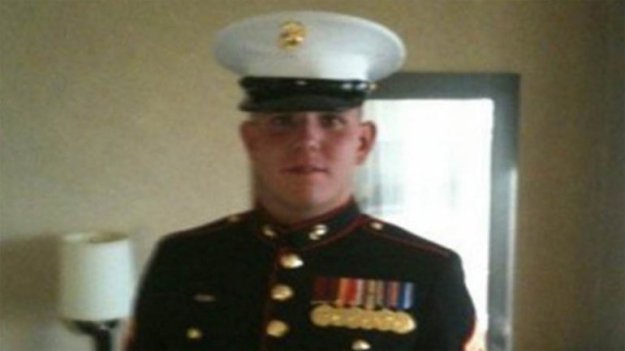
    The USMC just released a photo of SSgt Louis Cardin, KIA Saturday in Iraq. RIP Marine.


    Barbara Starr (CNN) reports, "A U.S. Marine stationed at Firebase Bell was killed by an ISIS Katyusha rocket attack on Saturday. Eight U.S. troops were also wounded in the attack. Three were medivaced to Germany where one is described as having serious injuries a defense official told CNN."  


    Why?

    Why did they die?

    Why did US President Barack Obama send them and others into Iraq?

    To help Iraq?

    He said, before he sent US troops in, that the only answer for Iraq was a political solution.

    But there has been no political solution.

    More to the point, there is no legitimate government.

    Yes, Barack forced Nouri al-Maliki to step down as prime minister before the end of his term.

    Yes, Barack backed Haider al-Abadi to be the new prime minister.

    But we're not talking about that.

    Iraq has no legitimate government.


    This is from Iraq's Constitution:


    Article 54:
    First: The electoral term of the Council of Representatives shall be limited to four calendar years, starting with its first session and ending with the conclusion of the fourth year.

    Second: The new Council of Representatives shall be elected forty-five days before the conclusion of the previous electoral term.


    Do you get it?

    Because the White House really, really hopes you don't.

    Nouri's term should have ended in November of 2014.

    Since Haider replaced Nouri, Haider's term should have ended in November of 2014.

    Haider is no longer a member of Parliament.

    There are legally no members of Parliament* because their four year term expired in November of 2014.


    [*We can argue this all you want but when Tareq al-Hashemi was Vice President from 2005 to 2010 and before he (and anyone else) was named to the posts following the 2010 elections, he was visiting other countries to promote investment and business in Iraq and Nouri objected and insisted that Tareq was not a vice president because his term had expired.  Nouri's understanding/view was not disputed by the press, they treated it as gospel.  So if that was the case then, it's the case now.]


    The current Parliament held their first official session November 11, 2010.  So if we're generous, we can argue their term expired in November 11, 2014.

    It's March 29, 2016.

    There is no legitimate government in Iraq nor any legal one.

    Where are the elections?

    Per the Constitution, they should have taken place over a year ago.

    Where are the elections?

    And how can Barack justify sending US troops into the failed state of Iraq when it doesn't even have a government?


    At the very least, he should have made any troops being sent in, any aid -- weapons or dollars conditional upon free and fair elections.

    Iraq is a failed state.

    The US troops are in Iraq to prop up the illegitimate government of Iraq.

    In what world is this acceptable?

    In the United States, elections are not postponed.

    9/11 did not result in a loss of elections nor, for that matter, did the American Civil War.


    What is Iraq's excuse?


    As we asked in yesterday's snapshot, where are the elections?


    We know where US troops are -- in Iraq with more to be deployed shortly.

    Thomas Gaist (WSWS) observes:


    In 2014, at the outset of the latest US Iraq war, known as “Operation Inherent Resolve,” the Obama administration vowed that the US intervention would be limited to air strikes and a minimal ground role, restricted to small numbers of “advisors” embedded with Iraqi units.
    During the nearly two years of escalating US operations that followed, these promises have been continuously rolled back. A familiar pattern has emerged, whereby the US military chiefs periodically announce, without any suggestion that the civilian administration has been consulted or even informed, their plans for an imminent expansion of the quality and role of US forces in the war.
    Last June, the Pentagon unveiled plans for the indefinite stationing of US ground forces throughout Iraq in a network of “lily pad” bases. In December, Secretary Carter announced the deployment of a Joint Special Operations Command (JSOC) “expeditionary targeting force,” essentially a small army of lavishly funded and equipped commando units specializing in assassination, kidnapping, and other black operations.
    The US moves toward larger ground operations have proceeded beneath a relentless bombing campaign. US-led coalition planes have pummeled Iraq with more than 7,336 strikes since the beginning of the air war in August 2014.
    The American military violence being inflicted upon Iraq in the name of fighting the Islamic State in Iraq and Syria (ISIS) is part of a decades-long assault on the country.


    And the pummeling of Iraq continued today with the US Defense Dept announcing/claiming/boasting:


    Strikes in Iraq

    Attack aircraft conducted four strikes in Iraq, coordinated with and in support of Iraq’s government:

    -- Near Hit, two strikes struck an ISIL bed-down location and an ISIL safe house.

    -- Near Sinjar, a strike destroyed two ISIL assembly areas and suppressed an ISIL machine gun position.

    -- Near Sultan Abdallah, a strike destroyed three ISIL assembly areas.


    Task force officials define a strike as one or more kinetic events that occur in roughly the same geographic location to produce a single, sometimes cumulative, effect. Therefore, officials explained, a single aircraft delivering a single weapon against a lone ISIL vehicle is one strike, but so is multiple aircraft delivering dozens of weapons against buildings, vehicles and weapon systems in a compound, for example, having the cumulative effect of making those targets harder or impossible for ISIL to use. Accordingly, officials said, they do not report the number or type of aircraft employed in a strike, the number of munitions dropped in each strike, or the number of individual munition impact points against a target.


    Turning to other violence, Al Jazeera reports:


    The armed group Islamic State of Iraq and the Levant has claimed responsibility for a suicide bombing in central Baghdad that police said killed seven people and wounded 27.
    The blast occurred on Tuesday near a gathering of workers in Tayaran Square, about a kilometre from a sit-in held by supporters of influential Shia cleric Moqtada al-Sadr to demand political reforms.


    Meanwhile, Moqtada's rally behind Haider position appears to be wavering:


  • While Haider stands in danger of losing support from his fellow Shi'ites, he's done nothing to reach out to the long persecuted Sunni community.


  • One of the many reasons the Sunni youth join the Tyranny of the Rafidah Snakes


  • Iraqi Sunni civilians arrested by Shia militias without guilt or charge


  • Haider has become not just the failed leader of a failed state but the illegitimate leader as well.  When will Iraq hold elections?  When will it follow the country's Constitution?


    Tuesday, March 29, 2016

    60 MINUTES needs to go

    Isaiah's THE WORLD TODAY JUST NUTS "Hillary Responds To Her Weekend Losses" went up Monday night.


    hillaryresponds


    What would a Clinton be without an enemies list?

    You better believe Hillary's keeping track.

    "TV: Truth and the lack of it" (Ava and C.I., THE THIRD ESTATE SUNDAY REVIEW):
    Truth can provoke giggles when it's so long suppressed.

    And if you doubt how much truth is suppressed in the United States, just flip over any Sunday night to CBS' 60 MINUTES -- or, as we like to think of it these days, BIG LITTLE SHOTS.

    Or, better yet, PUT 'EM OUT TO PASTURE ALREADY.

    Once upon a time, the program did investigative reporting.

    These days it's all p.r.

    That was made clear by Sunday's big story: Gossip columnist Charlie Rose dishes with rich people about the money they give away and how great they are.

    This was an 'update' to an earlier fawning.

    We should clarify, an earlier fawning on 60 MINUTES.

    Equally true is that Rose has repeatedly used THE CHARLIE ROSE SHOW to promote Bill and Melinda Gates and Warren Buffett.

    The update was about as 'in depth' as anything else Rose has done on the topic: gossip, jokes and a bunch of distraction.


    The Giving Pledge, it should be noted, is not binding.

    Anyone can sign it but they're not bound by it.

    It should be noted by us . . . because it wasn't by Charlie Rose.


    Not much was noted by Rose.

    At one point, a testimonial was offered about how Bill and Melinda were eradicating polio.

    No proof of this was offered but, more to the point, claims of polio eradication are nothing new.


    For example, polio was eradicated in China in 2000 . . . until it returned in 2011.


    Charlie Rose is an embarrassment.

    He fawns over the rich like a suck up.

    It really is time for 60 MINUTES to be cancelled.  The show is nothing but fluff and embarrassment these days.

    "Iraq snapshot" (THE COMMON ILLS):
    Monday, March 28, 2016.  Chaos and violence continue, Haider al-Abadi's given until Thursday to alter his Cabinet, US State Dept spokesperson John Kirby's spin gets a push back, where the hell are Iraq's national elections (now two years overdue), and much more.


    Today, the US military continued bombing Iraq -- an action that has taken place daily ever since August 2014.  The US Defense Dept announced/bragged:


    Strikes in Iraq
    Attack and fighter aircraft conducted 10 strikes in Iraq, coordinated with and in support of Iraq’s government:

    -- Near Mosul, four strikes struck an ISIL security headquarters and an ISIL tactical unit, destroyed an ISIL assembly area and suppressed an ISIL mortar position and an ISIL tactical unit.

    -- Near Qayyarah, three strikes struck two separate ISIL tactical units; destroyed four ISIL mortar positions, an ISIL machine gun and an ISIL supply cache; and suppressed an ISIL mortar position.

    -- Near Sinjar, a strike struck an ISIL tactical unit and destroyed an ISIL heavy machine gun position.

    -- Near Sultan Abdallah, two strikes struck an ISIL tactical unit and destroyed five ISIL fighting positions and an ISIL assembly area.


    Task force officials define a strike as one or more kinetic events that occur in roughly the same geographic location to produce a single, sometimes cumulative, effect. Therefore, officials explained, a single aircraft delivering a single weapon against a lone ISIL vehicle is one strike, but so is multiple aircraft delivering dozens of weapons against buildings, vehicles and weapon systems in a compound, for example, having the cumulative effect of making those targets harder or impossible for ISIL to use. Accordingly, officials said, they do not report the number or type of aircraft employed in a strike, the number of munitions dropped in each strike, or the number of individual munition impact points against a target.


    While the bombing has become a daily feature, at the US State Dept today, something different emerged.  In the midst of spokesperson John Kirby's daily nonsense, a participant refused to play along.


    QUESTION: Yes. The Iraqi prime minister, Mr. Al-Abadi, has been pushing ahead for reform in its government, and he claims to reshuffle his own cabinet. I was curious about your position on these claims about Abadi has been trying to accomplish.


    MR KIRBY: What you call claims I think are, in fact – you almost – it makes it sounds like he’s doing something wrong here. Prime Minister Abadi is --


    QUESTION: (Inaudible.)


    MR KIRBY: Prime Minister Abadi is trying to make necessary political reforms in his country and he has moved some officials around, and that’s the obligation, that’s the responsibility; those are the choices that a prime minister has to make. We continue to support his efforts to improve governance in Iraq and to enact appropriate reforms to try to facilitate that process.


    QUESTION: But bringing what he calls technocrats into his cabinet at this moment would definitely make a lot of people angry because he is going to exclude a lot of party appointed into his government. How would you react to that?


    MR KIRBY: Again, these are decisions that he has to make and his government has to make and the Iraqi people have to make, and those are internal decisions that we aren’t going to involve ourselves in each individual appointment that he makes. These are internal matters for Iraq to speak to and for him to speak to. In general, we support his efforts at reform and we support his efforts at trying to get a government in place – and keep a government in place – that can be responsive to the needs of the Iraqi people and can help them deal with the very real threat inside their own country represented by [the Islamic State].


    QUESTION: So wait, wait. So this – the position of the U.S. is that you’re not going to interfere in the president – or the leader of a country, his choices for cabinet, but you will interfere in who the – or you will choose who should be the leader of the country, but once your selected person is in power, they can have whoever they want in the cabinet? Is that basically what --


    MR KIRBY: Well, it was the Iraqi people that --


    QUESTION: After you guys --


    MR KIRBY: -- put Prime Minister Abadi in the position he’s in.


    QUESTION: After the U.S. pulled the rug out from under --

    MR KIRBY: We’re not – we don’t involve ourselves in the internal decisions of an electorate like that.

    QUESTION: Except in Syria.

    QUESTION: (Off-mike.)

    QUESTION: And --

    MR KIRBY: No.

    QUESTION: No?

    MR KIRBY: How is that – I’m not sure I follow how we’re doing that in Syria.

    Yeah.


    John Kirby's not just an embarrassment, he's a damn liar.

    In 2010, following the March elections and an eight month political stalemate, the US government gave Nouri al-Maliki a second term (even though he lost the 2010 election) via The Erbil Agreement.

    In 2014, the US appointed/backed Haider al-Abadi to replace Nouri.


    Reality: the Iraqi people did not vote on Haider.

    Bigger reality:  Iraq is over two years later on national elections.

    Is no one ever supposed to notice that?

    John Kirby's lie brings attention to that reality.

    Where are the national elections which should have taken place already?

    Where are they, John Kirby?

    More reality, what Haider's trying to do with the Cabinet?  It's not in the Constitution.

    Strange how Kirby and company back the Constitution -- except when they don't.

    Any observer of Iraq needs to be asking: Where are the national elections.

    Every member of Parliament?

    Their term has expired.

    They were elected in the 2010 elections.

    Where are the national elections?


    REUTERS notes:


     Iraq’s parliament on Monday gave prime minister Haider Al Abadi three days to present a new non-party cabinet to fight corruption or risk a no-confidence vote.
    A flash on state television called Thursday the “final deadline" for Mr Al Abadi, who said more than six weeks ago that he would replace ministers with technocrats unaffiliated with political parties.
    But other politicians, including some within his own party, have pushed back against a reshuffle, fearing it could weaken the political patronage networks that have sustained their wealth and influence for more than a decade.


    Muayed al-Tarifi (ANADOLU AGENCY) adds:


    "Thursday will be the final deadline for [al-Abadi] to present his new cabinet," MP Rahim al-Draji told Anadolu Agency.
    He said parliament would hold a confidence vote on Saturday if al-Abadi failed to present his government lineup by Thursday.


    Why is the State Dept not demanding elections?

    Why is the White House not insisting upon them?

    They are now two years overdue.

    The US government isn't interested in Iraq following its Constitution, they're just interested in bullying the country around.

    And their puppet Haider al-Abadi?

    Even if he wants to do this by Thursday, there's little chance he'll be able to.

    Following elections, putting together the Cabinet has been problematic.

    Even doing it partially has required weeks and weeks.


     Meanwhile, Kareem Raheem and Stephen Kalin (REUTERS) report,  "Powerful Iraqi Shi'ite Muslim leader Moqtada al-Sadr entered Baghdad's Green Zone, the heavily-fortified center of the capital housing government buildings and embassies, on Sunday to keep up pressure on the government to enact reforms."
    With a series of self-serving statements, Moqtada announced he would rally in the Green Zone while his supporters rallied outside.
    How brave.
    Within the safety of the Green Zone.


    XINHUA notes:


    "Our project is to reform, we will not give it up, and I will enter the Green Zone by myself and will sit-in inside the Green Zone and represent the Iraqi people, and you (his followers) keep your sit-in at the gates. None of you move," Shiite cleric Moqtada al-Sadr told hundreds of his followers before walking across the security checkpoint near the parliament building inside the government district. 


    All by himself?


    Except for his brigade of bodyguards.

    Moqtada's been desperate for days now to get some publicity.
    His rallies have been covered less and less -- even by Iraqi media.

    None of it really worked and, by Friday evening, really only NINA was reporting on him and his rally.


    Entering the Green Zone changed that.  He is said to have met with Iraq's Prime Minister Haider al-Abadi and ALSUMARIA reports that Saleh al-Mutlaq joined Moqtada in the tent he's set up inside the Green Zone.
    While he gets a flurry of attention (please note, Mariah Carey cancelling Brussels concert is a much bigger topic on Arabic media currently), the western media ignores Falluja.


    NINA reports that Arshad al-Salhi, head of Parliament's Human Rights Committee, states "that thousands of families in the besieged district of Fallujah die of hunger and pain caused by lack of food and water availability, calling on the government to assume its responsibilities in securing the requirements of insulated people."  ALSUMARIA notes that Iraqiya head Ayad Allawi is also noting the dire conditions in Falluja and calling for the Iraqi government and the United Nations to provide assistance.
    Felicity Arbuthnot (DISSIDENT VOICE) notes:

    In Fallujah, besieged by militias and according to another contact: “ … bombed since  January 1, 2014 by the government (armed by the USA and with US military advisers this whole time) and since August 2014 by the US Coalition”, the people are starving: “ On March 17th a husband threw himself his wife with their three children in to the river (Euphrates) from a bridge and drowned. They were desperate from hunger …” And the bodies of: “Nearly four thousand killed civilians have been taken to the hospital since January 2014.”


    In other problems for the country, Daniel J. Graeber (UPI) reports:

    The World Bank, meanwhile, said Iraq "needs to put its economic house in order" by reforming state-owned enterprises, enacting more even distribution of oil revenues and addressing chronic shortages of electricity.
    "Through demonstrating a commitment to such real changes, we hope Iraq can find the support it seeks to relieve its immense fiscal pressures in the light of significantly reduced oil prices," World Bank President Jim Yong Kim said.


    And that's why you don't take money from the World Bank or the IMF.  They loan it.

    And then they make demands.

    It's never handed out freely.

    And Iraq never needed the loans.

    Corrupt leaders have stolen billions from the country since 2003.


    And the problems never end for Iraq.  Jamal Hashim (XINHUA) reports:


    A potential catastrophe set forth by the condition of the Mosul dam, Iraq's largest dam, raised alarms as the rainy season approaches.
    The collapse of the Mosul dam could unleash a flood that may kill hundreds of thousands of people and trigger an environmental disaster, experts warned.

    It is 113 meters high and 3.4 km long and is located 50 km north of Iraq's second largest city of Mosul, the capital of the province of Nineveh in northern Iraq.


    Now let's move over to VOGUE and Julia Felsenthal's latest review:

    There’s a particularly wrenching moment early in Only the Dead See the End of War, the gripping, graphic new documentary about the Iraq war airing tonight on HBO. The Australian conflict journalist Michael Ware is filming the aftermath of a 2003 suicide bombing of the Jordanian embassy in Baghdad. Iraqi first responders dig through rubble, pulling out maimed and dead bodies. One man notices Ware. He puts his hand in front of the journalist’s lens. “Why do you film the dead?” he asks angrily.
    Ware doesn’t reply, nor does he lower his camera. More than a decade later, this documentary seems to offer an answer.


    Phil Zabriskie (TIME magazine) also weighs in:

    Only the Dead shows that while Ware may have escaped his time in Iraq with his life, his mind and soul were badly scarred. “I became a man I never thought I’d be,” he intones at one point. The most uncomfortable example of this comes when Ware films a dying man who’d been shot by American troops, doing nothing to intervene or remind the soldiers that the laws of war require them to provide medical assistance to wounded enemy combatants. The most poignant example comes when Joe Walker, a young Marine 2nd Lieutenant, shows Ware and photographer Yuri Kozyrev around Observation Point Hotel, a crumbling shell of a building in Ramadi that was taking fire every single day. Walker openly wrestles with the impact the experience is having. “I try my best to keep the big picture in mind,” he says. “When I got guys getting shot, getting killed, you start getting tunnel vision. You start hating this place. You start hating everybody here.”
    Ware’s camera catches a dazed, baleful expression across the Marine’s face. “I could see good men here losing their grip, losing themselves,” Ware narrates. He knows whereof he speaks, because the same thing, of course, was happening to him.


    No surprise, SALON and their critic Sonia Saraiya are lost.

    Saraiya expects every movie to tell her exactly what to think.

    Feeling clearly scares her as much as independent thought.


    By contrast, Hannah Block (NPR) concludes:


    Only the Dead is as much a reflection on the choices journalists make, and at what cost, as it is on the nature of war. We see Ware's face grow haggard and haunted as the film progresses. "I became a man I never thought I'd be," he says. In making this film, he's taken a brave look at himself as much as he has at the war that consumed him for so long.


    Earlier tonight, Isaiah's THE WORLD TODAY JUST NUTS "Hillary Responds To Her Weekend Losses" went up.  It notes that, over the weekend, Hillary lost Washington, Alaska and Hawaii to Senator Bernie Sanders in their battle to win the Democratic Party's presidential nomination.


    And it's not just those three Hillary's lost.  From the opening of Ava and my latest TV critique:


    "We've just won six out of the last seven contests," Senator Bernie Sanders told Jonathan Karl this morning on ABC's THIS WEEK about his repeatedly defeating Hillary Clinton in Democratic primaries and caucuses. "We have the momentum."


    On the topic of Hillary, we'll close with this:


  • . I didn't like her tone when she smirked at her "mistake" of sending 1000s of troops to their death in !


  • Sunday, March 27, 2016

    SHADES OF BLUE

    Thursday's episode of NBC's SHADES OF BLUE dealt with the aftermath of the robbery.

    The big news?

    Woz clearly was betrayed by Donnie.

    Donnie's nephew died.

    Or 'nephew.'

    The bartender at the strip joint blew the whistle to the feds.  When told they were nephew and uncle, she said she hoped not, she walked in on them blowing each other once.

    Tess survived the shooting.

    But where is the money?

    Woz and Harley had it and their car was hit.

    Secretly, Harley has it.  That was part of her plan.

    Now she's trying to leverage her way with the FBI which wants to rip up the immunity agreement because the robbery went sideways.

    Next week, Woz finds out something big as the series wraps up season one.


    "Iraq snapshot" (THE COMMON ILLS):
    Saturday, March 26, 2016.  Chaos and violence continue, the Islamic State launches more attacks in Iraq, more US troops will be heading to Iraq, UN Secretary-General Ban Ki-moon visits the country, and much more.


    AP reports that the death toll has now climbed to 41 with at least one hundred and five more people left injured from a Friday bombing in Iraq.  AL JAZEERA reports:

    Mobile phone footage widely shared by Iraqis on social media showed players in football kits gathering to collect trophies and footballs as at least one child stood nearby.
    One man throws a new football to the crowd, before the camera shakes violently and the footage ends, at what witnesses said was the moment a bomber in the crowd detonated an explosives belt.

    NATIONAL IRAQI NEWS AGENCY explains that a bomber blew himself up on the field of a soccer stadium in  Iskanderiyah. Abbas al-Ani (AFP) notes, "The mayor, Ahmed Shaker, was among the dead, as was one of his bodyguards and at least five members of the security forces."  BBC News reports that burying of the dead began today and "Many of the dead were young boys who were in a trophy ceremony hit by the bomber, himself said to be a teenager."  Michael D. Regan (THE NEWSHOUR, PBS) notes that the Islamic State has claimed they orchestrated the attack.


    The attack was condemned by the United Nations via Jan Kubis but more talk on Arabic social media revolved around Kubis' inability to find a suit that fits his body than focused on his words regarding "evil doers."

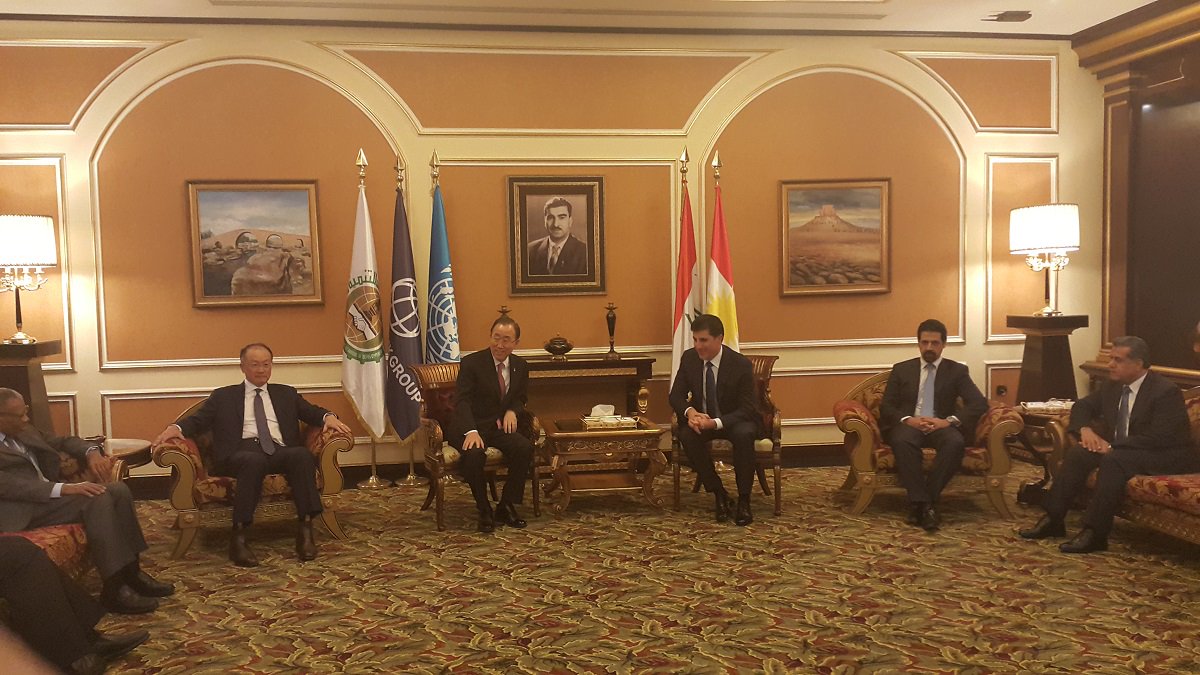
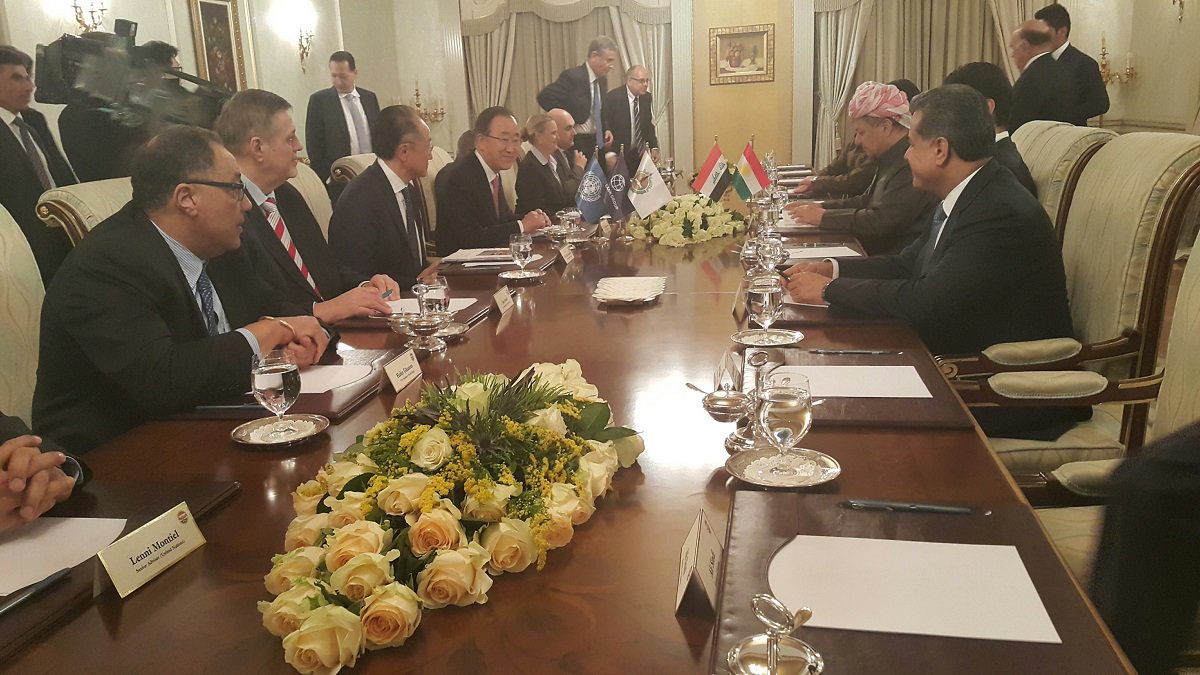
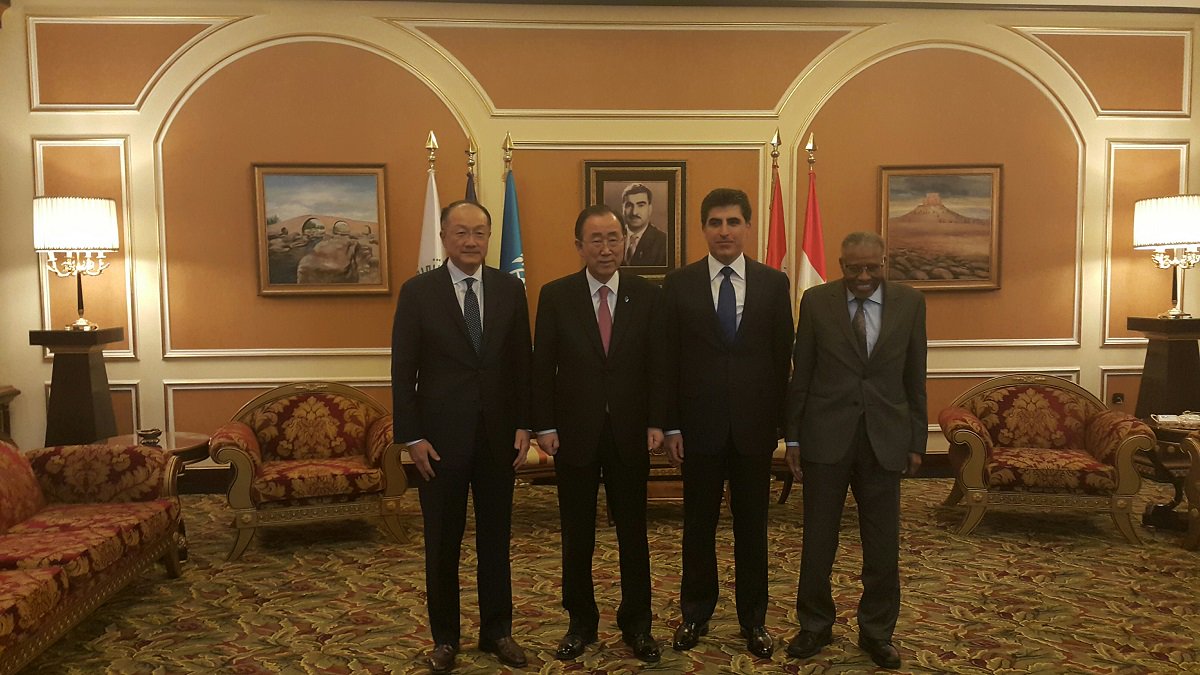
    The United Nations Secretary-General Ban Ki-Moon is in Iraq today and has met with KRG President Massoud Barzani.


    : Ban Ki-moon, WB, IDB Presidents in ,meet President Masoud Barzani, PM Nechirvan Barzani


    The visit was part of an economic effort -- for Iraq or for those who prey on Iraq? not yet clear -- which also featured Jim Yong Kim, president of the World Bank.  The two held a press briefing with Haider al-Abadi, prime minister of Iraq, and Ahmed Mohamed Ali al-Madani, president of the Islamic Development Bank.


    Saif Hameed (REUTERS) reports the UN Secretary-General again stressed the need for national reconciliation in Iraq.  This go round, he attempted to tie it in with the efforts to defeat the Islamic State but talk, without pressure or incentive, is just talk.


    Some of today's violence?

    AL JAZEERA reports that the Islamic State sent 10 suicide bombers to attack Ein el-Assad base today resulting in 8 of the bombers being killed by Iraqi forces, 2 of the bombers blowing themselves up and "at least 18 soldiers" being killed.  GULF NEWS explains, "Al Assad airbase, located about 180 kilometres northwest of Baghdad in Anbar province, is one of the largest military installations in the country."


    Meanwhile,  "The secretary and I both believe that there will be an increase to the U.S. forces in Iraq in the coming weeks."


    This announcement was made by Gen Joseph Dunford at the press briefing he and Secretary of Defense Ash Cater held on Friday.


    Q: The Marines this week in their support of the Iraqi offensive operation, is this something we will see more of, do you think, as time goes on in the fight to get to Mosul? And is -- can you talk about the accelerants that the secretary has talked about before and whether this is a key part of what you want to see the military do more of in Iraq over the next several months?


    GEN. DUNFORD: I mean, Lita, we've talked I guess now for some months about setting the conditions for success in Mosul and -- and facilitating the Iraqi forces and staging around Mosul to begin to isolate Mosul, and as the Iraqis have announced, that has begun. These Marines that were there, the artillery battery that were there were in direct support of that. We put the -- we put the battery there to support the Americans that are there advising the Iraqi forces and also in a position to provide support to the Iraqi forces.

    And from my perspective, this is no different than aviation fires we've been delivering. This happens to be surface fires -- (inaudible) -- artillery. But certainly no different conceptually than the fire support we've been providing to the Iraqis all along.

    And with regard to further accelerants, the secretary and I do expect that there'll be increased capabilities provided to the Iraqis to set the conditions for their operations in Mosul. Those decisions haven't been made yet, but we certainly -- we certainly do expect more of the kinds of things that we saw in Ramadi, albeit a bit different tailored for operations in Mosul. But it's -- but again, the primary force fighting in Mosul will be Iraqi security forces and we'll be in a position to provide advise, assist and enabling capabilities to make them successful.

    Q: It appears to be part of a -- more of a ground combat role than we've seen before.

    GEN. DUNFORD: No, it's not. I mean, we have -- we have -- we have surface fires in Al Asad and other places, as an example, and we've used those in the past. And so this is not a fundamental shift in our approach to supporting the Iraqi forces. This happens to be what was the most appropriate tool that the commander assessed needed to be in that particular location.

    [. . .]
    Q: But General Dunford, we've just heard this week that there are actually 5,000 U.S. troops on the ground in Iraq. Why is the Pentagon and senior military leadership reluctant to say that it's more than 3,800?

    GEN. DUNFORD: We're not reluctant, Jennifer. What we track is the number that are in our force management level. That's 3,800. But this is nothing that's inconsistent with what's been going on for the last 15 years in terms of people that are in and out on temporary duty less than a certain period of time, people that are in direct support of the embassy. Those have -- those have not been counted. In other words, there's a consistency in the way we've been counting people that's been going on for the last 15 years.

    And at any given time, we have 3,800 directly in support of the mission. When units rotate, for example, we don't double-count those numbers, so if there's a unit of 200 that's being replaced by a unit of 200 and they both happen to be on the ground at the same time, we don't count that as 400, we haven't in the past 15 years, because that hasn't -- that hasn't counted against our force management level.

    So the accounting of our people has been consistent. We're not denying that there's more people than 3,800; I think you got the numbers from us. But in terms of what we count in the mission, and that's in accordance with the direction that we've been given, the 3,800 is what's against the mission.

    SEC. CARTER: Jim.

    Q: (Off-mic.)

    GEN. DUNFORD: No, I didn't say 5,000 was accurate, I said 3,800 was the force management level and there's some number above that on any given day as a result of people that support the embassy, people at a TDY and people in other categories that don't count against that 3,800.

    SEC. CARTER: Jim?

    Q: I'd like to follow up, if I could, on Lita's questions about the Marines and that fire base. Unlike the previous U.S. military combat positions and fire support, this is an independent base, these are U.S. military only. And by all indications, they are not just defensive, but in this latest movement by Iraqi forces, they provided fire support for offensive operations against ISIS. So why is this not the first footprint of a U.S. combat ground operation there in Iraq?

    GEN. DUNFORD: Jim, the reason they're in a different base is simply a function of geometry. They're designed to support forces in an area called Makhmur. The artillery can't be co-located with the ground forces in Makhmur and provide effective fire support, so this position was selected because of the geometry necessary to support that particular location.

    And with regard to providing support to Iraqi offensive capability, once again, I mean, to me, there's no inconsistency between what this artillery unit did and what our aviation support is doing every single day. I don't draw a distinction with it. In other words, we've said that we're providing enabling support to include combined arms capability to Iraqi forces as they conduct operations, which is exactly what this artillery unit was doing.

    Q: Well, we have all indications that this is a pretty permanent position right now; that after a short period of time, U.S. Army personnel are going to replace the 26 MEU Marine there. And it still has all indications that the U.S. military is directly involved in the ground operations of -- with the U.S. -- with the Iraqi.

    SEC. CARTER: Yes, maybe very quickly just say, even since last week now, as the Iraqis have started to consolidate their positions, the situation on the ground has changed in terms of where the Iraqis are in the relationship to the support, the defense of support they're providing to our artillery unit that's there. So that's already changed, you know, through the course of the week.

    But in all honesty, I just cannot see this being inconsistent with everything that we've been doing over the last several months.

    SEC. CARTER: And let me just add to that, what we'll be doing in coming months. This is our approach to eliminating ISIL from Mosul. The Iraqi Security Forces are the ones who are carrying out the assault, the envelopment, the assault, but we're helping them.

    That's our -- that's been our approach and we'll continue to do that. Started in Ramadi, we'll continue to going up to Mosul. Carla?

    Q: When do you anticipate seeing U.S. American ground forces closer to the front lines as the battle towards Mosul looms?

    GEN. DUNFORD: Jim, one thing that I probably just need to clarify, this position is behind what is known as the forward line of troops for the peshmerga and Kurds. So it's by no means out in front on its own.

    And secondly, what I would say about your question about the future is we have a series of recommendations that we will be discussing with the president in the coming weeks to further enable our support for the Iraqi security forces.

    So again, the secretary and I both believe that there will be an increase to the U.S. forces in Iraq in the coming weeks. But that decision hasn't been made.

    Nor -- you know, you alluded to decisions that have already been made about Army units replacing the Marine units. All that is pre-decision. There's been no decisions made about what's going to happen to this particular position in the future.

    But it is going to be decided in the context of the broader issue that the secretary will bring to the president again, focused on what it is we need to do to maintain a minimum money campaign and what specifically do we need to do to enable operations in Mosul.


     "The secretary and I both believe that there will be an increase to the U.S. forces in Iraq in the coming weeks."


    So much for Barack Obama's promise of no boots on the ground and of no US troops in combat.

    Like every other promise, it was just another lie.


    The last time I saw Richard was Detroit in '68
    And he told me all romantics meet the same fate someday
    Cynical and drunk and boring someone in some dark café
    You laugh he said you think you're immune
    Go look at your eyes they're full of moon
    You like roses and kisses and pretty men to tell you
    All those pretty lies pretty lies
    When you gonna realize they're only pretty lies
    Only pretty lies just pretty lies

    -- "The Last Time I Saw Richard," written by Joni Mitchell, first appears on BLUE


    Lies and more lies from Barack.


    And lies have consequences.


    On the 13th anniversary of the start of the Iraq War, March, 19, 2016, another US service member died in Iraq.


    Dropping back to Tuesday's snapshot:

    Barbara Starr (CNN) reports, "A U.S. Marine stationed at Firebase Bell was killed by an ISIS Katyusha rocket attack on Saturday. Eight U.S. troops were also wounded in the attack. Three were medivaced to Germany where one is described as having serious injuries a defense official told CNN."  Spencer Ackerman (GUARDIAN) notes of the attack:

    The US marine who was killed in a rocket attack on Saturday died at the first exclusively American base established in Iraq since the Pentagon returned forces to the country in 2014, a spokesman said on Monday.
    The base, whose existence had not previously been public, has come under fire from ever closer range over recent days, an indication that Isis knew about the outpost before the Pentagon announced its creation.


    Dan Lamothe (WASHINGTON POST) offers a photo essay on the new base.


    Barack's sending US troops into Iraq again.

    And this as Iraqi soldiers are still deserting.  Wladimir van Wilgenburg (DAILY BEAST) reports:

    At first, Iraqi soldiers involved in an operation to capture villages close to Mosul on Friday were in good spirits. “Allah Akbar,” Arabic for “God is Great,” they shouted after they hit an alleged Islamic State (ISIS) suicide bomber with US-provided mortars. But just one hour later many of them fled, fearing ISIS would strike back.
    Early in the day, there were already signs of trouble. A sergeant named Hussein from the artillery battalion told The Daily Beast, “There has been some delays in what we expected, but it’s mostly because of their heavy use of sniper fire and of IEDS. We have not been really advancing today, but that is not part of our plan as of yet, but in coming hours, we are planning to move forward.”
    [. . .]

     When their artillery struck something that created a huge explosion inside Nasr, Jibouri and his men shouted with joy. They thought maybe they’d hit an ISIS suicide bomber. General Jibouri looked with his binoculars over the trench to see the result of the artillery, and it seemed he already thought he achieved victory over ISIS militants in the village. 
    Yet one hour later, his men were not so joyful, when most soldiers ran in panic, fleeing in their Humvees, fearing ISIS mortar attacks. Just a few of his men, including the artillery officers, stood their ground.
    This seems to be exactly the biggest problem for the Iraqi army: the lack of morale. One week ago Iraqi soldiers abandoned their base, which forced the United States to send in more Marines in support, and one of them was killed. Again this time, Iraqi army soldiers almost completely deserted their positions, fearing an ISIS response to their artillery when,  in reality, not one mortar shell or bullet hit close to their positions.


    Patrick Cockbun (INDEPENDENT) attempts to address what's going on:


    Without any pubic admission or even telling the families of the US soldiers involved, they sent 200 Marines from the Marine Expeditionary Unit with four artillery units to the by now largely abandoned base. Their arrival was wholly contrary to the impression the Pentagon had previously given that US soldiers in Iraq are limited in number and not engaged in front line combat duties. Though the Marines were within rocket range of Isis ten miles away, they were not added to the official US roster of 3,870 troops in Iraq because they were supposedly there on a temporary assignment.
    The US public may not have known that their soldiers were back in Iraq defending a fire base, but Isis certainly had observed the arrival of the Marines and the artillery. They began firing rockets at the base, one of which hit a bunker on 19 March, killing Master Sergeant Louis Cardin, a 27-year-old Marine from California, and injuring eight other Marines, three of them seriously. Two days later they made a ground attack in which two Isis fighters were killed.  At this point, the Pentagon was forced to become more open about where Sergeant Cardin had been when he died and admit that Marines were not just acting in support of the Iraqi Army and Peshmerga.

    The purpose of sending the Marine unit into such as dangerous place was to revive the morale of the 15th Division and to some extent this was successful. 


    Attempts?

    Where's the subject, where's the noun?

    He writes an overly long article but never names Barack Obama, the president of the United States.  Instead, things just happen, "they" do things.

    As opposed to Barack Obama sending "200 Marines" on the mission.


    Today, the US Defense Dept announced/bragged/boasted/claimed:


    Strikes in Iraq
    Using rocket artillery along with ground-attack, attack, fighter, and remotely piloted aircraft, coalition forces conducted 22 strikes in Iraq, coordinated with and in support of the Iraqi government:
    -- Near Fallujah, two strikes struck two separate ISIL tactical units.
    -- Near Hit, five strikes struck an ISIL improvised weapons factory, an ISIL communications facility, an ISIL weapons storage facility and two separate ISIL tactical units and destroyed two ISIL vehicles and an ISIL fighting position.
    -- Near Kisik, two strikes destroyed an ISIL artillery piece and suppressed an ISIL fighting position and an ISIL mortar position.
    -- Near Mosul, four strikes struck two separate ISIL tactical units, suppressed two ISIL mortar positions, and destroyed two ISIL supply caches and three ISIL assembly areas.
    -- Near Qayyarah, six strikes struck four separate ISIL tactical units, suppressed an ISIL mortar position, and destroyed three ISIL mortar positions, an ISIL artillery piece, an ISIL supply cache, an ISIL vehicle, and five ISIL assembly areas.
    -- Near Sinjar, a strike struck an ISIL tactical unit and destroyed an ISIL heavy machine gun position and an ISIL assembly area.
    -- Near Sultan Abdallah, two strikes struck two separate ISIL tactical units, destroyed an ISIL fighting position and denied ISIL access to terrain.

    Task force officials define a strike as one or more kinetic events that occur in roughly the same geographic location to produce a single, sometimes cumulative, effect. Therefore, officials explained, a single aircraft delivering a single weapon against a lone ISIL vehicle is a strike, but so is multiple aircraft delivering dozens of weapons against buildings, vehicles and weapon systems in a compound, for example, having the cumulative effect of making those targets harder or impossible for ISIL to use. Accordingly, officials said, they do not report the number or type of aircraft employed in a strike, the number of munitions dropped in each strike, or the number of individual munition impact points against a target.


    On the topic of US-led coalition bombings, we'll note this:


  • Reports confirm that about 30 Iraqi soldiers were hit mistakenly by US led coalition airstrike near Mosul.