Wednesday, May 25, 2011

Cindy and Libby

Casey Sheehan's birthday is approaching (May 29th) and Cindy Sheehan reflects at Cindy Sheehan's Soapbox:

One of the hardest things to do as a mother is to let your children grow up and make their own mistakes. Human beings usually don’t learn from the errors of others, but have to make their own. On Casey’s 21st birthday, he made a huge mistake: he joined Uncle Sam’s Army and 55 days before his 25th birthday, he was killed in Iraq in one of The Empire's Wars for Profit, Iraq.
Casey would be 32 on May 29th and it’s so hard to believe that his original birthday was 32 years ago! I can remember it like it was yesterday, but I can also remember his death day so vividly my heart hurts and my throat clenches up just to think about it. Tears are pouring down my cheeks and snot is flowing out of my nose as I write this. Burying a child is far more painful than giving birth to one (even with no pain medication).
For Casey’s birthday this year, I will be fasting in solidarity with Cindy Hickey and Laura Fattal, who are the mothers of Shane Bauer and Josh Fattal who were arrested by the Iranian government on July 31st in 2009 while they were hiking on the border of Iraq and Iran.

At Corrente, Libby Liberal has an interesting post.

She's talking about the costs Oprah must carry for selling Barack. While I agree with that aspect, I am also aware (though Libby leaves it out so she may not be) that Oprah also humanized Bush. She had him on her show in the lead up to the 2000 election and she found him funny and charming. There was even the famous photo-op from the show of Bush kissing her.

If you've forgotten that kiss, you can click here and here. The first link, CBS, tells you (in the photo caption) that the photo is from September 19, 2000.


"Iraq snapshot" (The Common Ills):

Wednesday, May 25, 2011. Chaos and violence continue, US Secretary of Defense Robert Gates states in a speech that he wants the US military to remain in Iraq, the US and Iraq are supposedly in secret talks to extend the SOFA, US House Rep Brad Sherman speaks out on the issues facing the country and the press (outlets, not reporters) ignores it and more,
US House Rep Lynn Woolsey writes a column for The Hill noting that the 60 day requirement of the 1973 War Powers Act requiring the president to receive a mandate from Congress to continue any unauthorized conflict which continues past 60 days has been ignored by the White House and that the House is debating altering the Constitutional -- as well as spitting on the founding fathers' intent -- in order to shirk their responsibility under the law to be the only body in the federal government who can delcare law. Woolsey notes:
I've had enough over the last decade of this state of permanent warfare. I have five grandchildren and not one of them knows what it's like to live in a country that's not at war with someone and killing someone else's grandchildren.
It's time to put the brakes on. It's time for Congress to draw some clear lines, and Libya is the perfect place to do so. That's why I am supporting Rep. John Conyers' (D-Mich.) amendment to the defense authorization bill specifically prohibiting the deployment of ground troops in Libya.
We cannot afford any further expansion of this engagement. We owe it to the American people who are footing the bill – and of course to our servicemen and women who are already fighting on two fronts – to keep this mission from mushrooming into a full-blown ground war and military occupation.
There were two major hearings today -- one in the Senate, one in the House. I'd planned on noting the Senate one today but we'll try to fit it in tomorrow's snapshot and, hopefully, touch on a number of veterans issues then. Instead we'll focus on the House hearing addressing issues Rep Woolsey noted in her column (to be clear, Woolsey is addressing HR 1540 and that legislation was not addressed in the hearing, the hearing was about war powers). The Constitution is explicit on who has the power to declare war: the Congress. Article One, Section Eight of the Constitution: "Congress shall have the power . . . To declare War, grant Letters of Marque and Reprisal, and make Rules concerning Caputres on Land and Water; To raise and support Armies, bot no Appropriation of Money to that Use shall be for a longer Term than two Years; To provide and maintain a Navy; To Make Rules for the Government and Regulation of the land and naval Forces; To provide for calling forth the Militia to execute the Laws of the Union, suppress Insurrections and repel Invasions . . ."
This morning the House Foreign Affairs Committee held a hearing where the witnesses were all US House Representatives who had proposed legislation regarding war. The witnesses were US House Rep Justin Amash, US House Rep Christopher Gibson and US House Rep Thomas Rooney -- all three are Republicans. As is the Chair of the Committee, Ileana Ros-Lehtinen. Democrat Howard Berman is the Ranking Member on the Committee. I missed opening statements -- and am told Ros-Lehtinen had an ab-lib joke about Rooney (both are from Florida) -- so this is from the Chair and the Ranking Member's prepared opening remarks (which may differ from how they were delivered).
Chair Illean Ros-Lehtinen: We meet today as part of our continuing oversight of the United States involvement in Libya, to hear from our non-Committee colleagues who have introduced legislation on War Powers and on authorities relating to the use of force to address the situation in Libya. The Committee will continue our efforts tomorrow morning at the House-wide Members briefing with legal experts. That briefing had to be rescheduled from May 12th, due to House floor votes. [. . .] The Administration has claimed that Congressional approval was not constitutionally required, and that the use of force in Libya was Constitutional because the President "could reasonably determine that such use of force was in the national interest" -- an extremely broad claim of war-making power. Even some who regard the President's actions as legal are concerned that the endorsement by the Arab League, the United Nations, and NATO seem to figure more prominently in his stated justifications than do clearly identified U.S. national security interests. [. . .] Mr. Rooney's resolution (H.Con.Res. 32) expresses the Sense of Congress that the President should obtain statutory authorization for the use of force pursuant to the War Powers Resolution. The bill introduced by Mr. Amash (H.R. 1212) would cut off funding for the use of force in Libya until it is authorized by Congress. And Mr. Gibson's bill (H.R. 1609) would revise the text of the War Powers Resolution replacing its current Congressional procedures with a shorter provision tied more directly to Congress's power of the purse."
US House Rep Howard Berman was apparently elected in order to serve Barack Obama because nothing in his minimizing and justifying statements acknowledged Berman had sworn an oath to the Constitution or that he is elected from a very small district that does not include Barack Obama as an inhabitant.
Ranking Member Howard Berman: I believe the efforts to either terminate funding for this effort or force an immediate withdrawal of forces would reverse, to disastrous effect, the very meaningful progress already made in Libya. It's time to end this stalemate, decisively. And that cannot be done by stopping now. I'd like to give the President limited time to pursue this mission. [. . .] Underlying this debate is a central legal question: the War Powers Resolution acknowledges the President may introduce forces into hostilities -- unilaterally -- for a period of up to 60 days. This may not be what the Constitution originally envisioned or consistent with a strict reading of congressional authority, but it quite clearly what Congress in 1973 presumed.
Berman went on to insist that "we can't argue theory here" -- as if the Constitution is mere theory? As if laws are mere theory? Let's see someone accused of murder explain, in a court of law, that the laws broken are "mere theory." US House Rep Donald Manzullo noted that "boots on the ground" weren't the test and that drones are assistance -- that a day after US Secretary of State Hillary Clinton noted that the US would not supply Libya's so-called 'rebels' with weapons, Barack announced that the US would be using drones to attack Libya. Manzullo was very clear that drones are assistance and are participation. Via a friend's note (reporter), I'll note Democrat Brad Sherman's remarks in full (again, these are not my notes and I have no hard copy of Sherman's prepared remarks) because he refused to play partisan politics and stuck to the issues. (My comment is in reference to Howard Berman.)
US House Rep Brad Sherman: The State Dept is working hard to bring the blessings of democracy and the rule of law to every country . . . except ours. Rome was built with legislative decision making. Rome declined and fell under an imperial executive. We probably should authorize some action with regard to Libya -- although I've got a lot of questions the administration doesn't need to answer because they view us as irrelevant. But any authorization should be limited as to time and scope so that we can then pass additional resolutions with further review. Any authorization should be conditioned on the Libyan rebels expelling from their midst those with American blood on their hands, those who fought us in Afghanistan and Iraq and particularly the Libyan Islamic Fighting Group. And, finally, I would want to see any resolution require that this mission be funded by the assets that Ghadaffi was stupid enough to leave in the United States which have been seized by the US Treasury. The Administration takes the extremist view that the Executive can deploy any amount of American force anywhere, anytime for any purpose, for any duration, with any effect, with only the most cursory discussions with only a few members of Congress. Worse than that, they won't even articulate that view. They won't even acknowledge the 60th day and the day on which they began violating that law. But as the Ranking Member points out, the fault is also here with Congress. So many of us would like to evade the tough decisions. Democrats and Republicans know how to vote on contentious issues because we come from Democrat and Republican districts. But this is one that crosses party lines, this is one that divides every one of our districts and a lot of people would just as soon duck the issue. That's not our job. We should put in every appropriations bill that the expenditure of funds in violation of the War Powers Act constitutes a theft of tax payer money. I tried with a few to get Congressional approval of both parties to put in the CR that no money could be spent in violation of the War Powers Act. We got no response. It's time for Congress to step forward. It's time to stop shredding the US Constitution in a presumed effort to bring democracy and constitutional law to Libya.
If the above doesn't flow, this section was actually what the snapshot originally ended with. But the friend who passed on Sherman's remarks didn't think their outlet would run with them. That is the case. So since some of those remarks were included in a version of a report but an outlet refused to include it (supposedly they weren't 'pertinent' to the hearing itself), we've moved it up to the opening and we'll also close the snapshot with US House Rep Brad Sherman's remarks.
I arrived at the hearing as Howard Berman was finishing his line of questioning to represent the 26th district of Israel and Howard's constitutents should know he had their interests -- Oops. Israel has no district in the US Congress. Berman's from the 26th district of California and it's amazing that he continues to make Israel his foremost issue -- whether it's related to the main points or not -- and the 26th district -- which has a small Jewish population -- continues to elect him (since redistricting). It's past time Howard Berman learned to serve his constitutents but if they're not going to hold him accountable, no one can. We'll note this exchange between US House Rep Renee Ellmers and the witnesses.
US House Rep Renee Ellmers: This is a very important exchange of information on an issue that I would consider gray. I do want to ask you directly though -- I know we've talked about the Libyan situation and we've talked about other situations where the War Powers Act has been put forth, do you believe that the President had the authority to do what he did in Libya? And I'll ask both of you that question. Do you believe that the Libyan situation basically adhered to the War Act?
US House Rep Christopher Gibson: No, I do not. Not only on the front end but even now. Let's look at the specific language from Public Law 93148 which is the War Powers Act. It says this, because this is a matter of fine point precision, we're talking sixty days here. This is what Section B -- Section 5 B says, "Within sixty calendar days after report is submitted or is required to be submitted pursuant to section 1543 (a) (1) of this title, whichever is earlier, the President shall terminate any use of United States Armed Forces with respect to which such report was submitted (or required to be submitted), unless the Congress (1) had declared war or has enacted a specifiic authorization for such use of the United States Armed Forces, (2) has extended by law such sixty-day periord, or (3) is physically unable to meet as a result of an armed attack upon the United States." Okay. So it's not so much that the president came here on the sixtieth day, according to the letter of the law, if we don't act within 60 days, the president is to cease operations and we're not in compliance.
US House Rep Renee Ellmers: And we've already -- We've met that 60 day marker right now and yet we have nothing going forward. Is that right?
US House Rep Christopher Gibson: We have surpassed the sixty days and Congress has taken no action to authorize the force. To be in compliance with the War Powers Act, we would have to cease operations. Now if the president requests, we can then provide stipulations on that withdrawal, we can actually give 30, 60 -- We can authorize how many days we think are prudent to make an orderly withdrawal. Let me also just conclude by saying that this is the current law. I think we should move -- I think we should delete these portions. I think we should either have authorization -- the president either has authority to move or he doesn't. And if he doesn't have authority to move, he comes here if he thinks it's that important. He comes here and the American people give their blessing with stipulations that the Congress may see fit and then we go forward. But to not do so really leaves open this ambiguity. This is what Mr. Connelly is referring to -- that the current War Powers Act -- as written -- really provides so much ambiguity as to expand the powers of the president and that's why we need the reform act is to bring balance back to this situation in line with the way the founders intended for the legislative and the executive branch to interact on these solemn manners.
US House Rep Renee Ellmers: Thank you, Mr. Gibson. Mr. Rooney?
US House Rep Thomas Rooney: I too and am apprehensive of thinking that Libya was justifiable. But according to my resolution, I can be convinced that it was the greatest resolution in the world. But the problem is that we've never had the debate.
US House Rep Renee Ellmers: Right.
US House Rep Thomas Rooney: And the president and the administration needs to come here and say more than just we welcome your support. So my predisiposition is no. But I'm open to suggestion. But, you're right, the 60 days has come and gone and just to add on [gestures to Gibson] in the past, there have been members of Congress who have sued, gone to federal court to say 'you're in violation of the War Powers Resolution and the Constitution.' And it's made its way to the Supreme Court without being heard directly on point -- that we, or those members that did sue, lack standing. So that adds to your idea that we're operating in a world of gray and, you know, possibly legislation like Mr. Gibson's would clarify that. But all I'm saying is that if he really thought that Libya was important and he would have come here within the War Powers framework of sixty days, he may very well have gotten the support of the Congress, but he didn't do that.
US House Rep Renee Ellmers: Thank you very much. Yes, please, Mr. Gibson?

US House Rep Christopher Gibson: Thank you for the opportunity to just to follow up. I just want to agree with my colleague here that it's certainly an arguable point, the one that I made. I mean, that's my read of the current law. It has been debated in other places and there have been opinions and some court cases related to this. That is one of the reasons why I'm not asking today that we take sanctions against the president. I think it's our responsibility to fix this. The ambiguity that exists has been exploited by presidents on both sides of the political aisle. And in a time when we need to create jobs, balance the budget and protect freedoms, now is not the time to be diverting into other matters. Other matters in terms of any other proceedings on whether the president is in concert with the law -- that is not my purpose here today. What I want to do is fix this going forward so we don't end up back here at this very same place spot.
Actually, if a president -- any president -- is in violation, that is the issue. That is always the issue. He or she is the people's servant, not a king, not a queen. As the servant to the public, he is bound by the laws. The Courts and the law have made quite clear that no one is above the law. Ava's covering some of Ron Paul's remarks at Trina's site tonight.
Will the US ever leave Iraq? Al Rafidayn reports US Secretary of Defense Robert Gates gave a speech to the American Enterprise Institute in DC declaring that US forces should remain in Iraq beyond December 31, 2011. Julian E. Barnes and Ben Lando (Wall St. Journal) add that Gates notes the US would agree to any request from Iraq for US forces to remain. Elisabeth Bumiller (New York Times) observes that Gates is set to retire next month, that Gates noted Iran would be uncomfortable with the US staying (Gates: "And that's a good thing") and that his remarks came as AEI released a report by Frederck Kagan. The paper Bumiller refers to is [PDF format warning] "IRAQ THREAT ASSESSMENT: THE DANGERS TO THE UNITED STATES, IRAQ, AND MIDEAST STABILITY OF ABANDONING IRAQ AT THE END OF 2011" and it's released by Kagan and "The Critical Threats Project of the American Enterprise Institute" -- yet another group lacking both the harmony and the grace of Harold Melvin and the Blue Notes. Sadly for Frederick and AEI, we do know them by now, they are the War Cheerleaders, they are the ones who rushed the country into war with lies. And now they want to be seen as trusted voices?
They can't even be trusted with "Key findings." Declaring, "The Iraqi Security Forces will not be able to defend Iraq's sovereignty, maintain its independence from Iran, or ensure Iraq's internal stability without American assistance, including some ground forces in Iraq, for a number of years," is not a "key finding." It is a regurgitation of the remarks Nouri al-Maliki and others have been making to the press for over a year now. That's a bit like AEI 'scholars' camping out in fron of The Weather Channel for three hours and then releasing a "key finding" that the eastern seaboard may see rain this weekend.
Later on in the 'findings,' it argues the US has to extend the SOFA and Iraq has to agree in order for Iraq to survive. Those actually are "findings" but they're not really supported by any work in the paper. In fact, backing things up is apparently one of those 'extras' the bad economy has forced AEI to cut back on. The unsupported conclusion insists:
If Maliki allows the United States to leave Iraq, he is effectively declaring his intent to fall in line with Tehran's wishes, to subordinate Iraq's foreign policy to the Persians, and, possibly, to consolidate his own power as a sort of modern Persian satrap in Baghdad. If Iraq's leaders allow themselves to be daunted by fear of Maliki or Iran, they will be betraying their people, who have shed so much blood to establish a safe, independent, multiethnic, multisectarian, unitary Iraqi state with representative institutions of government.
When has post-invasion Iraq ever been "safe, independent, multiethnic, multisectarian" or unitary? Never. If Frederick Kagan and the others who pimped this war had any brains, they never would have pimped illegal war to begin. But if they had even the smallest ability to learn or think on their feet, they'd keep their mouths shut right now. Their plan was a disaster. It was always going to be a disaster (you cannot make or enforce democracy on another group of people). The last eight years have demonstrated the plan to be a disaster. Continuing it under Barack will only further underscore what a disaster is. The smart thing for the War Pimps is to just keep their mouths shut, let the US military leave Iraq (no, that's really not happening, I know) and lay low for a year or two, then emerge beating their chests and insisting 'victory' had almost been reached but Barack Obama stole it from them by refusing to stand up. It's not all that differnt from the revisionary history on Vietnam, for example.
But War Pimps are not known for their brains and they tend cry and rage at the thought of the plug being pulled on illegal wars. Far more interesting than the report is the "About The Author" on the last page which notes Frederick Kagan prefers to be called Freddie, has owned seven cats -- all of which ran away from home, states, if he had his life to do all over again, he would do so in angora and dreams of one day being asked to do the Vanity Fair Proust Questionnaire.
Okay, truth, "About The Author" doesn't actually say that (or even imply it), but wouldn't it have made the report more interesting if it had? Rezgar (Kurdish Aspect) ponders the prospects of the US pulling out all forces from Iraq:
Will the US honor that agreement? It is easier said than done, particularly after having exhausted billions of dollars in Iraq war so far. Cogitating that it the US will so simply bid farewell to Iraq for good is a pure misperception. The US has never had any such plans to dump Iraqi largest oil reserves in the hand of any other imperial major power, nor consent to the hostile Iran to bolster its hegemony in the majority Shiite populated Iraq. There might be another substantial reduction of troops in Southern and Central parts of Iraq to win over anti-American Shiite clerics such as Muqtada al-Sadr, but in its place, the US will reposition its troops to the North, mainly Kurdistan, where US Troops are much hailed.
Hundreds of CIA operatives have already spread out throughout the North (Kurdistan), monitoring neighboring Iranian military activities and accumulating intelligence, opening clandestine bureaus in building complexes such as Zakaria Apartment Complex.
Kurdish officials have long appealed to the US administration to maintain permanent military bases in Kurdistan. Masood Barzani, Kurdistan Government President, held talks with James F. Jeffrey US ambassador, US Ambassador to Iraq, and Frank Helmick, Deputy Commanding General of US Forces in Iraq General to put this vital blueprint into motion. Maintaining the level of current stability in Kurdistan is mutually par for the course for the US administration.
Dar Addustour notes today that sources say a coalition is emerging among Nouri's supporters and others in Parliament to push for an extension and an MP for the Liberal Party states that they will resist these efforts to keep US forces on the ground in Iraq. This follows Dar Addustour reporting yesterday that the US State Dept's Deputy for Democracy and Global Affairs Maria Otero arrived Monday in Baghdad and a Kurdish MP says there is movement towards extending the SOFA and keeping US forces in Iraq past 2011. Ayas Hossam Acommok (Al Mada) also reported that "a high political level" unnamed source with State Of Law (Nouri's political slate) was stating that the Iraqi government has decided to extend the current agreement and not seek a new one. The source states that between 20,000 and 25,000 US troops will remain in Iraq and that Iraq will declare they need 13,000 to help with logistics and training while at least 5,000 will be said to be needed by the US Embassy. These particulars, the source stated, will be reviewed with the political blocs over the next ten days. All this while,
Aswat al-Iraq reported, Muzhir Hassan, Anbar Province Council member, became the latest official to call for the US military to remain on the ground in Iraq beyond 2011. Hassan stated that "the extension of the U.S. troops presence in Iraq" was necessary because otherwise "a security vacuum" will emerge. At Press TV, Anthony Gregory observes:

Last year 559 American troops died in Iraq and Afghanistan . This is considerably more than the 469 during Bush's last year in office. There has also been an increase in the presence of contractors in both wars, as well as their casualties. Contractors can obscure the true extent of the wars. When Obama has gone on record touting the reduction in U.S. fatalities, he neglects to mention "the contractor personnel now dying in their place," says professor Steven Schooner of George Washington University Law School . In the first half of 2010, 250 civilian contractors died in Iraq and Afghanistan-more than the 235 soldiers who fell during the same period.

Obama ran on cutting money from the war budget, but overall the U.S. spends almost as much, deploys nearly as many troops, and is losing as many lives as when Obama took over. Last year's defense budget, at over $700 billion, was the largest ever. In fiscal year 2012 the defense budget will be at least $671 billion, far higher than the budgets under Bush, and much too high given the country's financial problems.

Overall, the U.S. is as belligerent under Obama as it was under Bush. Obama has widened the war into Pakistan . Drone attacks have multiplied, killing ten civilians for every militant, according to Daniel L. Byman at the Brookings Institution. Moreover, Obama has bombed Yemen and Somalia , as well as started a war with Libya without congressional approval.

Meanwhile, on the political front, Alsumaria TV reports, "A source close to Iraqiya leader Iyad Allawi revealed on Tuesday that certain political leaders some of which are present in southern councils will join on Thursday Iraqiya's coalition during a meeting of members to renew support to Allawi." But the big political news, New Sabah reports, is Nouri al-Maliki's assertion that Iraq's legislative branch, the Parliament, has no power to make laws. He is quoted, from a speech, stating that "the House of Representatives has no right to initiate legislation [. . . -- their edit, not mine] the legislation, the laws must come from the Council of Ministers or the Presidency exclusively." The Council is Nouri's Council and it and the presidency are part of the executive branch. For those who need a review, Iraq -- like the US -- has three branches of government, the judiciary, the legislative and the executive.

As Peter Lorre explains, while hurling knives in 1947's My Favorite Brunette (starring Bob Hope and Dorothy Lamour), "The three branches of our government are? Hmm? The legislative, the executive and the judicial. What does the legislative branch of our government do? Hmm? Huh? It makes the laws. What does the executive branch of our government do? It carries out the laws."

Somehow that's too much for Nouri to grasp. And this is not just who the US government -- both the Bush administration and the Barack one -- has backed but the puppet they want US forces to remain in Iraq past 2011 in order to back. That's who AEI and the War Pimps have backed as well. Hint to AEI, next time you need a people's support to hail something as a success, try backing the people and not a puppet (though that does go against AEI's nature, I know).
But who supports the people? Each Friday, protests take place across Iraq. And the US press ignores them. Yet no one can stop trying to do a roll out for Moqtada al-Sadr, apparently. Maybe Karl Rove's freelancing for Moqtada? Tim Craig and Asaad Majeed (Washington Post) become the latest to 'report' on an event that hasn't taken place. Moqtada wants protests tomorrow in Iraq. This week alone, his desire for a protest has gotten more US press attention than all the protests of the people in Iraq that have taken place this month and last combined. What does that tell you?
Meanwhile Human Rights Watch has issued a release which includes the following:
Kurdistan regional government officials and security forces are carrying out a growing assault on the freedom of journalists to work in Iraqi Kurdistan, Human Rights Watch said today. Regional officials should stop repressing journalists through libel suits, beatings, detentions, and death threats, Human Rights Watch said.

Kurdistan authorities have repeatedly tried to silence Livin Magazine, one of Iraqi Kurdistan's leading independent publications, and other media. The international community should end its silence and condemn these widening attacks, Human Rights Watch said.

"The Kurdistan Regional Government promised a new era of freedom for Iraqi Kurds, but it seems no more respectful of Kurdish rights to free speech than the government that preceded it," said Sarah Leah Whitson, Middle East director at Human Rights Watch. "In a time when the Middle East is erupting in demands to end repression, the Kurdish authorities are trying to stifle and intimidate critical journalism."

On May 17, 2011, the Kurdistan Democratic Party (KDP) of regional president Massud Barzani brought a defamation lawsuit against the Livin editor-in-chief, Ahmed Mira, for publishing an article about an alleged plot by the KDP and its ruling alliance partner, the Patriotic Union of Kurdistan (PUK), to assassinate opposition leaders. According to court documents obtained by Human Rights Watch, the KDP is seeking total damages of one billion dinars (US$864,000) and an order to shut down the magazine by revoking its license.

The court documents say the party is suing Mira because the Livin article "not only has no basis in truth but is a threat to national security [and] a violation to the dignity and glory and the great achievements" of Iraqi Kurdistan.

Earlier in May, the Iraqi president, Jalal Talabani, the PUK leader, filed his own lawsuit over the same article. Mira told Human Rights Watch that, as a result, police detained him and a Livin reporter, Zhyar Mohammed, for five hours on May 5.

"Such libel suits by Kurdistan government officials are nothing more than a thinly-veiled effort to punish critics and create an atmosphere of fear and self-censorship," Whitson said. "The attacks by Barzani and his colleagues on independent journalists do more to undermine Kurdish 'dignity' and 'glory' than anything in the media reports."

A Livin reporter told Human Rights Watch that when he called Sheikh Jaffar Mustafa, Minister of Peshmerga (Kurdistan security forces), on April 24, Mustafa threatened Livin's editor, Mira, with death. The reporter had called Mustafa and taped the conversation because he wanted to get an official comment on an unrelated matter. The reporter said that Mustafa was upset over an unflattering article in the magazine that compared Mustafa to the Israeli defense minister, Ehud Barak. Mira said he decided to report the threat to the regional government's prime minister rather than make it public or go to the police, which he believed would be ineffectual and put him at further risk.
Though they ignore the protests in Mousl and Baghdad, Tim Arango and Michael S. Schmidt (New York Times) did manage to cover the above region last week. And, to clarify, the New York Times will cover (breathlessly, if the pattern holds) Moqtada's protest. Just like Ahmed Chalabi's organized 'protests' get covered. It's only the actions of the people that the US press likes to ignore.
Turning to the topic of violence, Al Rafidayn notes that police chief Msderfi Anfjarabbop was killed in Kirkuk today and one of his bodyguards and a police officer were injured in a bombing. In related news. Mohammed Tawfeeq (CNN) notes, "There has been longstanding sectarian tension among Kurdish, Arab and Turkmen people in Kirkuk. Namat is Kurdish, but there was no immediate information on whether the bombing was tied to ethnic hostilities." Reuters notes a Baghdad sticky bombing injured one police officer, a Baghdad shooting injured an Interior Ministry colonel, 5 Baghdad construction workers were shot and wounded, a Baghdad car bombing injured five people, a police officer in Kirkuk was wounded in an attack and, dropping back to Tuesday for both of the last items, 1 corpse was discovered in Kirkuk and Baghdad's car bombing yesterday resulted in 3 deaths and fifteen people injured.

Turning to the US, a verdict was reached in Fort Stewart court-martial today. England's Daily Mail reported earlier this month on the court-martial taking place in Georgia with Army Sgt Joseph Bozicevich accused of killing two US soldiers -- Staff Sgt Darris Dawson and Sgt Wesley Durbin -- in cold blood while he claims self-defense. It was agreed that he was being criticized for his performance (though the accused questions the accuracy of the criticism) and after that? The Associated Press added that the accused was stating he was threatened by "The Black Masons," that the deceased admitted they were masons and claimed they could get away with killing him as a result. The defense offered Dr. Thomas Greiger as a witness to speak about the accused's delusions. Mary Hashemi (WSAV) reports that, "A military jury found Bozicevich guilty on two counts Wednesday of premeditated murder. Bozicevich faces a life sentence. Sentencing will begin on Thursday to decide whether the punishment is with or without parole."
One more time from today's House Foreign Affairs Committee hearing, here are Brad Sherman's opening remarks:
US House Rep Brad Sherman: The State Dept is working hard to bring the blessings of democracy and the rule of law to every country . . . except ours. Rome was built with legislative decision making. Rome declined and fell under an imperial executive. We probably should authorize some action with regard to Libya -- although I've got a lot of questions the administration doesn't need to answer because they view us as irrelevant. But any authorization should be limited as to time and scope so that we can then pass additional resolutions with further review. Any authorization should be conditioned on the Libyan rebels expelling from their midst those with American blood on their hands, those who fought us in Afghanistan and Iraq and particularly the Libyan Islamic Fighting Group. And, finally, I would want to see any resolution require that this mission be funded by the assets that Ghadaffi was stupid enough to leave in the United States which have been seized by the US Treasury. The Administration takes the extremist view that the Executive can deploy any amount of American force anywhere, anytime for any purpose, for any duration, with any effect, with only the most cursory discussions with only a few members of Congress. Worse than that, they won't even articulate that view. They won't even acknowledge the 60th day and the day on which they began violating that law. But as the Ranking Member points out, the fault is also here with Congress. So many of us would like to evade the tough decisions. Democrats and Republicans know how to vote on contentious issues because we come from Democrat and Republican districts. But this is one that crosses party lines, this is one that divides every one of our districts and a lot of people would just as soon duck the issue. That's not our job. We should put in every appropriations bill that the expenditure of funds in violation of the War Powers Act constitutes a theft of tax payer money. I tried with a few to get Congressional approval of both parties to put in the CR that no money could be spent in violation of the War Powers Act. We got no response. It's time for Congress to step forward. It's time to stop shredding the US Constitution in a presumed effort to bring democracy and constitutional law to Libya.

Monday, May 23, 2011

Hedges


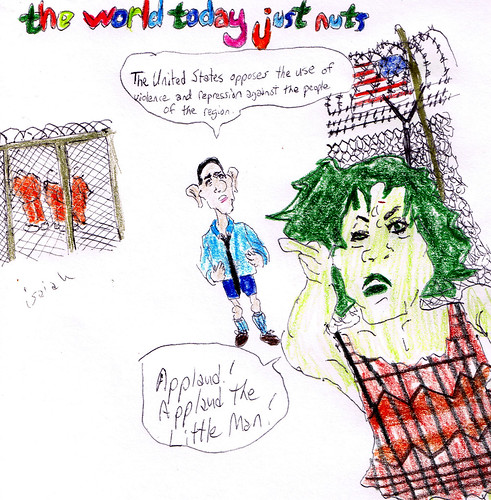
Little Man


Hail the liar in chief or deal with the rage of She Hulk Mama Obama.

"Why Liberal Sellouts Attack Prophets Like Cornel West" (Chris Hedges, Information Clearing House):

The liberal class, which attempted last week to discredit the words my friend Cornel West spoke about Barack Obama and the Democratic Party, prefers comfort and privilege to justice, truth and confrontation. Its guiding ideological stance is determined by what is most expedient to the careers of its members. It refuses to challenge, in a meaningful way, the decaying structures of democracy or the ascendancy of the corporate state. It glosses over the relentless assault on working men and women and the imperial wars that are bankrupting the nation. It proclaims its adherence to traditional liberal values while defending and promoting systems of power that mock these values. The pillars of the liberal establishment—the press, the church, culture, the university, labor and the Democratic Party—all honor an unwritten quid pro quo with corporations and the power elite, as well as our masters of war, on whom they depend for money, access and positions of influence. Those who expose this moral cowardice and collaboration with corporate power are always ruthlessly thrust aside.

The capitulation of the liberal class to corporate capitalism, as Irving Howe once noted, has “bleached out all political tendencies.” The liberal class has become, Howe wrote, “a loose shelter, a poncho rather than a program; to call oneself a liberal one doesn’t really have to believe in anything.” The decision to subordinate ethics to political expediency has led liberals to steadily surrender their moral autonomy, voice and beliefs to the dictates of the corporate state. As Dwight Macdonald wrote in “The Root Is Man,” those who do not make human beings the center of their concern soon lose the capacity to make any ethical choices, for they willingly sacrifice others in the name of the politically expedient and practical.

By extolling the power of the state as an agent of change, as well as measuring human progress through the advances of science, technology and consumption, liberals abetted the cult of the self and the ascendancy of the corporate state. The liberal class placed its faith in the inevitability of human progress and abandoned the human values that should have remained at the core of its activism. The state, now the repository of the hopes and dreams of the liberal class, should always have been seen as the enemy. The destruction of the old radical and militant movements—the communists, socialists and anarchists—has left liberals without a source of new ideas. The link between an effective liberal class and a more radical left was always essential to the health of the former. The liberal class, by allowing radical movements to be dismembered through Red baiting and by banishing those within its ranks who had moral autonomy, gradually deformed basic liberal tenets to support unfettered capitalism, the national security state, globalization and permanent war. Liberalism, cut off from the radical roots of creative and bold thought, merged completely with the corporate power elite. The liberal class at once was betrayed and betrayed itself. And it now functions like a commercial brand, giving a different flavor, face or spin to the ruthless mechanisms of corporate power. This, indeed, is the primary function of Barack Obama.

The liberal class, despite becoming an object of widespread public scorn, prefers the choreographed charade. It will decry the wars in Iraq and Afghanistan or call for universal health care, but continue to defend and support a Democratic Party that has no intention of disrupting the corporate machine. As long as the charade is played, the liberal class can hold itself up as the conscience of the nation without having to act. It can maintain its privileged economic status. It can continue to live in an imaginary world where democratic reform and responsible government exist. It can pretend it has a voice and influence in the corridors of power. But the uselessness and irrelevancy of the liberal class are not lost on the tens of millions of Americans who suffer the indignities of the corporate state. And this is why liberals are rightly despised by the working class and the poor.

Chris Hedges is correct.

He is also providing all the more reason for you to break free of the two-party political grip.

Looking back on the Bush years, I always had hope. I had hope that we would emerge victorious. That those of who believed in the Constitution and believed in the concept of democracy would emerge out of the tunnel into a better world.

I thought it would happen in November 2004, but it did not. We got more four more years of Bush. But that didn't depress me, it just made me more determined.

Now we've got Princess Tiny Meat in the White House.

Why the hell do we have to keep fighting?

Because there truly isn't a bit of difference between George and Barack or Republicans and Democrats.

That's the message.

There is no end to this tunnel.


"Iraq snapshot" (The Common Ills):
Monday, May 23, 2011. Chaos and violence continue, the US military announces deaths, the British military officially leaves Iraq, David Miliband weighs in on the Iraq War, a meet-up in Erbil offers little for Nouri to spin, and more.
In the United States, unemployment among young veterans of the Iraq and Afghanistan Wars is a critical issue. May 11th, US Senator Patty Murray, the Chair of the Senate Veterans Affairs Committee, held a news conference to note Hiring Heroes Act of 2011.
and she also noted that one out of every four young veterans is unemployed. From the news conference.
Senate Veterans Affairs Committee Chair Patty Murray: We have an unemployment rate of over 27% among young veterans coming home from Iraq and Afghanistan. That is 1 in 5 of our nation's heroes who cannot find a job to support their families, they don't have income to provide stability and they don't have work that provides them with the self-esteem and pride that is so critical to their transition home. All too often, we read about the results of veterans who come home, often with the invisible wounds of war, who can't find the dignity and security that work provides. We read about it in the sky rocketing suicide statistics, problems at home, substance abuse and even in the rising homelessness among our returning veterans. But I've also heard a lot about it first hand from the veterans that we have failed to provide better job support to. I've had veterans tell me that they no longer write on their resume that they are a veteran because they fear the stigma they believe employers attach to the invisible wounds of war. I've heard from medics who return home from treating battlefield wounds for days on end, in incredible conditions, who cannot get certification to be an EMT or even a ambuldance driver. I've talked to veteran after veteran who's said they didn't have to go through the military's jobs skills training program or that they were never taught how to use the venacular of the business world to describe the job and experience they did when they come home. These stories are heart breaking and they are frustrating. But more than anything, they are a reminder that we have to act now.
While we're on the Senate Veterans Affairs Committee, let's quickly note the following from Senator Murray's office:

In second of two major hearings, Chairman Murray will hear directly from veterans and top VA and Pentagon officials about challenges that remain in the care for amputees, rising suicide rates, poor coordination between the agencies, and delays in disability evaluations

(Washington, D.C.) – Wednesday, U.S. Senate Veterans' Affairs Committee Chairman Patty Murray will hear first-hand accounts from veterans who have faced challenges because of the lack of collaboration between the Department of Veterans Affairs (VA) and the Department of Defense (DoD). The hearing will focus on DoD and VA's joint disability evaluation process, military and veteran suicides, the lack of cooperation in certain areas between the two agencies, and the quality of care at the two Departments for amputees. During the hearing, Chairman Murray will also question VA's top mental health administrator about the recent 9th U.S. Circuit Court of Appeals ruling finding the mental health care offered by the VA to be so poor that it's unconstitutional.

WHO: Senate Veterans' Affairs Committee Chairman Patty Murray

Tim Horton, Iraq Veteran who was wounded and lost his leg to an IED attack in Iraq

Steve Bohn, Iraq Veteran, representing Wounded Warrior Project

Janet E. "Jan" Kemp, VA National Suicide Prevention Coordinator

Antonette Zeiss, Acting Deputy Chief Officer Mental Health Services, Office of Patient Care Services, Department of Veterans Affairs

Jim Lorraine, Lt. Col. ASAF (Ret.), Executive Director, Wounded Warrior Care Project

George Peach Taylor, Jr., MD, MPH, Deputy Assistant Secretary of Defense for Force Health Protection and Readiness

WHAT: Senate Veterans' Affairs Committee Hearing on the State of VA/DoD Collaborations and the Challenges those Agencies Face in Caring for Veterans

WHEN: Wednesday, May 25th, 2011

10:00 AM EST/7:00 AM PST

WHERE: Russell 418

WEBCAST: http://veterans.senate.gov/

Back to unemployment. "We have to act now." And Murray and senators on the Senate Committee -- Democrats and Republicans -- appear focused on the issue. In the House of Representatives, it's another story. Tomorrow morning, the House of Representatives' Veterans Affairs Committee was supposed to hold "Putting Veterans Back to Work." This hearing has been postponed. "Putting Veterans Back to Work" and "Postponed" -- pair the two up for the message (which I am sure is unintentional) that's being sent. This would have been only the second, only the second, hearing the House Veterans Affairs Committee had held on employment. The other hearing was March 3rd. Is it a crisis or is not one?
The figures say it's a crisis. The treatment of it by the Senate Veterans Affairs Committee telegraphs it's a crisis. But in the House Comittee the issue gets little attention and when it's finally supposed to get attention, it's "postponed." It sends a message. And, no, this wouldn't have happened under Bob Filner's leadership. But hopefully it's not an issue of political party. US House Rep Bob Filner is a Democrat and, until January, was the Chair of the House Veterans Affairs Committee. The current Chair is Jeff Miller who is a Republican. Hopefully, it's more an issue of someone new to being a chair failing to grasp the message being sent and also still stumbling with leadership issues.
Though addressing the needs of veterans can be ignored and postponed, the wars they serve in don't get put on hold -- or apparently end these days.
Yesterday 2 US soldiers were killed while serving in Iraq. AP notes all the US military shares is that the two died "conducting operations in central Iraq" and AP also notes they were the first US soldiers to die in Iraq this month.
Their deaths were part of a wave of violence across Iraq yesterday. Ned Parker and Raheem Salman (Los Angeles Times) reported on the two deaths and the deaths of multiple Iraqis, observing, "The bloodshed highlighted the tenuous situation around Baghdad, where assassinations and other attacks still occur almost daily. It also drew attention to Sunni Arab and Shiite militants' continuing efforts to kill American troops, who are scheduled to leave at the end of the year. There has been an increase in the shelling around U.S. military bases within Baghdad's airport grounds as well as the American Embassy compound in the fortified Green Zone enclave." Tim Craig (Washington Post) added, "Most of the explosions were directed at Iraqi police officers and government officials, who have become targets of terrorism in recent months. Security officials estimate that at least 21 people were killed and more than 80 injured during a succession of attacks that came from 8 a.m. to 9:30 a.m." Michael S. Schmidt (New York Times) counts eighty injured today and explains, "There were bombings in both Shiite and Sunni neighborhoods, including two in Sadr City, the stronghold of the radical cleric Moktada al-Sadr, but it was unclear whether they were coordinated. Insurgents have often attacked both groups simultaneously, in an attempt to incite sectarian strife and further destabilize the country." It was a day that began, Al Sabaah reports, with prime minister and puppet of the occupation Nouri al-Maliki declaring this is the best time (ever) for businesses to invest in Iraq and that he made this declaration yesterday morning at a ribbon cutting ceremony at the opening of the al-Jihad housing complex. Of the violence, Laith Hammoudi (McClatchy Newspapers) notes, "It raises again the question of whether a complete withdrawal of U.S. troops at the end of 2011 will open the way for a vast increase in extremist violence. Prime Minister Nouri al Maliki has called for a national debate on whether to ask some U.S combat to remain after December 31."

Al Sabaah reports that Nouri al-Maliki has stated that Iraq's political blocs are unclear about an extension. He has called for them to use the next weeks to figure out where they stand. The paper states that he's accused the political blocs of using the issue to attack one another and that he's asking them to come to an understanding before the issue goes to his Cabinet or to the Parliament. He also stated a need for US trainers. US troops were thought to be leaving by the end of the year. Some may, some may not. What the US administration wants is an extension of the SOFA or a new agreement.

Barring that, they will go with their back up plan of keeping "hundreds" (possibly "thousands") of US soldiers in Iraq but switching them from the DoD umbrella to the State Dept one. This in addition to the Marines who will guard the US Embassy in Baghdad -- as they guard embassies around the world -- and in addition to the contractors which will also be under State Dept control. As Congress continues to resist turning over billions to the State Dept for "Iraq operations," the back up plan becomes less and less attractive and the White House pushes harder for an extension of the SOFA.

Back to Al Sabaah which quotes Kurdish MP Hamid Adel stating that the depature would leave Iraq an easy target for regional countries. Adel states that they need from Nouri an update on the Iraqi military including whether the army can protect its borders and whether the air force can protect the skies. Since Nouri and the military have long ago stated that Iraq will be unable to protect its borders and since the Iraqi air force is not up and running, it's doubtful an update would provide any new information.

Al Rafidayn reports Jabbar Yawar, Secretary-General of the Ministry of the Pesmerga, declared in an Erbil press conference yesterday that, "We welcome the move to extend presence of US forces in Iraq." He stated that the army continues to need weapons, the air force continues to need training and that the country needs US military support.

Violence continued today. Aswat al-Iraq reports Ayad Ali Akbar, with the Ministry of Defense, was assassinated in Baghdad. UPI reports, a Kirkuk car bombing has claimed at least 7 lives (five were police officers). AFP notes that the 2 others killed were soldiers -- peshmerga or Iraqi is not noted. Aswat al-Iraq reports a Baghdad bombing has claimed 1 life and left nine people injured. Jamal Hashim (XInhua) reports, "Near Baghdad, a member of Awakening Council group of the town of Abu Ghraib, just west of Baghdad, was killed when a sticky bomb attached to his car detonated around midday as he was passing a security checkpoint in al-Shuhadaa neighborhood in central the town, a local police source told Xinhua on condition of anonymity." Hashim also notes 1 police officer was shot dead in Anbar Province. Marwan Ibrahim (AFP) adds, "Also Monday, a taxi driver was killed and his passenger wounded when a magnetic "sticky bomb" attached to their vehicle blew up in Ghazaliyah, west Baghdad, an Interior Ministry official said."

Jane Arraf: 18,000 concrete walls down and 62,000 more to go. They are meant to protect people and buildings from car bombs Some officials estimate hundreds of miles of the walls have been put up since 2003 -- most of them by the US military. The government says, apart from the Green Zone and government buildings, they'll all come down by the end of the year.
Bagdhad Security spokesperson Qassim al- Atta: General security is developing and progressing and there's no need now for barriers and street closings.
Jane Arraf: The last time authorities tried to dismantle the blast walls two years ago, suicide truck bombs detonated outside the Foreign and Finance Ministries killing more than 80 people. On Palestine Street, where a lot of walls were taken down a few weeks ago, some are afraid it will happen again.
Shop owner Ali Hassan Abdul Jabar: After they removed the blast walls, the next day a bomb was planted and killed two steet cleaners. The poor people, it blew up right in their faces.
Jane Arraf: In some parts of Baghdad, the walls have become concrete canvases for Iraqi artists. But no matter how you dress them up, they've still closed off major parts of the city. And during the sectarian violence, they sprung up to divide Sunni and Shia neighborhoods.
The walls divided the city, sectioned off. And now they come down? At a time when violence has been increasing and when the bulk of US forces could leave at the end of the year, most wouldn't be taking down the walls. In fact, the only strong reason to do so now would be if you were attempting to nudge the results on stay-or-go over to "US military stay!" by increasing the likelihood of violence. Whether the bulk of US troops stay or go, Saturday Jack Healy (New York Times) noted the following Americans remain missing in Iraq: Jeffrey Ake, Aban Elias, Abbas Kareem Naama, Neenus Khoshaba, Bob Hamze, Dean Sadek, Hussain al-Zurufi and Staff Sgt. Ahmed Altaie."
Over the weekend, Al Sabaah reported Nouri was insisting that it's time to push national reconciliation (after, please note, he's bullied his way into getting everything he wanted) and that the statements came as he prepared to for Monday's big meet-up. Dar Addustour noted the big meet-up in Erbil thismroning between the political blocs with the goal of ironing out the many problems (which result from Nouri's failure to live up to the Erbil Agreement). Alsumaria TV reports, "Al Iraqiya List led by Iyad Allawi stressed that it insists on implementing Arbil agreements fully noting that the party is keen on national partnership, a source told Alsumaria. Renouncing national partnership is a way of disclaiming the political process, it argued." In related news, Aswat al-Iraq reports Iraqiya's spokesperson Shaker Kattab has issued a denial of any knowledge that Iraqiya plans to nominate him for Minister of Defense. Iraq still has no Minister of Defense, Minister of Interior and Minister of National Security. Alsumaria TV notes, "Iraqi Vice President Tarek Al Hashemi urged security officials to introduce immediate amendments to the security plan in light of mounting security violations. Al Hashemi called for an urgent stand to accelerate the appointment of security ministers, a source told Alsumaria."
Despite its inevitable collapse, the United States strongly supports Iraq's unity government, praising it as a mature step forward. The U.S.-brokered settlement "reflects the results of those elections," wrote Vice President Joseph Biden at the time, and "does not exclude or marginalize anyone." Yet, the deal secured Nouri al-Maliki another term as prime minister, despite his bloc's second-place finish in the elections. The cornerstone of the accord was the foolhardy establishment of a National Council for Higher Policies.
The council was intended to hold "executive" and "binding" authorities to check Maliki's power, and was to integrate former Prime Minister Iyad Allawi into the government as its first chairman. But today, little American leverage remains to compel Maliki to cede any of his powers, especially to a committed rival. At best, the council stands to be largely an advisory body with no significant clout.
In idly sponsoring a national partnership, the U.S. endorsed a false promise for Iraq's future. The concept represented a gross misreading of Iraqi politics. Since the Sunni boycott of the 2005 elections, misconstrued Western biases have supported such a framework as a way of advancing national unity. But in reality, there are no broadly-shared ideological or overarching visions to sustain such a government. The practice of "governing by consensus" is not indigenous to Iraqi political culture. The experiment today is viewed as an American venture, and Iraqis perceive its foundations as a formula for dividing the spoils, not sharing power.
Moreover, the national partnership has reinforced Iraq's dysfunctional polity. To house a gargantuan government, some positions were arbitrarily created to satisfy Iraqi personalities. The new officialdom embraces 42 ministries, three deputy prime ministers, and three vice presidents. Many roles are ill-defined, and in some cases lack a constitutional basis. But unlike titles, governing power has become a zero-sum game: as a rule of thumb, no sharing agreement, however creative, will satisfy all of Iraq's major players.

That position is actually similar to Nouri's. Over the weekend, New Sabah quoted Nouri stating that "There is no minority that can control Iraq." Al Rafidayn reported that Nouri made the statement while speaking with Salahuddin Province tribal sheikhs and, with his statements regarding sections and factions, he may also be laying the groundwork for an all State Of Law Cabinet -- or possibly just a Shi'ite one.
In the background of all of Nouri's statements is what happens come June 7th. In an attempt to defuse Iraqi outrage, Nouri announced a 100 day period during which corruption would be dealt with. The 100 days comes to an end June 7th and Nouri has very little to show for it. He may have hoped for good news out of the Erbil meet-up but that appears to have gone the way it always does (stalemate). He needs something to distract from no end to corruption and Friday's prison break.

From Friday's snapshot:

Alsumaria TV reports, "An Iraqi informed security source revealed on Friday that five chiefs of the Mehdi Army managed to escape from Taji prison, north of Baghdad. Three detainees were reported missing while transferring them to Karkh central prison, the Justice Ministry said. A special force from Prime Minister's office headed on Thursday night to Taji Prison, nothern Baghdad, to transfer detainees to one of the capital's prisons, the source told Alsumarianews. Five chiefs of the Mehdi Army including senior leader Saad Sowar managed to escape during the transfer, the source said." New Sabah states that 182 detainees were being transferred when the escape took place.

Dar Addustour reported Saturday that the Justice Ministry has announced it is signing a contract with the US to install devices that will allow them to jam cell phones within prisons. Al Mada added that the Taji prison escape has resulted in numerous "conflicting statements" about the prison break. But the announcement regarding jamming cell phones appears to be a response to (if not an acknowledgment of) the veracity of the rumors that the prisoners used cell phones to stay in contact with helpers outside the prison. Cell phones may have also been used to organize and execute a prison riot which provided some cover for the prison break.

Sunday British forces kind-of-sort-of withdrew (finally) from Iraq. Rosa Prince (Telegraph of London) reports David Miliband stated, "Iraq obviously divided not only our country, but divided the whole world really. It proved how much easier it is to win wars than to win the peace and I think that is the sort of lesson that we have got to learn. I am afraid the failure of the Western forces to develop a proper strategy for peace, not a strategy for war, has held back the country." David Miliband made his statements on The Andrew Marr Show (BBC). Click here for video, here for transcript. Excerpt:
ANDREW MARR: Right now our last forces are pulling out of Iraq and forces will start to pull out of Afghanistan in the not too distant future. So it's a moment of reflection, I suppose, about our engagement across the whole region. At that moment, tell us what you think now about Iraq?
DAVID MILIBAND: I think you think, first of all, of the people that we've lost. You think, secondly, that while there have been gains, the list of negatives is long - longer than the list of gains. But you also think, thirdly, that there is still history to be made in Iraq and the possibility of a multi-confessional, multi-denominational political system in Iraq that is more or less democratic, can send out a message to the rest of the Arab world that is consonant with the sort of changes that you've been discussing in Egypt and elsewhere. Iraq obviously divided not just our country, but divided the whole world really. It proved how much easier it is to win wars than to win the peace, and I think that that is the sort of lesson that we've got to learn.
ANDREW MARR: And when you say the list of negatives is longer than the list of gains - that's what you mean, is it: that what followed the war was so horrific?
DAVID MILIBAND: Yes, exactly. I mean six, seven, even eight months after the fall of Saddam Hussein, the sort of Sunni-Shia conflict that came to mark the Iraq episode - hundreds of thousands of deaths - hadn't really started. It was still in the balance. I'm afraid the failure of the Western forces to develop a proper strategy for peace, not a strategy for war, has held back the country. Now it's still to play for despite the loss of blood and treasure, but I think that that is the key lesson.
As disclosed before, I know David Miliband. On Law and Disorder Radio this week ( WBAI had a two hour fundraising live broadcast of Law and Disorder Radio today, but on this week's actual hour long program which broadcasts around the country throughout the week), Michael Ratner, Heidi Boghosian and Michael S. Smith are joined by attorney Abdeen Jabara (American-Arab Anti-Discrimination Committee) to discuss events in Egypt and by journalists Arun Gupta. Also, commenting on last week's speech, Isaiah's The World Today Just Nuts "Little Man" went up Sunday.


Friday, May 20, 2011

Meaningless?

60 days after the March 21 informing of Congress of the attack, President Barack Obama has missed his legal deadline to obtain Congressional approval for the Libyan War. NATO insists the war will continue, but under US law, it is now completely illegal.


That's the War Hawk Barack. I will be so glad when he leaves the White House. He gets away with everything. As bad as things were under Bully Boy Bush (and they were bad), at least we could (on the left) feel like we were engaging in a struggle that had to be fought. Now so much of the left is just meaningless.


So much seems meaningless these days. However, C.I.'s "I Hate The War." If I ever wrote one post here as good as that -- or even just half as good -- I might be satisified with my posting.

While I'm not, I can still enjoy reading C.I.'s. You will too.


"Iraq snapshot" (The Common Ills):
Friday, May 20, 2011. Chaos and violence continue, Countdown Friday sees protests in Baghdad and Mosul, Barack's speech does not go over well in Iraq, the country sees another prison break, Joan Wile talks peace and more.
Today was Countdown Friday in Iraq. The Great Iraqi Revolution offers photos of the handbills for the demonstrations here and here. And people turned out in Baghdad. Revolution of Iraq offers photos of the protest (check out the one of 'shy Nouri' especially) here. They gathered in Tahrir Square, also known as Liberation Square because it has been a focal point of people action in the last months. Great Iraqi Revolution notes, "A number of protestors were beaten and cursed by the security services in Tahrir Square." Revolution of Iraq also notes the violence against the protesters. And Great Iraqi Revolution offers video of the protests here. The Great Iraqi Revolution has an important, must-read essay on the Baghdad protest. Excerpt:
But, first, let me tell you about COUNTDOWN FRIDAY – today – Tahrir, Baghdad welcomes hundreds of its old residents who visit it every Friday and they held a public auction for Haliki and his goons – the highest bid was a quarter of an Iraqi Dinar! People were obstructed by goons dressed in black carrying clubs and donkey sticks who tried to keep people away from the square, in particular on the western side of the square. A number of protestors were badly beaten up and verbally abused. Normal! We were told by protestors, live on air, that security forces were out in strength and some areas in Baghdad a curfew had been imposed. But the usual colourful crowd was in Tahrir, singing and reading poetry with the sad view of women with disappeared relatives holding their relatives' photographs. They had displayed beautifully amusing caricatures of Maliki! They all stated that it is not Maliki's or the parliament's decision to extend or not, the stay of the American Occupation – that it is the decision of the people and that they wanted the immediate departure of the American and the Iranian Occupations. Of course, they all sang our favourite song of Maliki being a liar and a thief. This song is a must as well as many others which have been composed since the Revolution began. A lady in Tahrir said that she had 5 brothers who had disappeared one of which was 13 years old since 2005, another, a son who was 15 years old and others and others…. I wonder what country Mr. Obama was talking about in his speech – and had he not intended to have his troops stay and had he not been sure that they were staying I wonder why he stated that Iraq was still under emergency rule for another year and why he stated that our funds are under protection for another year!!!!! At any rate, we know that the Americans and Maliki have already signed up. 5 bases at a cost of USD 400 billion – bases that are cities, totally self-sustaining and the largest embassy in the world – could it be called an embassy I wonder – with 20,000 employees as well as 18,000 mercenaries to protect it, or are they? Could they not be troops dressed in different uniforms???? With 2 official consulates and 2 regional offices as well as agents in every single Iraqi institution no matter how distant and unimportant as well as advisors. By the way, the British who announced a couple of days ago that that was their last day in Iraq are lying of course because there are and will be 5,000 British "advisors" remaining in Iraq! Just as there will be around 20,000 American advisors!
Don't imagine that I am one of the few people who know these facts – Most of the Iraqi people know – go out amongst the simplest in out-lying areas in the country and you will be told this by the simplest farmer!
Not that I have anytime for Mr. Obama and his lies, really – we really don't care about him or about what he has to say - we neither care nor are we impressed…. Lies, Lies, and more Lies!!
I will only say one thing to Mr. Obama and the powers that be in America, watch out for the Iraqis. You really don't know what we can do when we get angry and just wait for July and August!
I wonder what sort of democratic process he is speaking about and just as Haliki speaks about another planet so does Mr. Obama!
Dar Addustour notes approximately 2,000 protested in Mosul, carrying banners and chanting with demands including the departure of Nouri al-Maliki. Aswat al-Iraq notes that there were "hundreds" participating and that the demands also including that "the Iraqi government stop paying compensations to the Kuwaiti government. The compensations were imposed on Iraq after Gulf War I in 1991 by the UN Security Council."
That was a new development in the protests. Long standing demands have been for an end to corruption, the creation of jobs, the release of detainees and an end to the occupation. Let's stay with that last aspect, the occupation. Yesterday at Fort Leonard Wood, US Secretary of Defense Robert Gates spoke on the topic of a possible US withdrawal from Iraq and stated, "I think that most of us in our government believe that there is value in a residual U.S. force remaining in Iraq. [. . .] They still have a lot of work to do with logistics and things like intelligence. They basically have no air defense capability." It really is amazing how little US media attention the possibility of the US military remaining in Iraq past 2011 has received. The US print outlets (and AP) with reporters in Iraq have covered it. But so few others have. And, outside of CNN, there's been very little serious broadcast coverage of this issue (no, I'm not forgetting NPR -- NPR can't even keep a reporter in Iraq these days). In the Iraqi press, there's actually interest in the issue and some might argue "of course" noting it's the country in question; however, that same self-interest motive should prompt coverage in the US but hasn't.
Today Al Mada notes MP Sabah al-Saadi stating that it is highly likely that the agreement between the US and Iraq will be extended to keep approximately 20,000 US forces on the ground in Iraq past 2011. al-Saadi notes that 20,000 is the number being tossed around by the US in discussions with Iraqi officials. Another Al Mada article (also published today) on the issue notes that Robert Gates is pitching US troops as a way to "protect" the Iraqi government from popular protests. Gates appears to be on a mission to demonstrate just how hollow Barack's words were in yesterday's speech. In another article published today, Al Mada notes that Hezbollah Brigades have issued a statement that if the US stays in Iraq, armed violence will take place and the foreign occupiers will be expelled. Dar Addustour reported yesterday that Moqtada al-Sadr is now insisting that troops from "Arab and other foreign countries" be used to help stabilize Iraq in 2012. The other, right? Just sticks out there, doesn't it? Sounds like he means Iran, doesn't it? Wonder why that is? But he does realize the security situation talking point needs to be combatted so he runs with "our neighbors will help our defense." Fadel-Al Nashmi (Niqash) observes:
On one hand, locals have heard many Iraqi politicians say they don't want to see giant Hummers (American military vehicles) racing around their countryside anymore. On the other, they hear rumours, some of which come from inside the country's political elite, that there is a genuine need to keep US troops in Iraq for the sake of security, in a fledgling democracy not yet familiar with stability.
Yet failure to declare an opinion on this issue remains the most common attitude in Iraq's political circles presently. During his most recent press conference, a journalist asked al-Maliki where he stood on the matter. Without any trace of irony, the prime minster replied: "There are governments and many other protagonists who want to know where I stand on this. Why would I tell you?"
Nonetheless Azza Shabandar, an MP for the State of Law coalition, the second largest coalition in the Iraqi parliament which is headed by al-Maliki, told NIQASH that, "I can say with certainty that 80 to 90 percent of the political parties have a genuine desire to extend the presence of US troops in Iraq."
Al Rafidayn reports that a spokesperson for the Iraqiya (Ayad Allawi heads this political slate) stated yesterday that an agreement had been reached with State Of Law (Nouri heads this political slate) to move forward -- by submitting to Parliament -- drafts on the National Council for Strategic Policies and possibly move towards nominating a President of the National Council. What is that? March 7, 2010, Iraq held national elections. Allawi's slate came in first place. Slightly behind -- but behind nonetheless -- was Nouri's slate. Nouri refused to step aside or follow the Constitution. (The Constitution dictated that Allawi would have first short at forming a government -- that would have made him prime minister-designate -- and if he failed to do so after 30 days, the Parliament would pick a new prime minister-designate.) Nouri stubborness and crooked ways helped create the political stalemate that extended over nine months. Leaders from the National Alliance, State Of Law, Iraqiya, the two main KRG political parties and others gathered in Erbil in an attempt to end the stalemate. The deal they formed is known as the Erbil Agreement. It was formalized, it was signed, it should have been a done deal.
Immediately, it was announced the stalemate was over and, November 10th, efforts were made to move forward in Parliament. Nouri was named prime minister-designate (he would be named much later by Jalal Talabani in an abuse of power intended to give Nouri more than 30 days to form a Cabinet), there were efforts to clear up the names of several Iraqiya politicians who'd been falsely accused (by Nouri's henchman) of being Ba'athists. But Ayad Allawi and some others in Iraqiya walked out of that November 10th Parliament session. Why? He wanted the National Council to be voted on so it could become official. The Erbil Agreement made the National Council a board of review that had independence and true powers. And the deal was that Allawi would head it. Allawi sensed in the November 10th meeting that he was being played.
He was being played. And the National Council never did get created. All this time later. The rumors Al Rafidayn reported on could, if true, actually indicate some progress or progression in Iraq. However, yesterday evening, Aswat al-Iraq reported that Maysoun al-Damalouji, Iraqiya's spokesperson, was stating that no agreement had been reached. Aswat al-Iraq identifies Iraqiya's Shakir Kattab as the original source for the rumor and notes that the National Coalition denied any agreement had been reached. As Al Mada notes, this conflict has now raged for over a year and a half and, as it continues, there is a fear that this impass will become a norm in Iraqi politics.
That is one obstacle. February 3rd, the US Senate Armed Services Committee held a hearing and the Chair, Carl Levin, noted obstacles in his opening remarks.
Chair Carl Levin: Last December, after eight months of discussions, Iraq's political leaders agreed to form a national unity government. But the agreement was only partial. Iraq still awaits the nominations by Prime Minister al-Maliki to the key cabinet positions of Minister of Defense, Minister of Interior and Minister of National Security as well as the resolution of issues relating to the powers of the National Council on Higher Priorities, to be headed by former Prime Minister Ayad Allawi. The pressure on the Iraqi government to fill in these large gaps must continue.
The National Council we've noted above. Iraq still has no Minister of Defense, no Minister of Interior and no Minister of National Security. It's three months since Senator Levin made those remarks. It's over five months since Nouri became prime minister and over six since he became prime minister-designate. (Per the Constitution, he should not have moved from prime minister-designate to prime minister unless he filled all the posts in his Cabinet. Per the Constitution, if he couldn't do that in 30 days -- and he couldn't -- then Parliament was supposed to select a new prime minister-designate and give them a chance to put together a Cabinet.
As violence continues to rise, Nouri al-Maliki still can't get his act together. Parliament will be taking a vacation shortly. Still no rush to fill the posts. These are the three security ministries. They are vacant. (Nouri insists that he is filling all three posts -- and being Prime Minister -- while they are empty. If so, it's past time that he was called out for the lousy job he's doing on security.) Not only is violence on the rise but Mohammed Tawfeeq (CNN) points out that government officials are now being targeted and "the latest wave of violence in the country, especially in past few weeks, has raised questions about the ability of Iraqi security forces to protect the country as the United States plans to have all its troops out of Iraq by the end of this year."
Turning to some of today's reported violence . . .
Reuters notes a police officer left injured in a Kirkuk attack, a Hawija roadside bombing which injured two people, a Baquba roadside bombing injured an imam and claimed the lives of 2 other people (one of which was the imam's son), 2 workers for "the Iraqi intelligence facility" were shot dead in Baghdad, and Col Nameer Khazaal was shot dead in Baghdad. Aswat al-Iraq notes a Mosul roadside bombing claimed the lives of 2 police officers leaving eight others injured, a Tikrit sticky bombing injured a police director (and his driver and the police director's legs were amputated."
We're not done. May 8th there was an attempted prison break. From the May 9th snapshot:
Raheem Salman and Ned Parker (Los Angeles Times) report on a prison break aatempt of a suspect, Huthaifa Batawi, in the October 31st assault on Baghdad's Our Lady of Salvation Church. The death toll is 11 prisoners and six police officers: "The prisoners Sunday overpowered guards and killed a senior counter-terrorism general and five others before they were detained or shot dead. It was unclear how many detainees participated in the mayhem that lasted several hours." Jack Healy (New York Times) explains, "The melee inside the Baghdad prison began around 10 p.m. on Saturday when the man believed to have masterminded the church attack, Huthaifa al-Batawi, seized a police lieutenant's pistol, shot him in the head and led other inmates on a rampage, the officials said. It was unclear exactly where Mr. Batawi was when he grabbed the gun, but the authorities said that he and the other inmates had not been handcuffed, making it easier for them to overpower their captors, break out of a holding area and overrun the jail." Philip Caufield (New York Daily News) adds, "After killing his captors, al-Batawi freed nearly a dozen members of his crew, who snatched a cache of weapons -- including guns and grenades -- and attempted to overrun the prison, officials said." al-Batawi is among the dead.
Today a prison break. Alsumaria TV reports, "An Iraqi informed security source revealed on Friday that five chiefs of the Mehdi Army managed to escape from Taji prison, north of Baghdad. Three detainees were reported missing while transferring them to Karkh central prison, the Justice Ministry said. A special force from Prime Minister's office headed on Thursday night to Taji Prison, nothern Baghdad, to transfer detainees to one of the capital's prisons, the source told Alsumarianews. Five chiefs of the Mehdi Army including senior leader Saad Sowar managed to escape during the transfer, the source said." New Sabah states that 182 detainees were being transferred when the escape took place.
Yesterday US President Barack Obama gave another pretty speech. Iraqis were not impressed. Salar Jaff and Ned Parker (Los Angeles Times) report on the reaction at a Baghdad cafe and quote college student Ahmed Qoraishi stating, "Don't tell me the 'Arab Spring' is due to his efforts. On the contrary, I can tell that, deep inside, the Americans prefer a dictator here or there if they take care of the American national interests." Al Sabaah notes that some observers in Iraq feel Barack has contradicted himself and remember the campaign promises of 2008 and his Cario speech in 2009 -- how both years found him insisting that the internal affairs of Arab countries were their affairs and the US didn't need to interfere. Al Sabbah also points out that the withdrawal of US forces from Iraq has still not taken place. The Great Iraqi Revolution observes, "In his speech to the Arab World, asks Arab Leaders to respect their people and carry out reforms; he also mentioned all the Arab Revolts but did not mention the Iraqi Revolution whatsoever" and "Of course he would not mention us -- we are under their occupation and we are being ruled by his quizzlings but he is going to be surprised pretty soon!!!!!!" In the US, Trina observed, "Barack's decided he is the world's savior and set forward a list of conditions and pre-conditions that all nations will follow or else. [. . .] This was an awful speech and it was also a major one. It's the Barack Doctrine. The speech today is the equivalent of the 1999 Chicago speech Tony Blair made that became known as the Blair Doctrine. "
From the US War Maker to a US peace maker, activsts and artist and inspiration Joan Wile is the founder of Grandmothers Against the War and has written the book
The day was downcast, but the wonderful high school seniors from Brooklyn Collaborative School standing in the rain on Fifth Avenue were not. You could say they were upcast. They were living proof that daring and principled teachers could raise their students' consciousness about the material and political costs of our current wars and integrate them into the anti-war movement.
It was the morning of May 18. About 8 or 9 kids, all Latino and African American, had joined the Grandmothers Against the War weekly vigil at Rockefeller Plaza. Their Social Economics teacher, Stephen Simons, thought it would make a good field trip to supplement their class discussions regarding the question: was the Iraq war a just one?
Seniors from the Brooklyn Collaborative Studies school at (photo by Rex Bounds)
the Grandmothers Against the War vigil May 18, 2011
It would have done your hearts good to join with them, just as it did our hearts. Every single one of the youngsters is going on to college -- one with a full scholarship to Bard College and one with a full scholarship to Franklin and Marshall College. I suspect this impressive feat is due in part to the influence of their teacher.
Carol Husten, a former teacher and member of the Granny Peace Brigade, began the event by drawing the kids out about their thoughts relative to the wars in Iraq and Afghanistan. It became quickly apparent that the students were very well versed in the causes and effects of the war. When Ms. Husten asked them, for instance, why they thought we invaded Iraq when there were actually no weapons of mass destruction, one young man promptly replied, "Oil." They were also very aware of the fallacies spouted by military recruiters to lure kids into their ranks.
Barbara Harris, Chair of the Granny Peace Brigade Counter Recruitment Committee, explained Opt-Out options so that recruiters wouldn't be able to harass them in their homes. She told them that though they would be assured of being trained for all sorts of non-fighting jobs, in actuality they would be trained for only one thing -- combat!
Vietnam veteran and member of the Veterans for Peace, Bill Steyert, described the horrors and the immorality of the Vietnam war and urged the young people to stay out of the military.
At that point, the kids read to us a statement they prepared for our event, as follows:
"In May of 2003, former President Bush stated the Iraq War was part of 'Mission Accomplished.' Last year, 2010, President Obama shared that troops would come home by August 2011. Please, Mr. President, keep your word. No May 18th, 2012 with our troops in Iraq, no American troops engaged in warfare in our name. For the future of this country, re-do the American military budget. Switch for education and peace."
One of the students, Miguel Gomez, the person going to Franklin and Marshall, had this to say when asked what his conclusion was as to whether the Iraq war was a just one:
"The
Iraq war is one of the most controversial wars that impacted society.
Thousands of innocent civilians died in Iraq, thousands of our own men died
and to this day they are still recovering dead bodies. I believe the
Iraq war is an unjust war because of the amounts of
lives that were taken in vain due to an unclear cause, and because we
destroyed a country that never hurt us. The
living conditions in Iraq are worse in comparison to
Saddam Hussein's control in the past. We are enemies to ourselves because we
are hurting another country, killing our own men, and hurting our economy.
Bring our Troops Home !!"
Senior Andrea Navarro, who will
be attending the College of Staten Island in the fall, answered the same
question this way:
"I believe the war in Iraq was an unjust one. We
went in for mysterious reasons and it has taken away funds needed at home for
education and health care."

We were extremely inspired by these marvelous youngsters. We have long bemoaned the fact that there are no youths in today's anti-war movement -- we believe that without them policy cannot be changed, as it was in the Vietnam era. But the Brooklyn kids gave us hope that they can reverse the inertia of their generation about the wars and lead the way for them to become committed peace activists.
We grannies will not be here forever, and we urgently need to believe others will follow us and continue our struggle for peace. The Brooklyn high school students helped assure us we needn't worry.
Postscript: We were delighted to learn after the vigil that one of the students told
his classmates as they left that he had thought about joining the military, but after hearing Barbara Harris describe the truth about the recruiters' phony promises he had changed his mind.
ABC News Radio reports on the annual mental health survey for the Army which finds "actue stress and combined psychological problmes in 2010 is more than double what it was in 2005." That's surprising how? This issue's been raised before Congress in one hearing after another during the last five years. Lot of talk, lot of promises from the Defense Dept Secretary Robert Gates. No changes. Anna Mulrine (Christian Science Monitor) reports of the study:

Senior US military officials say they are hopeful that the research will provide insights into better caring for American soldiers currently facing "incredibly high" levels of combat.
The increased exposure to heavy fighting appears to be the No. 1 reason for the decrease in morale among soldiers, according to US military officials. "As a group, we were struck by the fact that levels of combat are extremely high," says Col. Paul Bliese, director of the division of psychiatry and neuroscience at the Walter Reed Army Institute of Research in Washington.
Nearly two-thirds of the respondents in the survey, for example, reported having roadside bombs explode "near" them, and more than three-quarters of troops surveyed say that they had seen a fellow soldier in their unit killed.
Some 80 percent reported "shooting at [the] enemy," and nearly half, 48 percent, said they were "responsible for the death of [a] combatant."

So "senior US military officials say they are hopeful that the research will provide insights," are they? Again, five years of this nonsense. The definition of insanity may need to be changed to "expecting Congress to solve the nation's problems."

Zooming in on women veterans, Shari Roan (Los Angeles Times) reports from the American Psychiatric Association, "In the study, presented this week, researchers studied 922 National Guard members -- including 91 women -- under mandatory deployment to Iraq in 2008. The guard members were screened using mental-health measures before deployment and three months after deployment. The study found that women were much more likely than men to meet the criteria for PTSD after returning home -- 18.7% of women had PTSD compared with 8.7% of men. There were no significant differences between men and women in their level of combat exposure. The women were much less likely to feel well-prepared for combat before deployment and were more likely to report a lack of unit cohesion during deployment."
Gee. Why might there be a problem with unit cohesion?


WENDY BARRANCO: My first experience with sexual harassment was with my recruiter...

NATHAN PELD: There was a young girl who I went to nuke school with who was working in our divisional office...

BARRANCO: Through that whole deployment I was harassed like every single day, I dreaded every day I went to work...

PELD: And she had a direct superior come in, and they had talked for a while, just genuine conversation, and then he dropped his pants and exposed himself to her...

BARRANCO: And I never reported it because it was just - I knew command wasn't going to do anything about it so there was no point...

PELD: When this reached the senior enlisted commander in my department he took it and tried to initiate a cover up...

BARRANCO: The last thing I would've imagined would've been joining an organization where by my own peers, by my own comrades I would've been harassed in that way.

PELD: Those members who try to play games of male dominance, you know, they receive all but a free pass.

That's from a text and audio report by Holly Kernan, Martina Castro and Rahsida Harmon for KALW News and the San Francisco Chronicle. One sexual assault victim explains in the report, "I felt really powerless and really helpless. You know, I was in this foreign country on a U.S. military base, an institution that wasn't really backing me up but that was in complete control of my life." Though they can be sexually assaulted and though many women have served in non-officially in combat in Iraq and Afghanistan, women are prevented from certain positions. Irin Carmon (Jezebel) addresses that topic today and she also notes Anna Holmes' column on the topic for the Washington Post. From that column:
The policy against women assigned to ground combat units has been in effect since the beginning of the U.S. military. (Regulations forbidding women to serve as crew members of planes and ships engaged in combat weren't even lifted until the mid-'90s.) But as circumstances change -- asymmetric wars in Iraq and Afghanistan: higher numbers, expanding opportunities and growing visibility of women in uniform -- it's becoming increasingly clear that the next blow against the military's bulletproof glass ceiling will be directed against the ban on women in Special Forces.