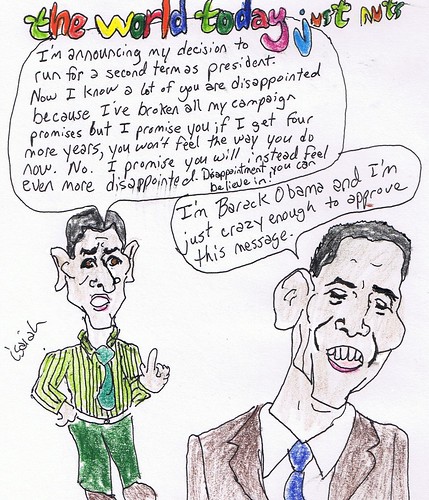
Monday, April 11, 2011

Book recommendation: I'm Over All That

Isaiah's The World Today Just Nuts "Disappointment you can believe in!" went
Disappointment You Can Believe In

Onto other topics. I am reading a book C.I. recommended.

She and Ava are thinking of doing something on it at Third, pairing it with another book. The one recommended, they love. The other one? Not so much.

Shirley MacLaine is, of course, one of my favorite actresses. She's also a nice person in real life who is funny, to the point and always questioning.

So I am really enjoying I'm Over All That And Other Confessions, her newest book.

I do not believe in reincarnation. I don't attack those who do. But I found Shirley's writing on the subject fascinating. I read all of her books on the subject and enjoyed them as much as I did Don't Fall Off The Mountain. She's a real writer, genuinely talented, genuinely capable of holding your interest. So it's a joy to read her on any subject.

This latest book? I'm only on page 91 but I love it.

When I finish, I'll share more but right now I'll just implore you to pick it up. It's fascinating.

One thing I'll toss out for right now, not book related, Shirley related. Why hasn't anyone paired Shirley and Ellyn Burstyn in a film yet? They've both worked with some of the same actors (Ann Bancroft, for example) but they've never worked together. They have so many shared interests and they're two strong actresses. C.I. and I were talking about that Friday.

"TV: The never ending rut" (Ava and C.I., The Third Estate Sunday Review):
They had other things to address. Like, in the words of Yochi Dreazen, "the war that dare not speak its name." The Libyan War for those scratching their heads. The Libyan War translated, on The Diane Rehm Show, as a discussion -- Well, not a discussion.

More like the verbal equivalent of the slam books you passed around in middle school of Libyan leader Muammar Gaddafi and the letter he sent US President Barack Obama. They thought they were comic geniuses as they ridiculed Gaddafi for "mispelling" Barack's name. Jeffrey Goldberg joined in the hilarity by declaring, "I think, according to Gaddafi, his name is Baraka Hussein Obamama, or something like that according to the latest letter. This is, I mean, if we needed proof that Muammar Gaddafi is a completely unhinged characer who lives in his -- obvious -- a world of his own creation, this is it." After the hilarity died down, Nadia Bilbassy would quietly slip in that the name "was not a mispelling or a grammatical mistake" but was "the Arabic translation to his name."

That's The Diane Rehm Show for you, facts never prevent any cheap laughs.

And that's the state of TV today. For truth, you either have to be there in person or go to YouTube because TV struggles to deliver it. Not only that, but it can't even handle the basics like a sitcom which provides laughs or public affairs programming (Democracy Now! airs on radio and TV) that provides needed information. Dumbing down of our culture is something that took place long ago and doesn't begin to describe the intentional misdirection the media now serves up.

This is a really strong piece that Ava and C.I. hate so much they've sworn they will never, not 20 years from now, read this. They're lousy judges of their own work, this is a great article.
"Iraq snapshot" (The Common Ills):

Monday, April 11, 2011. Chaos and violence continue, the US military announces another death, at least 23 Iraqis are killed in today's waves of violence, the government of China 'responds' to the US government, Nouri may be under pressure from the military to sign an extension of the SOFA, Nouri may have signed the extension, Nouri may get out of his political party and more.
Conor Friedersdorf (The Atlantic) observes, "After the September 11 terrorist attacks, mainstream newspapers and television programs briefly chose to be more graphic in their coverage, rightly judging that sanitizing the events of that day would do us a disservice. But why is it less important to fully confront the reality of what is happening now in Afghanistan and Iraq? The United States Armed Forces has lost 5,885 people in those two countries. When did you last see a photograph of one of their coffins? Has the story of an innocent Iraqi killed by our forces ever flashed across your TV screen? The figures are mere abstractions." Yesterday, AP noted another American soldier has died in Iraq and this "marks the sixth U.S. soldier to die in Iraq so far this month." If that's new to you, see last week's "5 US soldiers have died this month."
Gareth Porter: I mention that both American officials -- an American official and the Iraqi intelligence source that I got this story from agree that there's no guarantee that the al-Maliki regime is going to survive this summer. But he is under a lot of political pressure there from a protest movement that the Sunnis are mounting and one of the big questions is whether the Sadrists will join that protest movement? And should that happen, then the short term outlook for the al-Maliki regime is very dark indeed. But there's another factor even beyond that. And that is that the Iraqi military is quite upset that -- that al-Maliki is dawdling over and refusing to go ahead with signing this letter -- sending a letter to the White House requesting the stationing of troops. The Iraqi military which is very close to the US military wants that very badly. And I had a hint -- even more than a hint -- that it could be the case that the Iraqi military would try to carry out its own move against the Maliki regime.
Scott Horton: In order so that they can keep the American troops there --
Gareth Porter: Exactly.
Scott Horton: Which means that they're going to have to fight another civil war against Moqtada al-Sadr.
Gareth Porter: Exactly. Yep. And I think that is certainly something to watch for very closely.
Scott Horton: Well now -- so -- It's been a long time and I know the Supreme Islamic Council ain't what it used to be and whatever, but is it fair to say that the Iraqi army right now, I guess it's the leadership roles that are most important, but that's mostly made up of old Badr corps type rather than Madhi Army guys? Because I know there were a lot of Mahdi Army that went to volunteer for the Iraqi army as well, right?
Gareth Porter: That's right. Although there are some -- in key positions -- there are some Ba'athists as well.
Scott Horton: Well look, if-if Maliki's biggest threat is from Sunni protesters then he's going to really need Moqtada al-Sadr -- which means that he's not going to sign Obama's document.
Gareth Porter: Oh, I think that's right. I mean I am absolutely convinced that this is not going to happen. I think it's very, very unlikely, let's put it that way. I would be very surprised if he were to move in that direction at this point. It just seems to me the factors are all lined up in the same direction.
No one knows what will happen and Porter's an informed observer of the scene so his take is worth listening to and considering. That doesn't make it right. Counter-take on Porter. Under pressure from the military, Nouri signs up for the US soldiers to remain on Iraqi soil. Most likely scenario in which Nouri extends the SOFA?
Factoring in the military, Nouri signs up (if he hasn't already) because he's aware Moqtada al-Sadr is (a) weak and (b) all talk. Moqtada is in Iran. He's made a life there for years -- largely due to the outstanding arrest warrant in Iraq that he fears may be enforced. Moqtada was among those wanting a referendum on the SOFA and Nouri promised that in November 2008 -- swore that in July 2009 it would take place. Never did. He kicked it back and kicked it back.
And what did Moqtada do? Not a damn thing.
Does Moqtada have a great deal of power? That hasn't been tested in a very long time. He had a popular resurgance in 2007 when Nouri ordered the attacks on Basra and the Sadr City of Baghdad. Attacking Moqtada did help build his popularity. However, not enough that Moqtada could fight back. As most will recall, Nouri won that battle, Moqtada caved -- just as he would later do on the referendum -- and went along.
"Caved and went along," many could argue (and some in the State Dept do), is Moqtada al-Sadr's m.o. Moqtada can get supporters to attend a speech or rally. What he can't do -- at least thus far -- is get them to risk their own lives while he remains in Iran. That's been demonstrated repeatedly. Moqtada is popular with a certain international set -- Amy Goodman for example (who notes him and credits him a protest -- that wasn't his protest "across Iraq" -- he is a very minor figure in the entire country, his base is a huge sub-set of Iraq). They love to turn the homophobic and sexist and fundamentalist thug into a cuddly bear. That's not reality. Nor has reality ever demonstrated that Moqtada has the power he's supposed to have.
Should Nouri stand firm against him (again) and should Moqtada attempt to issue orders for combat from Iran, Moqtada might grasp just how much sway he's lost by making Iran his home.
Maybe not, but that is a counter-take. And it is also speculation based on the facts that are known.
It's not know if the SOFA has already been extended; however, Saturday New Sabbah reported that a source in Parliament states that Nouri's Council fo Ministers has voted to extend the SOFA and that they signed the extension as well "during the last meeting of the Council of Ministers." Since US Secretary of Defense Robert Gates told US troops Friday that the whole purpose of his visit was to raise the extension of the SOFA, if New Sabbah's source is being truthful, it would appear Gates will be leaving his post later this year feeling "MISSION ACCOMPLISHED." If the extension was signed, did Gates sign on behalf of the US or did US Ambassador James Jeffrey? (Then-US Ambassador to Iraq Ryan Crocker signed the original in 2008.) If the extension was done, this is not a "national security" issue and not only should the US Congress be informed but so should the American people.
Alsumaria TV reports Nouri al-Maliki is stating that Iraqi forces are capable of standing on their own. However, Robert Burns (AP) notes, "The U.S. wants to keep perhaps several thousand troops in Iraq, not to engage in combat but to guard against an unraveling of a still-fragile peace. This was made clear during Defense Secretary Robert Gates' visit Thursday and Friday in which he and the top U.S. commander in Iraq talked up the prospect of an extended U.S. stay." Al Mada reports former US envoy (during the Bush administration) Zalmay Khalilzad is visiting Iraq. You can probably guess why. Note that sending in the big guns does not require utilizing Chris Hill -- his reputation in Iraq helps no one. Ayas Hossam Acommok (Al Mada) notes that the US pressure also includes pressure on Nouri al-Maliki to name the security ministers.

New Sabah reports that Parliamentary Speaker Osama al-Nujafi is stating that the US is pressuring the government to extend the SOFA but al-Nujafi is deckarubg that will not happen. Of course, Parliament declared in 2006 that it would not happen -- but it did (with the UN mandate). And Parliament declared in 2007 that it would not happen -- but it did. In both cases, Nouri ignored their wishes and their will and just extended it all by himself. Mohammad Akef Jamal (Gulf News) feels the problems facing Iraq are rather obvious:


One of the current problems is the insistence of Al Dawa party (and the State of Law coalition) headed by Prime Minister Nouri Al Maliki, to hold the reins of power, despite the fact that the results of the election were not in its favour. The State of Law coalition, through guile, was able to use loopholes in the constitution, and struck complicated and fragile deals, and added foreign pressure, to remain on top. These actions also saw a clear split between the Iraqi masses and the elite. There was criticism from individuals and also mass demonstrations against government policies.
This year, the demonstrations widened and took the form of angry strikes which flared through many Iraqi cities and governorates, turning into protests against unemployment, and lack of basic amenities, such as electricity.
However, the demonstrations, some of which turned bloody, did not cause the government much concern, as it was able to contain them through false promises.


A number of people increasingly consider Nouri to be a problem. For example, Ma'ad Fayad (Aswat al-Iraq) reports: that the Dawa Party, according to "key" party member Salim al-Husni, is on the verge of announcing Nouri al-Maliki has been kicked out of the party for "abuse of the principles and ideas adopted by the Islamic Dawa Party." al-Husni insists that "the ideas and principles of our party are far from power-mongering. Instead, it is a cultural and mass party that is founded on the principle of serving people, rather than serving officials and covering up for them."
Dropping back to Saturday, Dar Addustour reported Sadr supporters, "tens of thousands" of them, rallied despite Iraqi forces shutting down bridges and imposing a vehicle ban. US flags wer burned, a call for national unity was made and, in a statement Moqtada al-Sadr issued (but had someone else read), it was demanded that all US forces leave Iraq. His statement denounced the presence of US forces noting "the occupation is still among us with assassinations, terror and tyranny." Al Rafidayn reported that, in his statement, he threatened to bring back the (armed) Mehdi militia if US forces were in Iraq after January 1, 2012. The paper notes that the Sadr bloc has 40 seats in Parliament (there are 325 total seats in the Parliament which means that they hold approximately 12.3% of the seats in Parliament) and they hold 7 of the 43 Cabinet ministries (which is about 16.28% of the ministries). If US forces do not leave, Sadr's representative, MP Kamel Saadi, declared that armed resistance will return to Iraq. Mohammed Tawfeeq (CNN -- link has text and video) reported:


That prospect of American troops staying in Iraq disturbs many citizens, including the thousands who support al-Sadr, a cleric with grassroots appeal in Iraq's Shiite cities and neighborhoods.
Sheikh Salah al-Obaidi, a cleric who read a statement to demonstrators on behalf of al-Sadr, raised the prospect of American troops staying in Iraq into next year and beyond.
"What if the invading forces decide not to leave our country? What if they decide to stay? What if American troops and others decide to stay in our lands? .... Will you keep silent? " al-Obaidi said, reading al-Sadr's statement to chants of "God is great."
"If they decide to stay in our country, then we have to do two things: first is to escalate armed resistance and lift the freeze on Mehdi Army," al-Obaidi said.

Al Mada noted that the protesters also demanded no US bases. Jane Arraf (Christian Science Monitor) and Laith Hammoudi (McClatchy Newspapers) reported:

Black smoke rose from the square from the burning American flags, and protesters set up a grisly display of Americans in business suits being burned in cages.
"We are time bombs," the protesters chanted between a choreographed wave of young men dressed in the satin colors of Iraq's flag.
The protest was the first major Sadr demonstration since demonstrations began sweeping the Arab world this year. Sadr – who has reinvented himself as s serious political figure after his leadership of the paramilitary Mahdi Army, which fought US forces in 2004 – has called for restraint in protests against the Iraqi government, in which his party members now play a key role. Instead, the young cleric has used the possibility of massive protests as a veiled threat against the government.


The Daily Mail (in an article feature multiple AP photos of the protest) quoted protester Haidar Nuaman stating, "It seems that the government does not know what to do. Muqtada's is an important voice to stand against any intention by the government to extend the presence of forces." RIA Novosti reminded, "Al-Sadr lives in Iran where he is engaged in religious study. During a visit to Iraq in January".

Though Moqtada al-Sadr is a media created hero, there were protests elsewhere in Iraq having nothing to do with him. Dar Addustour reports that hundreds rallied in Salahuddin Province also calling for US forces to leave, for detainees to be released and hundreds gathered in Nineveh Province also calling for US forces to leave while hundreds rallied in Anbar Province calling for US forces to leave Iraq and for George W. Bush to be tried as a War Criminal while.
A key city in Anbar Province is Falluja which was slammed with twin bombings today. DPA reports after the first bomb exploded, police arrived and then the second bomb went off. Fadel al-Badrani, Jim Loney and David Stamp (Reuters) report the bombs went off near a busy market. Tang Danlu (Xinhua)adds that a police source tells the news agency 6 people are dead and twenty injured. Mohammed Tawfeeq (CNN) notes that 2 Khan Bani Saad roadside bombings claimed 10 lives and left two people injured, a Baghdad sticky bombing claimed the life of 1 Iraqi police officer and left "his driver" injured, a Baghdad roadside bombing claimed 3 lives and left eleven injured and a Baghdad bombing left one person injured. Reuters adds that an Iskandariya roadside bombing claimed the lives of 3 police officers.

Staying with violence, over the weekend Mu Xuequan (Xinhua) reported:

U.S.-led wars in Iraq and Afghanistan have been causing huge civilian casualties with 63 percent of some 109,000 people killed in the Iraq war being civilians, according to a report on the U.S. human rights record released on Sunday.

The figures were quoted from a WikiLeaks trove by the Human Rights Record of the United States in 2010, which was released by the Information Office of China's State Council in response to the country reports on Human Rights Practices for 2010 issued by the U.S. Department of State.

The Chinese government's report is said by some to be a retaliation for the US State Dept's release last week of a report critical of the Chinese government, the 2010 Human Report on Human Rights Practices. In their report, the government of China doesn't just zoom in on Iraq, it notes that poverty has increased in the US, it notes the gender discrimination that is widespread and a great deal more. The question shouldn't be whether or not China was angry about the US report, the question should be why aren't Americans angry about the report -- specifically that the Iraqi 'government' continues to receive support (military, financial, diplomatic, etc.)? From the report:
The constitution expressly prohibits torture in all its forms under all circumstances, as well as cruel, inhuman, or degrading treatment. During the year there were documented instances of torture and other abuses by government agents and similar abuses by illegal armed groups. The government's effectiveness in adhering to the rule of law in these circumstances faced obstacles from continuing large-scale violence, corruption, sectarian bias, and lack of civilian oversight and accountability, particularly in the security forces and detention facilities.
Local and international human rights organizations, the MOHR, and the human rights directorates of the MOI and Ministry of Defense (MOD) continued to report allegations of torture and abuse in several MOI and MOD detention facilities, as well as in KRG security forces' detention facilities. A MOHR prisons report for 2009 indicated that there were 326 documented cases of torture and mistreatment at MOI facilities, 152 cases at MOD facilities, 14 cases at Ministry of Labor and Social Affairs (MOLSA) facilities, one case at Ministry of Justice (MOJ) facilities, and 12 in Peshmerga facilities in the Kurdistan region during that year.
As in previous years, reports of abuse at the point of arrest and investigation, particularly by the MOI's Federal Police and MOD battalion-level forces, continued to be common. Allegations of abuse included use of stress positions, beatings, electric shocks, sexual assault, denial of medical treatment, death threats, and death.
On April 19, the local and international media reported the discovery of a secret prison operated by security forces under control of the Prime Minister's Office containing more than 400 Sunni detainees, of which over 100 were reportedly tortured. The detainees were arrested by the ISF during October 2009 security sweeps in Ninewa Province and then transferred to a prison in Baghdad. One prisoner reportedly died in January from the abuse, while others were allegedly beaten, raped, suffocated with plastic bags, and had electricity applied to them. Authorities initially arrested three officers, but they were later released without charge. There were no prosecutions of any officer or judge associated with the event. Subsequently, 75 of the prisoners were released and 200 were transferred to other jails, according to government officials.
In May 2009 three detainees at the MOI's Al Forsan detention facility in Ramadi were allegedly tortured, and in June 2009 prison guards allegedly tortured and raped female detainees at an MOI detention facility in the Adamiya neighborhood of Baghdad. Charges were brought against the officers involved; no further updates were available. In June 2009, in response to three COR members' allegations that 11 detainees had been subjected to abuse and torture by MOI officials, the government established a committee that charged 40 police officers with abuse. According to government reports, one general, two colonels, two majors, and two lieutenants were suspended pending additional investigation into charges of detainee abuse; no further updates were available.
Still on violence, CBS and AP report that US humanitarian aid was finally allowed into Camp Ashraf. AP's Lara Jakes reports that the Iraqi Parliament voted today to close down the camp. Following the US invasion, the US made these MEK residents of Camp Ashraf -- Iranian refuees who had been in Iraq for decades -- surrender weapons and also put them under US protection. They also extracted a 'promise' from Nouri that he would not move against them. July 28, 2009 the world saw what Nouri's word was actually worth. Since that Nouri-ordered assault in which at least 11 residents died, he's continued to bully the residents. Iran's Fars News Agency reported Monday that the Iraqi military denied allegations that it entered the camp and assaulted residents. Specifically, Camp Ashraf residents state, "The forces of Iraq's Fifth Division invaded Camp Ashraf with columns of armored vehicles, occupying areas inside the camp, since midnight on Saturday." Friday saw another attack which the Iraqi government again denied. Iraq4All News explained that the 2500 security forces present at the assault are commanded by Nouri al-Maliki. Stephanie McCrummen (Washington Post) reported that Iraqi forces are saying one thing and Camp Ashraf spokespeople another while "Journalists were prevented from entering the sprawling settlement, known as Camp Ashraf, which is home to about 3,000 people and has polished representatives in Paris and lawyers and congressional allies in Washington." UPI noted, "[US Secretary of Defense Robert] Gates said no U.S. troops stationed near Camp Ashraf were involved in the clash, but may have offered medical assistance."
Saturday, Tim Arango (New York Times) reported that Nouri's forces refused to allow "the delivery of American humanitarian aid" to Camp Ashraf today according to the US military and that "some reporters" were permitted to visit the camp today; however, they were prevented from speaking to the residents. CNN added, "Camp dwellers staged angry protests, hoisting banners and inviting journalists to talk to them. 'Please journalists -- come visit us and check on our people,' one sign read." Tim Arango noted some of Reporters Without Border statement, we'll include their statement in full:

Reporters Without Borders condemns the news blackout imposed by the Iraqi authorities on events at Camp Ashraf, a camp in northern Iraq that houses 3,500 Iranian exiles. An attack by the Iraqi army yesterday reportedly resulted in the deaths of around 30 residents and many wounded.

"This news blackout is unacceptable," Reporters Without Borders said. "The security forces are denying journalists access to the camp to hide abuses committed against civilians. Anyone trying to take photographs of the clashes is being attacked in a systematic and targeted fashion."

According to several news organizations, the camp is surrounded by armoured vehicles and army trucks. Journalists have been forced to remain at the camp gates. No media personnel have been allowed inside.

Located 60 km west of the Iranian border and 120 km north of Baghdad, Camp Ashraf was set up in the 1980s to house members of the People's Mujahideen, a militant Iranian movement opposed to Iran's Islamic regime.

US forces began disarming them after the 2003 invasion. Since then the camp's residents have been protected under the Geneva Conventions. After overseeing the camp for six years, the US military handed over control to the Iraqi authorities in January 2009.

The Iraqi authorities have banned journalists from entering the camp since July 2009, following clashes between Iraqi security forces and the camp's residents (http://en.rsf.org/iraq-journalists-detained-for-trying-to-05-08-2009,34012.html). The residents accuse the Iraqi authorities of trying to please the Iranian government while the Iraqis blame claim the violence on the Mujahideen.

In a rare move for Camp Ashraf issues, the US State Dept issued a comment. Mark C. Toner, Acting Deputy Spokesperson for the State Dept, states, "The U.S. Government is deeply troubled by reports of deaths and injuries resulting from this morning's clash at Camp Ashraf. Although we do not know what exactly transpired early this morning at Ashraf, this crisis and the loss of life was initiated by the Government of Iraq and the Iraqi military. The U.S. Embassy, United States Forces-Iraq, and United Nations Assistance Mission for Iraq are in regular contact with Iraqi officials at the highest levels to repeatedly urge them to avoid violence and show restraint. We reiterate our call for the Iraqi government to live up to its commitments to treat the residents of Ashraf humanely and in accordance with Iraqi law and their international obligations." David Alton is a member of England's House of Lords. Today he contributes a column for The Hill calling on the US to protect Camp Ashraf and noting a similarity between Friday's attack and the July 28, 2009 attack: Secretary of Defense Robert Gates was on the ground in Iraq when both took place. Alton writes, "In fact the attacks both happened only hours after a meeting between Nuri al-Maliki and Secretary Gates. Although Secretary Gates may not have had any knowledge of what was in the making by al-Maliki, this can hardly be a coincidence. There are not so many options: either Nuri al-Maliki has received some kind of green light from the Secretary Gates or he wanted to demonstrate that he carries some sort of pre-arrangement with the US; or he is contemptuous of U.S. opinion." AFP notes that the residents are "protected under the Geneva Convetions" and explains, "A left-wing Islamic movement, the PMOI was founded in 1965 in opposition to the Shah of Iran and has subsequently fought to oust the clerical regime that took power in Tehran after Iran's 1979 Islamic Revolution."
At the Left Forum last month, Debra Sweet, director of World Can't Wait, moderated a panel on "Why We Resist" with the Center for Constitutional Rights' Pardiss Kebriaei, Iraq War resister Matthis Chiroux and journalists Eric Stoner of the War Reisisters League. This was the World Can't Wait panel and WCW posted the video of it on Friday. We're noting an excerpt from Pardiss Kebriaei today and we'll note Matthis and Eric Stoner in two other snapshots this week. Just some background before we get to the excerpt. Habeas corpus refers to producing the body. It's Latin. If you were going to charge someone with murder, you would be required to produce a corpse to prove that a crime took place. When someone files a habeas petition today (write of habeas corpus) they are usually (and in the example below, they are) asking that the imprisonment be justified. Produce your charges thereby demonstrating that someone is not being held in violation of the law or Constitution. That's a general overview. We could get more specific but that handles what's coming up in the excerpt. The only time it has been suspended in the US was during the Civil War by President Abraham Lincoln. Unless they did it be 'secret order' (which really shouldn't cut it when you consider what the writ addresses), neither George W. Bush nor Barack Obama suspended it.
Pardiss Kebriaei: I was going to talk about two aspects of what I work on at CCR which is Guantanamo and the issue of targeted killing. And I guess it makes sense maybe to start with what the Bush administration and the Obama administration are continuing to do domestically. And then we can move on to some of the impacts abroad from my fellow panelists. So starting with Guantanamo which I think is -- and the power of the administration it claims it has to detain people it deems enemies of the state. You know, we're talking about a small group of people who are left but I think the power that's being claimed and the principle still holds and could apply to anyone really who the administration deems to be al Qaeda or associated forces or enemies. And I just wanted to start with a story about a man I represented who was released in July. This is an example of one of the lucky people who was released and then to contrast that with the people who remain and what they face. The person who I represented who was recently released, this was in last July, his name is Abdul Nasser. He's a man from Syria. About 50 but looks about 20 years older than he is because of the toll of his eight years of detention and abuse at Guantanamo. He was transferred to the prison with his son Muhammed in early 2002. And they were both detained there without ever being charged of a crime. We filed cases for them in court. The first chance they had after their arrivial at Guantanamo in 2002, the first chance they had to actually challenge their detention was in 2005. We filed habeas petitions for them in court. Those cases were never actually reviewed -- even though there was the right to do so -- because of obstacles put up by the government and delays. So they're both out now but never actually had the legality of their detention determined by a court. Because they're from Syria and because of the stigma of their detention at Guantanamo, they feared being returned to Syria, to their family and to their home there and so they needed resettlement and needed third countries to take them in. So Muhammed was the first to go. Portugal offered him resettlement. But him alone, not with his father. So he had to make the tortuous decision between his freedom or staying back with his father and waiting for a country to take both of them. And I was with him when he was making this decision. I saw him when he was with his father saying goodbye. It was one of the hardest things I've ever had to see. But he-he decided to go in the end because he thought one person in Guantanamo -- or one person out was better than two people in. And he thought he could do more for his father on the outside than he could do than he could on the inside. So he left. A year later, Cape Verde -- a former colony of Portugal -- offered Abdul Nasser, his father, resettlement. And again, it might seem like it wouldn't take much thought to decide, for someone detained, whether to leave Guantanamo. But it was a very difficult decision for Abdul Nasser. He wanted to be with his son in Portugal. He had just spent years in detention in a remote island in Guantanamo and knew nothing about Cape Verde other than it was another remote island off the coast of Africa. He, at least in Guantanamo, was with men he had known for years who he could eat with and pray with and speak Arabic with. There's no community of -- Muslim or Arabic speaking community to speak of in Cape Verde. It's a very poor country with few resources to deal with victims of torture, with refugees. So he knew that he would be very isolated and that the transition would be hard. So we spent a lot of time talking about his decision and ultimately he did decide to go. And he's there now, he's been there now for three-fourths of a year. And I think, he's alone, he has no one to speak with. He can talk occassionally with his family but he has no real community or support or structure to his day. But I think that every day -- or more days than not -- he's thankful to be out. And I know that I feel that way despite the difficulty of watching his transistion. And I know his son feels that way. And I feel that way in particular because of what I've been watching with respect to the men who remain. There are 170-plus people who are still in Guantanamo, this is facing their tenth year of detention there.

Saturday, April 09, 2011

China

"Oh, Bob, get off the road" is Kat's post from Wednesday and you really need to read it.

Bob Dylan performed in China. Refused to call out human rights abuses. Maybe not surprising. He's never been that brave. However, on top of that, he agreed to let the Chinese government determine which songs he performed.

"Clinton Has Tough Words For China On Human Rights" (Michele Kelemen, All Things Considered, NPR):

Secretary of State Hillary Clinton had some tough words for China today — amid a crackdown on dissent there.

She unveiled the department's 35th annual human-rights report saying the struggle for human rights begins by telling the truth — and in China that means highlighting the plight of political prisoners, who are growing in number.

As he was putting the final touches on this year's human-rights report, the State Department's point person on the issue, Michael Posner, said that China is the country that keeps him awake at night.

"We are having a very rough and bad period in China, without a doubt," he said.

He says there's been a crackdown ever since the Nobel Prize went to jailed Chinese dissident Liu Xiaobo last year, and that crackdown intensified following the uprisings in Egypt and Tunisia. Clinton expressed alarm today about this trend in China.


That's who Bob Dylan got in bed with this week to have a few more coins tossed his way. How very, very sad.


"Iraq snapshot" (The Common Ills):

Friday, April 8, 2011. Chaos and violence continue, protests continue around Iraq, Nouri makes more power-grabbing efforts, today's dead includes a young girl who was killed when police fired randomly, will a shadow cabinet emerge, and more.
In Iraq, today is Departure Friday as protests took place around the country, the chant in Baghdad's Liberation Square was "OUT WITH THE OCCUPIERS!". The Great Iraqi Revolution notes, "Thousands , [F]riday Prayers - The Imam Shaikh Taha spoke frankly and critically - he was courageous and brave because he covered all the relevant points - he did not leave anything out and then the speeches, chants, slogans and thousands of people - women, old crippled men in wheelchairs and children - are all there now - Turn on Baghdad Satellite Station and you will see it all LIVE." The Great Iraqi Revolution notes: "All the roads to Tahrir are open at the moment so please all you Young Men and Women - all you Iraqi Brave Revolutionaries - Your God and Your Country demand your presence in Tahrir. Peacefully Peacfully - Dont allow them to force you to react - this is the price we have to pay to get rid of the Occupation and their stooge gang of a government." Trend notes the thousands "gathered in front of Abu Hanifa mosque in the Adhamiya areas carrying banners proclaiming 'Occupiers, get out!' and chanting slogans such as 'America leave leave, We want a free Baghdad'." Al Jazeera live blogged protests in the MidEast today and, on Iraq, they noted:
IRAQ - Protesters in Tahrir Square, Baghdad, have been talking to Al Jazeera's Jane Arraf. Many are angry about the continued oresence of US military troops in the country. One who preferred not to give their name said:
They have no credibility. They said, "By the end of 2011 we will be out of Iraq," and yesterday, Gates came here and said that there are hints about keeping the US forces, although they denied this before.
They are not going to leave Iraq, and if they don't leave Iraq by the end of 2011, then there will be no peaceful demonstrations, there will be something else.
The Great Iraqi Revolution has posted video of the protests and this one is good footage to start with. They note, "The Revolutionary Youth of A'adhamiya came out protesting with its nationalist patriotic identity after it saw the Council of Ulama's, another face of the Islamic Party, attempting to use this great revolution for its own political advantage and for its political agenda. The Great iraqi Revolution is Iraqi and refuses all the political parties brought in with and by the Occupation in its attempt to occupay Iraq and tare it apart under the guise of its false democracy." And they report, "We have just heard that at 13.05 hrs today 2 demosntrators were taken away and arrested by security forces attached to Regiment 11, from Tayaran Squarey were in Baghdad. The y were Alla'a Nabeel and Ahmed Hussain Hussain." Dar Addustour reports that students demonstrating in Baghdad were calling for a withdrawal of occupation forces as well as the press coverage of the demonstrations which have been taking place since February 25th." Mohammed Tafeeq (CNN) covers protests throughout Iraq but we'll note this on Baghdad:
Women carried pictures of their sons and husbands who are missing or were killed during the war.
"During this war, so many women lost sons and many others became widows, not only Iraqi women but also American women. We are the ones who paid the price of this war," said Shima Kareem, who was among the protesters.
In addition, the Great Iraqi Revolution notes that a protest took place in Sammarra with people demanding the occupying forces leave "and asking for the bringing to justice of all the corrupt officials." Dar Addustour reports "two thousand" demonstrated in Samarra
after Friday prayers" and called for an end to corruption (with punishment for the guilty) and for the US to leave. And they note, "Arrest of a number of demosntrators in A'adhamiya where protestors were calling for the IMMEDIATE DEPARTURE OF AMERICAN OCCUPATION TROOPS AND ALL RELATED PERSONNEL." Rana Haddad (Iraqhurr.org) reports they also protested the secret prisons in Iraq and called for them to be closed and for all innocent prisoners to be released. While mosques and religious figures impacted many of the protests they were heavily represented in Adhamiya where Sheikh Sabah al-Obeidi called the protesters peaceful and stated their most important demands were the withdrawal of US forces and the release of innocent detainnes ("who do not have the blood of innocent people on their hands") -- both of which he hoped would be embraced by the Parliament and Cabinet. Sheikh Adnan al-Nuaimi also noted the detainees and stated that too many of them were unnaccounted for and they all needed to be released. Dar Addustour adds that the Aadhamiya protesters numbered in the thousands and were primarily students who called for the immediate departure of all US troops and no extensions to allow them to stay and that protesters demonstrated in downtown Falluja as well calling for the departure of all US troops and for those responsible for the 2004 Falluja attacks (when the US twice attacked Falluja) to be brought to justice before the International Court of Justice. Dar Addustour also notes that 200 buses were used to transport protesters to Basra and that the protesters there included 4 MPs. Protests are scheduled for tomorrow as well and The Great Iraqi Revolution notes, "TOMORROW - SATURDAY 9TH APRIL - The central collection and gathering point in Baghdad is Tahrir Square. Should Haliki's security forces cut off bridges and roads and cut off the Rassafa from Karkh, then people on Karch should gather in Nissour Square. Nissour Square is significant because it is the site of the Blackwater Massacre of Iraqis which has still gone unpunished." Edith M. Lederer (AP) reports that the United Nation Security-General's Special Envoy to Iraq, Ad Melkert, has "warned that unless the government tackles these demands [by protesters], Iraq's political and democratic gains so far 'may seem hollow to ordinary Iraqis'."

While protesters demonstrated peacefully, Iraqi security forces again made news for assaults again. Elisabeth Bumiller (New York Times) wouldn't be reporting, "Defense Secretary Robert M. Gates urged the Iraqi government to show restraint on Friday in the wake of an apparent attack by Iraqi security forces on a group of Iranian dissidents protected by the United States." Gates was referring to an apparent attack on Camp Ashraf. Marc Champion (Wall St. Journal) adds, "Iraq's armed forces moved against a camp holding thousands of members of an Iranian resistance movement that's based in Iraq Friday, killing dozens and wounding hundreds, according to a spokesman for the movement. It wasn't immediately possible to verify the claims of the People's Mujahedeen Organization of Iran, or MEK, of 31 dead and 300 wounded. Video clips sent out by the MEK's political wing showed armored personnel carriers and military Humvees breaching the perimeter of Camp Ashraf, apparently in the early hours of Friday morning. Five Iraqi soldiers also were reported injured." Aiden Mahler Levine and Mohammed Tawfeeq (CNN) note, "The U.S. embassy in Baghdad said it was 'monitoring the situation at Camp Ashraf and are in contact with the government of Iraq,' and urged 'all sides to exercise restraint'." UPI explains, "In e-mails received by UPI, the People's Mujahedeen said 20 people had been killed and 300 injured." Iraq4All News reports the names of three Camp Ashraf residents who were killed: Haneef Kafaee, Zuhair Thakiri and Hassan Awani. The assault may have legal implications for the US. Mark Tran, James Ball and Melanie Newman (Guardian) report:
The raid was the latest in a series of interventions at the camp since jurisdiction was passed from the US to the Iraqi government in 2009. A WikiLeaks cable identified by the Bureau of Investigative Journalism at City University in London shows the US was aware the Iraqi government planned to crack down on the MEK, with potentially grave humanitarian consequences.
"If the government of Iraq acts harshly against the MEK and provokes a reaction," warned the US deputy chief of mission in Iraq, Patricia Butenis, in a cable in March 2009, "the USG faces a challenging dilemma: we either protect members of a foreign terrorist organisation against actions of the Iraqi security forces and risk violating the US-Iraq security agreement, or we decline to protect the MEK in the face of a humanitarian crisis, thus leading to international condemnation of both the US government and the government of Iraq."
Phil Shiner of the UK law firm Public Interest Lawyers, which represents some Ashraf residents, said: "I have not seen these cables. However, from what I can gather their content is quite astonishing and shows that the US – and by implication the UK – knew Iraqis were treating residents inhumanely, foresaw the possibility of serious injuries in clashes at the camp, and knew what was happening at the time of the deaths but did absolutely nothing."
International law requires other states to take positive action to protect innocent civilians in these circumstances, he added.
Iraq4All News also notes that the 2500 security forces present at the assault are commanded by Nouri al-Maliki. Stephanie McCrummen (Washington Post) reports that Iraqi forces are saying one thing and Camp Ashraf spokespeople another while "Journalists were prevented from entering the sprawling settlement, known as Camp Ashraf, which is home to about 3,000 people and has polished representatives in Paris and lawyers and congressional allies in Washington."

Camp Ashraf? Since long before the start of the Iraq War, Iranian dissidents have lived in Iraq. Following the US invasion, the US made these MEK residents of Camp Ashraf -- Iranian refuees who had been in Iraq for decades -- surrender weapons and also put them under US protection. They also extracted a 'promise' from Nouri that he would not move against them. July 28, 2009 the world saw what Nouri's word was actually worth. Since that Nouri-ordered assault in which at least 11 residents died, he's continued to bully the residents. Iran's Fars News Agency reported Monday that the Iraqi military is denying allegations that it entered the camp. Specifically, Camp Ashraf residents state, "The forces of Iraq's Fifth Division invaded Camp Ashraf with columns of armored vehicles, occupying areas inside the camp, since midnight on Saturday." Of today's alleged attack, UPI notes, "Gates said no U.S. troops stationed near Camp Ashraf were involved in the clash, but may have offered medical assistance."
The Iraqi authorities must immediately launch an independent investigation into reports that Iraqi troops killed and injured residents of a camp for Iranian exiles north of Baghdad in an unprovoked attack, Amnesty International said today.
"Iraqi troops moved into the camp this morning and used excessive force against residents who tried to resist them, according to the information we have received," said Malcolm Smart, Director of Amnesty International's Middle East and North Africa Programme.
"This is the latest of a series of violent actions that the Iraqi government has taken against the Camp Ashraf residents, whose continuing presence in Iraq they oppose."
Clashes broke out this morning after Iraqi security forces took up positions in the camp using armoured personnel carriers and, apparently, live fire against residents who tried to resist them, resulting in multiple deaths and injuries. As yet, the number of casualties cannot be independently verified.
The camp in Diyala province around 60 km north of Baghdad is home to some 3,400 Iranian exiles and refugees, including members and supporters of the banned Iranian opposition group the People's Mojahedin Organization of Iran (PMOI).
PMOI officials told Amnesty International that due to restrictions imposed by the Iraqi government, Camp Ashraf's medical facility does not have adequate medicines or equipment with which to deal with those reported by the PMOI to have been injured in today's clashes.
"If true, this is very worrying," said Malcolm Smart. "Whether they like it or not, the Iraqi authorities are responsible for the security and well-being of Camp Ashraf's residents and this includes providing access to adequate and immediate medical treatment when needed."
Video clips of the clashes that the PMOI has uploaded to YouTube appear to show Iraqi soldiers firing indiscriminately into the crowds and using vehicles to try and run others down.
An Iraqi government spokesman said Camp Ashraf residents threw rocks at security forces in what he termed a "riot." Troops did not open fire, he said, but force was used to push residents back inside the camp.
Since the US ceded control of Camp Ashraf to Iraqi security forces in mid-2009, the PMOI has told Amnesty International that the constant military presence has made it difficult to access medical treatment inside and outside the camp.
An Iraqi security committee controls the influx of medical supplies into the camp and decides who can travel outside the camp for specialist treatment.
In July 2009 the Iraqi government stated that it had set up an investigation into the killing of six Iranian exiles during an Iraqi security force raid on the Camp Ashraf. The findings of this investigation have yet to be made public and no members of the security forces are known to have been held to account fir the killings.

Read More

Iraq: Iranian opposition group supporters must not be forcibly evicted, (Press release, 11 December 2009)

Iraq: Detainees held incommunicado risk torture, (Urgent action, 6 October 2009)

Which side is telling the truth? When Nouri's side began insisting today that there was no attack, they were just installing a new unit, they reveal themselves to be lying. That was the same excuse they gave for what took place Sunday. Saad Abdul-Kadir (Scotsman) explains, "The army stormed the camp [. . .] hurling smoke bombs at a crowd of about 100 masked people." For Al Jazeera, Jane Arraf reported on Camp Ashraf today (link is video):
Adrian Finighan: Now to Iraq and a crackdown by Iraqi security forces on an Iranian dissident camp has left 25 people dead and 320 wounded -- that's according to a representative of the camp. The Iraqi government said that five members of its security forces were injured in the incident at Camp Ashraf in Diyala Province which is about 90 kilometers north of Baghdad. Let's go live now to Baghdad. Our correspondent Jane Arraf joins us there. Tell us more about this dissident camp and why the Iraqi government wants to crack down on whatever's happening there.
Jane Arraf: Well, Adrian, this camp was really the last holdout of the major Iranian opposition group that was fostered here under Saddam. And it's a huge problem for the Iraqis. They simply refuse to leave. Many of them have European passports, many of them have ties to the United States. And in this latest clash, which took place overnight, Iraiq security forces moved in to bring in a new unit and were met with protesters throwing stones, according to officials. Now the casualty toll is in dispute but this is a base that the Iranian government has put heavy pressure on the Iraqi government to close. It's a continuing problem and the latest casualties Here in Baghdad, more protests --
Adrian Finighan: I'm sorry Jane, I was just going to ask you about the protests in Baghdad. Just as in the rest of the region, we've seen further protests there today. But slightly different from what we've seen elsewhere in the rest of the region
Jane Arraf: Well they're a little bit different because here they've gotten rid of their dictator. Saddam Husein The interesting thing about thess protest -- which take place against the backdrop of a visit by US Defense Secretary Robert Gates here is that they seem to be increasingly militant. And it's not just the burning of the US flags that we mean by that. It's that a lot of these people say it's not just the US military they want to leave, it's the US civilian presence. Now the United States has announced plans to double its embassy here to 18,000 people next year -- the biggest of its missions in the world. Protesters here say that's just not going to happen. And it will make it very difficult for the US to keep any sort of military presence here certainly after the end of this year.
Adrian Finighan: Jane, many thanks. Jane Arraf there live in Baghdad.
US staying? First, it's not as if they've left. As Nathan Hodge (Wall St. Journal) points out, "After all, the war here is not over. Over 47,000 U.S. troops remain on the ground, and the U.S. mission in Iraq, to quote a marvelously phrased memorandum sent yesterday by Deputy Secretary of Defense William Lynn, is not '"excepted" from cessation'." UPI reports State of Law's MP Saad Muttalibi (State of Law is Nouri al-Maliki's political slate) is giving interviews stating the US wants up to 20,000 troops in Iraq beyond 2011. Alsumaria TV notes, "Iraqi Prime Minister Nuri Al Maliki informed US Defense Secretary Robert Gates that the government refuses any US or foreign military presence in Iraq, Cabinet spokesman Ali Al Dabbagh said in a statement to Alsumaria." The US knows Nouri's hold on power is weak and possibly fading and have already agreed not to pressure him publicly. They did the same in the summer of 2006 and 2007 when they came to an agreement each year to extend the UN mandate -- and up until the UN announced the extensions, Nouri was denying them publicly. In other words, take it with a grain of salt. Gladkov Vladimir (Voice of Russia) reports that Sheikh Burhan Mizher (of Kirkuk's provincial goverment; heads the province's agricultural department) stating, "Of course, we want them to stay." Elisabeth Bumiller (New York Times) observes that "keeping troops in Iraq beyond the 2011 deadline would have political ramifcations in both Washington and Baghdad. President Obama promised to pull all American forces out of Iraq when he ran for the White House in 2008; Prime Minister Nouri Kamal al-Maliki of Iraq is facing pressure from politicians loyal to the anti-American cleric Moktada al-Sadr to get all American troops out by the deadline." Gareth Porter (Dissident Voice) reports:
President Barack Obama has given his approval to a Pentagon plan to station U.S. combat troops in Iraq beyond 2011, provided that Iraqi Premier Nouri al-Maliki officially requests it, according to U.S. and Iraqi sources.
But both U.S. and Iraqi officials acknowledge that Maliki may now be reluctant to make the official request. Maliki faces severe political constraints at home, and his government is being forced by recent moves by Saudi Arabia to move even closer to Iran.
And it is no longer taken for granted by U.S. or Iraqi officials that Maliki can survive the rising tide of opposition through the summer.
As early as September 2010, the White House informed the Iraqi government that it was willing to consider keeping between 15,000 and 20,000 troops in Iraq, in addition to thousands of unacknowledged Special Operations Forces. But Obama insisted that it could only happen if Maliki requested it, according to a senior Iraqi intelligence official.
And the White House, which was worried about losing support from the Democratic Party's anti-war base as Congressional mid-term elections approached, insisted that the acknowledged troops would have to be put at least ostensibly under a State Department-run security force.
Nathan Hodge (Wall St. Journal) reports that Gates addressed US soldiers Friday and told them his three-day trip to Iraq was "all about" extending the US military presence in Iraq beyond the end of this year.
Nouri's attempt at seizing control of the government never ends. Al Rafidayn reported this week that Nouri's spokesperson Ali al-Dabbagh informed the press that from now on all official remarks will come from either a spokesperson for the Ministry of Government, a spokesperson for the Minister of Foreign Affairs, Nouri or Nouri's spokesperson. Statements by any other government official or spokesperson, al-Dabbagh insisted, had "no value" from Wednesday forward. He noted that the Cabinet had adopted the measure -- the Cabinet Nouri controls. Power grabs are nothing to Nouri who has already insisted that the previously independent Independent High Electoral Commission was now under his supervision. Rumors swirl in Iraqi media that the head of the commission, Hadmiay al-Husseini, is resigning; however, Aswat al-Iraq reports that the Commission's Faraj al-Haydari states that the commission has received no resignation notice.
Nouri's efforts at control and inability to form a complete Cabinet all this time later is alarming many officials in Iraq. Al Rafidayn reports Ayad Allawi and Ahmad Chalabi are meeting and working on plans for the formation of a shadow government. England has a Shadow Cabinet which is the political party out of power forming a cabinet with alterntive members to the main cabinet -- hence "shadow," they mirror the larger cabinet. This is not a "take over the government" body in England (except via elections if the voters want it). It is an organized opposition prepared to make counter-arguments and policy proposals. The National Conference's Mohammed al-Moussawi explains that the need for the shadow government was registered when Nouri angered the leaders of many political blocs by talk of dissolving the current government (which he's found unruly) and replacing it with a "majority government" which he would pick. An amazing -- and Constitutionally non-existent -- power for someone whose political slate came in second in the March 7, 2010 elections. Dar Addustour reports today that Adel Abdul Mahdi is part of the team meeting on the shadow government issue. He is one of Iraq's two vice presidents (despite the fact that their terms expired), the Shi'ite one, and he's announced he will not seek the post in the 'new' government Nouri 'is forming' since November.
Tim Arango (New York Times) notes a move to ease tensions:

But just recently, to calm tensions in the northern part of the country near Kirkuk, the divided city whose control is disputed by three ethnic groups -- Arabs, Kurds and Turkmen -- a battalion of American forces has been patrolling and taking up positions on their own. "We went in as U.S., unilateral," said Maj. Gen. David G. Perkins, commander of United States forces in northern Iraq, in an interview this week. He stressed that everything was done in coordination with the Iraqi Army and the pesh merga, the security forces from the semiautonomous Kurdish area in the north.
Aswat al-Iraq notes that a struggle at Kirkuk's Technological Institute has left at least nine college students wounded. [. . .] Mohammed Tawfeeq (CNN) reports [. . .] on the Kirkuk struggle explains, "Dozens of Turkmen students had rallied at the institute to protest against corruption and bad management in Kirkuk. Some of the students, who carried flags and banners of the Turkmen party, chanted slogans that provoked Kurdish students, police said. Iraqi security forces entered the institute and brought the clashes to an end, according to Kirkuk police." Xinhua offers, "The clash occurred during a ceremony held by the Turkoman students to honor the Turkomans who were killed in the town of Elton Kubri, some 40 km north of Kirkuk City, during the Turkomans' uprising in 1991 against Saddam Hussein's regime, the source told Xinhua on condition of anonymity." Reuters quotes 19-year-old Turkmen Aydin Mohammed stating, "A few days ago Kurds were marking the events of Halabja, and we did nothing to stop them. Today we have a day for Turkmen martyrs, and they prevented us from observing it because they are racist."
Today Dar Addustour reports that Turkmen and Kurdish students at the cafeteria of the same Technical Institute to Kirkuk fought again today -- this time over a video the Turkmen were showing (music video) which included images of a KRG flag being burned.
Reuters notes Taha Hamad Jaafar (al-Masar TV) and Abid Farhan (who belonged to a political prisoner advocacy group) were shot dead in Mahmudiya and, dropping back to yesterday for both that follow, a tribal leader was shot dead in Kirkuk and a Baghdad roadside bombing claimed 2 lives and left four more people injured. Mohammed Tawfeeq (CNN) notes al-Massar TV's Taha "Hammed was also a senior official with the governing Islamic Dawa Party -- Iraq Organization" (that's Nouri's political party -- not his political slate, his politcal party). Aswat al-Iraq reports 1 woman was shot dead in front of her al-Kut home, a Baghdad roadside bombing injured one person, a Baghdad bombing wounded Lt Col Basel Muhammad Hassan, and a Nasseriya clash over the corpse of a child found in al-Hollandi River resulted in police firing randomly at the citizens and killing 1 young child in the process along with injured 2 adults. Al Rafidayn adds that Baghdad landmine claimed the life of a young girl in Baghadad and left her sister injured.
April 9, 2003, US forces were in Baghdad and occupying government buildings. Which is why the date will see protests in Iraq and around the world. In the US, protests on the 9th will include NYC and San Francisco will be the staging area for an April 10th protest. At David Swanon's War Is a Crime, Maureen Baillargeon Aumand contributes an essay on the action which includes:
On April 9th in NYC and 10th in San Francisco, human rights, civil rights, and workers rights leaders and advocates - religious and secular - Jewish, Muslim, Christian, humanist - are linking arms in solidarity and common commitment with antiwar activists to take to the streets in the face of what Dr. King once called an "unfolding conundrum".
A true tempest is rising from the triple threat which Dr. King outlined so eloquently decades past of materialism, racism and militarism.
To be sure there is a tsunami fast approaching which is threatening by its erosion of foundational principles and their hard won incarnation over two centuries of struggle and evolution to tear the very moorings out from under all that has made the "American experiment" such a bearer of hope and promise for the human planetary community as a whole.
Materialism - because greed and possession rule. What is good for business is god and what is good for business is the bottom line- period and this religion has been franchised : in education, in health care, in fiscal policy and budgets, in statehouses, in boardrooms, in elections, in Congressional chambers, in the White House, in foreign policy. Though rhetoric may say otherwise (and even that is shifting and shifting blatantly, frighteningly) honest men all know this to be so.
Materialism because the worship of capital at the expense of all else fosters systemic myopia, self-interest, isolation, fragmentation, class division; materialism because its maintenance requires spiritual blindness, mindless group think, loss of idealism, cynicism, a retreat to hedonism or vapid disinterest.