Tuesday, January 25, 2011

Iraq and other disasters (includig FFP)

Please read Betty's "Priorities" from last night. She was also tackling the nonsense of Francie and combining it with the nonsense of CCR (Center for Constitutional Rights). I really do believe there are more important battles to fight than the reputation of Francie. But have it, just don't come whining to me when it bites you in the ass.

"The Doomsday Project, Deep Events, and the Shrinking of American Democracy" (Peter Dale Scott, Information Clearing House):

January 25, 2011 "JapanFocus" - -In recent years I have become more and more concerned with the interactions between three important and alarming trends in recent American history. The first is America’s increasing militarization, and above all its inclination, even obsession, to involve itself in needless and pernicious wars. The second, closely related, is the progressive shrinking of public politics and the rule of law as they are subordinated, even domestically, to the requirements of covert U.S. operations abroad.

The third, also closely related, is the important and increasingly deleterious impact on American history and the global extension of American power, of what I have called deep events. These events, like the JFK assassination, the Watergate break-in, or 9/11, which repeatedly involve law-breaking or violence, are mysterious to begin with, are embedded in ongoing covert processes, have consequences that enlarge covert government, and are subsequently covered up by systematic falsifications in media and internal government records.

One factor linking Dallas, Watergate, and 9/11, has been the involvement in all three deep events of personnel involved in America’s highest-level emergency planning, known since the 1980s as Continuity of Government (COG) planning, or more colloquially as “the Doomsday Project.” The implementation of COG plans on 9/11, or what I call Doomsday Power, was the culmination of three decades of such planning, and has resulted in the permanent militarization of the domestic United States, and the imposition at home of institutions and processes designed for domination abroad.

Writing about these deep events as they occurred over the decades, I have been interested in the interrelations among them. It is now possible to show how each was related both to those preceding it, and those which followed.

That's a very interesting article, I just gave you a small taste of it. It also had a quote from Frank Church that may make you wonder where those with spines went? (Answer: Out of the Congress.)

Today, as C.I. discusses in the snapshot, two members of Tony Blair's Cabinet testified to the Iraq Inquiry. It was not pleasant for Blair.

As I read the snapshot, my first thought was, "Oh, they smell blood now." Meaning the two going public now felt they could because Blair was damaged and bloodied and already caught in a web of lies. Maybe that's correct, maybe it's not.

But the idea that Blair was informing the Cabinet in the lead up to illegal war is a lie.

I really thought I could write more about this topic but C.I. told me a hypothesis she was forming (she presented it last week very briefly) and how she planned to go into that this week. So, since I know it's in a snapshot to come, I'm going to stop now except to say, I agree with her completely.


"Iraq snapshot" (The Common Ills):

Tuesday, January 25, 2010. Chaos and violence continue, Nouri's attempted power grab receives more attention, two witness contradict Tony Blair in their testimonies today before the Iraq Inquiry, and more.
Last night Hari Sreenivsan (PBS' NewsHour, link has text, audio and video) noted, "At least 26 people died in Iraq today when twin car bombs targeted Shiite pilgrims south of Baghdad. The blasts occurred just outside Karbala, where annual religious rituals were being held. Some 75 people were wounded. A recent surge in violence has claimed the lives of more than 170 people in Iraq in just the last week." In this morning's New York Times, John Leland adds, "American and Iraqi security forces have regularly reported discovering collaborations between former Baathists and Al Qaeda in Mesopotamia, a Sunni extremist group, though the two groups are radically different in their orientations and goals. Recently Lt. Gen. Robert W. Cone, second in command of American forces in Iraq, said he had seen little evidence of such collaboration, though some Baathists might work for Al Qaeda for money."
Despite the violence, Abdelamir Hanoun (AFP) reports Shi'ite pilgrims poured into Karbala today, "Arbaeen marks 40 days after the Ashura anniversary commemorating the slaying of Imam Hussein, one of Shiite Islam's most revered figures, by the armies of the caliph Yazid in 680 AD. Throngs of mourners overflowed Hussein's shrine in Karbala, demonstrating their ritual guilt and remorse at not defending him by beating their heads and chests in rituals of self-flagellation. Sad songs blared from louspeakers throughout the city and black flags fluttered alongside pictures of Hussein and his half-brother Imam Abbas, both of whom are buried in the city." Muhanad Mohammed, Ahmed Rasheed, Jim Loney, Michael Christie and Tim Pearce (Reuters) quote several pilgrims including 57-year-old Abdul-Khaliq al-Hathal who states, "It's my first visit . . . and I feel stunned by the vision of a sea of pilgrims. I can't say I'm not afraid, but how long should we be deprived of practicing our rituals?" 38-year-old Aqeel Fadhil states, "I'm happy to finish the rituals and I'm not afraid at all because when I left Baghdad I was expecting death at any moment, but that would never deter me." Alsumaria TV notes, "Iraqi Forces tightened security in the city of Karbala to protect pilgrims coming from inside Iraq, Arab and Islamic countries. The annual Arbain pilgrimage draws hundreds of thousands of Shiite Muslims from Iraq, neighboring Iran and other Shiite communities in the Muslim world." Nabil al-Haidari (Iraqhurr.org) reports this year's pilgrimage saw a marked increase in the number of participants and that the estimates from locals on the number of visitors was ten milliong with approximately 300,000 being non-Iraqis. England's Press and Journal notes that in the wake of this week and last week's violence, "Followers of anti-US Shia cleric Muqtada al-Sadr, who have been blamed for some of the worst sectarian violence in past years, criticised Mr al Maliki for not naming new defence, interior and national security ministers. Mr al Maliki formed a new government on December 21 after months of deadlock but has said he needs more time to find security ministers who are apolitical. He meantimes controls the ministries."
He controls a great deal more. Over the weekend, Ahmed Rasheed (Reuters) reported that the easily manipulated court system in Iraq had again bended to Nouri al-Maliki's will in what some are terming a "coup" as independent agencies -- such as the Independent Higher Electoral Commission, the High Commission for Human Rights and the Central Bank of Iraq -- put under the control of Parliament by the country's Constitution are being turned over to Nouri by the Supreme Court. Ned Parker and Salar Jaff (Los Angeles Times) quoted opposition group Iraqiya's statement, "The decision of the federal court to connect the independent boards to the council of ministers directly instead of the parliament . . . is considered as a coupl against democracy." Prashant Rao (AFP) reports today, "Several of the agencies affected have already criticised the supreme court ruling, noting it harms their non-partisan reputation, while opponents of the decision have said it was a move by the government of Prime Minister Nuri al-Maliki to consolidate power. Among the most prominent critics of the move was central bank governor Sinan al-Shebibi, who warned on Tuesday that the ruling threatened Baghdad's assets overseas." AFP explains al-Shebbi is arguing that tying the Central Bank to Nouri al-Maliki, as opposed to allowing it to be an independent body, might lead to claims and/or seizures from Iraq's creditors -- "a host of potential claims, dating from the 1991 Gulf War, from several countries and many businesses and individuals" in five months when it no longer has the United Nations Security Council to protect the monies. Alsumaria TV notes that the Central Bank has requested "the Supreme Court [. . .] issue a second explanatory ruling that clarifies its first ruling placing it under the supervision of the cabinet, and not of parliament." Shashank Bengali and Sahar Issa (McClatchy Newspapers) note, "The controversy illustrates the widespread anxiety over Maliki's tendencies toward authoritarian rule, two months into his second term, even after he unveiled a Cabinet last month that includes members of rival parties. It underscores the fragility of Iraq's democratic institutions less than a year before U.S. troops are to complete their withdrawal." And they quote Judge Qassim al Aboudi (and Independent High Electoral Commission member) stating, "The move has no legal basis. This will have very grave consequences for the course of democracy in this country." Liz Sly (Washington Post) explains, "The ruling, sought by Maliki in an unpublicized case brought in December and posted without fanfare on the court's Web site late last week, went largely unnoticed for several days because it coincided with a major Shiite holiday. But as the holiday winds down, opposition is building, with critics denouncing the ruling as further evidence that Maliki, a Shiite, is bent on consolidating power at the expense of democratic institutions." And Nizar Latif and Phil Sands (The National) provide this perspective:
Since starting his second term as prime minister last month, Mr al Maliki already had unprecedented personal control over the ministry of defence, ministry of interior and ministry of national security. After this latest move, he is now also in charge of overseeing how elections are run in Iraq, how the central bank allocates funds and how human rights abuses and corruption inside his government are to be investigated.
Civil servants as well as Mr al Maliki's political opponents - and even some of his allies - have reacted with alarm, saying Iraq's fledgling democracy may have been fatally undermined.
"It's a coup," said Leyla Khafaji, a National Alliance MP, part of the coalition that Mr al Maliki heads. "How can you have a working democracy if the institutions monitoring the government are under government control?
"From this moment onwards, we cannot know if elections will be fair and independent, and if the integrity commission answers to the government, how will it fight the legions of corruption that stand behind that government?"
In addition, Ned Parker (Los Angeles Times) reported that Nouri's Baghdad Brigade "is holding detainnes in miserable conditions for months at a time" at Camp Honor. Khalid Walid (Iraqhurr.org) reports that the Deupty Minister of Justice, Busho Ibrahim, continues to deny the charges of abuse and mistreatment including during an interview with Radio Free Iraq. He insists they are being dealt with a timely and fair manner and that their families and attorneys can visit them in the prison within the Green Zone but Walid notes that just to get into the Green Zone you have to have special identification and this can prevent many from entering which has led human rights activists such as Hassan Shaaban to argue that the prison needs to be moved outside the Green Zone.
In today's violence, Fang Yang (Xinhua) reports a Baghdad roadside bombing "hit a minibus carrying Shiite pilgrims" leaving seven of them injured.
Last last Friday War Criminal Tony Blair testified to the Iraq Inquiry. Patrick Cockburn (at Belfast Telegraph) shares these thoughts on Blair:


But, in truth, the war that he started has yet to finish. The wounds inflicted on Iraqis since the invasion of 2003, coming on top of the Iran-Iraq war, the Gulf war and sanctions, will take decades to heal.
The main impression I got from both Mr Blair's evidence to the inquiry last year and his autobiography was his extraordinary ignorance of Iraq.
Even more damning than what he did before the war was Mr Blair's failure to learn much about the country after the invasion.

DD Guttenplan (Middle East Online) offers:

It has often been said, and with considerable justice, that the Iraq Inquiry panel is far too deferential in the way it treats its witnesses. Of the four members of the panel, only Sir Roderic Lyne, a veteran career diplomat, ever comes close to asking a probing question -- and even he seems hampered by an overwhelming fear of appearing impolite. (Though for connoisseurs of the inquiry his remark today that "what is not clear is at what point you were actually asking the cabinet to take decisions" is a masterpiece of understated disdain.)

However it was Sir Martin Gilbert, a distinguished historian but no one's idea of a grand inquisitor, who asked the $64,000 question: "Can you tell us at what point you took the decision to join the United States is using force?" He could, but he wouldn't. However, if the tone of the questions is any indication, the Inquiry may have already arrived at an answer -- and the indications are that history is not going to be very kind to Tony Blair.

Today the Inquiry heard from Cabinet Secretary and Head of the Home Civil Service (1998 - 2002) Richard Wilson and Cabinet Secretary and Head of the Home Civil Service (2002 -2005) Andrew Turnbull. Wilson testified that, by the time he left in September 2002, the Cabinet was "in the thick of it" in determing what actions to take (or not take) with regards to Iraq. We're going to emphasize some sections that stand out and then note what the press took away from today's testimonies.
Richard Wilson: If you had said to me "Is the Prime Minister as the man who devises and drives through strategy serious about military action?" I would have said "There is a gleam in his eye which worries me." I think I used that phrase at the time.
[. . .]
Committee Member Roderic Lyne: On what you describe as the gleam in the Prime Minister's eye, that gleam found expression in quite a loft of correspondence with President Bush between December of 2001 and the end of July 2002 and continuing beyond. Did you see that correspondence?
Richard Wilson: No.
Committee Member Roderic Lyne: Are you surprised you didn't see that correspondence?
Richard Wilson: Not necessarily. The Prime Minister spent a lot of time on the phone to is opposite numbers in other countries. It was one of the revelations to me about the life of a Prime Minister. I had no idea how much time, when I became Cabinet Secretary, how much time they spend talking to people in other countries. My history is as a domestic civil servant, so it is a side of life which on the whole I had not seen. So I would not have necessarily expected to see all the letters unless they were really important. I saw one --
Committee Member Roderic Lyne: That's an important qualification. Some opposite numbers are rather more important than others?
Richard Wilson: For instance, I did see the letter that Mr Blair wrote to President Bush, I think it was the day after 9/11, but it may have been the 13th, because I remember it came round -- we all knew there was going to be a phone call. It was a hugely tense time. We all knew there was going to be a phone call. It was a hugely tense time. We all knew there was going to be a phone call. We had been sort of, you know, up all hours on this, and a copy of what -- a record of the discussion came round to me and I read it and it said at the end the Prime Minister promised Mr Bush a note or paper or a letter which he would -- promised to write giving him his views. So I went instantly round to Number 10 and I said "Do you want a draft?", which is a good bureaucratic response, and Jonathan Powell said "No need, he's done it". I will not -- and he showed it to me and indeed he had done it and it was recognisably his drafting, because I know his style. So at that time I saw the transcript -- not the transcript -- the record of the discussion and I saw the paper which he sent. I htink that was the last time I saw any such document.
We're jumping ahead to the discussion of the 2002 meet-up between Bush and Blair in Crawford, Texas.
Committee member Lawrence Freedman: I mean the July, 23rd meeting. A version of this is in the public domain -- recommended the establishment of an ad hoc group of officials under the Cabinet Office chairmanship to consider the development of an information campaign to be agreed with the US. Tom McKane told us in his evidence that this was not connected to the dossier and that work had not really started when he handed -- you left the Cabinet Office. Do you have any understanding of this ad hoc group?
Richard Wilson: I think Tom McKane would be right. If you remember -- you don't remember, because I have not told you -- after the -- this is memory -- after the Crawford meeting David Manning -- my memory is that David Manning sent me a minute, which has not been found on the file, so it is perfectly possible it is a figment, but I can see page 2 in my mind, and it had -- it simply said -- my understanding of Crawford, which you have very kindly not asked me about -- my understanding of Crawford, which is another twist in the story, was that we came back realising -- because the purpose of Crawford was to find out what the Americans were thinking, what Bush himself was thinking, because there were all sorts of people around him thinking all sorts of things -- where was Bush on this -- was that he was more serious about regime change and about the possibility, if necessary, of military action than we had grasped. The Prime Minister had asked for further work to be done on three areas, and this is relevant to in answer to your question. One of those areas was building up opinion both in this country and overseas for United Nations action on Iraq. My understanding of the group that was being set up on 23rd July was that was about this process of building up a campaign of public understanding in this country and overseas. I think Tom McKane's evidence is right.
Committee Member Lawrence Freedman: Is there anything else you would like to tell us about Crawford?
Richard Wilson: No, other than I would quite like to know what happened to Crawford.
Committee Member Richard Wilson: All will be revealed.
Will it. An argument can be made that a great deal has been revealed. Richard Norton-Taylor (Guardian) reports, "Two former cabinet secretaries -- the country's most senior civil servants -- mounted a devastating critique of the way Blair handled the run-up to war. The cabinet were trapped in a position where they had to agree to attack Iraq or bring down the prime minister, the inquiry heard. Today's witnesses disputed Blair's claim to the inquiry last Friday that cabinet ministers might not have seen official papers but would have known about plans from the media." Mark Stone (Sky News) notes, "Two former Cabinet Secretaries have disputed Tony Blair's claim on Friday that the Cabinet knew military action against was likely a year before the invasion. The former Prime Minister told the Iraq Inquiry on Friday that his cabinet were aware from early 2002 that they had endorsed a policy that would probably lead to an attack on Iraq. But Lord Wilson, who was Cabinet Secretary from 1998 until 2002, and Lord Turnbull who was his successor, have both told the Inquiry that this was not the case." BBC News adds, "Former Cabinet Secretary Lord Wilson told the Iraq Inquiry he alerted Mr Blair to legal concerns -- which he saw as being a brake on military action. In separate evidence, his successor, Lord Turnbull said the cabinet 'did not know the score' about Iraq when they were asked to back military action." Rosa Prince (Telegraph of London) also emphasizes this, "In some of the most damning evidence heard by the inquiry to date, the respected former mandarins rejected claims made by Mr Blair to the committee last week in which he insisted that cabinet ministers were kept informed of the progress to war. Lord Turnbull said that the cabinet was not asked for their approval until the eve of the invasion in March 2003, by which time they were 'imprisoned' and had little choice but to consent -- or bring the prime minister down." Chris Ames (Iraq Inquiry Digest) offers this analysis:
I'm not sure that this is word for word but it gives the same impression -- that Wilson suspects that Tony Blair was moving more definitively towards war at that time than he understood.
Wilson also said that during the full discussion of Iraq policy on 7 March 2002 (ie pre Crawford) the concerns expressed by the cabinet and Blair's discussion of it, did not represent any kind of approval for a policy that would lead to war. He said the same of the much shorter discussion that followed Crawford. Wilson appears to be contradicting Blair's claim on Friday that the cabinet knew where the policy was leading. Wilson twice repeated and endorsed the account given in Alastair Campbell's diaries, that the general feeling was "where is all this going?" Wilson said later that the concerns raised were about possible bombing of Iraq, not the possibility of a military invasion.
At the end, Wilson said that a sobering and humbling point for him was that he now realises, having read the papers, that "I didn't know what was going on -- enough."
As the Inquiry may be making some head way, Chris Ames notes a new area of concern: Margaret Alread:
The secretary to the inquiry, Margaret Aldred, is on secondment from her role as deputy head of the Cabinet Office Foreign and Defence Policy Secretariat, formerly Defence and Overseas Secretariat (DOS), where she has worked since 2004.
When the inquiry announced Aldred's appointment in July 2009, it made no mention of her role in Iraq policy during the previous four and a half years. But parliamentary questions, freedom of information (FOI) disclosures and my investigations show that it was a significant one -- and the main reason for her appointment.
The inquiry has stated that it has been given papers from the section where Aldred worked but has declined to state whether it has documents relating directly to her. It has not published any Cabinet Office documents from this period.
Last week, Tom McKane, one of Aldred's predecessors at DOS was a witness at the inquiry. It appears that Aldred would herself have been called as a witness if she were not the inquiry's secretary.
Turning to the US where the Justice Dept is targeting activists. Friday, September 24th FBI raids took place on at least seven homes of peace activists -- the FBI admits to raiding seven homes -- and the FBI raided the offices of Anti-War Committee. Just as that news was breaking, the National Lawyers Guild issued a new report, Heidi Boghosian's [PDF format warning] "The Policing of Political Speech: Constraints on Mass Dissent in the US." Heidi and Michael S. Smith and Michael Ratner covered the topic on WBAI's Law and Disorder Radio including during a conversation with Margaret Ratner-Kunstler which you can hear at the program's site by going into the archives and the program has also transcribed their discussion with Margaret and you can read it here. Earlier this month (week of January 10th), Law and Disorder Radio spoke with Maureen Murphy who is one of the people ordered to appear before a grand jury (click here for text excerpt). Maureen was scheduled to appear today and explained why she wouldn't be testifying in a column at Ma'an News Agency:
So what is this investigation really about?
The activists who have been ensnared in this fishing net with different groups to end the US wars and occupations in Iraq and Afghanistan, to end US military aid for Israel's occupation of Palestinian land and US military aid to Colombia, which has a shocking record of repression and human rights abuses. All of us have publicly and peacefully dedicated our lives to social justice and advocating for more just and less deadly US foreign policy.
I spent a year and a half working for a human rights organization in the occupied West Bank, where I witnessed how Israel established "facts on the ground" at the expense of international law and Palestinian rights. I saw the wall, settlements and checkpoints and the ugly reality of life under Israeli occupation which is bankrolled by the US government on the taxpayer's dime. Many of us who are facing the grand jury have traveled to the Israeli-occupied West Bank and Colombia to learn about the human rights situation and the impact of US foreign policy in those places so we may educate fellow Americans upon our return and work to build movements to end our government's harmful intervention abroad.
Travel for such purposes should be protected by the first amendment. But new legislation now allows the US government to consider such travel as probable cause for invasive investigations that disrupt our movements and our lives.
The June 2010 US Supreme Court decision Holder vs. Humanitarian Law Project expanded even further the scope of the Antiterrorism and Effective Death Penalty Act of 1996 to include first amendment activity such as political speech and human rights training.
Even former President Jimmy Carter feels vulnerable under these laws because of his work doing elections training in Lebanon where one of the main political parties, until earlier this month a member of the ruling coalition, is listed as a "foreign terrorist organization" by the US State Department. "The vague language of the law leaves us wondering if we will be prosecuted for our work to promote peace and freedom," Carter has said.

Citing Murphay, WGN reported this morning that "none of them plan to testify at the Dirksen Federal Building in Chicago Tuesday." At OpEdNews, Kevin Gosztola profiles another of the targeted, Tom Burke whose wife has also been subpoened leaving them to wonder what happens after they refuse to testify? They are raising their five-year-old daughter. Do they both get carted off for refusing to testify?
Lynne Stewart is a political prisoner. She's an attorney, a wife, a mother, a grandmother, a cancer survivor, a national treasure. And once upon a time, from across the aisle, people would admit they admired Lynne for her courage and dedication to the law, for feeling that the Constitution guaranteed everyone a defense. The people's attorney is not a criminal or a terrorist and she broke no law but two administrations -- those of Bush and Barack -- have conspired to imprison her. From Carswell Federal Prison, she sends this statement:
I began my career as a political movement lawyer. The government was rounding up the last of the die hard militants, many of whom had been underground, and prosecuting them as a part of the panther movement.
They also subpoenaed anyone with any tangential relationship to those who had been arrested. I am talking about their daters, their lovers, their teachers, their religious leaders, their estranged relatives, those who had attended meetings, rallies, etc.
All of this activities centered upon an expropriation in suburban NY of a Brinks armored truck and the people who were arrested then and later. Their purpose? To intimidate that branch of the movement that could be counted on to support militancy and troll for even the most insignificant crumbs of information that might be fitted together to enmesh suspects.
What happened? Most people who had been taped by the government, lawyered up with movement lawyers, guided in part by the legal work of Bob Boyle and Guild lawyers who had written legal representation before Grand juries which remains the standard on what to do and when to do it. A person subpoenaed is in the unenviable position of having only the vaguest idea of what the government may want, and is faced ultimately with the choice of testifying against comrades or spending long months in jail.
They may even face a possibility of being indicted for contempt and facing a sentence that is completely up to a judge. In the face of this challenge in that day, I can only say that most people chose not to testify and to wait out the government. They gave up an existence as they were living it-- jobs, relationships, and all that constitutes daily life, and they went to jail. And they stayed in jail for many months and they didn't give in.
Now we are in another era -- one that was not born from the euphoria and idealism of the 60's, and the government is once again arresting, subpoenaing, and tormenting movement people, hoping they will become informants. And the reaction of the movement? We resist.
We stand strong with the resisters who elect not to become part of the same prosecution team that has terrorized the world. Now the so-called Department of Justice [ha!] has decided to focus on support groups of the world's peoples and also on eco-terrorism. Why? Because they can! It sends a message to the people that it's dangerous, don't join, don't resist. That message must once again be shouted down, first by the resisters who will go to jail, and second by us, the movement who must support them by always filling those cold marble courtrooms to show our solidarity, and by speaking out so that their sacrifice is constantly remembered.
Our principle of non-collaboration has so far proved robust. There has been no wavering. Our support must continue to convince everyone involved that these are issues of principle. There can be no compromise. Resisters must be defended to the utmost of our strength and abilities.
Venceremos
Love/Struggle
Lynne Stewart
Carswell Federal Prison
Iraq War veteran Kyle Wesolowski has become a Conscientious Objector. We'll try to work that in tomorrow but I was hoping to do it today. (Working it in requires overlapping it with another issue. There's not enough space in today's snapshot.) We'll close with this from Chris Hedges, author most recently of the book Death of the Liberal Class. This is from his "Where Liberals Go to Feel Good" (Information Clearing House):

We are now in Act IV, the one where the liberal class postures like the cowardly policemen in "The Pirates of Penzance." Liberals promise battle. They talk of glory and honor. They vow not to abandon their core liberal values. They rouse themselves, like the terrified policemen who have no intention of fighting the pirates, with the bugle call of "Tarantara!" This scene is the most painful to watch. It is a window into how hollow, vacuous and powerless liberals and liberal institutions including labor, the liberal church, the press, the arts, universities and the Democratic Party have become. They fight for nothing. They stand for nothing. And at a moment when we desperately need citizens and institutions willing to stand up against corporate forces for the core liberal values, values that make a democracy possible, we get the ridiculous chatter and noise of the liberal class.

[. . .]
The only gatherings worth attending from now on are acts that organize civil disobedience, which is why I will be at Lafayette Park in Washington, D.C., at noon March 19 to protest the eighth anniversary of the invasion and occupation of Iraq. Veterans groups on March 19 will also carry out street protests in San Francisco, Los Angeles and Chicago. You can link to the protests here. Save your bus fare and your energy for events like this one.
Either we begin to militantly stand against the coal, oil and natural gas industry or we do not. Either we defy pre-emptive war and occupation or we do not. Either we demand that the criminal class on Wall Street be held accountable for the theft of billions of dollars from small shareholders whose savings for retirement or college were wiped out or we do not. Either we defend basic civil liberties, including habeas corpus and the prosecution of torturers or we do not. Either we turn on liberal institutions, including the Democratic Party, which collaborate with these corporations or we do not. Either we accept that the age of political compromise is dead, that the corporate systems of power are instruments of death that can be fought only by physical acts of resistance or we do not. If the liberal class remains gullible and weak, if it continues to speak to itself and others in meaningless platitudes, it will remain as responsible for our enslavement as those it pompously denounces.

Monday, January 24, 2011

The liars at The Progressive

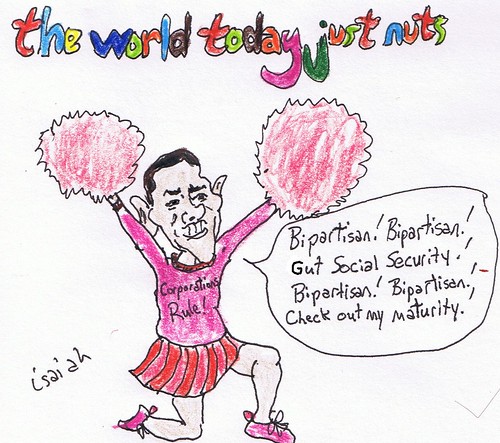
Isaiah's The World Today Just Nuts "State of the Union"

State of the Union

Tomorrow Barack Obama gives another lame speech.

Heaven help us all because we're clearly on our own. That's the message the LIARS of The Progressive send. First up, Matthew Rothschild writing about drama queen Frances Fox Piven:

Since he started to air these attacks, Piven has begun receiving death threats.

“I got e-mails that said, ‘Die You C**t,’ and ‘May cancer find you soon,’ ” she tells The Progressive. “And people are posting my address on the Internet with their messages that are really crude and ugly and violent.”

No wonder Francie never made it at a real university, she can't grasp the language. "May cancer find you soon" is not a "death threat."

I don't care for Frances, I never have. I've never found her to be an honest person and she's always one of those money beggars. I just don't have the time and, honestly, don't see why an able bodied woman (which she was the last time I was around her -- yes, that has been awhile) can't provide for herself. That's before you even factor in her patronizing attitude towards African-Americans.

But this is reality: She wrote for attention and fame. She got it. It wasn't pretty? It seldom is. C.I.'s had death threats for decades. Crazy fans convinced they were her husband, or her child or -- in one instance -- her father. People who would park outside her home until the police forced them to leave. People who wrote real death threats (which were turned over to the authorities).

Pay attention, Matty and Francie, C.I.'s never once whined about it in public. Never once raised it in any interview -- print, audio or TV. She's fully aware that you put yourself out there, people will have a reaction.

Piven wanted much more than academic fame. She got it. She needs to stop whining. It's a violent society. If she thinks she's receiving death threats, she needs to turn them over to the FBI.

Matthew Rothschild is so deceitful when he lies and calls "May you get cancer" a death threat. In that regard, he's a lot like Francie.

Francie's a kook. She's truly lost it. She was raving on Democracy Now! about someone writing ____ about her (she got the title wrong -- intentionally, she took a pedestrian title and changed it to make it violent) at his blog (it was at the website Pajamas Media). I never got so many phone calls from old friends laughing at Piven. She always thought she was a leader but in the peace movement, we ignored her. We were the New Left, we were part of the old Communist guard that had come up before, during and (the last wave) right after WWII.

We had no use for her or her ideas of how you could "trick" people into being on your side.

So when I read an article about how she's getting death threats and I'm reading over them and not seeing a great deal that constitute a death threat, I think, "Oh, there goes Francie crying wolf yet again."

It reminds me of the way they tried to turn it into a tragedy that she agreed to let two men tape her answering questions. But it turned up on YouTube!!!! So?

Don't invite strangers into your own home. That's fairly obvious. Very few reporters doing a piece on C.I. have ever been invited into any of her homes. You draw a line of privacy or you don't.

I'm really sorry that Frances Fox Piven is so stupid that, in this day and age, she thinks, "I don't know these people, I've never heard of them before and I don't know anyone who can vouch for them, but let me invite them into my home!"

You're asking for trouble. She's lucky she didn't wake up with a bruise and her valuables missing.

I started to type "Learn a lesson" but the key to Francie is that she's never been able to.

By the way, did you note Matthew was using his favorite word again? The c-word?

Then we get to Ruth Conniff who wants to write about Keith Olbermann.

Ruth, I do realize your boss has put the c-word in your magazine but that doesn't minimize "slut" or all the other names Keith Olbermann called various women on the air for years and years. It's a detail Ruth can't find even though it's among the details which have stood out the most for Bob Somerby over the years.

But Ruth's not really wanting to write. That requires thought. All she wanted to do was grab some 'hot topics' (cold before she touched them) and pretend she'd thought of something to add to the existing dialogue.


"TV: One Less Bag To Leak Gas" (Ava and C.I.):
Remember how we said Ashleigh Banfield was the Rosetta Stone? She really is. She's all over this story without even trying. For example, shortly after Olbermann made his announcement, John Nichols of The Nation was pouncing on it and lavishly praising Olbermann and those 'commentaries.' Where was Nichols' column on Banfield?

No where to be found and that's the worst damage that Olbermann and his kind have done. Ashleigh Banfield was an actual reporter (back when her own program first started, MSNBC was trying to ape CNN). And when she was vanished, The Nation and others didn't care. Actual overseas reporting wasn't defended. Does the world really need more Olbermanns or more Banfields? For John Nichols, the well known sexist, the answer is very clear: Pontification is more important than investigation.

And that's sad and it's telling. And it certainly explains why Olbermann and his MSNBC co-stars have been able to escape serious criticism from so many for repeatedly altering facts to create a stronger narrative. It's also true that if Ashleigh Banfield had been Ashton Banfield, she might have gotten some support. She certainly wouldn't have had Michael Massing's bitchy comments about her hair style appearing in The Nation had she been a man. And, if she really wanted support from the echo chamber of the left, she'd need to be a man who embraces sexism the way so many of the left commentators do.

Keith Olbermann embraced it. Bob Somerby long documented that reality but basically stood alone in doing so (two notable exceptions were Rebecca Traister and Rachel Sklar). And in 2008, we saw FAIR and the so-called News Dissector Danny Schechter refusing to call out the sexism Olbermann utilized and bathed in repeatedly. That damaged the left, make no mistake. The use of sexism and the refusal to call it out did great damage to the left. While Bob Somerby was able to call out Olbermann, it turns out that some left writers were as well.

At least privately.

Last summer, The Daily Caller did their stories on Journolist -- a listserv among self-styled lefty journalists -- and one of the revelations that got very little attention was the story about the number of writers objecting to the sexism of Keith Olbermann and doing so in 2008. But doing so privately, among themselves. As one left voice after another lodges objections, along comes Luke Mitchell (then with the notoriously sexist Harper's magazine) to declare, "Olberman is irritating and his obvious sexism is reprehensible. But yes, someone going on TV and saying that torture is bad is a net positive." Because women don't matter and because domestic abuse -- in Luke Mitchell's mind -- isn't torture and possibly also not considered abuse. Sexism breeds abuse. But Luke Mitchell didn't care. He just needed a man to say "torture is wrong." Apparently because he worships the penis and because, without a man saying it, it might not be true in his mind.

With all the writing about Keith Olbermann over the last two days, it's surprising just how little attention has been paid to his sexism. Niall Stanage (Salon) was one of the few to go there:

Olbermann’s claim to the moral high ground here was strictly relative. This is a man, after all, who once reported an allegation that Paris Hilton had been punched in the face under the tagline "A Slut and Battery." Hilarious, no?


Olbermann's gone and, as telling as what's being discussed, it's what's not being discussed that really tells the tale of both Olbermann and so much of the left. As for his departure? The answer can be found in track ten on Carly's Boys In The Trees album:

Now in the place where I come from
The people don't grow on trees (except some of the boys)
And you can't treat people like meat
Without getting brought to your knees
Now and then baby . . .

Amazing. Ava and C.I. have the courage to confront what Ruth Conniff refuses to do.

"Iraq snapshot" (The Common Ills):

Monday, January 24, 2011. Chaos and violence continue, Nouri al-Maliki stages a power grab, ugly realities about Iraqi prisons emerge, a British citizen (and Iraq War veteran) stands trial in Iraq, and more.
The violence never ends in Iraq. Yesterday, Jane Bradley (Scotsman) reported Baghdad experience "a series of car bombs" resulting in 6 deaths and twenty-nine more people left injured. Aziz Alwan and Liz Sly (Washington Post) noted the death toll rose to 8 and that the bombs "ripped through the city and its environs over a three-hour period starting shortaly after 7 a.m., and primarily seemed to target eitehr security forces or Shiite pilgrims setting out to attend rituals associated with the Arbaeen religious holiday." Mohammed Tawfeeq (CNN) explains, "The Arbaeen is the culmination of 40 days of mourning for Imam Hussein, a grandson of Mohammed who died in a 7th century battle in Karbala." John Leland (New York Times) observes, "Other parts of the country have recently been hit by large-scale attacks, mainly against security forces and religious pilgrims, but until Sunday Baghdad had been spared." DPA adds, "Iraqi Vice-President Tareq al-Hashemi said Sunday the country should brace itself for an increase in attacks ahead of an Arab League summit scheduled to be held in Baghdad in March" and they quote him stating, "We should anticipate a possible escalation of terrorist attacks as we get closer to the date of the coming Arab summit in Iraq." Peter Walker (Guardian) points out, "Despite the security, there have been a series of bomb attacks during the pilgrimage period, killing at least 159 people. Last week, a triple suicide attack along the main roads leading up to Karbala killed 56 people, mainly Shia pilgrims." Global Post adds, "On Sunday, an Al Qaeda front group in Iraq claimed responsibility for the series of suicide bombings north of Baghdad last week, in Baquba and Tikrit."
The emphasis today is on Kerbala. Reuters notes a Kerbala bombing claimed 6 lives with twelve people left injured followed by a second bombing with both blasts resulting in at least 14 dead and one-hundred and forty-one injured. AFP quotes Province Vice Chief Nusayef Jassem stating, "There were three car bomb explosions, two at 8:30 AM (05:30 GMT) and another 30 minutes later." Ned Parker and Salar Jaff (Los Angeles Times) quote eye witness Mohammed Thayish stating, "Many charred bodies were there, women, children and men. It was so sad and horrible. Blood was everywhere. It's so frustrating to have car bombs every few days against Imam Hussein pilgrims. Where are the security forces? They should have better measures and intelligence to prevent such terrorist acts." BBC counts 25 dead and later John Leland (New York Times) counted 30 dead while noting, "The attacks led to a flurry of theories and recriminations. Some Iraqis speculated they were meant to undermine confidence in security before the Arab League Summit, which is scheduled to be held in Baghdad in March. Others offered conspiracy theories involving foreigners and Saddam Hussein loyalists. Saad Abdul-Kadir (AP) counts "at least 18". In addition, Reuters notes two Baghdad roadside bombings resulted in 1 death and nine people being injured and a Tirkit roadside bombing injured five of Governor Ahmed al-Jubouri's bodyguards, Taha Othman was injured after being shot outside his Mosul home, 1 Imam was shot dead in Falluja and the corpses of 2 Sahwa members turned up in Riyadh.
Ahmed Rasheed (Reuters) reports that the easily manipulated court system in Iraq has again bended to Nouri al-Maliki's will in what some are terming a "coup" as independent agencies -- such as the Independent Higher Electoral Commission, the High Commission for Human Rights and the Central Bank of Iraq -- put under the control of Parliament by the country's Constitution are being turned over to Nouri by the Supreme Court. Ned Parker and Salar Jaff (Los Angeles Times) explain:

But some parties were suspicious of Maliki and the high court, remembering how the prime minister requested a ruling last year over who had the right to form the next government after an election that saw Maliki and his secular rival, Iyad Allawi, finish in a dead heat.
The court's ruling that the largest bloc in parliament could form the government after a vote effectively allowed Maliki to create a majority with the other main Shiite bloc in parliament.
Allawi's Iraqiya bloc expressed its alarm over the latest ruling in a statement Saturday.
"The decision of the federal court to connect the independent boards to the council of ministers directly instead of the parliament … is considered as a coup against democracy," the bloc said.

Wow. Imagine Nouri doing a power grab after he secured the post of prime minister. Who could have ever seen that happening? Good thing Moqtada al-Sadr is in Iraq, right? Oh wait, as noted in Friday's snapshot, Moqtada al-Sadr is back in Iran. For a visit or another two-year-plus stay no one knows. BBC News notes he was only in Iraq for two weeks (and think of all the press he got for what might have been a vacation). Moqtada al-Sadr's presence didn't make a damn bit of difference (only the ruling came down Friday, Nouri's the one who brought the case). We're dropping back to the January 10th snapshot for 11 paragraphs where we explained that, having gotten the post, Nouri didn't care about anyone else or the laws and that this was evidenced by his first term as Prime Minister:
Last night, we wrote: "He's reporting on al-Sadr's threats to leave Maliki's government should the US stay beyond 2011. Guess what, Chulov, al-Sadr left Maliki's government in 2007 for just that reason. It didn't topple then either. We'll address that and Rebecca Santana's conclusions for AP and Gulf News' opinions in a snapshot this week (hopefully tomorrow)." He was Martin Chulov. Moqtada al-Sadr has no power now in terms of the government, not if you judge by the past experience. He pulled out of the government in April 2007, remember?
In Iraq today the six cabinets filled by Moqtada al-Sadr's block are now vacant. Tina Susman (Los Angeles Times) explains: "A key Shiite Muslim bloc in Iraq's governmental pledged Sunday to quit over Prime Minister Nouri Maliki's refusal to set a timetable for the withdrawal of U.S. troops, a move that would further weaken the country's leadership at a time of soaring sectarian violence." Edward Wong and Graham Bowley (New York Times) listed "protest at the refusal of Prime Minister Nuri Kamal al-Maliki to set a timetable for American troops to withdraw from Iraq." (No link. Currently the New York Times has 'withdrawn' the story. You can find it quoted here.) AFP quotes a statement issued by the puppet of the occupation: "Prime Minister Nuri al-Maliki welcomed the announcement of his eminence Muqtada al-Sadr." The puppet was the only putting up a brave front, the Turkish Press quotes White House flack Dana Perino who steps away from her stand up schtick on the beleaguered US Attorney General Alberto Gonzales long enough to declare, "Doalitions in those types of parliamenty demoncracies can come and go." That funny Perino! "Democracies"! She cracks herself up. Amy Goodman (Democracy Now!) noted: "The Sadr movement controls six cabinet posts and a quarter of seats in Iraq's parliament. The pullout follows one of Iraq's bloodiest weekends in months. McClatchy newspapers is reporting nearly 300 people were killed in violenace around Iraq Saturday." [CBS and AP's count on Sunday for the Karbala bombing Saturday was 47.] Jim Muir (BBC News) offers analysis, "Nobody expects Mr Sadr's move to bring the government down. Nor did observers believe that was his intention. Rather than leave the cabinet seats empty, he himself suggested that the six abandoned portfolios be given to non-partisan independents, and some of his aides urged that competent technocrats be appointed. . . . The Sadr bloc has 32 of the 275 seats in the current parliament, and intends to continue its activities there and in the Shia coalition, despite withdrawing from government. Another member of the Shia coalition, the Fadhila party, announced early last month that it was pulling out of that alliance because of the government's poor performance and sectarian quota composition. But only if other major factions such as the main Sunni bloc and Iyad Allawi's secular Iraqi List were also to walk out of the government, would it be at risk of collapse." Ross Colvin and Yara Bayoumy (Reuters) note "concerns about whether Sadr's Mehdi Army, which Washington calls the biggest threat to Iraq's security, will maintain the low profile it has so far duing a U.S.-backed security crackdown in Baghdad."
Kawther Abdul-Ameer and Mussab al-Khairall (Reuters) reported April 17, 2007 on his withdrawal of support (the ministers from his bloc left Nouri's Cabinet) and how Nouri al-Maliki told the reporters, "The withdrawal (of the Sadrist bloc) does not mean the government is witnessing weakness." Nor did it mean the government collapsed. Iraq's Constitution is not being followed by Nouri. Did no one grasp that at all during his first term?
The only power anyone had to stop Nouri was to stop him from forming a government. He's done it. He's now going to ride through the second term. If ministers walk, so what? It's not led to a vote of confidence by Parliament and it most likely won't. Nouri never had a full Cabinet. And he still doesn't, he's starting off his second term without a full Cabinet. Rebecca Santana notes that, "Many Iraqis and U.S. officials are believed to want an American presence beyond the end of 2011, as currently planned under a U.S.-Iraqi agreement, to do such things as control Iraq's airspace and monitor the borders. But al-Sadr's remarks made clear it will be difficult for al-Maliki to renegotiate that deal." Moqtada's remarks suggest no such thing. Moqtada's ministers left (in 2007) because? The continued US presence was the reason give publicly. They walked and the government continued. If that's how Nouri behaved in his first term, why would anyone expect he would accept new impositions in his second term? How do you logically infer that?
I don't see how you do. Gulf News insists, "But Al Maliki's confidence comes from a very fragile base, and the political unity achieved so painfully around the new government could easily fall apart." How? Do we mean military coup? That's a possibility.
But if we're talking about the government falling apart because X walks out -- however many units you apply to X -- that doesn't seem likely because it's not what happened before or what's already happened. During the many months without any government -- when the UN should have imposed a temporary government -- the Minister of Electricity resigned. Nouri just made the Minister of Oil also the Minister of Electricity. There is no Constitutional power that allows him to do that. There is no "circumvent Parliament one time only" card that exists. Currently, there are 13 empty spots -- 3 of which Nouri has appointed himself (temporarily, he insists). And for those saying, "Well Moqtada has a lot of seats in this Cabinet!" He has says 7 seats in this Cabinet. And before some fool cries, "Well, see, it's one more than last time!" Uh, not really. They had 6 when there were 32 Cabinet positions (plus the Prime Minister). Now they have 7 when there are 45 Cabinet positions (plus the Prime Minister). Now that's just dealing with the 2007 walk out. That was far from the only walk out of Nouri's Cabinet. There was, for example, the great Sunni walk out of 2008. It doesn't matter who walked out, it never crippled Nouri or even made him pause.
So you can have the opinion that Moqtada al-Sadr or even Ayad Allawi hold power in the executive branch of the government today but, based on pattern, that's not a sound opinion. You may say, "In spite of pattern, I think this go round if A happens then B and C band together and . . ." But the pattern's already established and until you acknowledge the pattern, if your opinion goes against it and you can't explain why that is, your opinion's not a sound one.
At any time during the walk outs of Nouri's first term, Parliament could have toppled the government with a vote of no-confidence. They didn't. That was due to the fact that Nouri was able to offer 'rewards' to those who were loyal and he didn't have to offer rewards to many because so few MPs were ever present for votes. Now you can say, "Things will be different now, Parliament will be prepared to do a no-confidence vote." And maybe they will and maybe they won't but if you're not acknowledging that Parliament refused to do so before then your opinion's not sound.
Nouri's not a new face. How he's going to govern is no great mystery. He's just started his second term. Ayad Allawi's supporters will hate this but when Allawi (or rather Iraqiya) agreed to go forward without the security council being established, that was a huge mistake. (Allawi did protest that. He himself did not go along with that.) Once Nouri got the vote and moved from prime minister-designate to Prime Minister, he didn't need them anymore. That's why he could launch an assault on al-Sadr's supporters -- jump the gun on the US an launch an assault, as Gen David Petreaus testified to Congress repeatedly in April of 2008 -- without fears of reprisal.
There will be unexpected and surprises but the pattern's established and those sure that a pear tree is going to bear apples this year can hope all they want but, based on what we know from past experience, that's just not going to happen. Equally true, human development is A to B, A to C or A to D for most people. Few of us ever experience an A to Z change. In other words, Nouri today is basically the same Nouri he was from 2006 through 2010.
End of excerpt and, again, don't say you're surprised unless you want to admit how foolish you were to have ever believed that Nouri in term two would be vastly different than Nouri in term one. And the . . . Let's call it "news." And the "news" just continues to pile up around Nouri. Saturday, Jennifer Rizzo (CNN) reported the ACLU is, via Freedom of Information requests, in possession of "thousands" of documents which "show 'unjustified homicide' of detainees and concerns about the conditions of confinement in U.S.-run prisons in Iraq, Afghanistan and Guantanamo Bay" and notes:

Others are thought by the ACLU to be new. In one such case, a detainee was killed by an unnamed sergeant who walked into a room where the detainee was lying wounded "and assaulted him ... then shot him twice thus killing him," one of the investigating documents says. The sergeant than instructed the other soldiers present to lie about the incident. Later, the document says an unnamed corporal then shot the deceased detainee in the head after finding his corpse.
In another example, documents note a soldier "committed the offense of murder when he shot and killed an unarmed Afghan male." But, according to the ACLU, the individual was found not guilty of murder by general court-martial.
And that's only one of Nouri's prison issues. Ned Parker (Los Angeles Times) followed that with a story about how Nouri al-Maliki's "elitist security force [the Baghdad Brigade . . .] is holding detainees in miserable condtions for months at a time [at Camp Honor] without access to lawyers or families despite Maliki's pledge last year to rein in the unit, Iraqi officials and diplomatic sources say. [. . .] A man held at the facility in April and May said he recognized one detainee as an official from Diyala, one of Iraq's most politically sensitive provinces. The arrest of Najim Harbi, a member of the Diyala provincial council, has sparked accusations that the security forces had been politicized. Harbi was elected to parliament last year, but has been unable to take his seat." In April of last year, Parker reported that there was an attempted arrest of Iraqiya's Sheik Qais Jaoburi and that this followed the arrest of Harbi who "was taken into custody before the national vote, but he was elected anyway while being held in an undisclosed location. Another elected Iraqiya lawmaker from Jabouri's district, Madaen, southeast of Baghdad, has also gone into hiding after receiving warnings from contacts in the Iraqi security forces that a raid on his home was imminent." Assad Abboud (AFP) quotes Busho Ibrahim, the Deputy Justice Minister, stating, "It [Camp Honor] is under the control of the ministry of justice. It is my responsibility, and I deny all these accusations -- they are all lies. The prison is visited by the ministry of human rights and the International Red Cross. They know about it. There are 270 detainees and most of them were arrested over counter-terrorism offences and by Baghdad Operations Command."
This is who the US government installed -- twice over. This is what they picked. And this is what they risk US lives to keep installed. Mark Brunswick (Minneapolis Star-Tribune) reports, "In its second-largest deployment since World War II, the Minnesota National Guard will send more than 2,400 troops to Iraq and Kuwait later this year." Rupa Shenoy (Minnesota Public Radio) reports with text and audio on the deployment. Becky Purser (Macon Telegraph) reports that "soldiers from the Macon-based 352nd Combat Sustainment Support Battalion" are deploying to Iraq, "The soldiers agreed that being remembered by folks back at home strengthens them while stationed overseas. 1st Lt. Jonathan Castillo, 26, of Orlando, Fla., has support from his parents, a 7-year-old sister and five brothers. He recalled what it meant to him and others deployed to Iraq at Christmas in 2007 to receive Christmas stockings with each of their names as well as letters of encouragement from people they didn't even know. Sgt. Kenisha Neal, 23, recalled the Girl Scouts sending cookies during her deployment in southern Iraq 2007-2008 and the letters from second-graders that 'told us how much they loved us'." Candace Hollingshed and Bofta Yiman (WMAZ) add, "Family and friends said goodbye to their loved ones after a deployment ceremony that took place at Macon State College on Sunday." And who's leaving when? Arieh O'Sullivan (The Media Line) reports:
More than eight years after arriving in the country, American troops are readying to leave Iraq by the end of December, but defense analysts say the U.S. Air Force will likely be staying for years to come.
Iraq's Air Force won't ready to maintain air sovereignty any time in the foreseeable future, the experts said. Last year, the government announced its intention of purchasing 18 F-16 Block 52 multi-role interceptors in an effort to fast track its way to an effective air defense, but delivery will only begin in 2013 and even this date is reportedly being pushed back, they said
"I don't think the U.S. Air Force will be able to leave Iraq for at least five years, as there's no way that the Iraqis alone will be able to deal with any kind of air threat for this period," said Brig.-Gen. (ret.) Musa Qallab, an independent defense expert and former program manager for Gulf Cooperation Council Defense Issues Gulf Research Center in Dubai
Who is leaving? A large number of refugees. But some Iraqi refugees are being forced to return to Iraq. As Jomana Karadsheh (CNN) reported last week, Sweden has forcibly deported 26 Iraqis back to Iraq (at least, Sweden's saying they were Iraqis; last year, Sweden forcibly deported an "Iraqi" back to Iraq only to discover the Swedish government didn't know what the hell were doing because he wasn't an Iraqi).The UNHCR tells Karadsheh that 3 of the 26 were Iraqi Christians. Iraqi Christians have been targeted throughout the Iraq War but the latest wave began October 31st with the assault on Our Lady of Salvation Church in Baghdad. DPA noted, "The plans have been criticized by various international agencies - including the United Nations refugee agency, UNHCR - citing fears that the refugees would be returned to areas where Christians and other minorities have recently come under attack. Swedish churches, human rights groups, and members of the opposition have also protested the move." Coming under increasing criticism for their move, CNN reported, "Sweden's Minister for Migration and Asylum Policy, Tobias Billstrom, defended the decision by pointing to a recent decision of the European Court of Human Rights, which he said decided that there is no need to stop the return of Iraqis who had unsuccessfully sought asylum in Sweden." They don't come off very humanitarian with their actions. Nor do recent revelations indicate that they've acted out of humanitarian impulses. DPA reports:


While Sweden was prepared to receive asylum seekers there was need for 'a return agreement' with Iraq for refugees whose applications were rejected the ministers said, according to US diplomatic cables leaked by whistle-blower site WikiLeaks and quoted by the daily Svenska Dagbladet.
During a September 2007 visit to Iraq, Foreign Minister Carl Bildt and Tobias Billstrom, minister for migration and asylum policy, met with Iraqi officials and US embassy officials in Baghdad.
According to the US cable, Bildt and Billstrom mentioned concerns that many arrivals after 2003 were 'more difficult to assimilate.'
Contributing factors were that the asylum seekers were destitute, and often had poor education or lacked language or professional skills.

Sweden's The Local reports:

A Green Party member is considering reporting Foreign Minister Carl Bildt and Migration Minister Tobias Billström to a parliamentary committee following a WikiLeak exposing statements that they made in 2007 about Iraqi refugees.
Bildt and Billström are the subject of renewed criticism following the revelation. At the time, Bildt stated Sweden's demands for a tougher immigration policy. The opinions were expressed during a meeting between the two ministers and a US ambassador.
Bildt and Billström attended a breakfast meeting with then-Swedish ambassador to Iraq Niclas Trouvé and then-US ambassador to Iraq Ryan Crocker, according to the classified documents on Iraqi immigration to Sweden, Swedish newspaper Svenska Dagbladet (SvD) reported on Friday.
The problem was the Iraqis that Sweden did not want to grant residence permits to. Bildt wanted an agreement with Iraq on the return of these asylum seekers. Without one, it would have been impossible to establish a Swedish embassy in Baghdad, said Bildt, according to the documents.

Ida Karlsson (IPS) reports, "Both the United Nations and Amnesty International have criticized Sweden for its latest expulsion of Iraqi migrants who fled their home country to seek shelter in the European nation, citing concerns that violence in Iraq continues to threaten the lives of deported migrants." UNHCR notes that the UNHCR High Commissioner for Refugees Antonio Guterres addressed the issues declaring that efforts should be made "to address the security, property and reintegration issues that would allow people to return in safety and in dignity" but all returns should be Iraqis wanting to return. He continued, "To force people to return home against their will where insecurity prevails is unacceptable."
Iraq War veteran Danny Fitzsimons remains imprisoned and on trial in Iraq. He served in the British military for eight years and was stationed in Afghanistan and Kosovo as well as Iraq. He returned to Iraq in the fall of 2009 as a British contractor, or mercenary, accused of being the shooter in a Sunday, August 9, 2009 Green Zone incident in which 1 British contractor, Paul McGuigan, and 1 Australian contractor, Darren Hoare, died and one Iraqi, Arkhan Madhi, was injured. BBC News reports that the trial has adjourned until February 20th so that the judges may examine the psychiatric evaluation and that the defense argues the three contractors were drinking, had an altercation, Dany Fitzsimons returned to his lodging and the other two broke in and began attacking him, threatening to kill him leading Danny Fitzsimons to shoot Paul McGuigan dead and then fight over the gun with Darren Hoare. Martin Chulov (Guardian) adds:


The judge, Ali Yousef, questioned Fitzsimons on forensic evidence prepared for a coroner, which said powder burns were absent from Hoare's body, not supporting Fitzsimons's account of a close contact struggle during which fatal shots were fired from a short range.
Fitzsimons said: "I think the evidence was manipulated by the security company. The crime scene was changed."
Salam Abdul Kareem, a lawyer for the victims' families, urged the court to hand down the maximum sentence, which is death by hanging, or life imprisonment. "He did not stop shooting until all 14 bullets were finished," he said.

Steve White (Daily Mirror) quotes
Fitzsimons testifying, "I was seconds away from death." In terms of the trial, my only opinion is that there's been no proof that justice can be found in the Iraqi legal system. But the issue of drinking has always been a part of the narrative from the moment the story broke. Point? Whether or not the two men were entering his residence to kill him, if they did break or burst in and he was drunk (as were they), his own perception of the situation would be influenced by that. As would their poor judgment be influenced by the booze leading them to think 'breaking in would be a great idea.' Amy Corderoy (Sydney Morning Herald) adds, "A former team-mate from Mr Hoare's AFL football club, Peter Johnson, 47, said Mr Hoare and his wife [Molly-Joe] were well-loved and respected members of the Curra Swans football club, and local community."
We'll close with the opening of "Debra Sweet: Why I Oppose a Grand Jury Investigation of Anti-War Activists" (World Can't Wait):

A contradiction to ponder:

  1. A three-year investigation by the Department of Justice into the CIA operatives who carried out waterboarding, filmed the acts on 2 men, and then destroyed the tapes, ended this past November – with the government deciding not to prosecute anyone. Jason Leopold, in Special Prosecutor Declines to File Criminal Charges Over Destruction of CIA Torture Tapes wrote:It is widely believed that the videotapes were destroyed to cover up torture. It is also believed that the tapes were destroyed because Democratic members of Congress who were briefed about the tapes began asking questions about whether the interrogations were illegal, according to Jane Mayer, author of the book, "The Dark Side" and a reporter for The New Yorker magazine.
  2. A two-year secret federal investigation of the U.S. anti-war movement has been conducted by the Obama administration, apparently with a federal grand jury in Chicago hearing evidence from Prosecutor Patrick Fitzgerald, looking into "possible links between U.S. anti-war groups and foreign terrorist organizations," according to the Chicago Tribune. Fitzgerald issued subpoenas beginning in September 2010, delivered via FBI raids to their homes, for activists to appear before the grand jury. With all the records sealed by court order, it is impossible to know about the scope and intent of the probe.
But knowing what we know about how the "war on terror" has been conducted, one can be suspicious that the aim of the first investigation was to find no crimes, while the aim of the second is to manufacture crimes.

23 anti-war activists have now been targeted by the FBI, many through September raids that confiscated a wide range of personal material.