Monday, June 07, 2010

Isaiah, BP, Janis, Grace, Ava and C.I.

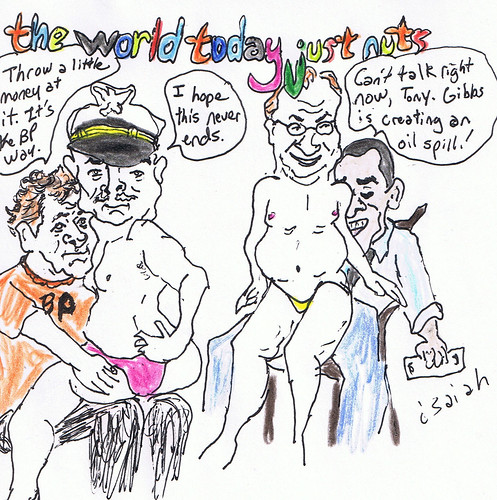
Isaiah's The World Today Just Nuts "Working It For BP."

Working It For BP

"Why do the Obama folks lowball the size of the oil spill?" (Mark Seibel, McClatchy blog: Planet Washington):
If you're kind, you might think only that the administration was, well, just not very quick on the uptake here and that it needed some newspaper reporters previously unschooled in deep water blowouts to figure out what was going on (for another example click here for McClatchy's Shashank Bengali's exploration of the huge loophole in the administration's most recent drilling moratorium). But the pattern suggests that the administration, from the White House and various Cabinet secretaries right down to the NOAA administrator, whose task it was to figure out how much oil was leaking and yet remained stubbornly uninterested in finding out until a university professor from Indiana testified before Congress, was deliberate in its efforts to downplay the size.
On Thursday, we learned from the Center for Public Integrity, which got hold of Coast Guard logs from the early days of the spill, that within a very few hours the Coast Guard thought what was left of the Deepwater Horizon well might gush 8,000 bbd, a number that soon grew to, worst case scenario, 64,000 bbd (the Center's article on the topic can be found
here).
And we learn
from ABC News that from the beginning the Coast Guard had ample access to videos that showed crude oil billowing out of the wrecked riser and blowout preventer, but didn't think to come up with a better estimate of the leak and didn't try to make the videos public so someone else could. (Interestingly, the Coast Guard told ABC that BP wouldn't release the videos, saying they were proprietary, which is the same reason the Interior Department is using to refuse to identify the 33 offshore exploratory rigs in the Gulf that are supposed to shut down "when it's safe to do so." Without their locations and their operators' names it'll be hard for anyone to check to see if the Interior Department actually enforces that order.)

Why was the White House so slow? When did they learn of the problem because it's starting to appear that they knew by April 23rd what was about to take place. They did nothing. Nothing.

"Janis Joplin: The Queen Of Rock" (Laura Sydell, NPR's Morning Edition, 50 Great Voices):
Janis Joplin was dubbed the first queen of rock 'n' roll, and her voice is singular. She was rough around the edges, vulnerable and charismatic, and she paved the way for countless women in rock.
Mid-1960s San Francisco was a mecca for counterculture musicians. Many became megastars, including
Jimi Hendrix, The Grateful Dead and Santana, but Joplin and her female peers found many doubting they could play with the boys. Singer-songwriter Tracy Nelson says it wasn't easy in 1966.
"I don't know how many musicians [told] me, 'Why do you want to do this? This is no place for women. This is no business for a woman.' You know, 'Why not just stay home, find a man,' " Nelson says.
That same year, Janis Joplin was also trying to break through that paternalistic San Francisco culture. She and Nelson shared a bill at the Avalon Ballroom.


Use the link and enjoy Janis or learn about it for the first time. One of the great rock icons. Swiping from C.I., "The legendary Grace Slick is the subject of a Biography (A&E) that Hulu has posted. For more about Grace, you can check out the Jefferson Airplane website. " Grace and Janis were bookends for the sixties. You really can't imagine 60s rock without the two.

"TV: Grime and Whora Flanders" (Ava and C.I., The Third Estate Sunday Review):
That was embarrassing. But shameful? Whora insisting "but people outside of Washington, let's talk about the movements that exist." The same Whora who claims her show is "putting the public back in the public debate."
When?
For an environmental segment, she has no activist present. She has an alleged journalist and a professional lobbyist. For the segment on the LGBT protests, the one she promised would allow you to hear from "six" LGBT members who were arrested demanding the repeal of Don't Ask, Don't Tell, she featured a blogger and the head of an LGBT organization. They weren't the six arrested. She wondered why the sea of change, the difference between GetEQUAL and the laughable HRC? But she wasn't asking the people involved.
For all her people-power talk and all her pretense to democracy, Whora's not interested and has never been. Her appalling 2008 behavior is finally explained: She sees no future. She can't reshape the world because she can't see a new one. She's unable to do anything but mimic the world around her with all its imbalance while pretending to rally against it.

I really loved the way that concluded. Ava and C.I. are so very tired of doing TV and I think that's part of the reason C.I.'s been getting sick to her stomach and throwing up each Sunday. (Also due to being tired.) There are so many expectations on them each weekend and it is just a ton of a weight to carry. Especially when you're already tired.

But somehow, they manage to do it.

"Iraq snapshot" (The Common Ills):
Monday, June 7, 2010. Chaos and violence continue, at least 12 people are dead and 66 wounded in violence today, over the weekend Iraqiya sees two party members assassinated, Sahwa is stripped of the right to carry guns, the military arrests someone over the Wikileaks assault video, the Iranian military reportedly sets up a base in Iraq, and more.


Monday April 5th, WikiLeaks released US military video of a July 12, 2007 assault in Iraq. 12 people were killed in the assault including two Reuters journalists Namie Noor-Eldeen and Saeed Chmagh. Mark Memmott (NPR) reports that an Army intelligence analyst has been arrested and quotes this Army statement:
"United States Division-Center is currently conducting a joint investigation of Spc. Bradley Manning, 22, of Potomac, Md., who is deployed with 2nd Brigade 10th Mountain Division, in Baghdad, Iraq. He was placed in pre-trial confinement for allegedly releasing classified information and is currently confined in Kuwait. The Department of Defense takes the management of classified information very seriously because it affects our national security, the lives of our Soldiers, and our operations abroad. The results of the investigation will be released upon completion of the investigation."

Steven Aftergood (Secrecy News) provides this context, "His arrest is the third known apprehension of a suspected leaker during the Obama Administration, after Shamai Leibowitz and Thomas A. Drake, and seems to reflect an increasingly aggressive response to unauthorized disclosures of classified information." Michael Evans (Times of London) reports, "Specialist Manning, who had clearance for top secret material, was arrested two weeks ago after Adrian Lamo, a former computer hacker-turned-whistleblower, alerted the FBI to an online conversation that he had had with the intelligence analyst." Luis Martinez (ABC News) quotes Lamo from his Twitter account writing, "I outed Manning as an alleged leaker out of duty. I would never out an Ordinary Decent Criminal. There's a difference." Someone tell the snitch to climb down from the cross already -- he's neither overseen a miracle nor suffered for anyone's sins. Judas brags to the BBC, "I like to think I prevented him from getting into more serious trouble." In Spanish, Adrian Lamo's last name translates to "I lick." Today he demonstrates it also stands for "I suck." Ellen Nakashima and Julie Tate (Washington Post) quote journalist Namir's sister Nabil Noor-Eldeen: "Justice was what this U.S. soldier [Manning] did by uncovering this crime against humanity. The American military should reward him, not arrest him." Jeff Stein (Washington Post) takes a historical look at leaks and observes, "Two of the most important factors in a mole's decision to steal secrets were present in Manning's situation, [ . . .]: The 22-year-old's alleged emotional distress, and lax military security." WikiLeaks tweated this statement: "If Brad Manning,22,is the 'Collateral Murder' & Garani massacre whistleblower then, without doubt he's a national hero." They also state: "Statement: Washington Post had Collateral murder video for over a year but DID NOT RELEASE IT it to the public." And: "Did Wired break journalism's sacred oath? Lamo&Poulson call themselves journalists.Echoes of Olshansky shopping Diaz?" And: "@6/@kpoulson There's a special place in hell reserved for "journalists" like you and "lawyers" like Barbara Olshansky" Barbara Olshanksy is a friend and co-writer of David Lindorff's. She used to be with the Center for Constitutional Rights, however her actions -- snitchery -- saw to it that Lt Commander Matthew Diaz was court-martialed. Diaz sent her a list with the names of over 500 Guantanamo prisoners on it. The Center was very interested in getting this sort of information but Olshansky decided to snitch out Diaz to the Feds. Diaz was discharged, served six months in prison and was awarded the Ridenhour Prize in 2008 for his brave actions. The US not having a prize per se for snitchery but Barbara did get hired by Stanford and for some strange reason the laughable International Justice Network took her apparently to assist her in the outing of other whistleblowers.

Saturday
Anthony Shadid (New York Times) reported that assailants (in Iraqi soldier and officer uniforms) have shot dead Faris Jassim al-Jabbouri who is a member of Iraqiya and had been a candidate (unsuccessful) for Parliament in the March elections. He is the third Iraqiya candidate to be shot dead. Moreover, Mohammed Al Dulaimy (McClatchy Newspapers) observed, "Al Jubori is the third candidate killed in Mosul from the same bloc." Jamal al-Badrani, Muhanad Mohammed, Matt Robinson and Jon Boyle (Reuters) reported on the assassination but with a different twist, "A police source, who asked not to be named, said Jubouri was shot dead by gunmen in police uniform overnight in his home near the restive northern city of Mosul." Oliver August (Times of London) added that hee "was executed in front of his family by a group of 20 men in police uniforms [. . .] The Killers searched an entire neighbourhood for Mr Jassim, aided by a masked informant, before finding him, tying up his brother and his son and killing him." He was the third Iraqiya candidate assassinated. In February, Abdullah Jarallah became the first Iraqiya candidate assassinated and the United Nations condemned the murder here. In May, Bashar Hamid Al Ukaidi was assassinated. Alsumaria TV reported on the murder here. Amnesty International called the murder out here. That made three. The assassinations did not end Saturday. Adam Schreck (AP) reported Sunday that Ehab al-Ani, a member of Iraqiya, was killed by a Qaim roadside bombing and that "[t]he initial investigation indicated that al-Ani was not a random victim, as is often the case with such bombings, but was targeted because of his ties to Iraqiya, a police official said."

For those late to the party, Iraqiya is the political slate which won the most seats in Parliament in the March elections. It is headed by former prime minister Ayad Allawi. They won 91 seats. 163 seats are needed to form the executive government (prime minister and council of ministers). When no single slate wins 163 seats (or possibly higher -- 163 is the number today but the Parliament added seats this election and, in four more years, they may add more which could increase the number of seats needed to form the executive government), power-sharing coalitions must be formed with other slates, parties and/or individual candidates. (Eight Parliament seats were awarded, for example, to minority candidates who represent various religious minorities in Iraq.) Second place went to State Of Law which Nouri al-Maliki, the current prime minister, heads. They won 89 seats. Nouri made a big show of lodging complaints and issuing allegations to distract and delay the certification of the initial results while he formed a power-sharing coalition with third place winner Iraqi National Alliance. Together, the two still lack four seats necessary (or so it is thought) to form the government.

At Inside Iraq last week, an Iraqi correspondent for McClatchy interviewed a section of Iraqis about the long delay (three months tomorrow) in forming a government. We'll note 25-year-old Aseel because Iraqi women remain under represented in the press which appears stuck in some sort of Eisenhower era, 'man' on the streets type inquiry:

"Our situation is very bad. No security at all. No jobs opportunities and no basic services. Nothing will change whether the politicians form the government or do not. In fact, it would be better for us if Iraq remains without a government because they political parties will keep discussing their demands and they will not fight each other. I believe that forming the government will take another six months because all the politicians work for their interests. I am sure God will send us to heaven after we die because we live in hell now."

In an editorial,
Gulf News notes Sunday's massive violence and the gridlock gripping Iraq currently while advocating for Nouri al-Maliki and Ayad Allawi to meet and come to some form of understanding. This, of course, overlooks the press reports of last week that Nouri had repeatedly canceled face to face meeting with his rival and was doing so at the request of the Iranian government. Alsumaria TV reports today, "While Iraqi Parliament is close to convene its first session, some signs are looming over regarding the disintegration of some political parties."

Today, it's three months since the Iraqi elections concluded (early voting began March 4th and all voting concluded March 7th) and they've got nothing to show for it but continued violence. The rules are not followed and the US, with no "stick" left, has no functioning Ambassador in Baghdad who can offer "carrots." Two more US service members died last week due to the Iraq War (possibly three, one died of a brain injury and it's thought to stem from his TBI). And three months later, still no government.
As noted at Third Sunday, "Some point to the 2005 experience and note the elections were held in December and the prime minister (Nouri) not selected until April. Four months later. By that schedule, they may be on track. But haven't we heard how much better things allegedly are? Haven't we repeatedly been told the bad days of the 'civil war' are over? With all the supposed improvements, shouldn't the process have moved a lot smoother and a lot more quickly this time?"

Nothing is going smoothly in northern Iraq which is under assault from both the Iranian military and the Turkish military. Starting with the latter to pick up KRG President Massoud Barzani's historic visit to Turkey. The five-day visit is Barzani's first since 2004.
Hurriyet Daily News reported Saturday, "Iraqi Kurdish leader Massoud Barzani on Saturday urged all parties including the outlawed Kurdistan Workers' Party, or PKK, to stop violence and support the Turkish government's initiative to solve the Kurdish problem, adding that the PKK's decision to end the cease-fire was a negative development." Today's Zaman adds, "During the meeting with journalists when Sedat Ergin from the Hürriyet daily asked him about the terrorist Kurdistan Workers' Party (PKK) declaration in which it announced that it ended its unilateral decision concerning a de-escalation of violence, Barzani got upset. Ergin said Barzani got upset because the PKK made this declaration when he was visiting Ankara." The KRG notes that Barzani met with commerce leaders on Sunday and declared, "We see Turkey as a gateway for us to Europe and the wider world, just as we believe the Kurdistan Region can also become a gateway for Turkey to the rest of Iraq and futher south to the Gulf countries." Reuters noted armed clashes between the PKK and the Turkish military not far from the bordertown of Uludere resulted in the deaths of 3 PKK on Sunday. The Turkish military continues shelling northern Iraq. So does the Iranian military. (Both share Iraq's northern border.) Yassen Taha and Hannah Allam (McClatchy Newspapers) reports the shelling is causing outrage in Iraq as is the decision last week to send the Iranian military "about a mile into Iraqi territory, a brief incursion that Kurdish officials said elicited not a word of protest from the Iran-friendly administration of Iraqi Prime Minister Nouri al Maliki, who like Iran's ruler is a Shiite Muslim." Yahya Barzanji (AP) adds that a protest of some sort has finally been lodged, "Deputy Iraqi Foreign Minister Labeed Abawi told The Associated Press he summoned the Iranian ambassador to complain about shelling in the Kurdish region, which enjoys considerable autonomy from the rest of Iraq." The right-wing World Tribune carries an unsigned report which maintains, citing Jabar Yawar, the Deputy Kurdish Interior Minister, that not only did the Iranian military enter Iraqi space but that they "established a base in the Kurdish village of Predunaz on June 3" and remain there.


In other news ov violence, the targeting of Sunnis by the government or 'government' continues.
Hilmi Kamal (Reuters) reports that the country's military states that Sahwa ("Awakenings" or "Sons Of Iraq") are no longer allowed to carry weapons, "Today, Saturday, we received an order from the Defence Ministry ground forces leadership to withdraw all the badges of Sahwa personnel and replace them with new ones that do not authorize them to carry weapons." It's certainly interesting timing. One could even argue Nouri was planning an assault on the Sunnis -- as opposed to these one at a time killings -- and that's why he was disarming the Sahwa. There is a context that this is taking place in: Nouri's refusal to stand down. As with everything else he's done in the last three months, this has to do with his desire to hold onto the position of prime minister. Since the Parliament is supposed to be sitting (for the first time, new Parliament) within two weeks, why is Nouri issuing orders? Again, there's a context, it's the same one that goes to the deals he's signed after elections concluded March 7th -- deals with foreign corporations and on control of Iraqi assets. There is a context for this. And today Reuters reports a Sunday evening attack on Sahwa members in Jurf al-Sakhar which saw 3 shot dead in their homes with a fourth injured.

Turning to some of today's reported violence . . .

Bombings?

Reuters notes a series of Qaim home bombings targeting a Sawha leader and his son and claiming the lives of 2 police officers (three more injured), a Baghdad car bombing which claimed 3 lives (nine injured), a Baghdad roadside bombing which claimed the lives of 2 police officers (seven people injured), another Baghdad roadside bombing which injured five, a Mansouriya roadside bombing which injured two police officers, a combed shooting and bombing Falluja attack on police officers homes which claimed 1 life (twenty injured), two more Baghdad roadside bombings which left ten people injured, a Mosul roadside bombing which left two people (father and son) injured.

Shootings?

Reuters notes 1 shop owner shot dead in Mosul and an attack on an Imam in Abu Ghraib in which he and two sons were killed, his wife was injured as was their youngest son.

Sunday
Alsumaria TV reported what can only be dubbed "a major understatement," "US Forces spokesman in Iraq General Steven Lanza announced that Iraqi security forces are not in a perfect position security and military wise. They need intensive training in order to take full command of Iraq's internal security following the full withdrawal of US troops from Iraq."

Meanwhile in the United States, Michael O'Brien (The Hill) reports, "A senior House Democrat likened President Barack Obama to former Vice President Dick Cheney over his handling of the war in Iraq." US House Rep Charlie Rangel spoke with the New York Daily News criticizing Barack Obama for the continuation of the illegal war and Rangel stated, "I challenge anyone to tell me we aren't there [Iraq] because of the oil. The lack of an honest explanation [for the war] is consistent with Bush and Cheney." Today Erin Einhorn (New York Daily News) reports that at a rally yesterday, New York Governor David Paterson showed his support for Rangel and Rangel repeated his remarks about the Iraq War adding, "The fact that I can have an issue with even a great President, I really don't think warrants the headlines but . . . whatever makes you feel good, it's okay with me."

From the House to the Senate, we'll note this from the
Senate Democratic Policy Committee:

On May 27th, Senate Democrats led the effort to pass a bipartisan supplemental appropriations bill that funds key counterterrorism and national security missions and supports disaster recovery initiatives by a vote of 67 to 28. The bill provides a total of $58.96 billion in emergency funding for Fiscal Year 2010 in support of ongoing missions in Iraq and Afghanistan, including the addition of 30,000 U.S. troops in Afghanistan as well as $2.6 billion for the Afghan Security Forces Fund and $1 billion for the Iraqi Security Forces Fund; more than $5.5 billion for continued and emerging disaster relief and recovery initiatives for affected communities across the United States; $2.8 billion to support relief efforts in Haiti; and $68 million in initial disaster response to the Gulf of Mexico oil spill.
The supplemental bill provides a total of $32.8 billion in funding, as requested, for the Department of Defense (DoD) for operations, personnel costs, and equipment related primarily to the U.S. mission in Afghanistan , but also in support of ongoing operations and continued drawdown efforts in Iraq.
Providing our troops with the resources and tools they need to fulfill their missions. Funding provided in the bill will ensure that our forces engaged in critical national security missions in Iraq and Afghanistan have the most effective weaponry, communications, and other equipment they need on the battlefield. It fully funds key readiness programs necessary to prepare military forces for combat operations and other missions and also funds vital initiatives that support our forces in theater, including high priority intelligence, surveillance and reconnaissance systems.
Protecting our troops fighting in Iraq and Afghanistan . The supplemental bill ensures that our deployed service members are armed with the best force protection equipment available. It provides a total of $1.1 billion for Mine Resistant Ambush Protected (MRAP) vehicles and funds key upgrades to equipment and detection systems to safeguard troops in Iraq and Afghanistan from the threat of improvised explosive devices (IEDs). The bill also supports the Army's Ground Standoff Mine Detection System for convoy protection and road clearing in Afghanistan and fully funds the Special Operations Command's requirement for additional protective equipment.
Ensure our troops are provided first-rate care and services. The supplemental bill provides $1.8 billion for military personnel, including special pay and allowances, for Active, Reserve, and Guard troops activated for duty in Iraq , Afghanistan , and other contingency operations. It also includes $33.4 million for the Defense Health Program.

One way to protect the troops is, of course, to immediately withdraw them. We don't have room for the full press release in the snapshot. We'll run it almost in full tomorrow morning. Almost? I don't allow "Oh my G--" or any similar things here (and it's why we didn't participate in the make fun of Allah day recently as well) that insult someone's religion. I also don't allow a certain (non-religious) phrase here and have never allowed it here. Noam Chomsky rightly called that phrase out during the first Gulf War. It does not appear here. (It's a bumper sticker and intended to silence dissent, as Chomsky rightly pointed out.) Outside of curse words, there's very little that's censored but we don't mock the religious deities people worship (or take their names in vain) and we don't use that phrase Chomsky's has rightly decried.

"Is justice a property of the strongest? Is this a case of might makes right?" asked Jasim Azawi on the latest
Inside Iraq (Al Jazeera, began airing Friday and the show's not up at the website yet). Jasim's guests were Brad Blackeman who used to run a front group for the Bush White House and former Egyptian Ambassador to Israel Hassan Issa.

Jasim Azawi: Ambassador Hassan Issa, a simple question, why should former president Bush and prime minister Blair should be tried as War Criminals?

Hassan Issa: We have a million reasons in the form of a million anihalted Iraqis by the American decision to invade Iraq. I have four million reasons in the form of four million displaced Iraqis inside and outside Iraq. I have a country that is completely destroyed, beyond repair. Because of the decision made by President Bush, ex-President Bush and his follower Prime Minister Blair who still insists that they were right up to this day. This is a disgrace in the face of humanity and it is about time that somebody calls both of them to be tried as War Criminals.

Brad Blakeman, you heard the man. He called your former boss, President Bush, a War Criminal. This indictment is not limited to Hassan Issa. Hundreds of thousands, if not millions, in the Arab world and Africa and Latin America as well as part of Europe, they consider President Bush and Prime Minister Blair as War Criminals. Are they all wrong?

Brad Blakeman: Yes, they are. There are hundreds of millions who think that President Bush and Prime Minister Blair and our coalition partners did exactly the right thing. Where was the outrage with Saddam's regime which punished its own people, prevented people from voting, killed people, raped people, in fact used Weapons of Mass Destruction against his own people. Where was the outrage? And let me say this,

Hassan Issa: Oh my goodness, oh my goodness. Mr. Blakeman, you're still talking about Weapons of Mass Destruction? This doesn't exist. It never existed.

Brad Blakeman: Yes, but let me --

Hassan Issa: Up to this day, you're still talking about --

Brad Blakeman: Let me conclude my point, let me conclude my point.

Hassan Issa: Oh my goodness.

Brad Blakeman: Let me conclude my point. And my point is this: We could not have been successful in removing Saddam Hussein without our Middle East partners. If you're going to indict President Bush and Prime Minister Blair, then you must indict as well the Emir of Qatar [Sheikh Hamad bin Khalifa Al Thani]. We have our largest base there. Without our Middle East partners, like the Saudi government, we could not have been successful. Without the King of Jordan [King Abdullah II]. Without Egypt. There are many Middle Eastern countries who encouraged us to take the action we did against Saddam. In fact, they gave us aid to do so.

Jasim Azawi: How about that, Ambassador Hassan Issa?

[crosstalk]

Hassan Issa: For heaven sake --

Brad Blakeman: You must indict --

Hassan Issa: For heaven sake

Brad Blakeman: -- them as well.

Hassan Issa: For heaven sake, who ever encouraged you to anahilate a million human beings in Iraq, who ever encouraged you to displace four million Iraqis, who ever encouraged you to destroy a country, an Arab country -- you cannot blame Arab countries for supporting you.

Brad Blakeman: We freed an Arab country, my friend!

Hassan Issa: We never supported President Bush.

Brad Blakeman: We freed an Arab country! Tens of millions of people are now free because the action that the United States, Britian and our coalition partners. Where's the indictment of --

Hassan Issa: Free where, Mr. Blakeman?

Brad Blakeman: -- of the thirty or so nations?

Hassan Issa: Free where? In Iraq? Free in Iraq?

Brad Blakeman: Yes, free in Iraq! Yes, sir! Free elections! Free from tyranny. Yes. We are proud of what we did. We are proud of what we did. And we'd do it again. We think the Emir of Qatar [C.I. note, if the idiot really thanked the Emir, he would know the Emir's name, the same with King Abudllah II]. We thank the President of Egypt [Hosni Mubarak]! We thank the King of Jordan! We think the Saudis! We thank --

Jasim Azawi: I am sure the list is very long, Brad Blakeman. Many, many Arab countries, they consented if not given the green light for this invasion. To their chagrin and their regret right now. Ambassador Hassan Issa, you have a bone to pick with Brad Blakeman and the people who espouse his views. But let me ask you, why don't you listen to what President Bush said? He said he did not invade Iraq simply because he wanted to, he was told by God -- he said by Providence, Providence gave me the green light

Hassan Issa: He what? Please. No, no, no, no. Please repeat this again because I can't believe what you said.

Jasim Azawi: He said Providence gave me the green light to launch this war. God talked to him to say this is a righteous cause.

Hassan Issa: [Laughing] Oh, my goodness.

Brad Blakeman: Please! Don't take his words out of context! Come on, you know better than that!

Hassan Issa: Are you kidding me?

Brad Blakeman: We operate under a rule of law!

Hassan Issa: Honest to God, are you kidding me? Are you joking?

Brad Blakeman: No, I'm not joking. We operate under the rule of law unlike the person we removed from power, a brutal dictator. Where is the outrage on your part for what Saddam has done to his country? To his people? Where is the outrage for that, Mr. Ambassador? You don't have it! You --

Hassan Issa: Sir, sir, you removed him and you replaced him by 150,000 dictators. 150,000 American troops.

Brad Blakeman is just a fat liar. And, repeating, if you think someone needs to be thanked, you learn their damn name. What an idiot. And I'm getting really tired, as an American, in seeing Americans go on this show and show their ass. They need to grasp that this goes out through the Arab world and screaming and shouting and throwing tantrums is not conveying a good impression of the United States.

Since the Providence remark especially seemed to set Blakeman off, we'll note that this was not one comment at one time. Judy Keen's "
Strain of Iraq war showing on Bush, those who know him say" (USA Today, April 2, 2003): "Bush believes he was called by God to lead the nation at this time, says Commerce Secretary Don Evans, a close friend who talks with Bush every day." Tom Carver's "Bush puts God on his side" (BBC News, April 6, 2003): "He became convinced that God was calling him to engage the forces of evil in battle, and this one time baseball-team owner from Texas did not shrink from the task." Ewen MacAskill's "George Bush: 'God told me to end the tyranny in Iraq'" (Guardian, October 7, 2005):

George Bush has claimed he was on a mission from God when he launched the invasions of Afghanistan and Iraq, according to a senior Palestinian politician in an interview to be broadcast by the BBC later this month.
Mr Bush revealed the extent of his religious fervour when he met a Palestinian delegation during the Israeli-Palestinian summit at the Egpytian resort of Sharm el-Sheikh, four months after the US-led invasion of Iraq in 2003.
One of the delegates, Nabil Shaath, who was Palestinian foreign minister at the time, said: "President Bush said to all of us: 'I am driven with a mission from God'. God would tell me, 'George go and fight these terrorists in Afghanistan'. And I did. And then God would tell me 'George, go and end the tyranny in Iraq'. And I did."

Matthew Rothschild's "
Bush Salutes Ted Stevens, Invokes God's Will Again in Iraq War" (The Progressive, August 5, 2008):

As in many of his speeches post-9/11, Bush again invoked God as a justification for the Iraq War. Speaking to troops who will soon be going to Iraq, Bush said: "I believe there's an Almighty, and I believe a gift of that Almighty to every man, woman, an child on the face of the Earth is freedom." Implying that he is doing God's will, he said, "It's in our national interest to help others realize the blessings of a free society."


iraq
nprmark memmott
xinhua
wikileaks
the times of london
michael evans
abc news
luis martinez
the washington postellen nakashimajulie tate
jeff stein
the new york daily news
the new york timesanthony shadidreutersjamal al-badranimuhanad mohammedmatt robinsonjon boylehilmi kamalmcclatchy newspapersmohammed al dulaimy
oliver august
the associated pressadam schreck
todays zaman
hurriyet daily news
hannah allem
al jazeera
inside iraqjasim azawi

Friday, June 04, 2010

The Gulf Disaster

Reader Jill e-mailed the video below. If you're able to stream, please do.


It charts all the time Barack spent avoiding the Gulf Disaster. That includes flying to Buffalo, NY for hot wings, going to North Carolina for date weekend, going on vacation, golfing, chatting with Bono, etc.

At the end, this message comes up: Plug the damn hole.

I think that's a powerful video that underscores how Barck's provided no leadership at all.

A few weeks ago, I noted oceanographer Sylvia Earle who was on Charlie Rose's program. Today she was on NPR and I'll note a section of it.

"Oil Spill: Can Science Clean Up This Mess?" (Talk of the Nation, NPR):
Dr. EARLE: I would. In fact, it's baffling that actions hadn't been taken before this time right away to track and really come up with straight answers to straight questions.
I don't regard this as a mitigation kind of action. It's more an unmitigated disaster to add so much of this dispersant material. The idea is to do exactly what the name suggests, to break the oil up in small pieces. Well, it would seem more logical to try to keep the oil in a place where you could gather it up and get it out of harm's way, get it out where it's not going to cause harm.
So there are various techniques for gathering the oil - application of straw and other things that will collect it - but there's this perverse other approach to try to break it up into little pieces and make it less easy, more difficult to capture. In fact, it becomes, then, a part of the food chain, a part of the water column. And to actually be able to understand the size of it, the scope of it and the fate of it would seem to be a high priority, before putting even one gallon, let alone a million gallons - even if it weren't toxic, which it is, the dispersants that have so far been used, primarily this Corexit that doesn't correct anything, it seems to me. I can understand, and I would endorse almost a surgical application of dispersants if you see oil coming, and no other means seems to be working to protect a critical marsh or a wetland or a bird rookery, but to just put it at the source of where the oil is coming out and to sprinkle it widespread over the surface of the ocean would seem to be compounding, not reducing, the problem.


FLATOW: Would it be better not to do anything at all with the dispersants and let the bacteria and the natural degradation of the oil occur?

Dr. EARLE: Oil is toxic, has toxic components, but it is a naturally occurring substance, and there are organisms that will break it down. The dispersants are - include elements that are not found in nature, and what happens to them ultimately, we should know. We should want to know.
We shouldn't be so ready to just make the Gulf of Mexico a big experiment and then afterwards say, well, I wonder how that - what the effect was?


I wish she'd be on every program. She always makes solid points, she always points to where we should be focused. I actually wish she was serving on a board -- or chairing it -- in charge of addressing the Gulf Disaster.


"Iraq snapshot" (The Common Ills):

Friday, June 4, 2010. Chaos and violence continue, there are four vying for the role of prime minister in Iraq, Iran in northern Iraq?, and more.

Today on NPR's
Diane Rehm Show, Susan Page filled in for Diane and the second hour's guests were MBC TV's Nadia Bilbassy, Christian Science Monitor Howard LaFranchi and PoliticsDaily.com's David Wood.

Susan Page: Well Iraq's high court ratified the results of the national elections that were held on March 7th, Howard, who won?

Howard LaFranchi: Well according to the uh the Supreme Court ruling bascially what they did was uh verify that the uh bloc led by uh Ayad Allawi uh who is a uh a secular Shi'ite that his bloc won the most seats. Uh the problem is that they didn't win uh anything near a majority. Coming in second, just uh a few seats behind was the bloc of the current prime minister Maliki. And uh so now uh although it sounds great that okay finally there's a ruling and uh the results have been certified but now the-the jockeying and the-the power struggle shifts to Parliament because someone is going to have to come up with a uh coalition that will be a majority -- to be able to form the government. Uhm. Last -- or recently anyway [C.I. note,
May 4th] -- Maliki sort of envisioning this formed a coalition with the forces of uh . . . [pause] the Islamic Sh'ite Movement of uh of uh Sadr uh a name that I think many Americans will be familiar with.

We got to break in, there's too much wrong there. What the hell is he saying? He doesn't know what he's saying. He's got some names he almost knows and tosses them out but does so wrongly. Nouri's State of Law formed a power-sharing coalition on May 4th with the Iraqi National Alliance slate. Ammar al-Hakim and his Islamic Supreme Council of Iraq or Supreme Islamic Iraqi Council are part of that alliance along with 17 other components/parties as well some independent politicians. Moqtada al-Sadr is also a member of the Iraqi National Alliance with his Sadr bloc. His bloc won the most seats of any component/party in the Iraqi National Alliance (40, followed by ISCI and Bard Organization with 18 seats. The INA, chaired by Ibrahim al-Jaafari, holds 70 seats in the new Parliament. Ayad Allawi heads Iraqiya which won 91 seats in the Parliament. Nouri al-Malki heads State Of Law which won 89 seats in the Parliament. State Of Law's power-sharing coalition with the Iraqi National Alliance gives them 159 seats currently (after Parliament is seated, the candidates are MPs and cannot be removed by their party and replaced with another candidate on their party's list -- once seated, some members of some blocs may decide to cut their own deals). 163 seats are needed for the government (prime minister and council) to be formed.

Howard LaFranchi (Con't): Uhm but the question will be the-the right to try to form a government will go first to uh uh --

Nadia Bilbassy: Allawi.

Howard LaFranchi: Allawi and the question will be if he will be able to succeed.

Susan Page: And, Nadia, is this taking longer than we expected.

Nadia Bilbassy: I think every time I come on The Diane Rehm Show I ask the same question.When they going to from the government and, I think, I don't have an answer. Probably September. I mean it's a good thing the highest judicial body in Iraq has certified the results because that means that they're no disputed anymore. And we heard from Prime Minister Maliki who said, 'No, we won, we have to recount it by hand. We have to do this, we have to do that.' So now it's over except for two seats that were disputed -- ultimately, it's not going to effect the results. As it stands now, 91 and 89 for Allawi [she has the totals backward, Allawi's slate has the 91]. The problem now it is jockeying for power. Who is going to form the government and, funny enough, it reminds me of Israel because, if you remember, Kadima won the election but they couldn't form the government and therefore it lost so it doesn't mean the winning party who got the popular vote will ultimately form the government. What we have seen now is actually Prime Minister Nouri al-Maliki trying to go and coordination with the second larg -- third largest bloc which is the Iraqi National Alliance which includes Sadr and Hakim and others. The problem is people already see it as a Shi'ite domination and it's not just Shi'ite domination but Shi'ite religious domination and that will alienate the secular and the Sunnis. So the problem now is where do you go now? The President Jalal Talabani has 15 days to ask the Parliament to convene and after they nominate the Speaker and the Deputy Speakers they will go forward to ask the winning party -- which is Ayad Allawi's Iraqiya Party -- to form the government.

Susan Page: Now, Nadia, says that the government may not be formed until September. We have an August deadline for the reduction of US troops in Iraq --

Nadia Bilbassy: I mean, I hope it's [government formed] before.

Susan Page: Yeah, we hope it's before. But it's obviously taking quite a bit of time and no end yet quite in sight. Could this imperil the timetable for the withdrawal of US troops, David?

David Wood: I don't think so, Susan. We're going to have General Ray Odierno, top US commander in Iraq, briefing at the Pentagon in about an hour so we'll get an answer from him. But he met with President Obama this week and what he said was that the withdrawal of US combat troops was on track and they will all be gone by August 31st. About 50,000 US military personnel [troops] will be left in Iraq, but let me stress they are not organized in fighting units. [Apparently, they're instead organized in sewing circles. Quilting bees?] And they are largely technicians and administrators so that if violence does break out and the US is needed they will have to come back in from the outside.

They are combat troops. That's what the US military trains the troops for. When Barack first presented this laughable idea of "noncombat" troops being left in Iraq, Michael R. Gordon (New York Times) rightly -- and repeatedly -- expressed bewilderment over how Barack could 'create' this category. Since then
Thomas E. Ricks has called it out repeatedly and many others as well. Ricks has, in fact, been the most elequent on this topic. On The Diane Rehm Show, for example, March 4th, Ricks observed, "I hate the phrase 'combat troops.' There is no pacifisit wing of the Marine Corps or the 101st Airborne. And I think it's effectively a lie to the American people. When they hear 'I'll get combat troops out,' what they hear is 'No more American troops will die' -- and that is blatantly untrue. And I think the sooner the president addresses that, the better for him." Exactly. We'll include David Wood's uninformed comments. I went back and forth on it but the reality is we'll return to them months from now in order to hang him with his own words. Joost R. Hiltermann examines the current situation in "Iraq's Summer of Uncertainty" (New York Review of Books):The outlook is ominous. As the politicians dither, governmental institutions -- never particularly effective -- could become paralyzed, as senior officials fear for their careers if they make decisions that would anger Iraq's future rulers. Uncertainty over the country's prospects could spread through society and the economy. In a political vacuum, outside regional powers would almost certainly gain greater influence and be tempted to meddle more than they already do. The United States, which has been so eager to depart that it failed to craft an exit strategy, would then have trouble being heard over the din. Lacking strong support in Baghdad, parties and politicians would have little choice but to seek succour in neighbouring capitals, insinuating these states' countervailing interests into what is already a combustible mix. And Iraq's insurgencies could get a second wind, again making violence the primary mode of politics.

Alsumaria TV states Iraqi National Alliance's Bahaa Al Araij is stating that an announcement will be forthcoming and that while State Of Law is going with Nouri, the Iraqi National Alliance will nominate their chair Ibrahim Al Jaafari and Adel Abdul-Mehdi. Ibrahim al-Jaafari was Iraq's second post-invasion prime minister. He was also the first choice, following the December 2005 elections, to be (remain) prime minister; however, the US government objected to him and Nouri al-Maliki was then chosen as a compromise candidate. In the 2005 elections, he had the support of Moqtada al-Sadr's followers. That allowed him to defeat Adel Abudl-Mahdi by a single vote in those elections. Adel Abdul-Mahdi currently serves as Iraq's Shi'ite vice president (Iraq has two vice presidents) he belongs to al-Hakim's political party. al-Jaafari spent his exile time in Iran and England while Abdul-Mahdi spent his exile time in France. Nouri spent his exile time predominantly in Syria and Iran while Allawi spent significant time in England. All potential prime ministers (thus far) are former exiles.

Nouri wants to continue in the post. There is opposition to that within the Iraqi National Alliance. Tossing out their two most popular figues from the last election appears to indicate that they do not see the power-sharing coalition as a rubber stamp for Nouri's continued reign.

Nouri's close ties with Iran have not resulted in Iraq's territorial sovereignty being respected.
Tuesday some reports maintained the Iranian military had entered northern Iraq while other reports insisted no entry had taken place:

Sherko Raouf, Shamil Aqrawi and Matt Robinson (Reuters) report that there are rumors (denied by Kurdish officials) that Iran has entered northern Iraq but that over 100 Iraqi families have fled the area in the last seven days. Sunday Mohammed Tawfeeq (CNN)reported the Iranian shelling claimed the life of 1 teenage Iraqi girl in nothern Iraq. Xinhua (link has text and audio) identified the 14-year-old as Basouz Jabbar Agha. As with the Turkish military, Iranian military claims their target is the PKK -- a group identified by many countries (including the US) and the European Union as a terrorist organization and one that has established a base in nothern Iraq (among other places). [They would actually claim their target is PJAK and we're not drawing a line between the PKK and PJAK here -- they have the same leader, the same goals and are 'mingled' in the northern Iraq bases.] The PKK seeks an official Kurdish homeland (usually within Turkey) and points to decades of persecution. One of their leaders is Abudllah Ocalan who has been in a Turkish prison since 1999. The BBC reported over the weekend that he was rumored to have announced "he was abandoning efforts for dialogue with the Turkish government." Hurriyet Daily News reports that Turkish Prime Minister Recep Tayyip Erdogan will hold a terrorism summit on Wednesday (Turkey labels the PKK a terrorist organization). Meanwhile AFP quotes an unnamed "security official" stating that Iranian troops have moved "three kilometers" into northern Iraq. Caroline Alexander and Kadhim Ajrash (Bloomberg News) quote KRG spokesperson Kawa Mahmoud stating, "These reports about an Iranian incursion into Krudistan are totally false. There may be Iranian activity near the border, but there is no incursion." The reality? At this point unknown. Iran's most recent invasion of Iran (December 2009) was greeted with denials from some Iraqi government officials and from some Iranian government officials. But the violation of sovereignty did take place.


This afternoon,
Leila Fadel and Dlovan Barawri (Washington Post) report that Nouri's officials deny the Iranian military has entered northern Iraq; however, "Incensed by the intensity of the attacks and what they say is a brazen ground movement nearly two miles into Iraqi territory, Kurdish officials have reached out to the central government to stop the Iranian incursion and continued shelling, said Jabar al-Yawar, the spokesman for the peshmerga, the Kurdish regional force." Meanwhile the PKK in northern Iraq announced the end of their ceasefire with Turkey's military. This announcement came as KRG President Masoud Barzani was in the midst of a five-day visit to Turkey -- his first in approximately five years. Mehmet Ali Birand (Hurriyet Daily News) opines, "We shouldn't expect Barzani to grab a weapon and fight for Turkey up in the mountain or fight against the PKK. No matter how much he dislikes this terrorist organization and is against the interests of Iraqi Kurds, this means a war between Kurds. That's why we shouldn't expect Barzani to fight for Turkey against the PKK. But on the other hand, we expect him to take measures and stop the PKK strolling around freely. We can do this only by acting together." Today's Zaman reports, "While expressing support for the Turkish government's efforts to engage its Kurdish population with the aim of ending decades of fighting with the outlawed Kurdistan Workers' Party (PKK), which has killed tens of thousands of people, Iraqi Kurdish leader Massoud Barzani on Thursday also voiced regret over the deaths of young people in the conflict between Turkish security forces, no matter if they are Kurdish or Turkish."

Today's violence,
Reuters notes, included a 2 Mosul roadside bombings which claimed 2 lives and left six people wounded and a Mosul car bombing which injured three people.

Earlier this week, we noted BP wants to get their unskilled hands on more Iraqi oil.
Ben Lando (Time magazine) reports on this topic and it appears the US government is using US officials -- military and civilians -- as whores for BP: Major General Vincent Brooks, commander of U.S. forces in southern Iraq, towered over dozens of fellow visitors on a recent dusty morning in the Rumaila oil field in Iraq's oil capital Basra province. With U.S. Ambassador Christopher Hill nearby, Brooks chatted up the president of Iraq operations for BP. In November BP signed a contract along with Chinese partners to develop the field. Rumaila was first drilled by BP a half century ago, but the company, along with other foreign oil companies, was kicked out in the 1970s when Iraq nationalized its oil sector.A US commander and the US ambassador do not need to whore their positions by accompanying BP around. That's disgraceful and oh, so telling. So as Iraq continues to struggle, remember that Chris Hill, when not on a crying jag from his manic depression, could be found showing the fellows of BP a good time out in the oil field.

At the Pentagon today, Gen Ray Odierno gave a briefing that was song and dance and someone break it to him that he lacks rhythm. He spun like crazy and as you heard that significant markers showed improvement and this one and that one was arrested, you may have been reminded of "WORLD CUP TO BE ATTACKED BY AL-QAEDA!" How'd that work out? Apparently, it was spin. But it sure did eat up airtime on CNN and take us far, from reality. Today was nonsense. We'll note this section of Odierno's remarks:

There will still be bad days in Iraq. There are still violent elements that operate inside Iraq. There violence is less than it was before but it's still violence. And we will continue to work with the Iraqi security forces to improve their capacity and capability to deal with the violence to continue to increase stability inside of Iraq and to continue to increase the capability of the government as we move forward.

We've seen Odierno testify to Congress, we've seen him manipulate the media (giving them a non-answer they mistake for an answer). In all that time, for any paying attention, one thing is obvious, when Odierno lies, he closes his eyes. To see him at the podium today was to really see that personal tic play out.

F16s are something the press is running with. Butt Ass Stupid apparently being an easy way to. They tend to ignore the most important remark in that exchange: "This will be an evolving process over the next few years." What will be? Determining and turning over F16s to Iraq. Iraq's Air Force is not ready. A sale of F16s would help them somewhat but would not make them ready. This has not changed and that was a key point from the briefing to those paying attention. Odierno misdirected and controlled the press conference but that tends to happen over and over and the press never pays attention, never learns and still can't identify even one of his uncomfortable tics let alone his lie tic. Again, when he's lying, he closes his eyes while speaking. Jim Wolf (Reuters) is one of the few paying attention and he's the one who asked about the F16s. He also did a follow up.

Jim Wolf: But they wanted something to be there by the time US combat troops completed their withdrawal at the end of next year. Are you saying that if this is going to take years the US won't be able to meet that request?

Gen Ray Odierno: Well I think what they'll have is they'll have some Air Force capability, they'll continue to build some capability, not fighter aircraft. The fighter aircraft will come some time after 2011. Like we do in many other countries as we sell them aircraft.

Jim Wolf reports on the briefing
here.


Yesterday's snapshot addressed Don't Ask, Don't Tell at length. Today To The Contrary (PBS) has a discussion on the policy and how it effects women and minorities. The weekly program broadcasts on PBS and each week it also offers an exclusive online segment which, this week, is on Don't Ask, Don't Tell. Bonnie Erbe is the program's host and producer and her panelists this week (from the right) are Linda Chavez and Karen Czarnecki and (from the left) Melinda Henneberger and US House Rep Eleanor Holmes Norton:

Bonnie Erbe: All of this comes just as a recent survey finds minorities and women are disproportionately effected by the ban. In 2008, 45% of troops discharged under Don't Ask, Don't Tell were minorities yet minorities made up 30% of the military that year. And while female troops made up 14% of the military, they accounted for 34% of discharges. So what's going on here? Why -- Why, first of all, are minorities and women disproportionately discharged like this?

Linda Chavez: I don't think we know the answer based on this one survey. I actually was a bit skeptical about, certainly, the figures on minorities. It didn't make sense to me. The women made a little more sense to me. I think it is more likely -- and probably going to get myself into trouble here -- but I think it's more likely that a lesbian would be comfortable in a very masculine role in the military. So the fact that there might be more lesbians in the military than there are gay men --

Bonnie Erbe: Actually, let me throw a, you know, mine your way as well. I called the head of the Service Persons United and more often the threat of -- of falsely outing a woman is used to get her to succomb to sexaul advances than a lesbian, an actual lesbian. So some of this is happening at least because a guy hits on a woman, she tells him to go take a hike and he runs to their commander and says, "She's a lesbian."

Melinda Henneberger: Well it would have to be that, right?


US House Rep Eleanor Holmes Norton: Well no, it isn't that. And this is why this law is so cockeyed: It's Don't Ask, Don't Tell. So the fact that she's a lesbian and somebody thinks she's a lesbian should have nothing to do with this. You have to out yourself. Now this is subject to great abuse because what is outing yourself -- saying, "I am a lesbian" -- mean? Does it mean that someone's tricked you into saying what you are? I hope that this study [Pentagon review] that is going to be out before this goes into effect also looks at this. This is contra-indicated. I also agree with you [Linda Chavez] for one thing, in the minority community, there is enough homophobia so that people would tend to surpress it, leave aside Don't Ask, Don't Tell. And for women, one does wonder if that is real abuse of the Don't Ask, Don't Tell process which lends itself to that anyway.

Karen Czarnecki: I always thought Don't Ask, Don't Tell was supposed to be a compromise. Keep it to yourself, we don't want to hear about it. And so at least it could keep the peace in the military. The fact of the repeal? I don't know how it's going to effect anybody. They couldn't study anything because of the Don't Ask, Don't Tell so I think, similar to what you're [Linda Chavez] saying, we don't know enough about how this will effect. It will make some people happy, it will make other people angry. It's going to be a whole mix of emotions as this evolves.

Bonnie Erbe: Melinda, John McCain says he's going to fight it in the -- fight lifting the law in the Senate because to allow gays to serve openly would effect morale. Agree? Disagree?

Melinda Henneberger: I strongly disagree and I think that based on what I've heard from PoliticsDaily's war correspondent, he says he has yet to meet the soldier in the field who has time to worry about such a thing or who has voiced that in a very, very long time. So, no, I think that is a minority view that -- John McCain is in a tough political primary right now

Linda Chavez: Well I also think it's a generational thing, Melinda, because I think if you check people in John McCain's generation or even in my generation, they're going to be much more dubious about this. But if you talk to young people -- who are the people serving in the military now -- I think we've become much more accepting of gays in all walks of life and so I think they're going to be less uncomfortable.

Melinda Henneberger: I agree with what [pointing to Karen Czarnecki] --

US House Rep Eleanor Holmes Norton: Fortunately we have the Army and the Air Armed Forces has big experience in this. If you want to talk about effecting morale, I'll tell you this without fear of contradiction, 1948, straight-away, Blacks and Whites must be in the same unit. If you think that White Americans -- this is before the '54 decision [Brown v. Board of Education], before any law of any kind had been passed, were ready for that, I can tell you that what made them ready was that they were in a command structure. And if that command structure does its work, I'm not even a little bit worried.

Bonnie Erbe: Alright. Thanks for watching TTC Extra. Whether your views are in agreement or To The Contrary, please join us next time.

TV notes. Of course,
Bonnie Erbe will sit down with Linda Chavez, Melinda Henneberger and Eleanor Holmes Norton on the latest broadcast of PBS' To The Contrary to discuss the week's events. On PBS' Washington Week, Peter Baker (NYT), Michael Duffy (Time) and Doyle McManus join Gwen around the roundtable or at least in the NO WOMEN ALLOWED Club House. Seriously, Gwen, where the hell do you get off booking three men? Do you know how many times Gwen books an all female roundtable. As Maya Rudolph's character Jodi would say on Bronx Beat, "0.00." Bonnie Erbe will sit down with Linda Chavez, Melinda Henneberger and Eleanor Holmes Norton on the latest broadcast of PBS' To The Contrary to discuss the week's events. And at the website each week, there's an extra just for the web from the previous week's show and this week's bonus is a discussion on whether female soldiers suffer more under Don't Ask, Don't Tell. And turning to broadcast TV, Sunday CBS' 60 Minutes offers:
The SwindlerTo understand how Bernard Madoff could have done what he did, listen to so-called "mini-Madoff" Ponzi schemer Marc Dreier tell Steve Kroft in his first television interview how he scammed $400 million.
Watch Video
The Case Against Nada ProutyFormer FBI and CIA terrorism fighter Nada Prouty was herself accused of aiding terrorism, but in her first interview, she denies she was anything other than a patriot. Scott Pelley investigates her case. Watch Video
The SharkmanAnderson Cooper dives unprotected with great white sharks and the South African who's spent more time up close with the ocean's most feared predator than anyone else. Watch Video
60 Minutes, Sunday, June 6, at 7 p.m. ET/PT.

We'll close with this from Andy Worthington's "
Torture and the 'Black Prison', or What Obama is Doing at Bagram (Part One)" (World Can't Wait):For eight and a half years, the US prison at Bagram airbase has been the site of a disturbing number of experiments in detention and interrogation, where murders have taken place, the Geneva Conventions have been shredded and the encroachment of the US courts -- unlike at Guantanamo -- has been thoroughly resisted. In the last few months, there have been a few improvements -- hearings, releases, even the promise of imminent trials -- but behind this veneer of respectability, the US government's unilateral reworking of the Geneva Conventions continues unabated, and evidence has recently surfaced of a secret prison within Bagram, where a torture program that could have been lifted straight from the Bush administration's rule book is still underway.

iraq
nprthe diane rehm show
the washington postleila fadel
delovan barwarialsumaria tv
todays zaman
hurriyet daily news
time magazineben landothe new york review of booksjoost r. hiltermann
60 minutescbs newsto the contrarybonnie erbe
washington week
the world cant waitandy worthington

Wednesday, June 02, 2010

Gulf Disaster

Louisiana Republican Sen. David Vitter believes the Obama administration needs to treat the Gulf disaster like "war" and establish a clear chain of command to deal with the worst oil spill in American history.

Vitter said that while Louisianans are "mad as hell at BP," opinion is also turning against a federal government they believe is failing them again five years after Hurricane Katrina.

A sign of Barack's lack of leadership is how he is providing the Republican Party with the ability to grand stand on the Gulf Disaster. His inaction, his refusal to show leadership is going to bury the Democratic Party. The disaster is appalling and I'm not pretending it's not. But on the chance that maybe Barack at least cares about his own ass, I'll note how he's hurting the party.

The Republicans are coming off like heroes and concerned. Bitchy remarks in speeches about them are not going to take that away. The only thing that does is real action.

Bill Clinton used to talk about this and it's a damn shame that (the heavily stage managed and criminal) Ronald Reagan was Barack's hero and that he didn't care for Bill because he repeatedly talked about how voters want politicians to take action.

But Barack's never been about action. He's been about posing and speechifying. He's a Chatty Cathy and that's not usually a trait we admire in a president.

The Republicans are going to go into these midterms looking like people of action while Barack's indecision and inaction is going to bury the Democratic Party.

The only thing that makes Barack look a tiny bit better is that professional joke Dennis Kucinich keeps issuing idiotic statements from whatever mother ship he's now orbiting Mars in. What a loon. What a disgusting loon.

James Carville is someone I've loudly applauded for doing the right thing. This is his home, this is where he grew up, that's being destroyed and he's not mincing words.

"Carville unrepentant on W.H. criticism" (Glenn Thursh, Politico):

Carville walked out of the restaurant unrepentant. “I don’t think they particularly care for me, and I don’t blame ‘em. I’ve been around long enough to know there’s consequences,” explained Carville, a former adviser to both Bill and Hillary Clinton.

“I’m doing what I have to do,” said Carville, who has called the administration’s initial response to the spill “lackadaisical” and lacking urgency. “I tried to get their attention for some time. I am a Democrat. I like almost all of their policies. But I’m trying to everything in my power to help my state — short of just going after them. But I did and I will again.”

If only we could all set aside blind loyalties and knee-jerk reactions to do what's needed which is speak up for and stand up for our planet. This is an ecosystem. The system has to remain in balance. If it gets too far out balance, that's it. There's no more life when that happens. I prefer ecosystem to environment for a number of reasons including the fact that we can usually grasp that in a system everything influences everything else.


"Iraq snapshot" (The Common Ills):
Wednesday, June 2, 2010. Chaos and violence continue, the cost of the illegal war continues to rise, Ayad Allawi outlines his strategy, Obama and Odierno meet up, and more.

We'll start with some of the financial costs of the Iraq War for the US.
The Institute for Public Accuracy issued the following today:


JO COMERFORDComerford is executive director of the National Priorities Project, which analyzes budget choices. She said today: "Over the weekend, the National Priorities Project Cost of War counter -- designed to count the total money appropriated for the Iraq and Afghanistan wars -- passed the $1 trillion mark. "Taxpayers in Natick, Massachusetts have paid $206.9 million for total Iraq and Afghanistan war spending since 2001. For that amount, instead of implementing a proposed 4 percent cut for Natick's libraries in 2011, the town could double its total current library budget, and pay for it for 56 years. "To date $747.3 billion has been appropriated for the U.S. war in Iraq and $299 billion for the war in Afghanistan. The pending supplemental making its way through Congress will add an estimated $37 billion to the current $136.8 billion total spending for the current fiscal year, ending September 30." See NPP's Cost of War counters. For more information, contact at the Institute for Public Accuracy: Sam Husseini, (202) 347-0020 or David Zupan, (541) 484-9167

March 7th, Iraq concluded Parliamentary elections. To form the next government, the magic number is 163. No political party or slate reached that number. The leading slate was Iraqiya which won 91 seats. They were followed by State Of Law (Nouri al-Maliki's slate) with 89 seats, the Iraqi National Alliance with 70 seats and the Kurdistan Alliance with 43 seats, minorities have 8 seats, Gorran has 8 seats, Iraiq Accord Front has 6 seats, Unity Alliance of Iraq has 4 seats, Kurdistan Islamic Union has 4 seats and the Islamic Group of Kurdistan has 2 seats.
Speaking on BBC's HARDtalk today, Iraqiya leader Ayad Allawi outlined a strategy though talk of and focus on the violence may have prevented some from absorbing that.

.
Ayad Allawi: This is what we are seeing now. There is, again, a new trend of sectarianism emerging in the country which can be -- which can be very bad and this is causing a lot of violence already.

HARDtalk: Do you understand those Shi'ites though who say, "Look we were ruled by Sunni regime, we were ruled by Saddam Hussein. We know that your party is backed heavily by Sunnis and we just don't want to go down that road again. We're not willing to take that risk."


Ayad Allawi: No -- Well, uh, you know, it's uh, the-the Iraqiya is Sunni and Shia, it's not --

HARDtalk: No, but you were heavily backed of course by Sunnis.

Ayad Allawi: Because they wanted to see change. As the Shi'ites voted for us, the Sunnis voted for us. The Sunnis want to see change and of course they don't want to align themselves with Shi'ite groups so they found a secular group which is us and they voted for us. And I think they should be encouraged. And people want to see change in the country ultimately. They don't want to be -- to have the country stagnate on sectarian issues and bases.

HARDtalk: You've warned that unless there is a deal, the country is in danger, and I quote you, "of descending into a new sectarian war." That's very strong language. What are you saying there?

Ayad Allawi: I am saying that if sectarianism comes to Iraq again, depending upon, of course, the drawdown of the American forces and withdrawal, this would lead the country into severe violence unfortunately as we have witnessed in 2005, '06 and '07.

HARDtalk: Are you worried -- you sound as if you're worried in particular about the reactions of the Sunnis who backed your party. That if they feel that they're being sidelined and left out of any government deal by Nouri al-Maliki and other Shi'ites that they will do something.

Ayad Allawi: It's not a matter of them doing something. It's a matter of getting Iraq back into the sectarian beginning when things went very bad -- because sectarianism is associated with extremism. And if this visits Iraq again and the landscape is reversed now back to sectarianism then of course Sunnis and Shi'ites will clash.

HARDtalk: I suppose the ultimate conclusion to that is that it still could lead to this very real worry that people have had for many years of the breakup of Iraq.

Ayad Allawi: Unfortunately. I hope this is not going to happen. I think Iraq is still holding itself very tight. Definitely sectarianism will cause a lot of trouble to the country.

HARDtalk: Aren't you fueling all of these splits though by talking about sectarianism. I was talking to an Iraqi friend of mine and she said very clearly, "Look, I'm secular too -- lilke Allawi. But he's destroying the country. He needs to accept that he's not won this election. He can't become prime minister. He needs to either do a deal with Nouri al-Maliki or just leave the political stage and let someone else get on with trying to form a government.

Ayad Allawi: No, we are -- Of course, we are ready to make a deal but we have won the elections definitely. The seats we have --

HARDtalk: But you're sixty or seventy seats short of an overall majority. That's --

Ayad Allawi: Fine. Everybody is short. Not only us. But we don't want to merge with a sectarian outlook -- whether it's Sunni or Shi'ite. That's why we think and believe our natural allies are the Kurds and will be the Kurds. And we are looking into the smaller groups that have formed the new Parliament -- are forming the new Parliament. And I think this will give us the edge again. But here we are not talking about this. We are talking about two separate issues. One is the spearheading the formation of the government and the second issue is the vote of confidence by the Parliament. It is not necessarily that we are going to get the vote of confidence. Of course, then people like Maliki and others will try their luck. But definitely as far as we are concerned, we should spearhead the formation of the government.

HARDtalk: This would seem on the face of it a very dangerous moment for Iraq.

Ayad Allawi: It is. It is very critical. And that's why everybody has said this is an important milestone for the country.

Key points (in terms of freshness) from the interview: "That's why we think and believe our natural allies are the Kurds and will be the Kurds. And we are looking into the smaller groups that have formed the new Parliament -- are forming the new Parliament. And I think this will give us the edge again." Is it possible? Assuming that the current power-sharing coalition between State Of Law and the Iraqi National Alliance holds and assuming he meant only the Kurdistan Alliance, that's 43 plus 91 for 134. 29 seats would still be needed. Gorran might come on board (might not) to give an additional 8 seats. for example. But if the SOL and INA power-sharing coalition held, that would mean Iraqiya would need -- plus the Kurdistan Alliance -- all the groups (Gorran, Unity Alliance, Iraqi Accord Front, Kurdistan Islamic Union, Islamic Group of Krudistan and the minorities) to not only reach the magic number but to ensure that SOL and INA didn't reach it. At 159, the coalition is only 4 seats away from the magic number.

And with the above, you have a little bit of information. Not all.
Waleed Ibrahim, Ahmed Rasheed, Suadad al-Salhy, Jim Loney, Mark Heinrich and Eric Beech (Reuters) report that the Supreme Court ratification of the vote yesterday was "final" and that Chief Judge Midhat al-Mahmoud declared the new parliament will need to be called "into session within 15 days." Leila Fadel (Washington Post) adds, "The court decided that the largest bloc on the day the 325-member parliament convenes will be the first contender to appoint the prime minister and cabinet. It is unclear whether the ruling is binding, but the tentative merger of Maliki's coalition with its Shiite rival, the Iraqi National Alliance, could mean that Allawi's bloc, most popular among Sunni Arabs and secular Iraqis, won't get to form the government." When Parliament is seated (sworn in) what else can happen? Bloc voting can fall aside. Once your sworn in, you are an MP. You can't be replaced by your political party. Right now you can be. And the two candidates that weren't signed off on (one from Iraqiya, the other from the Iraqi National Alliance) are being replaced by their respective political parties. Once you're an MP you may or may not stay in a bloc vote. You may cut a deal. You may loathe Allawi or al-Maliki so much that you cut a deal. Any number of factors could figure into this. Should that happen, Nouri and Ayad will not only need to make deals with individuals in attempts to woo, they'd also need to make sure those already showing support remained firm.

Persecution.org notes that the 325 MP seats include 5 for Christians: "In total, 14 seats out of the 325-seat legislature are held by non-Msulims, five of which are Christians. In comparison, Christians held two seats last term." In other Iraqi Christian news, John Pontifex (Catholic Herald) reports on the continued violence aimed at Christians and notes, "It is not clear whether the objective is primarily political - to force Christians out of Mosul into the neighbouring Nineveh plains - or is purely an act motivated by religious bigotry. What is beyond dispute, however, is that Church leaders see a strong government as a pre-requisite for reducing the security risk." Evan Williams (England's Channel 4 News) is embedded with the United States Third Infantry Division explored Mosul for last Friday's broadcast of Unreported World. Williams blogged:

On February 27 this year, he said, three Arab gunmen entered their family home shouting that they had to leave. When Father Marzan's father and two brothers tried pushing the them out of the house, the gunmen opened fire killing all three men instantly.
Father Marzan wouldn't allow us to film his mother, but as he started to describe in detail how her husband and sons were brutally gunned down in their own home, I had the horrible sudden realisation that I should have asked the old lady to leave the room. The look of pain and shock on her face was almost unbearable, as if someone were going to walk in at any moment and tell her it was ok and they were all still alive.
Father Marzan is priest in the Chaldean Church, one of the world's oldest Christian communities, founded 2000 years ago among the Assyrian people of northern Iraq, who have been here for millennia.
They have suffered pogroms and attacks in the past, of course, from the Persians, Arabs and Turks. But a new level of violence is now driving many out of the country for good. When the Americans invaded in 2003, there were about one million Christians in Iraq. Now, Church leaders told us, half have already fled the country and more are trying to leave.

The US military is training police forces in the area and they (Iraqi security forces) tell Williams their guess for what happens when the US departs is "civil war."
Aamer Madhani (USA Today) reports from the area (Hamdniyah) and notes threatening calls to nuns and a bombing of the Immaculate Virgin convent, the flood of refugees the violence is creating and, "The U.S. Commission on International Religious Freedom, a government panel tasked with monitoring religious freedoms around the world for the State Department, recently recommended that Secretary of State Hillary Rodham Clinton designate Iraq as a 'country of particular concern' because of the violence against Christians and other religious minorities." AINA notes, "In a recent BBC radio interview, Archbishop of Canterbury Rowan Williams lamented that the 'level of ignorance about Middle-Eastern Christianity in the West is very, very high.' According to Williams, many even well informed Westerners think Middle East Christians are primarily 'converts or missionaries,' rather than indigenous communities that predate Islam. Of Tony Blair and George W. Bush, the archbishop surmised their Christianity was 'on the whole, a very, very Western thing,' and, 'I don't sense that either of them had very much sense of the indigenous Christian life and history that there is in the region'."

Meanwhile, the always embarrassing
Tom A. Peter (Christian Science Monitor) makes the usual idiot of himself today with a whine that could be entitled, "Iraqi Christians Have It Easier!" Based on what, he never can say. He can whine about more of them being in the US (on the first page, burying on the second page the UN point that they make up a huge precentage of Iraq's external refugees) and he can hiss and boo. It's really embarrassing. Elizabeth Campbell of Refugees International might want to think twice before speaking to him again. Her comments are taken out of context and reassembled by Peter to push the story he wants. (Read her comments carefully, she's not backing up the thesis Peter is proposing -- her conditionals undercut his thesis.) The Monitor itself might want to ask why Peter (or as I always think of him: DICK) is pushing something as news when it's not news, it's his opinion. This isn't a column, it's passed off as reporting. He has no proof, the UN does not release the figures he would need, Campbell gives him conditional quotes, and there's no independent backing, just DICK PETER writing about his hunch as if it were fact. For the record, that press pulling that sort of crap? That's exactly what led Mary Baker Eddy to start the Christian Science Monitor. DICK PETER is not only an embarrassment, he's a disgrace to the news outlet.


Yesterday, assertions were made and denied that the Iran had entered Iraq. Xinhua reports, "The Iranian troops entered the Iraqi semi-autonomous region of Kurdistan on Tuesday, Dubai-based Arabiyah Pan Arab news television reported. The Iranian troops have entered 5 km inside the Iraqi territories, the channel said without giving further details about where exactly the incursion took place." Aysor Armenian News adds, "Iranian troops were operating three kilometers inside Iraqi territory following a series of clashes in recent days between Iranian forces and rebels of Party of Free Life of Kurdistan (PJAK), an Iraqi official said, requesting anonymity." The Kuwait Times runs an AFP report making the same assertion; however, Iran's Fars News Agency quotes KRG Minister of State for Peshmerga Affairs Jafar Mustafa stating, "Infiltration of the Iranian forces into the soil of Iraq's Kurdistan region is a baseless and false claim. We have not witnessed anything like this."

Meanwhile
Liz Sly (Los Angeles Times) reports, "But the Green Zone now is American no longer. On Tuesday, Iraq took full control of the 4-square-mile enclave in the heart of Baghdad that, to many Iraqis, symbolized so much of what went wrong with the U.S. military presence in Iraq. At a brief ceremony held beside a bomb-damaged palace, the battalion of U.S. military police that had been advising Iraqis at Green Zone checkpoints cased their colors and prepared to redeploy to a base near the Baghdad airport, and is to depart this summer." Let's translate, having conquered (killed off the natives and run off those they couldn't kill) the West, the fort was turned over to sympathizers who will continue to run it as an outpost. In Sly's report, is all of world's history for any paying attention, repeating yet again and, as always, sold as a breakthrough, an advance, and done so via silencing the dissenting voices. The Green Zone belongs to Nouri now and all that might have had other claims will be shut out. Those against the US occupation will not be heard from. Those suffering under the government the US military propped up will not be asked for an opinion. Today Obama met with General Cust -- General Ray Odierno. This afternoon, White House Deputy Press Secretary Bill Burton declared on Air Force One:


To start, I've got a readout for you on the President's meeting with General Odierno, which he made -- which he had before we left. The President met today with General Odierno to review security and political progress in Iraq. General Odierno provided a positive assessment of the current security conditions and the ongoing transition of responsibilities to Iraqi security forces ahead of the change of mission of U.S. forces at the end of August. The President and General Odierno also discussed the encouraging step taken by Iraq's federal supreme court to certify election results, as well as U.S. support for an inclusive government formation process. The President thanked General Odierno for his service to the nation.


Margaret Warner (NewsHour, PBS) interviewed Ahmet Davutoglu yesterday. He is the Turkish Foreign Minister. If you
click here, you get an extended interview. And it's not real 'extended' if that should translate into "in depth." Why did PBS interview an official from another country? If it was to illuminate or inform viewers, they failed at that task. If it was just to fill out air time and to offer their chance to chase after the same damn topic every other outlet is obsessing over, they achieved their goal. Yesterday, we were noting that Recep Tayyip Erdogan, Turkey's Prime Minister, would be holding a terrorism summit today and addressing the issue of the PKK. Guess PBS didn't think that was important. Guess PBS didn't feel that Americans might benefit from any discussion of that -- or any information on it. AFP reports KRG President Minister Massud Barzani is in Turkey today, "making his first visit to Ankara as regional president". AFP also reports:A soldier and two outlawed Kurdistan Workers' Party, or PKK, members died in the latest clash in Turkey's Southeast near the Iraqi border, local officials said Wednesday. The clash erupted late Tuesday near the Cukurca town in Hakkari province, when a group of PKK members fired on a group of soldiers on patrol duty, the provincial Governor's Office said in a statement. Seems like Margaret Warner should have asked about the PKK, doesn't it? Seems like the American people would have benefited from a dialogue on this issue. But they didn't get it. Israel's the 'hot' topic but, for the Turkish government, the PKK is the most pressing internal and external issue. And has been for some time. Some people may support the PKK, some people may not. But no one will never know where they stand or might stand when issues are not addressed. Warner spoke at length to Turkey's Foreign Minister. The day before Turkey holds a terrorism summit to address the PKK. When Barzani is in the country and represents northern Iraq where the PKK has set up another base. And the violence continues. But there wasn't time to address any of that on The NewsHour? No, there was time for it, it just wasn't judged 'hot.' When PBS chases after the 'hot' topic, we're all in trouble. This visit that The NewsHour ignored? Ayla Jean Yackley (Reuters) states it's being hailed as "a breakthrough for regional stability." Hurriyet Daily News reports that "Barzani is one of the most criticized regional leaders in Turkey as he has been seen as the protector of the PKK in northern Iraq." The Turkish Press reports that he will meet tomorrow with Ahmet Davutoglu, the Foreign Minister of Turkey.

Ahmet Davutoglu. Hmm. That name is so familiar. Why is that name so familiar? Oh, that's right, that's who Margaret Warner was speaking to Tuesday night on The NewsHour. Again, she didn't ask about Barzani, she didn't ask about the PKK, she didn't ask about the terrorism sumit. Apparently referring to Barzani's visit -- and having noted the violence, US State Dept Assistant Secretary Philip Crowley stated yesterday that "iraq and Turkey are involved in high-level discussions about" the PKK.


Harold W. Geisel is the Deputy Inspector General of the US State Dept.
Charley Keyes (CNN) reports on new findings from that office: the US Embassy in Baghdad cannot do inventory and has apparently lost or had stolen from it "vehicles and millions of dollars of other equipment, from cell phones to medical supplies" -- the medical supplies include oxycodone and morphine. Matthew Lee (AP) explains the findings cover July 2009 through November 2009 and quotes the report stating, "Embassy Baghdad has had difficulty controlling and accurately accounting for its U.S. government property."

Liu (Xinhua) reports that a Baghdad roadside bombing claimed 1 life and left three people injured, another injured two people and "In northern Iraq, the body of an Iraqi soldier who was kidnapped late Tuesday night in eastern Mosul, some 400 km north of Baghdad, was found by the Iraqi police on Wednesday, a local police source said."

Turning to business news, yesterday in Shanghai, Iraq took part in the Shanghai World Expo.
Xinhua quotes Iraqi diplomat Rahman L. Muhsin stating, "Iraq has overcome many difficulties in participating in the Shanghai World Expo and opening the pavilion at last." Rebecca Santanna (AP) quoted Iraq's Minister of Oil Hussain al-Shahristani declaring of the price of oil per barrel, "On the one hand it is sufficiently high to encourage investment, to develop marginal fields, mostly outside of OPEC countries. [. . .] On the other hand it is not too high to adversely affect the recovery of the world economy. I think we are at the right balancing point." The price of oil per barrel as this is being written is a little over US$72. Carl Mortished (Times of London) reports:

A clutch of big oil multinationals has entered into service contracts with the country to develop several huge oilfields, including Rumaila, a monster that already delivers 1.1 million barrels per day, almost half of Iraq's current output.
BP is charged with raising the bar at Rumaila and by 2016 it expects output to reach a plateau of 2.8 million bpd, a level greater than the present output of every Opec state except Iran and Saudi Arabia.
Oh, yes, the lovely and responsible BP.
Cameron Scott (San Francisco Chronicle) has a photo essay on BP and it's 'care' of the Gulf, this is from his intro to the photos:

One cleanup worker took a New York Daily News reporter on a
tour of alleged forbidden areas after watching pelicans trying to get oil off of themselves -- "They keep trying to clean themselves. They try and they try, but they can't do it" -- and discovering a dolphin carcass with oil "just pouring out of it."
AP photographers have gotten a few snaps, too, but relative to the number of journalists trying to get stories out of the area, the number of photographs is pretty low. If only BP's spill cleanup efforts (about which, detailed post tomorrow) were as successful as its press containment efforts appear to be.


iraq
xinhuaaysor armenian newsthe kuwait timesfars news agency
the christian science monitortom a. peter
the washington postleila fadel

the los angeles timesliz slythe associated pressrebecca santanathe san francisco chronicle
pbsthe newshourmargaret warner