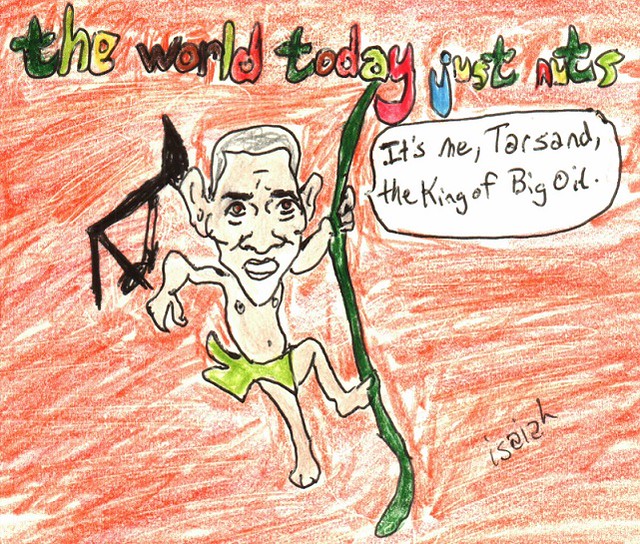
Isaiah's The World Today Just Nuts "Tarsands" went up Sunday
The only TV series I ever blogged about -- blogged about every episode -- was Smash which NBC slashed and burned after two seasons.
Well AP is reporting that Bombshell -- the musical they were working on during the entire first season and about half of the second -- may be going to Broadway for real.
I would see it.
I'm not joking.
I'd buy tickets and fly in for that.
A) I'd be curious to see how they'd do it (versus the way they did it in the TV show) and (B) I did love the songs.
"Iraq snapshot" (The Common Ills):
Monday, June 22, 2015. Chaos and violence continue, 2 blowhards tell Iraqi Sunnis what Iraqi Sunnis feel, Iraq tops a new list, Iraq's national guard proposal just isn't happening, and much more.
Let's start with crap.
Oh, Medhi, we love you.
We love all the 'special' from Al Jazeera -- the channel that went silent because of the deal the owner made with Nouri al-Maliki back in the day.
People are periodically shocked that Al Jazeera self-censors and lies but, remember, we told you about it in real time.
Mehdi links to Joel Wing -- are you sides aching yet? And Joel's interviewed Mr. Naval War College.
He interviewed a part of the war machine who, no surprise, wants you to know the Islamic State has done more damage.
Why?
Because Craig Whiteside is an idiot, a liar or a whore.
He can pick which one.
It doesn't matter because he doesn't know what he's talking about.
[Joel Wing King Dumb Ass]: 2. A conventional wisdom has formed about how the Islamic State was able to rebuild itself after its nadir in 2008. Most of that argument centers on Syria providing a rebirth for the group, and Prime Minister Nouri al-Maliki’s autocratic politics. You’ve written those were important, but there was more to the story. What else do you think was pivotal for the group’s re-emergence?
A conventional wisdom?
Rebirth from 2008?
Even in the administration, there is not agreement that you can trace the Islamic State back to 2008 in Iraq. Let alone prior.
Even in the Pentagon, there is disagreement on that.
And I can quote Secretary of Defense Ash Carter on that.
And as for "some grievance narrative against Maliki"?
What a bunch of cheap liars.
The murders carried out by Nouri al-Maliki will continue to emerge.
The Sunnis were targeted.
Even removing the ethnic cleansing -- which Nouri carried out with the US government's help -- pre-2008 leaves you with a lot of dead.
And that's before we get to the other issues.
The Islamic State did not run off a Sunni politician. Tareq al-Hashemi was run off by Nouri al-Maliki.
It was Nouri who staged a dawn raid on a Sunni politician's home, after all.
It was Nouri who tortured peaceful protesters.
Craig, don't remember you saying a damn word when that took place but, of course, you wouldn't.
And it's cute how after so many Sunnis have spoken to the press, Captain Blowhard knows better than the Sunni people.
Here's Alice Fordham reporting on NPR's Morning Edition on February 3, 2015:
Now his group is in a de facto alliance with al-Qaida's successor, ISIS. Their thinking is similar. They fight alongside each other. Dabbash's views are typical of a broad spectrum of Sunnis in Iraq - Islamist, tribes, one-time supporters of Saddam Hussein. They feel victimized by Iraq's Shiite-led government, and many fight against the Shiite-dominated army, either joining ISIS or allying with them, even if they find the group extreme.
Here's Nour Malas and Ghassan Adnan (Wall St. Journal) reporting May 22nd:
While some of his Sunni kinsmen in Anbar province set about working with Shiite militias on a strategy to oust Islamic State, Emad al-Jumaili was making a very different kind of plan.
The tribal elder was busy preparing to guard his home and family from those same militias.
“I have always said I would much prefer to be killed by a Sunni terrorist organization than a Shiite terrorist organization,” said Mr. Jumaili.
Abigail Hauslohner (Washington Post) reported July 12, 2014:
The worshipers and other Sunnis interviewed in Baghdad said they have little affinity for the al-Qaeda-inspired Islamic State that routed Iraqi forces last month and declared a “caliphate” across a vast swath of the country.
But as the militants take aim at Iraq’s Shiite-dominated government, these educated, professional Sunnis leave no doubt that their sympathies lie with the insurgents.
“It’s a revolution against oppression,” Moussa said. “We believe there will be a zero hour here in Baghdad soon. The Sunnis have nothing to lose.”
We could do this all day.
But what do Sunni Iraqis know about themselves, right?
So much better to have their own words 'corrected' by Captain Blowhard.
In August of 2014, Lucy Fisher (New Statesman) observed, "After all, the plight of the nation’s Sunnis, disenfranchised under Nouri al-Maliki’s Shia-dominated government, is well known."
And they are well known -- except to blow hards like Joel Wing and Captain Big Mouth.
Joel Wing is a danger to himself and others.
He's infamous for promoting a whack job whose public meltdown included that the CIA and others were following him around, harassing him at public libraries, blah blah blah crazy insane.
Joel is also infamous for insisting that KRG President Massoud Barzani was powerless and his rule over -- those are e-mails Jim and I continue to laugh about to this day, Joel -- back in 2011.
In other words, where there is wrong, there is Joel Wing.
Count on it, over and over again.
Thanks for playing, Joel. It's always fun to watch you make an ass out of yourself.
By the way, from time to time Joel Wing thinks we can be friends. He never gets that I wouldn't give a damn about him, wouldn't even slam him, if he didn't have his long, long history of attacking the Sunnis.
Explain this one, Joel:
Oh, that's right, you can't -- or more precisely: You won't.
Sorry, Joel, I don't need a xenophobe for a friend. Don't e-mail.
Or in the words of Blondie
You got a big mouth, I'm happy to see
Your foot is firmly entrenched where a molar should be
If you talk much louder you could get an award
From the federal communications board
Don't be cruel
Be a thing -- sweet thing, as a rule
Don't be sad
I left you in the street, you're pre-fab
I had to get away.
Don't go away sad
Don't go pre-fab
Don't go be bad
Don't go away mad
Just go away, go away
-- "Just Go Away," written by Debbie Harry, first recorded by Blondie on their album Parallel Lines.
This morning, we noted:
Voting this month on a new national anthem?
That's a trifle.
That's something you can maybe do if you're addressing the serious issues.
But when you're ignoring the national guard prospect that you've agreed to form but done nothing on, when you're ignoring working towards political solutions and when you're working against the Constitution (such as the move to defy the Constitution on the death penalty by giving the power to decide executions to the Minister of Justice when the Constitution places that authorization solely in the hands of the presidency council), when you still can't pay the KRG their part of the national budget, you really don't have time to waste or dick around on issues like the national anthem.
Now All Iraq News reports that (Shi'ite) National Alliance MP Muhammad Naji is stating that the national guard bill will be voted on . . . "next legislative term."
If that delay alone isn't disgusting enough, he adds, "we will approve on condition that it is not related to the local provinces."
But that's exactly what it's about -- the local provinces.
The plan US President Barack Obama has been arguing for since Summer 2014 is for local forces. The National Guard would be a group where the KRG forces took care of the KRG, Sunni forces took care of predominately Sunni localities and the Shi'ite forces took care of the rest.
The entire basis of the plan is "local provinces."
So what the politician is really saying is: "We ignored it for months -- as we took US tax dollars and utilized US military support -- and now we've kicked it back to the next legislative session where we will again ignore it."
Meanwhile, Josh Rogin and Eli Lake (Bloomberg News) report:
Two senior administration officials confirmed to us that U.S. soldiers and Shiite militia groups are both using the Taqqadum military base in Anbar, the same Iraqi base where President Obama is sending an additional 450 U.S. military personnel to help train the local forces fighting against the Islamic State. Some of the Iran-backed Shiite militias at the base have killed American soldiers in the past.
Some inside the Obama administration fear that sharing the base puts U.S. soldiers at risk. The U.S. intelligence community has reported back to Washington that representatives of some of the more extreme militias have been spying on U.S. operations at Taqqadum, one senior administration official told us. That could be calamitous if the fragile relationship between the U.S. military and the Shiite militias comes apart and Iran-backed forces decide to again target U.S. troops.
The report was noted in today's US State Dept press briefing moderated by John Kirby.
QUESTION: On Iraq, there are reports talking about the Taqaddum base that – which is considered to be used for the 45 percent – for the 450 advisors – U.S. advisors to be positioned there. So it’s – there are reports talking about that this is also shared by the Shia militias which is considered as Iranian-backed Shia militias. And there are reports that are talking about that these militias are spying on the U.S. advisors or the other personnels there. Do you have any response for that, or do you have any concerns if the Shia militia’s also positioned in this base?
MR KIRBY: I haven’t seen the reports. I don’t know to what degree Shia militia members are on al-Taqaddum and the base or where they are. I mean, I would refer you to the Defense Department for that kind of thing. That’s certainly not something that we would speak to here at the State Department.
QUESTION: But in any case like that, if you positioned these advisors, is that going to be something – will be used by U.S. advisors or other Iraqi forces?
MR KIRBY: Again, you’re asking questions that are much better put to the Defense Department. What we’ve said is that all the forces operating against ISIL inside Iraq need to be under the command and control of Prime Minister Abadi and the Iraqi Government. Prime Minister Abadi has made that very, very clear that that’s his expectation. As for the particulars of who’s on what base and how close they are, I think you just – I’d have to refer you to the Defense Department.
QUESTION: And lastly, I wanted --
MR KIRBY: I wasn’t trying to do an Abbott and Costello thing there either.
QUESTION: Last one on Iraq? One more?
MR KIRBY: Yeah.
QUESTION: The WikiLeaks document talking about the Iraqi officials and Iraqi – some of the Iraq Sunni politicians and also political parties got fund from the Saudi Arabia. Do you think this is going to impact – have a negative impact on the Iraq and Saudi relations? I mean, including also U.S. in the past encouraged the – promoting the relations between Iraq and Saudi and also even opening the embassy of Saudi Arabia in Baghdad – one of the good steps seen by the State Department as a good step of relations between Iraq. So do you think these kind of documents revealed will have a negative impact on that relation?
MR KIRBY: We’ve made it pretty clear policy that we’re not going to talk about the content of leaked documents, so just not going to touch that.
Abigail.
QUESTION: State Department issued – or updated a travel warning today warning U.S. citizens from going and joining the conflict in Iraq. Just wondering, as the last one was at the end of April and there’s usually a greater length of time, is there any new concern regarding U.S. citizens traveling to Iraq to join the conflict?
MR KIRBY: I wouldn’t read too much into the timing of this particular travel warning. As you know, they’re routinely reviewed. Now they’re always on a six-month thing, but they can be reviewed and updated outside the six-month window, and that was the case with this one. But you’re right, it did specifically talk about Americans going to join the conflict, and I think that that’s an issue that we have been continuing to watch and to be concerned about. And I think it just follows – makes good sense to – as we looked at this travel warning to update it.
But it wasn’t driven by – and I wouldn’t want to leave you with the idea that it was driven by a specific case or a specific incident or a specific terrorist in mind or anything like that. The flow of foreign fighters, even those from the United States into the fight, remains a significant concern for the coalition. As I’ve said before, more than 30 nations have taken administrative and legal action to try to stem that flow. The United States is one of those nations that’s trying to do that, and I think this travel warning simply follows on just good, prudent thinking about a tough problem.
QUESTION: John, I have a quick question on Mosul. Do you have an update about the situation in Mosul? Because it’s – Kurdish politicians are arguing that ISIL is losing ground within Mosul because of some logistical problems.
MR KIRBY: Yeah, I --
QUESTION: Do you agree with them?
MR KIRBY: Yeah, when I took off the uniform, I stopped doing battlefield updates.
QUESTION: (Laughter.)
MR KIRBY: You’re going to have to go to the Defense Department.
Away from the chuckles, the news is not good for Iraq. Action On Armed Violence has released the results of their latest study which finds civilian deaths and injuries on the rise throughout the world with Iraq topping the list with 10,735 civilian casualties in 2014.
In today's violence, Xinhua reports, "A total of 25 people were killed and 28 wounded on Monday in air strikes, clashes with the Islamic State (IS) militants and violent attacks across Iraq, security sources said."
Isaiah's The World Today Just Nuts "Tarsands" went up Sunday and new content at Third:
Lastly, the Feminist Majority Foundation is attempting to halt a 'trade' pact that promises little for the people but a great deal for corporations that want to trample on the environment, workers rights, human rights and much more:
Yes, I want to sign the petition to stop Fast Track and the Trans Pacific Partnership.
iraq
alice fordham
npr
morning edition
eli lake
josh rogin
xinhua
Let's start with crap.

"if you looked at who has harmed the Sunni people the most since 2008, it would easily be the Islamic State movement" http://musingsoniraq.blogspot.com/2015/06/behind-revival-of-islamic-state-in-iraq.html …
Oh, Medhi, we love you.
We love all the 'special' from Al Jazeera -- the channel that went silent because of the deal the owner made with Nouri al-Maliki back in the day.
People are periodically shocked that Al Jazeera self-censors and lies but, remember, we told you about it in real time.
Mehdi links to Joel Wing -- are you sides aching yet? And Joel's interviewed Mr. Naval War College.
He interviewed a part of the war machine who, no surprise, wants you to know the Islamic State has done more damage.
Why?
Because Craig Whiteside is an idiot, a liar or a whore.
He can pick which one.
It doesn't matter because he doesn't know what he's talking about.
[Joel Wing King Dumb Ass]: 2. A conventional wisdom has formed about how the Islamic State was able to rebuild itself after its nadir in 2008. Most of that argument centers on Syria providing a rebirth for the group, and Prime Minister Nouri al-Maliki’s autocratic politics. You’ve written those were important, but there was more to the story. What else do you think was pivotal for the group’s re-emergence?
[Idiot/Liar/Whore Craig Whiteside:] We tend to rely on these simplistic narratives to explain complex events like the resurgence of the IS. Not to defend the indefensible, but I don’t think you can say that Maliki’s autocratic politics – as counterproductive as they were - can physically force someone to join a horrific organization like the Islamic State. The Sunnis know exactly who IS is and what they are capable of doing. I mean, if you looked at who has harmed the Sunni people the most since 2008, it would easily be the Islamic State movement, which has killed thousands of Sunnis in its return to power (and advertised this fact in real time on jihadist websites by the way). So I don’t see the IS resurgence simply as a result of some grievance narrative against Maliki, or from the very real advantages the IS movement did see from their investment and leverage of the chaos in Syria to recruit, upgrade weapons, and secure additional funding from extortion and oil sales. It is more complex than that.
A conventional wisdom?
Rebirth from 2008?
Even in the administration, there is not agreement that you can trace the Islamic State back to 2008 in Iraq. Let alone prior.
Even in the Pentagon, there is disagreement on that.
And I can quote Secretary of Defense Ash Carter on that.
And as for "some grievance narrative against Maliki"?
What a bunch of cheap liars.
The murders carried out by Nouri al-Maliki will continue to emerge.
The Sunnis were targeted.
Even removing the ethnic cleansing -- which Nouri carried out with the US government's help -- pre-2008 leaves you with a lot of dead.
And that's before we get to the other issues.
The Islamic State did not run off a Sunni politician. Tareq al-Hashemi was run off by Nouri al-Maliki.
It was Nouri who staged a dawn raid on a Sunni politician's home, after all.
It was Nouri who tortured peaceful protesters.
Craig, don't remember you saying a damn word when that took place but, of course, you wouldn't.
And it's cute how after so many Sunnis have spoken to the press, Captain Blowhard knows better than the Sunni people.
Here's Alice Fordham reporting on NPR's Morning Edition on February 3, 2015:
Now his group is in a de facto alliance with al-Qaida's successor, ISIS. Their thinking is similar. They fight alongside each other. Dabbash's views are typical of a broad spectrum of Sunnis in Iraq - Islamist, tribes, one-time supporters of Saddam Hussein. They feel victimized by Iraq's Shiite-led government, and many fight against the Shiite-dominated army, either joining ISIS or allying with them, even if they find the group extreme.
Here's Nour Malas and Ghassan Adnan (Wall St. Journal) reporting May 22nd:
While some of his Sunni kinsmen in Anbar province set about working with Shiite militias on a strategy to oust Islamic State, Emad al-Jumaili was making a very different kind of plan.
The tribal elder was busy preparing to guard his home and family from those same militias.
“I have always said I would much prefer to be killed by a Sunni terrorist organization than a Shiite terrorist organization,” said Mr. Jumaili.
Abigail Hauslohner (Washington Post) reported July 12, 2014:
The worshipers and other Sunnis interviewed in Baghdad said they have little affinity for the al-Qaeda-inspired Islamic State that routed Iraqi forces last month and declared a “caliphate” across a vast swath of the country.
But as the militants take aim at Iraq’s Shiite-dominated government, these educated, professional Sunnis leave no doubt that their sympathies lie with the insurgents.
“It’s a revolution against oppression,” Moussa said. “We believe there will be a zero hour here in Baghdad soon. The Sunnis have nothing to lose.”
We could do this all day.
But what do Sunni Iraqis know about themselves, right?
So much better to have their own words 'corrected' by Captain Blowhard.
In August of 2014, Lucy Fisher (New Statesman) observed, "After all, the plight of the nation’s Sunnis, disenfranchised under Nouri al-Maliki’s Shia-dominated government, is well known."
And they are well known -- except to blow hards like Joel Wing and Captain Big Mouth.
Joel Wing is a danger to himself and others.
He's infamous for promoting a whack job whose public meltdown included that the CIA and others were following him around, harassing him at public libraries, blah blah blah crazy insane.
Joel is also infamous for insisting that KRG President Massoud Barzani was powerless and his rule over -- those are e-mails Jim and I continue to laugh about to this day, Joel -- back in 2011.
In other words, where there is wrong, there is Joel Wing.
Count on it, over and over again.
Thanks for playing, Joel. It's always fun to watch you make an ass out of yourself.
By the way, from time to time Joel Wing thinks we can be friends. He never gets that I wouldn't give a damn about him, wouldn't even slam him, if he didn't have his long, long history of attacking the Sunnis.
Explain this one, Joel:
- Shiite militias crimes prevent sunnis civilianin
#Iraq reading books Saudi scientists & considers it a crime!
 #IRAQ شمرية العراق

Oh, that's right, you can't -- or more precisely: You won't.
Sorry, Joel, I don't need a xenophobe for a friend. Don't e-mail.
Or in the words of Blondie
You got a big mouth, I'm happy to see
Your foot is firmly entrenched where a molar should be
If you talk much louder you could get an award
From the federal communications board
Don't be cruel
Be a thing -- sweet thing, as a rule
Don't be sad
I left you in the street, you're pre-fab
I had to get away.
Don't go away sad
Don't go pre-fab
Don't go be bad
Don't go away mad
Just go away, go away
-- "Just Go Away," written by Debbie Harry, first recorded by Blondie on their album Parallel Lines.
This morning, we noted:
Voting this month on a new national anthem?
That's a trifle.
That's something you can maybe do if you're addressing the serious issues.
But when you're ignoring the national guard prospect that you've agreed to form but done nothing on, when you're ignoring working towards political solutions and when you're working against the Constitution (such as the move to defy the Constitution on the death penalty by giving the power to decide executions to the Minister of Justice when the Constitution places that authorization solely in the hands of the presidency council), when you still can't pay the KRG their part of the national budget, you really don't have time to waste or dick around on issues like the national anthem.
Now All Iraq News reports that (Shi'ite) National Alliance MP Muhammad Naji is stating that the national guard bill will be voted on . . . "next legislative term."
If that delay alone isn't disgusting enough, he adds, "we will approve on condition that it is not related to the local provinces."
But that's exactly what it's about -- the local provinces.
The plan US President Barack Obama has been arguing for since Summer 2014 is for local forces. The National Guard would be a group where the KRG forces took care of the KRG, Sunni forces took care of predominately Sunni localities and the Shi'ite forces took care of the rest.
The entire basis of the plan is "local provinces."
So what the politician is really saying is: "We ignored it for months -- as we took US tax dollars and utilized US military support -- and now we've kicked it back to the next legislative session where we will again ignore it."
Meanwhile, Josh Rogin and Eli Lake (Bloomberg News) report:
Two senior administration officials confirmed to us that U.S. soldiers and Shiite militia groups are both using the Taqqadum military base in Anbar, the same Iraqi base where President Obama is sending an additional 450 U.S. military personnel to help train the local forces fighting against the Islamic State. Some of the Iran-backed Shiite militias at the base have killed American soldiers in the past.
Some inside the Obama administration fear that sharing the base puts U.S. soldiers at risk. The U.S. intelligence community has reported back to Washington that representatives of some of the more extreme militias have been spying on U.S. operations at Taqqadum, one senior administration official told us. That could be calamitous if the fragile relationship between the U.S. military and the Shiite militias comes apart and Iran-backed forces decide to again target U.S. troops.
The report was noted in today's US State Dept press briefing moderated by John Kirby.
QUESTION: On Iraq, there are reports talking about the Taqaddum base that – which is considered to be used for the 45 percent – for the 450 advisors – U.S. advisors to be positioned there. So it’s – there are reports talking about that this is also shared by the Shia militias which is considered as Iranian-backed Shia militias. And there are reports that are talking about that these militias are spying on the U.S. advisors or the other personnels there. Do you have any response for that, or do you have any concerns if the Shia militia’s also positioned in this base?
MR KIRBY: I haven’t seen the reports. I don’t know to what degree Shia militia members are on al-Taqaddum and the base or where they are. I mean, I would refer you to the Defense Department for that kind of thing. That’s certainly not something that we would speak to here at the State Department.
QUESTION: But in any case like that, if you positioned these advisors, is that going to be something – will be used by U.S. advisors or other Iraqi forces?
MR KIRBY: Again, you’re asking questions that are much better put to the Defense Department. What we’ve said is that all the forces operating against ISIL inside Iraq need to be under the command and control of Prime Minister Abadi and the Iraqi Government. Prime Minister Abadi has made that very, very clear that that’s his expectation. As for the particulars of who’s on what base and how close they are, I think you just – I’d have to refer you to the Defense Department.
QUESTION: And lastly, I wanted --
MR KIRBY: I wasn’t trying to do an Abbott and Costello thing there either.
QUESTION: Last one on Iraq? One more?
MR KIRBY: Yeah.
QUESTION: The WikiLeaks document talking about the Iraqi officials and Iraqi – some of the Iraq Sunni politicians and also political parties got fund from the Saudi Arabia. Do you think this is going to impact – have a negative impact on the Iraq and Saudi relations? I mean, including also U.S. in the past encouraged the – promoting the relations between Iraq and Saudi and also even opening the embassy of Saudi Arabia in Baghdad – one of the good steps seen by the State Department as a good step of relations between Iraq. So do you think these kind of documents revealed will have a negative impact on that relation?
MR KIRBY: We’ve made it pretty clear policy that we’re not going to talk about the content of leaked documents, so just not going to touch that.
Abigail.
QUESTION: State Department issued – or updated a travel warning today warning U.S. citizens from going and joining the conflict in Iraq. Just wondering, as the last one was at the end of April and there’s usually a greater length of time, is there any new concern regarding U.S. citizens traveling to Iraq to join the conflict?
MR KIRBY: I wouldn’t read too much into the timing of this particular travel warning. As you know, they’re routinely reviewed. Now they’re always on a six-month thing, but they can be reviewed and updated outside the six-month window, and that was the case with this one. But you’re right, it did specifically talk about Americans going to join the conflict, and I think that that’s an issue that we have been continuing to watch and to be concerned about. And I think it just follows – makes good sense to – as we looked at this travel warning to update it.
But it wasn’t driven by – and I wouldn’t want to leave you with the idea that it was driven by a specific case or a specific incident or a specific terrorist in mind or anything like that. The flow of foreign fighters, even those from the United States into the fight, remains a significant concern for the coalition. As I’ve said before, more than 30 nations have taken administrative and legal action to try to stem that flow. The United States is one of those nations that’s trying to do that, and I think this travel warning simply follows on just good, prudent thinking about a tough problem.
QUESTION: John, I have a quick question on Mosul. Do you have an update about the situation in Mosul? Because it’s – Kurdish politicians are arguing that ISIL is losing ground within Mosul because of some logistical problems.
MR KIRBY: Yeah, I --
QUESTION: Do you agree with them?
MR KIRBY: Yeah, when I took off the uniform, I stopped doing battlefield updates.
QUESTION: (Laughter.)
MR KIRBY: You’re going to have to go to the Defense Department.
Away from the chuckles, the news is not good for Iraq. Action On Armed Violence has released the results of their latest study which finds civilian deaths and injuries on the rise throughout the world with Iraq topping the list with 10,735 civilian casualties in 2014.
In today's violence, Xinhua reports, "A total of 25 people were killed and 28 wounded on Monday in air strikes, clashes with the Islamic State (IS) militants and violent attacks across Iraq, security sources said."
Isaiah's The World Today Just Nuts "Tarsands" went up Sunday and new content at Third:
- Truest statement of the week
- A note to our readers
- Editorial: Barack's actually trying to ramp up the...
- TV: Brian Williams joins the cast of Mistresses
- Why does Disney hate Bette Midler?
- Tweet of the week
- From The TESR Test Kitchen
- Winner of the week
- Refugees
- This edition's playlist
- Obama versus Hersh: Who's Telling the Truth? (Sher...
- We Declare The US Government Illegitimate, Agenda ...
- Support Grows for Jason Simcakoski Memorial Opioid...
Lastly, the Feminist Majority Foundation is attempting to halt a 'trade' pact that promises little for the people but a great deal for corporations that want to trample on the environment, workers rights, human rights and much more:
Yes, I want to sign the petition to stop Fast Track and the Trans Pacific Partnership.
The TPP is no deal for women. It hurts women workers and undermines women’s rights and human rights, while also threatening environmental regulations, availability of affordable medicines, food safety, and more. That’s why over 2,000 organizations, including the Feminist Majority, AFL-CIO, National Organization for Women, NAACP, People for the American Way, Pride at Work, and the Sierra Club, have opposed legislation to fast track the TPP.
Help us stop the TPP in its tracks. Tell your Senators to oppose Fast Track.
iraq
alice fordham
npr
morning edition
eli lake
josh rogin
xinhua


 Pau Gasol